








Intern's outlook on the encrypted market: Metaverse remains the main narrative, and the war among new public chains will continue
TechFlow Selected TechFlow Selected
Intern's outlook on the encrypted market: Metaverse remains the main narrative, and the war among new public chains will continue
The market performance in the first half of each year is generally not great, and crypto has performed relatively well in this round of financial turmoil.
 Navigating Web3 tides with focused insights
By: TechFlow Intern
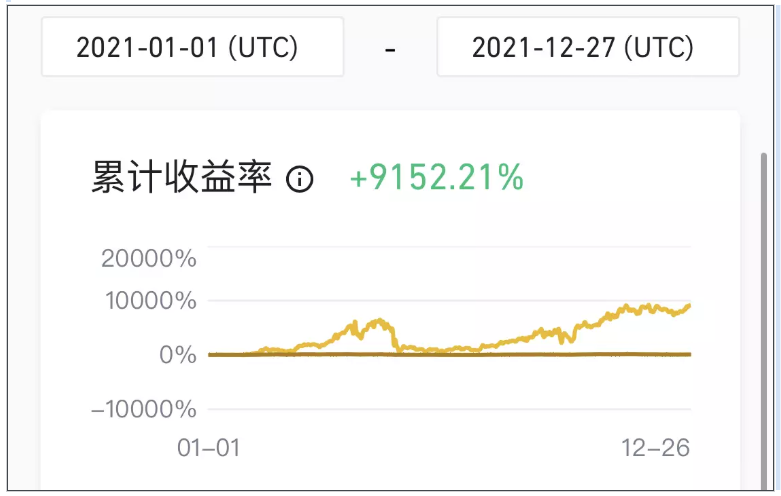
Note: This is a cryptocurrency market analysis and outlook written by a TechFlow intern. Frankly, we’re usually reluctant to write content related to market movements because it’s akin to divination—getting it right brings no real benefit, getting it wrong invites criticism, and overall it's thankless work. However, given that this intern achieved nearly 100x returns in secondary markets on Binance last year, we decided to share this piece, which focuses primarily on technical analysis and does not constitute any investment advice.
Below is the full article:
Each era has its own Ponzi scheme tailored for its generation.
The first half of each year usually doesn’t deliver strong market performance. Crypto has held up relatively well during this financial storm. There’s been a lot happening this year, but fundamental analysis isn’t my strongest suit, so I’ll quickly walk through the crypto market from a technical perspective. These are purely personal views and should not be taken as investment advice.
1. BTC, ETH
BTC and ETH largely represent the scale of the crypto space (BTC will act more like an index; based on BTC’s movement, I decided to sell my large position last December). Going forward, it will be difficult to generate massive returns solely from these two. Of course, I still hold the view that ETH remains the "king of altcoins," though I question its role as the "bull market engine." As for BTC, the so-called "digital gold," its absurd surge during this high-inflation era has drawn massive attention. I believe that with increasing institutional capital flowing in, it will soon shed its label as a risky asset.
Due to shifts in capital structure and the absence of extreme pumps in this bull run, we likely won’t see a deep bear market either. In the short term, after an extended consolidation period and the removal of negative catalysts, the market saw its first rebound—a small bull run. I’m not bearish out of malice; although I’m not strong in fundamentals, I clearly recognize that the broader macro environment in the second half of this year remains bleak (not just in crypto). Therefore, even if prices reach 46,000, don’t get overly excited—prioritize securing profits.
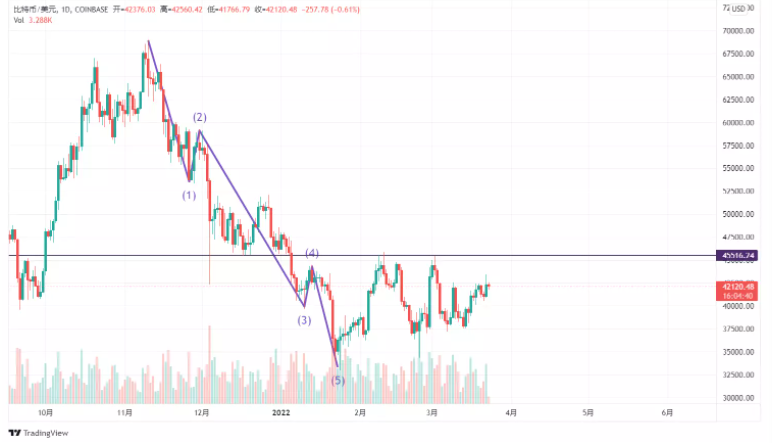
Regardless of bull or bear, what I dread most is BTC entering prolonged high-level consolidation. Given that liquidity within the market is now far greater than before, large players can trigger sudden price spikes during market oscillations. But even if prices go wild, how many can actually catch the moves? Watching others profit while staying out causes anxiety; jumping in only to get trapped when the market drops again is exhausting. However, in the future, if the price breaks below the fifth wave low and quickly rebounds, that would—at least for me—be an excellent entry point.
2. Metaverse, GameFi
As the most mainstream and expansive narrative in crypto recently, the metaverse has truly brought blockchain from behind the scenes into the spotlight. With massive capital involvement, technological progress in the metaverse has never been faster—from 2D to virtual projections, from blocky avatars to AAA-quality games. Similar products are emerging like mushrooms after rain, and people seem to have already forgotten about Decentraland and Sandbox.
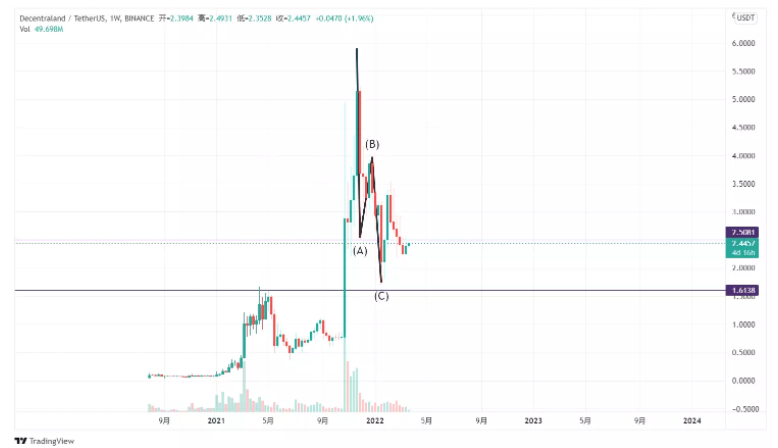
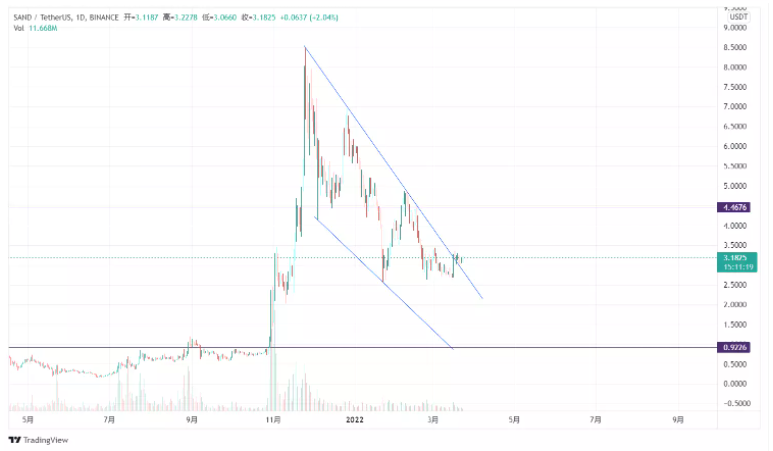
Mana and Sand, as veteran projects in the metaverse sector, possess undeniable first-mover advantages and scalability. They can iterate rapidly with the times and have laid a solid foundation for future metaverse development.
From the charts, Mana has declined about 59% from its all-time high (Sand around 63%), outperforming most altcoins. I have no reason not to be optimistic about their future. Consolidation periods present good entry opportunities. If prices fall into my target range, I will add positions without hesitation. As for how the teams will promote them in the future? A pump is the best marketing.
Of course, I don’t think trend-following products are all trash. Capital also drives progress. We can call projects like Decentraland and Sandbox “Metaverse 1.0,” and newer projects with better technology and visuals “Metaverse 2.0.” In my opinion, Passage is one such “Metaverse 2.0” project.
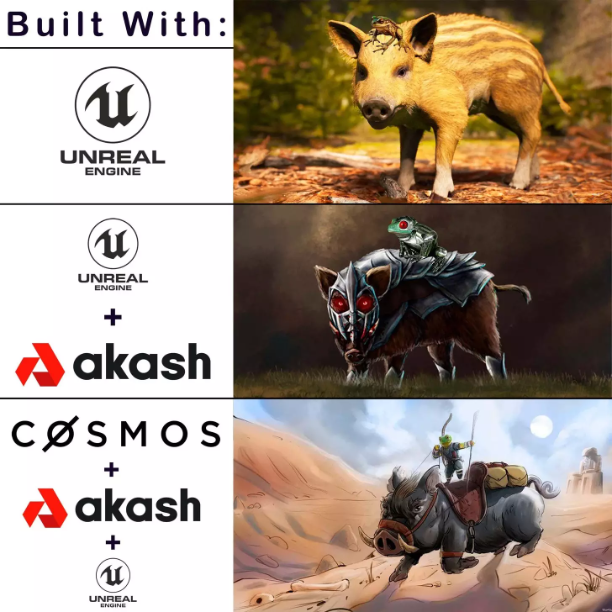
“Passage is an accessible and customizable 3D world for video chatting, presentations, collaboration, and e-commerce.” It’s the first metaverse in the native Cosmos/IBC ecosystem built using Unreal Engine, while leveraging the Akash Network (a cloud computing protocol in the Cosmos ecosystem) for CPU allocation. (Think of it as the metaverse version of Room.)

Alright, as a gaming enthusiast, I admit I was initially drawn by its use of Unreal Engine. As everyone knows, Unreal Engine greatly ensures decent game graphics—and indeed, Strange Clan, the first game developed by the Passage/Three Division team, leads the pack in visual quality.
After GameFi took off, Axie became a legendary project last year. I think it will be extremely hard to see another phenomenon-level project surpass Axs. Currently, it's difficult to find solid GameFi 1.0 assets, but AXS, Cra, Jewel, etc., have solid fundamentals, ample capital, and strong scalability, making them prime candidates for a second wave of narratives. While Metaverse 2.0 hasn't fully materialized, these remain worth watching.
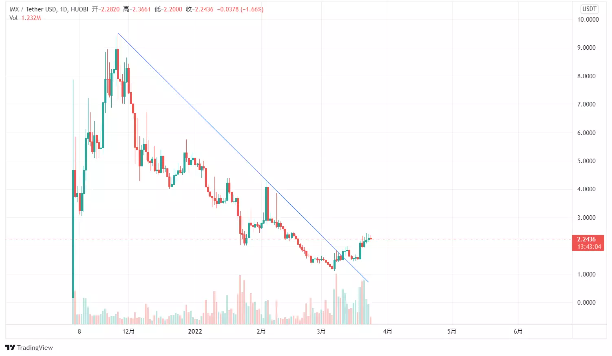
Actually, I want to highlight that gaming-focused blockchains are excellent targets—for example, IMX. As an Ethereum Layer-2, it enjoys strong resources. I bring it up because it recently secured funding from Tencent, putting it in the spotlight. Its candlestick chart stands out among other gaming chains. Gaming chains generally struggle to attract new users compared to broader L1s, but Tencent’s backing has already maximized attention. Why did Tencent choose IMX? As a gaming (and investment) company, Tencent must have unique insights.
There are many promising Metaverse 2.0 and GameFi 2.0 projects out there—such as BigTime, Ascenders, Illuvium, Aurory—and they’re all impressive. I mention Passage not only due to its strong theme and quality but also because it seems to have little attention beyond the Cosmos community.
3. Cosmos
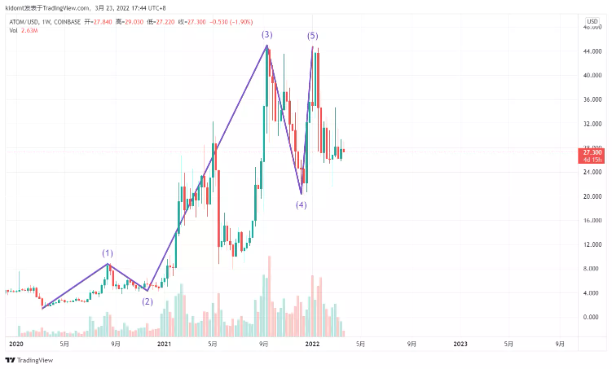
Following up on Cosmos mentioned above. I’ve been bullish on it since the beginning of this year, completely captivated by its ecosystem’s “airdrop culture.” Simply put, how does an ecosystem retain users? By letting them make money. Polkadot, often discussed as Cosmos’ competitor, comes to mind. I haven’t deeply explored Polkadot, but judging from its TVL dropping 70% over the past year, the relative strength between the two is clear (so far). Looking at Atom’s chart, in this de-bubbled environment, Atom has only fallen about 39% from its ATH and hasn’t even formed a clear downtrend yet—if you hold a large position in Cosmos, congratulations.
For the two other major players within the ecosystem—Osmosis and Juno—if you entered before the big airdrop wave, you’re likely still in profit. Osmo is down about 24% from ATH, Juno about 32%. The airdropped tokens alone might have already covered your cost basis. Especially Juno—with its high airdrop frequency (rumored hundreds more across the ecosystem this year) and simple mechanics—is unlike anything I’ve seen before. If you believe in Cosmos and the multi-chain future, stake these tokens. They give you the feeling that your airdrops are rewards for growing alongside the ecosystem.
4. Smart Chains
Smart chains remain a hot topic, fiercely competitive and highly saturated. This is a long-term race with no clear winner anytime soon. After the May 19 crash, smart chain assets were primarily responsible for helping me quickly recover and boost my returns. Let’s take Shiba as a dividing line: if DeFi was the alpha for early adopters to get rich, then smart chains became the meme for newcomers.
If cryptocurrency is a newly developing world, each smart chain can be seen as a country. Our task is to identify developing nations beyond the “developed” ones. Excluding developed chains like ETH, Sol, FTM, Terra, this year I’ve decided to allocate part of my portfolio to AVAX and NEAR.
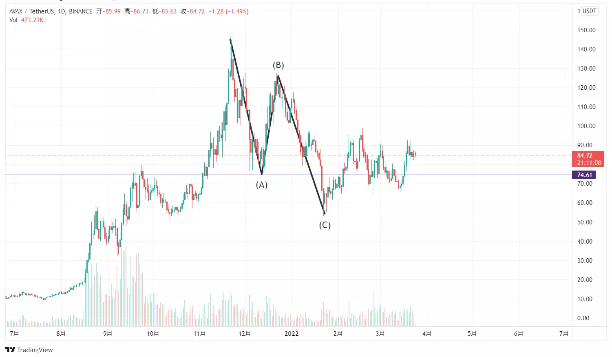
AVAX has pulled back about 42% from its ATH, second only to Cosmos. It’s often compared to Solana, which has dropped 64%. Besides Avalanche launching its subnet this year, AVAX also shows strong underlying capital (in the smart chain war, whoever has money survives).
TLDR:
1. Short-term rebound likely, medium-term risks exist, long-term upward trend remains
2. Metaverse remains the dominant narrative—keep interest and attention on Metaverse 2.0 and GameFi 2.0
3. Bullish on the Cosmos ecosystem
4. Smart chain wars will continue—bullish on AVAX and NEAR
Join TechFlow official community to stay tuned
Telegram:https://t.me/TechFlowDaily
X (Twitter):https://x.com/TechFlowPost
X (Twitter) EN:https://x.com/BlockFlow_News


