








A Guide to Understanding Why Metaverse Land Is So Expensive and How to Evaluate Its Value
TechFlow Selected TechFlow Selected
A Guide to Understanding Why Metaverse Land Is So Expensive and How to Evaluate Its Value
Virtual land in virtual worlds combines user-generated content with 3D or VR experiences and asset ownership that can be verified through on-chain proofs.
 Navigating Web3 tides with focused insights
Original title: On Metaverse Real Estate
Author: Joel John
Translation: Hu Tao, ChainCatcher
Land as an asset in the metaverse is relatively nascent. Compared to $22 billion spent on NFT purchases over the past few years, it has seen only about $1.9 billion in transaction volume. In scale, a single NFT series (Bored Apes) with $2.2 billion in trading volume exceeds all land-related transactions across every metaverse platform combined. Compared to token assets with trillions in market capitalization, the total market cap of all available land across the entire metaverse is only around $3.6 billion.
As of January 2022, approximately 57,000 wallets held land-related assets. Compared to an estimated 4 million wallets participating in DeFi, you can get a sense of how early this theme is. Part of the barrier to entry here is the high capital commitment required to purchase a plot of land in a virtual world. Unlike tokens that can be divided into smaller portions, they require substantial funds to acquire. The average price of a plot in Sandbox is about $10,399. According to data from Decentraland, this number is approximately $11,954. Why would people spend so much money? To understand this, we must first define what a piece of land means in the metaverse.
What is land in the metaverse?
In metaverse projects like Cryptovoxels, Decentraland, or Sandbox, a piece of land is a digital plot where anything can be expressed digitally—a fixed space users can customize for their own digital experiences. This could be an art gallery in Decentraland similar to Sotheby's. Or it might be a venue for digital concerts, like the one Snoop Dogg set up in Sandbox.
Land is a digital plot where you can create any visual expression or development—like even a Domino’s pizza vending machine. It may sound silly, but the mental model for metaverse land is being compared to space on rapidly growing websites like Reddit. If you could permanently own a small banner (about 3x5 inches) in the top-left corner of a website, would that be a good investment? I believe it would be, provided you got it early and inbound traffic to Reddit continues increasing over time. The catch is, when it comes to virtual worlds, everything on Reddit (in this hypothetical example) is owned by different individuals, each with unique expressions.
This may sound far-fetched, but it actually happened in 2006. A 21-year-old named Alex Tew built a website selling 10x10 pixel blocks for $1 each. He managed to sell a million dollars' worth of pixels to random advertisers (as shown above), eventually dropping out of university. This is somewhat analogous to the early vision of what NFT land would eventually become. (Trivia: Alex dropped out and went on to found the Calm app.)
Unless adjacent users coordinate, you’re unlikely to get a unified experience from metaverse land assets—just as real-life neighborhood prices are determined by local behavior and quality of life. Virtual land combines user-generated content with 3D or VR experiences and asset ownership verifiable on-chain. Today’s virtual worlds aren’t far removed from Club Penguin or Farmville. The key difference is that you own the land and can use it to build unique experiences as you wish.
Want to explore how it works? You can access the most visited parcel on Cryptovoxels via this link on desktop. Click the “Visit” button (top-left) to enter the Cryptovoxels version of the metaverse. According to the site, it has received around 187,000 visits. That parcel sold last year for 100 ETH. But why? What drives value in virtual worlds?
Factors determining price
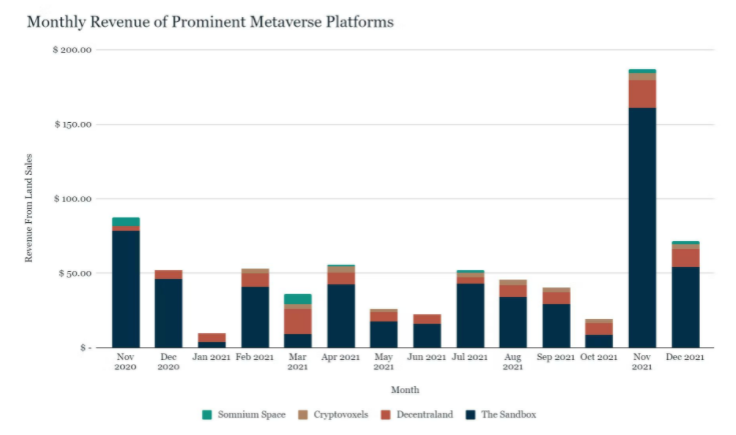
The data above gives us insight into how land-related revenue performs across four well-known virtual world platforms. For context, Sandbox accounts for 77% of all land-related transaction volume. In terms of market share among the four platforms, Decentraland lags behind at around 16%. What causes these differences?
Here are some hypotheses based on my observations:
Traffic volume—Take New York’s Times Square or Dubai’s Burj Khalifa as examples. Part of what drives the value of these properties is foot traffic. The more people spending time within these spaces, the higher the value per square foot. This is part of the risk in virtual land: you're primarily betting on your ability to create experiences that attract large numbers of individuals. It's akin to speculating whether a blog will attract attention over the long term.
Meme proximity—In my article last year about Bored Apes, I mentioned that NFTs are an interesting asset class because they reduce the cost of being "connected" to celebrities. Someone like me sitting in Dubai historically couldn't claim proximity to Snoop Dogg unless he decided to base himself in the Middle East.
Suppose I invest heavily in land next to Snoop’s property. Then, not only can I claim proximity to him, but I can also capture attention from those visiting his metaverse estate. This is why individuals buy land next to celebrities. But what if celebrities keep buying land everywhere? In my view, value is a function of human traffic and attention concentration in the metaverse. Endlessly buying properties dilutes their focus on any single location. Thus, unnecessarily purchasing land assets is counterintuitive.
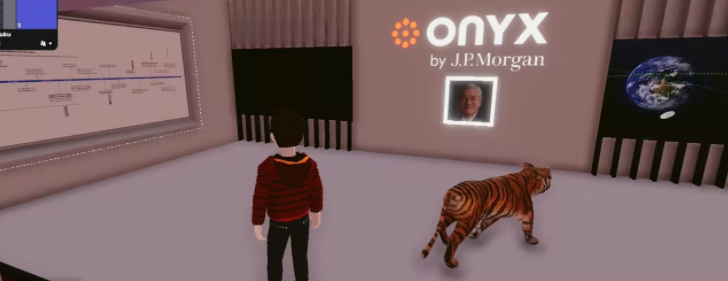
This might be JPMorgan’s most casual office ever.
Spatial context—Meme proximity depends on individuals gaining reputation by owning the same assets as known figures. Spatial context comes from the advantage of being close to commercial entities in the metaverse. One relies on reputation; the other on the flow of capital through these business hubs. For instance, consider the screenshot above from JP Morgan’s office in Decentraland (I have no idea why they have a tiger roaming around). If you jump into this metaverse, you’ll notice CoinGecko’s office is right next door.
As more brands join the metaverse and their users adopt these platforms for experiences, surging land prices near brand-owned plots will become standard. We could foresee collective groups coordinating to buy parcels adjacent to enterprises, effectively controlling them. I'm not planting ideas here—I’m just saying it would be fascinating if people did. By the way, if people decide to do this, Syndicate might be a great tool.
Financialization—One point I often make to game developers is that Axie Infinity’s core innovation was bringing together financial institutions from emerging markets (like hedge funds) and gamers through guilds. Financialization of metaverse assets could be a key driver of future land prices. Organizations like Everyrealm have been strategically acquiring land across various metaverses, intending to hold or generate revenue from them.
Revenue from metaverse land will come from short-term leasing or allowing individuals partial ownership at higher prices. Certain plots that allow resource gathering in games can generate income through microtransactions. Game developers could consider selling strategic land instead of equity to raise capital. Similarly, artists might sell usage rights of a plot hosting events to third parties to fund their activities early. In return, third parties could sell tickets to metaverse-linked concerts to recoup costs. Think this is nonsense? Artists like Justin Bieber have already earned millions doing exactly this.
Art—This relates more to emerging games than user-generated content metaverses. If a game launches with pre-existing graphics and stunning in-house art, game developers can credibly auction specific in-game locations. Landowners can advertise to, charge, or deliver updates to users passing through.
This may seem absurd now, but a few weeks ago, I met a team developing an Indian version of Fortnite, supported by gorgeous artwork enhancing gameplay. Given the depth of thought behind in-game assets, I wouldn’t be surprised if they pursued in-game asset auctions. In such cases, the motivation to buy land early hinges on betting that a large user base will eventually pass through specific game segments due to the depicted art. Sounds stretched, I know. More info on the team and game coming soon!
One central argument many make is that virtual worlds aren’t valuable because land can be infinitely generated at will. That’s like saying blogs aren’t valuable because there are countless blogs. The value of a plot in the metaverse is proportional to the attention it receives over time. To maintain pricing, publishers must limit the amount of land available in their metaverse variants. This is already happening.
Cryptovoxels, Sandbox, and Decentraland each have caps on purchasable land. As demand for metaverse properties increases, so does the price per plot. But what if tomorrow there are 50 different metaverses, just as we have different games today?
I think two things may happen long-term. First, land could become so expensive that only professional financial institutions can afford it—similar to how certain music streaming rights are owned today. This means ordinary users won’t pay huge sums upfront but engage via microtransactions. Metaverse platforms without user bases or financial incentives to own them will die worthless if they fail to capture human attention. This is the primary risk in investing in metaverse real estate.
A more ideal outcome is that collectives emerging from user communities end up owning assets within metaverse platforms. This empowers users to have a say in game development while enabling developers to secure early revenue by auctioning in-game land assets.
Some DAO-based initiatives are already exploring this model. One is PangeaDAO. Users in the DAO pool assets to purchase land across different projects. You can learn from this article how they evaluate land prices. The key point is that metaverse-based land ownership will matter in the future for two core reasons.
One is enabling user ownership of platforms. Empowering users to own a platform unlocks unique business models through user-generated content, meaning it won’t just be a game studio creating content, but an entire community. Considering the game experiences users have created on games like GTA 5 today, this could be extremely powerful. In this scenario, the game itself becomes a platform, and individual players publish micro-applications within it. This could open entirely new ways to monetize AAA games in the future.
The other reason is that it allows independent game studios to raise funds directly from users. Raising capital ahead of time from the user base also means customer acquisition costs trend downward as landowners become distribution channels. Think of it as tokens—but for metaverse experiences.
Where is all this headed?
When I sat down to write this, I wondered why anyone would buy land in the metaverse, whether it would become an asset class, and whether it could create new opportunities for creative individuals. From my observation, metaverse real estate won’t trade like tokens. These plots have high entry barriers, and even when collectively owned, holders will be incentivized to develop them rather than immediately resell for quick profits.
The most prominent entrants in the virtual real estate economy may hold these properties until they see significant appreciation in value. Because value stems from developing digital experiences and attracting users—not merely holding. Given the high cost of entry, does this mean retail users will be completely priced out? Probably not. Fractionalization of NFT land may soon emerge as a major theme. I wouldn’t be surprised to see mobile-first apps allowing users to invest small amounts into various plots. REIT-like collective models enabling index-style investments in famous metaverse land could generate significant interest.
Another emerging, underexplored factor is the role of collectives. LobsterDAO—one of my favorite NFT communities—has about 3,500 members. I wouldn’t be surprised if new metaverse platforms offer discounted land to communities to quickly bootstrap activity on their platforms. For enterprises, most current metaverse participation is likely for research purposes. Spending $20,000 on a few small plots could yield exponential media coverage and interest from potential customers.
I believe a new breed of investment banks focused solely on the metaverse will emerge in the coming years. They will help traditional asset allocators buy and custody metaverse assets—similar to how FalconX and Fireblocks handle tokens today. A major factor here is companies like Microsoft and Facebook attempting to execute metaverse strategies. With Facebook’s average user age rising daily, Zuckerberg and his team have strong reasons to push the metaverse as a theme. Their ownership of Oculus also gives them an edge.
The challenge for existing businesses is choosing between old monetization models (data mining users and targeted ads) and new ones (enabling user ownership and earning revenue via sales commissions on platforms like OpenSea). Moving in either direction is difficult—they must choose between appeasing Wall Street or retaining users, quarter after quarter. To me, metaverse land managed today via DAOs symbolizes how the internet might evolve toward decentralization, user ownership, and a slightly wilder direction. In my view, the future is a hybrid of the past.
Join TechFlow official community to stay tuned
Telegram:https://t.me/TechFlowDaily
X (Twitter):https://x.com/TechFlowPost
X (Twitter) EN:https://x.com/BlockFlow_News
 @joel_john95






