








Conversations with NFT Community Pioneers: How NFTs Are Transforming the Art World
TechFlow Selected TechFlow Selected
Conversations with NFT Community Pioneers: How NFTs Are Transforming the Art World
People hear that NFTs are going mainstream and see them as a get-rich-quick scheme.
 Navigating Web3 tides with focused insights
Author: RSC
Translation: Block unicorn
Hosted by RCS, featuring Carlos Marcial and Richard Entrup—two pioneers from different realms of the NFT community.
RCS: Carlos, I’d like to start by asking about the early days in the NFT space, when there was no mediation or gatekeeping like we see today. Can we still distinguish this new decentralized art market from the old centralized model?
Carlos Marcial: I wouldn’t be here talking with RCS and the former CIO of Christie’s if I hadn’t had access to a “decentralized” global art market that I care deeply about. When it comes to marketing, everything boils down to attention—an excellent artist cannot escape this reality. If you don’t draw attention to your art, your persona, your biography, then essentially, you don’t exist. The fact remains that NFTs have enabled someone like me, based in the Global South, in Mexico City (though I grew up in the Caribbean), to sell my artwork. That is revolutionary to me.
Otherwise, what would my options have been? I’d have had to move to New York and take a job at a restaurant near museums and galleries. While waiting tables, I’d try to catch the attention of people from those institutions. With NFTs, I’ve not only captured collectors’ attention but also critics of NFTs—all from my home in Mexico. This would never have happened without NFTs, especially as a digital artist.

Carlos Marcial, (still from) L'Echelle du Modernisme, 2021. Courtesy of the artist
Richard Entrup: I think Carlos eloquently summarized the impact of this NFT movement—one that has allowed thousands of artists to sell their work who otherwise would have had no mechanism on traditional platforms. They no longer need to rely on galleries and auction houses historically dominated by white privilege in the art world. So when we hear how many billions of dollars OpenSea did last month, how much Beeple sold for, or how much Christie’s made on NFTs last year, that magic is undeniable. That’s great for them—but let’s not forget that blockchain offers full democratization and decentralization within the art world, and it should be about artists, not middlemen taking a cut.
Carlos Marcial: Something as centralized as the art world can’t become decentralized overnight. It’s a gradient, a process—and we’re not even halfway through; we’re still at the beginning. But even now, you have artists like Osinachi from Nigeria, who continues to work from home and connect directly with collectors; Frenetik Void in Argentina; myself in Mexico City—we’re all able to make a decent living from our art. So this is a dual revolution. On one hand, digital art—which over the past two decades saw cultural capital shift into digital spaces—has finally become collectible. On the other, there’s a profound decentralization of access to this market.
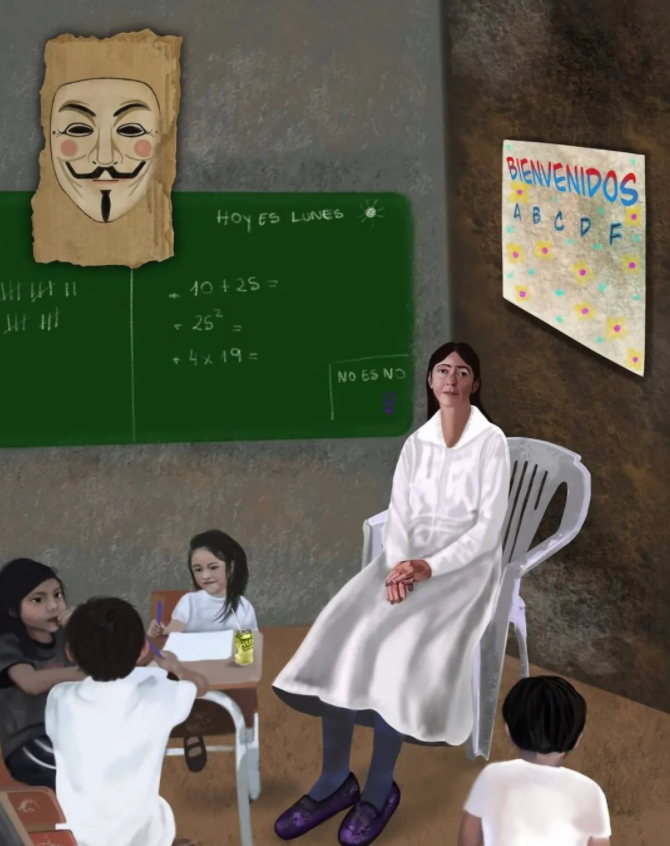
Panter Xhita, Shadows of Clichés: Guy Fawkes Mask, 2021. Courtesy of the artist
RCS: As an OG (crypto elder) rooted in Mexico’s NFT community, do you still feel like an outsider artist, or sometimes even like a gatekeeper?
Carlos Marcial: I think I feel a bit of both. Honestly, I don’t particularly like being called an OG—maybe because I still feel like an outsider, or because I’m still attached to that identity. I’m just an ordinary guy from Mexico City, which makes me feel like an outsider. But truthfully, because I’ve become quite prominent in the crypto art scene, I get approached almost daily by Latin American, Mexican, and Caribbean artists who assume I can open doors for them. Right now, I’m curating Metafisica, a SuperRare space—I’m the one selecting the artists.
RCS: Richard, from your perspective having worked in both art worlds, what do you think are auction houses’ intentions in entering the primary market given their experience in secondary markets? Is there a grand strategy, and if so, has it succeeded?
Richard Entrup: In 2018, we held our first blockchain-based auction at Christie’s. We partnered with Artory, a company run by my dear friend Nanne Dekking, which remains very active today. It was a test—we pulled it off, but then momentum dropped, and there was no further desire to continue. At the time, apart from teamLab, no digital art was being auctioned. Christie’s inaugural Art + Tech Summit focused on art on the blockchain, where Jason Bailey (Artnome) introduced NFTs to the traditional art world. But for Christie’s, this was primarily a way to attract new physical art buyers. They didn’t view it as a native platform for selling digital art—it was more about drawing new collectors into buying tangible artworks. I think some auction houses still hold that mindset.
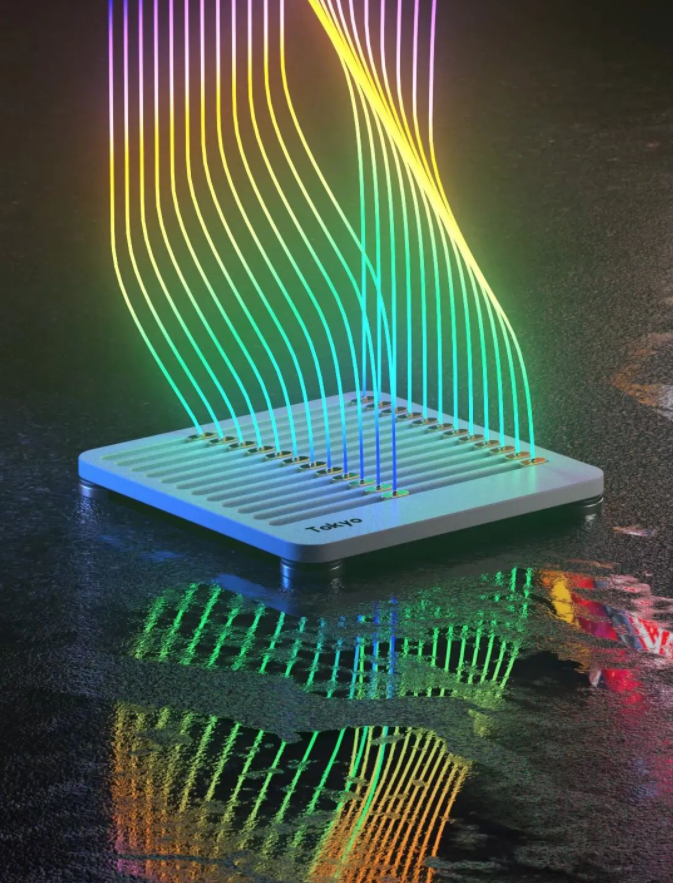
Flavio Cavalcante, Tokyo Night – January 1, 2021. Courtesy of the artist
Carlos Marcial: I think the relevance of auction houses is decreasing. But in the past, recognition from Sotheby’s or Christie’s carried real weight—a kind of validation. My mother is an art historian, so I grew up hearing stories about Frida Kahlo’s works being auctioned. That always caught my family’s attention. I’m not sure younger generations have the same attachment. Would I accept if Christie’s or Sotheby’s came knocking? Maybe—you know, because at least for me, they still carry certain cultural prestige. But another part of me thinks, “Screw them,” I’m already a platform—I can do this myself.
RCS: Can we now achieve cultural validation without all the speculation?
Richard Entrup: No, I think the association between NFTs and cryptocurrency is cultivating a new generation of collectors—crypto billionaires who have nothing else to buy with BTC or ETH and don’t want to cash out into dollars. People hear that NFTs are going mainstream and see it as a quick path to wealth. For all the great artists of the past 200 years, their work rarely sold for even a fraction of today’s prices during their lifetimes. Now, that process is accelerated globally via the internet and NFTs, tied to crypto speculation, recognizing NFTs—as with crypto—as a new asset class for investment.
Carlos Marcial: I also think this reflects the added value of provable digital provenance, a long-standing issue in the traditional art world. But I can’t deny the speculative benefits brought by my current status as an artist whose works now sell for seven figures. I was ready to be overlooked. I was prepared to die a poor artist. But you know, the emergence of NFTs completely changed the market dynamics.
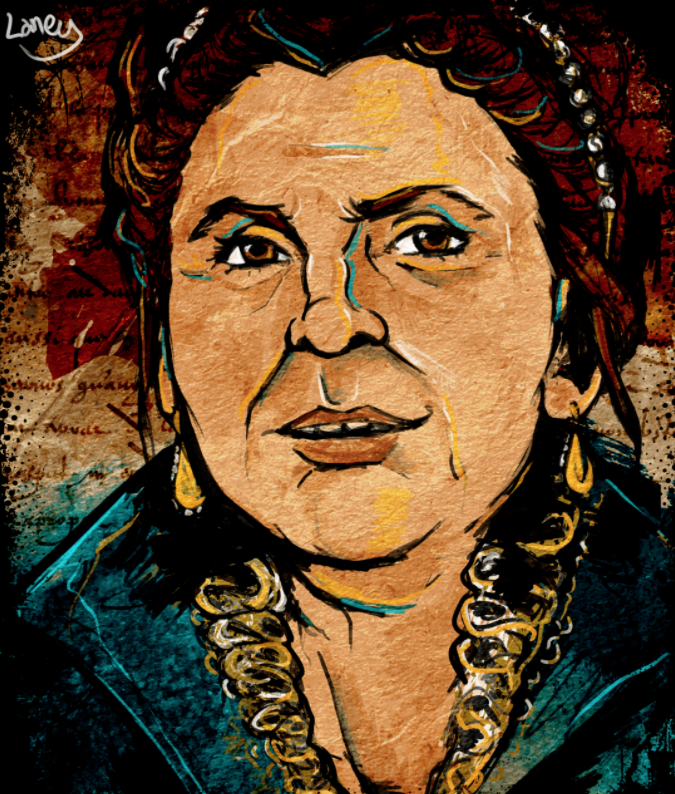
Cryptopom, Know Your Place #05: Catherine de' Medici, 2021. Courtesy of the artist
Most people in the Global South live paycheck to paycheck, right? We also lack financial education—that’s partly why we seek additional income streams. Collecting art requires money, and a certain level of cultural literacy. But I believe NFTs are changing this, enabling people in developing countries to become art collectors. Artists from the Global South deeply care about our fellow artists. We’re united. Wherever we are—Haiti, Dominican Republic, Peru, Bolivia—for many, this could be the first opportunity to use financial tools meaningfully.
Richard Entrup: Carlos’s point also ties into the broader mission of crypto democratization—getting everyone into the system. Anyone can buy a small share; anyone can participate in this new monetary world. NFTs are merely proof-of-concept for that. Let’s be honest—you still can’t buy many things with cryptocurrency. But with Coinbase, PayPal, and other exchanges emerging, and more companies and nations accepting it as currency, mass adoption and NFT markets may follow wherever there’s attention. It’s simply another digital marketing channel supporting participation, conversion, retention, and ultimately revenue. That’s why big corporations are jumping on board.
RCS: This isn’t just a new art market—it feels as though creativity itself has undergone massive financialization, not to mention the gamification of the art world, centered around rituals of descent. We’re also seeing many artists themselves collecting in ways we’ve perhaps never seen before. Has the artist’s psychology fundamentally shifted?
Carlos Marcial: When you go to art school, or film school, one thing they never talk about is the market. So artists don’t understand how their work can become a financial instrument. Worse, there’s this enduring myth of the starving artist who never sells anything. But selling is an act of communication—it explains why someone should care about my art, or support me or other artists. The entire digital culture around NFTs accelerates this exchange.

Amanda Godreau, Prism 2, 2020. Courtesy of the artist
Richard Entrup: Auctions have always gamified competition—people bidding against each other. This dates back centuries, with wealthy individuals raising paddles to buy fine decorative art. But now, a new form of art acquisition and gamification has emerged, especially with PFP projects that include utilities beyond the NFT itself. The problem with collectibles is that they satisfy a human desire to collect—whether baseball cards, stamps, coins, comics, or in my case, Beatles memorabilia and fine wine. But by adding an auction component to the sale process, you can significantly raise the base price or hammer price, as people begin competing and driving prices upward. The higher the gamification, the greater the demand, and the higher the price.
When I was at Christie’s, I tried applying AI to analyze predictability among collectors participating in online sales. We even attempted to detect when a buyer might hover their mouse over the purchase button during an online sale, so the auctioneer could say, “Hello Miami, we see you might want to bid,” encouraging action based on intent.
But for many NFT collectibles, buying is just the beginning. You buy a kitten or a rabbit, whatever it is, and gain entry to an entire community where you can play games together. Now, restaurants in Manhattan are opening specifically for token holders. But this isn’t about the art. People like me who buy on Feral File—we pursue works by Casey Reas or Refik Anadol—not to play games, but to own, view, and share them. Of course, there are different types of collectors.
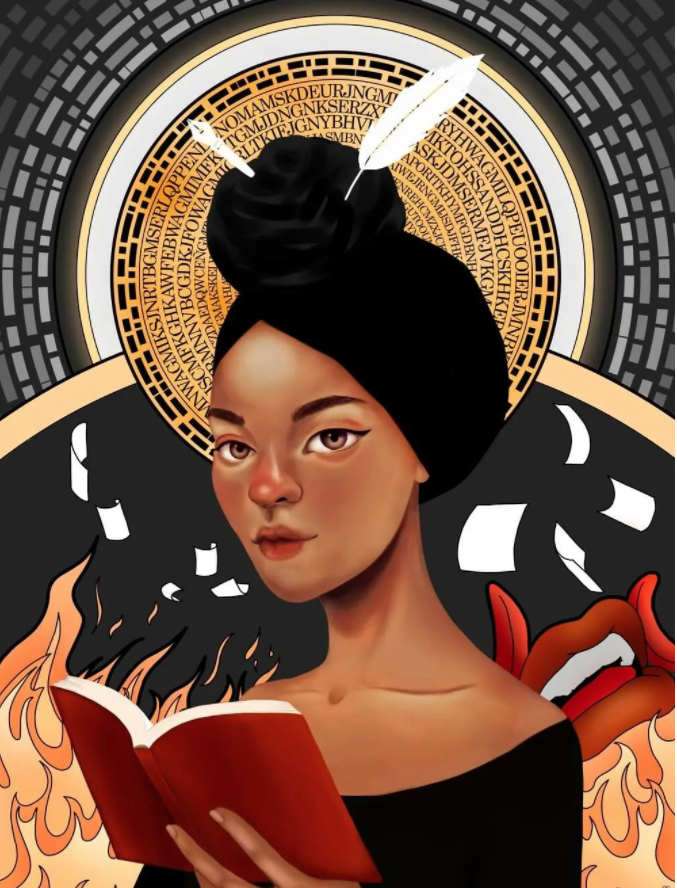
Alejandra Her, Our Silent Goddess, 2021. Courtesy of the artist
RCS: Carlos, as an artist, do you feel you're competing with NFT collectibles in ways traditional artists never did before? If so, how do you view this expanded artistic field?
Carlos Marcial: I tweeted before—I might be the only crypto artist who doesn’t mind PFPs. Like Richard, I believe collecting and building communities through collections is innate to us. As a crypto artist, I don’t mind competing with collectibles because I know that if I were in the traditional art world, selling through Christie’s or Sotheby’s, I’d still be competing for the same wealthy patrons’ money—whether it's a house in Miami or stocks in the stock market.
RCS: At least for now, the economic value of fine art NFTs seems lower than that of collectible NFTs—is that a problem?
Carlos Marcial: I think history has a funny way of sorting these things out. Or at least, that’s what I choose to believe. I see collections like Bored Apes becoming convenient speculative vehicles for wealthy crypto individuals. In a sense, they represent lowbrow culture driven by speculation, while digital fine art relies on different forces to build an artist’s body of work and reputation. But oddly enough, I don’t mind—because I know fine art always takes longer to emerge.
Richard Entrup: In fact, most sales currently occur within PFP communities, while—to my knowledge—only 10% to 20% happen in the traditional art sphere. Artists like Carlos, Casey Reas, IX Shells, Mario Klingemann, Snowfro, and Jared Tarbell have achieved solid prices, but still fall far short of apes and punks. This could change. Ultimately, you must look at the data. The top 50 projects are all PFP collections and Pokémon-style sales. That’s just how it is now.
I happen to know several major art collectors from the traditional art world who have entered the crypto space. They own Apes, Art Blocks, and native generative art—though it remains a niche group.
RCS: Before the pandemic, there still felt like a divide between fine art and cultural industries—including digital creatives unaccustomed to selling their work at high prices. But in recent years, our experience of all art forms has been compressed onto a single digital plane, making it feel like we’ve entered a cross-media era of art. Do you agree with this assessment?
Carlos Marcial: I love calling crypto art “post-postmodern art,” because we’ve evolved from the modernist artist who shunned the market into something entirely different—an artist who decides when to drop an NFT, who talks directly to collectors, who becomes the platform. In postmodernism, we’ve transitioned from artist-shamans into platforms ourselves, becoming Christie’s or Sotheby’s. It’s a double-edged sword: you earn more money, but you also become too much of a promoter or marketer.
Richard Entrup: I just wonder what would happen if Refik Anadol, Beeple, or XCOPY launched their own NFT exchanges to sell directly. Right now, they still sell through third-party platforms or auction houses. Why don’t they go direct-to-consumer like Disney and others? The whole beauty of blockchain democratization is that it allows artists to reach audiences without intermediaries. Unfortunately, in attempts to democratize the music industry, musicians still can’t sell directly to fans without massive marketing engines. Spotify and Apple control the market.
Who are the tastemakers in the NFT space telling people what to buy? I don’t rely on Christie’s or Sotheby’s to recommend new digital artists. But I’d like to know what Carlos is buying.
Carlos Marcial
A Puerto Rican digital artist born in Mexico City, Marcial has been active in crypto art since 2019. Before becoming one of the first full-time crypto artists in early 2020, he helped establish and creatively lead a studio in Toronto, Canada, providing design services for blockchain projects and companies. It was at this studio that he first discovered NFTs and purchased his first CryptoKitty.
Richard Entrup
Has led technology, innovation, and digital transformation initiatives for numerous global brands including Verizon, Christie’s, Disney/ABC, Time Warner, MoMA, Viacom, and Tiffany & Co. At Christie’s, he envisioned and executed a major digital transformation program encompassing the first blockchain-based auction, augmented and virtual reality hanging applications, predictive analytics using AI and ML (data structures), computer vision tools, and mobile online bidding during live auctions. In 2018, he helped launch Christie’s inaugural Art + Tech Summit focusing on blockchain and artificial intelligence, where ClubNFT CEO Jason Bailey (Artnome) first introduced NFTs to the traditional art world.
Join TechFlow official community to stay tuned
Telegram:https://t.me/TechFlowDaily
X (Twitter):https://x.com/TechFlowPost
X (Twitter) EN:https://x.com/BlockFlow_News






