








NFT Scam Prevention Guide: Three Tips to Help Protect Your NFT Assets
TechFlow Selected TechFlow Selected
NFT Scam Prevention Guide: Three Tips to Help Protect Your NFT Assets
A phishing email scam stole $4.16 million.
 Navigating Web3 tides with focused insights
Author: NFT Labs, Research Institute of Looop
The world of crypto is like a dark forest, where countless dangers may lurk around you. Recently, hackers took advantage of OpenSea's contract upgrade to send phishing emails to all users' inboxes. Many users mistook these for official messages and granted wallet permissions, resulting in theft. According to statistics, this single email led to the theft of at least 3 BAYC, 37 Azuki, and 25 NFT Worlds NFTs. Based on floor prices, the hackers earned as much as $4.16 million.
On that same night, Niq, a Tongji University student from "All in NFT," had his long-held 1/1 Doodle stolen after a private transaction negotiation. The attacker lowered Niq’s guard and then sent him a fake transaction website link.
Today, we must guard not only against technical hacks but also social engineering attacks. With NFT project values rising rapidly, even a momentary lapse can lead to massive financial loss. Given the recent surge in NFT-related scams, Looop has summarized several common fraud tactics, urging readers to stay vigilant and avoid falling victim.
Common Scam Tactics
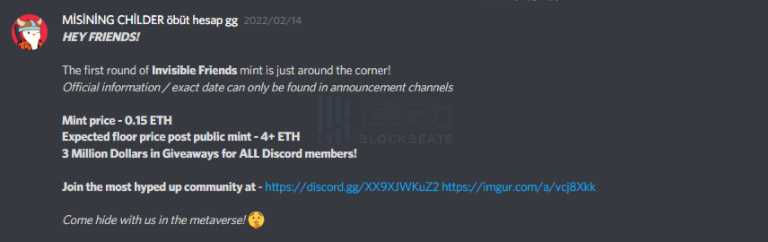
1. Fraudulent Website Links via Discord DMs
Sending phishing links through Discord direct messages is a common tactic used by hackers. They often mass-message members across different communities or impersonate community administrators offering help, tricking users into revealing their wallet private keys. Alternatively, they send fake websites claiming users can claim free NFTs. Once users authorize such counterfeit sites, they risk significant financial losses.
2. Hacking Discord Servers
Almost every popular NFT project experiences Discord server breaches. Hackers compromise admin accounts and post fake announcements across channels, directing members to fraudulent websites set up in advance to purchase counterfeit NFTs. Modern hackers often steal server admin tokens by sending phishing links, rendering two-factor authentication (2FA) ineffective. If the fake site requests wallet authorization, victims could suffer severe asset losses.
3. Sending Fake Transaction Links
This scam commonly occurs during private NFT transactions between buyers and sellers. Platforms like Sudoswap and NFTtrader encourage users to privately negotiate swaps of NFTs or tokens and provide security measures for such deals—generally beneficial for the NFT market. However, hackers now create cloned versions of Sudoswap and NFTtrader to carry out fraud.
After negotiations, Sudoswap and NFTtrader generate an order confirmation page requiring both parties to approve before the smart contract executes the trade. Scammers initially appear legitimate, showing real links. Then, under the guise of modifying terms, they send a fraudulent link. Once the user clicks to confirm, their NFTs are transferred directly to the scammer’s wallet.
4. Stealing Seed Phrases
Scammers use various methods to trick users into sharing their private keys or seed phrases—such as creating fake websites or pretending to be support staff. These actions aim to lower user defenses and steal critical access credentials.
5. Creating Fake Collections and Soliciting Trades in Public Discord Channels
Fake NFT collections frequently emerge before major project launches. Prior to an official NFT blind box release, scammers upload similarly named collections on platforms like OpenSea and carefully design them using publicly available information. Since genuine collections aren't yet live, users searching online are more likely to encounter these look-alike projects first. Some scammers even simulate trading activity by placing offers on fake listings to increase credibility.
To avoid platform and project royalties, community members often engage in off-platform trades. Beyond mimicking Sudoswap or NFTtrader, some scammers post links to fake collections priced slightly below floor value in public channels. Users eager to grab a bargain may overlook authenticity checks and fall victim to the scam.
6. Fake Emails
Most NFT platforms require users to bind an email address so they can receive instant updates about their NFT transactions, making email a prime target for scams. Scammers often impersonate official OpenSea accounts, sending phishing links under false pretenses such as needing to update contract addresses or re-verify wallets. Just recently, following OpenSea’s announcement of a contract upgrade, hackers used this method to steal nearly $4 million worth of assets. As of this writing, OpenSea’s team is still identifying affected users.
Anti-Fraud Guide
1. URL Verification
Regardless of how convincing the presentation or persuasive the language, when hackers ultimately attempt to steal your digital assets, they always need a way to interact with your wallet. While average users might lack the ability to assess smart contract risks, we’re fortunate to still operate largely within a web2-dominated internet landscape. Nearly all blockchain contracts rely on web2 front-end interfaces to interact with users.
Therefore, the vast majority of crypto asset theft targeting end-users occurs through counterfeit phishing websites. Learning how to identify these fake sites alone can protect you from 99% of crypto theft attempts.
For Gen Z users who grew up with smartphones, immersed in app-based ecosystems, the concept of traditional web pages may feel outdated and unfamiliar. In the web2 era, the DNS system assigns each website a globally unique identifier. Understanding basic domain naming rules equips you to detect nearly all phishing sites.
In standard DNS structure, domains have three levels. Starting from the first slash (/), read right to left, with each dot separating one level. For example, in https://www.opensea.io/, ".io" (like ".com" or ".cn") is the top-level domain and cannot be customized. "opensea" is the second-level domain—the main name—and must be unique within its top-level domain (e.g., no duplicate "opensea.io" under .io). "www" is the third-level domain, which operators can customize freely, even adding fourth or fifth-level subdomains before it.
Domain hierarchy runs counterintuitively—from right to left, decreasing in level. This goes against typical reading habits and creates opportunities for attackers. For instance, https://www.opensea.io.example.com looks very similar to the real OpenSea, but its actual domain is "example.com", not "opensea.io".
Whether Web3 will eliminate phishing remains uncertain. But in today’s web2 world, the DNS system ensures domain uniqueness. If the domain is authentic, users are extremely unlikely to land on a fake site.
2. Never Share Private Keys or Seed Phrases
Unlike Web2 accounts such as email, crypto wallets cannot reset or recover private keys or seed phrases. Once exposed, the wallet effectively becomes shared between you and the hacker. All assets in the wallet can be transferred at any time by the attacker. Due to Ethereum address anonymity, you won’t know who stole your funds, recovery is impossible, and the wallet should no longer be used.
3. Revoke Wallet Permissions Promptly
If you’ve already granted permission on a phishing site, visit any of the following three links immediately to check and revoke unauthorized access:
Join TechFlow official community to stay tuned
Telegram:https://t.me/TechFlowDaily
X (Twitter):https://x.com/TechFlowPost
X (Twitter) EN:https://x.com/BlockFlow_News






