Circle Founder's Conversation with SBF: How Can Crypto Infrastructure Reshape Global Market Structure?
TechFlow Selected TechFlow Selected
Circle Founder's Conversation with SBF: How Can Crypto Infrastructure Reshape Global Market Structure?
This is a compiled transcript of the conversation from Circle's podcast series "The Money Movement," featuring Jeremy, founder of Circle, in dialogue with SBF, founder of FTX. The discussion delves into blockchain-based market structures and examines how policy and regulation impact the development of cryptocurrency economic infrastructure.
 Navigating Web3 tides with focused insights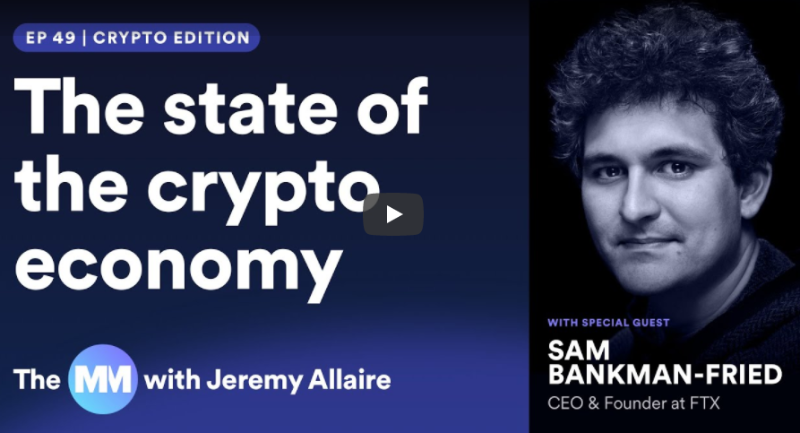
TechFlow is authorized by Circle to compile and republish this article.
Transcript
Jeremy: Welcome, Sam. I have many different topics I'd like to discuss with you today, starting with broader questions about cryptocurrency’s impact on the world—and bigger ones too, as I often say: Why do this at all? I remember a professor in college who always asked, "Why are you doing this? What are you really doing? What truly matters?"
Regarding crypto, I think people have only a superficial understanding. You've spoken extensively in the past about effective altruism and how this long-term game creates value for the world. So now, why are you doing what you're doing?
Sam: There are many ways to approach that question. Perhaps I’ll start with market structure—an aspect I believe is underappreciated. Everyone should have equal access. In traditional stock market structures, you need 10 different intermediaries and must pay tens of millions annually just to see the order flow.
The direct and fair access environment in crypto can inform and guide other financial products. I'm excited to be part of changing market structure and hope to help deliver what I believe is a more appropriate framework for consumers.
Of course, getting into this was somewhat accidental—just like crypto itself, it’s a new frontier where we can rethink problems from scratch. For example, when custodial stocks and clearing happen, the process becomes extremely messy. I don’t even know who owns what or who has arbitration rights over holdings. We have to build extensive infrastructure just to answer basic ownership questions.
But with crypto, you can definitively answer who owns a particular Bitcoin or USDC. This means you don’t need specialized clearing and custody firms—the blockchain helps eliminate some of that complexity. And you don't need numerous intermediaries to move assets from one place to another; you can do it directly yourself.
Jeremy: Yes. Let’s go deeper—why does this matter? Why is direct access to capital markets important? Why are you so passionate about solving market structure issues, and how does this benefit society and the world?
Sam: I’d answer this through prediction markets. What is a prediction market? If you want to know whether something will happen in the world, you create a market for it. If you want to find out what the temperature will be in five years, you create a market where people can trade on that outcome—it’s powerful.
Market forces then generate a price reflecting the expected temperature in five years. If you're researching climate change or modeling its impacts, or if you work in an industry sensitive to temperature—like energy or agriculture—you can use that information.
If you’re buying oil, you need substantial liquidity. Or if you’re purchasing corn but don’t want to pay five times the average price—well, who knows what the average price is? The market does. Any entity or business doing financial planning needs to understand pricing and how it affects their finances.
Look at companies—why are stock markets important to them? Investors need to decide how much funding a company deserves and how much investment makes sense, enabling businesses to grow. If a company with little innovation receives massive capital, that’s a huge waste for the world.
Jeremy: So we want to avoid that. What you’ve described touches on markets and information—they’re two sides of the same coin. At the end of the day, if markets generate information, investors seek the best information because it has value.
My understanding of your point is that crypto and blockchain could bring more valuable information into the system, incentivize better insights, and enable us to access the best possible information. Real-world economic participants will gain greater confidence and better outcomes when using this data. This infrastructure can accelerate both information and economic velocity globally.
Sam: Exactly right. We can flip the coin and ask: Why is money useful? Because barter is terrible.
Jeremy: Information systems. Money is a record-keeping system—it's simply a way to organize information. It comes with a social agreement that proves highly functional for participants and the world—because it minimizes trust and enables near-zero-cost global interactions.
Sam: When you start viewing money as a record-keeping system, it begins to make sense. Why distributed ledger technology... why is blockchain so useful for money? Blockchain is a global, decentralized, distributed ledger—exactly what you need when trying to maintain records.
Jeremy: Here’s an interesting story I’ve shared several times. A while ago, I met the CIO of the Federal Reserve and pressed him: “What *is* real dollar?” He said, “What do you mean?” I was thinking: “Is it a database? What kind of database?” Turns out the dollar is essentially a cluster of oracle databases running on Sun Microsystems clusters—fascinating.
One view says, “Crypto is speculative assets or something similar.” Another builds on what we just discussed: “This is next-generation global economic infrastructure, providing a new foundation for organizing economic activity.” That gives us a new lens: We’re not just debating whether people should be allowed to trade Bitcoin, stablecoins, or altcoins—we should recognize that a strategic infrastructure is being developed, with global collaboration underway. Questions like, “What is this? What impact will it have?” become critical. I’d love to hear your thoughts: How can crypto infrastructure transform market structure?
Sam: Let’s talk about remittances or social media messaging. Say you're sending $1 from someone in the U.S. to someone in Brazil. This brings us back to your question to the Fed: What *is* a dollar? What exactly are you transferring? Is it $1 USD or Brazilian currency? It gets worse—they’re not on the same system.
Today’s system requires private companies that host ledgers whenever two parties want to exchange information or assets.
Jeremy: Yes, like PayPal and others.
Sam: Right, which makes sense—but we also see the problems these systems create. Consider public reaction to Facebook’s decisions about censoring election-related content. Their services may not function as intended. The trusted answers are selective. The real issue is: Who controls these two systems? How do they communicate? These small-scale examples highlight opportunities for efficient services and rapid innovation.
Jeremy: Who has read/write access to regulated databases?
Sam: You might say governments, but then you quickly run into questions: “Well, which government?” Especially in cross-border transfers between Brazilians and Americans—which government controls the transfer? There’s no clear answer.
When discussing feedback systems for governments, sometimes the response is negative—some countries operate this way today. I believe such systems exhibit characteristics many people dislike. Blockchain offers a fundamentally third option—neither corporate nor governmental—that transmits and records information.
Jeremy: In some ways, this represents the next phase of internet growth. It’s like the next logical layer of infrastructure—the internet’s next protocol layer—playing a larger role in society. In the early days of the internet, most voice calls still routed through government-controlled infrastructure, operated by monopolistic state enterprises with backdoors for surveillance. But open-source software and protocols on the internet allow free interconnection with anyone.
Sam: Essentially, yes.
Jeremy: Returning to policy—if you’re a government representing national interests, say Congress—you need to ask: “If this is new economic infrastructure, what does it mean for our economy’s future? What opportunities will it create for households and businesses?”
Sam: Many questions remain unanswered by the world—we’ll need to learn through development.
Open infrastructure brings both crises and risks. It’s not inherently secure—it gives people access and choice. People can choose which protocols they interact with. Choice matters. Our current choices may have long-term consequences for practical decision-making.
Stablecoins are perhaps the clearest example. Stablecoin usually means USD-backed stablecoin—currently, there aren’t really other types. This isn’t how the world should be. If I were the Fed, I’d want the answer to be USD, not something else. When considering stablecoin policy, we must evaluate available options. I believe it serves broad interests to define what those options should be. And we should ask tough questions: Does this mean we should try to eliminate stablecoins—or does it mean we should consider which stablecoins become mainstream?
Jeremy: Clearly, this overlaps with national competitiveness—dollar competitiveness. This new global economic infrastructure will achieve internet scale in the coming years, creating significant and massive impacts. If you’re the U.S. government, what should be the internet’s currency?
Your earlier point emphasized the importance of letting people choose which protocols they interact with—openness is paramount. It’s the air we breathe. Historically, regulated database operators controlled it. But now we say, “No, this is an open internet.”
Sam: Yes.
Jeremy: Another part is technological potential. There’s an underlying desire for seamless, on-demand transportation anywhere via handheld devices—coordinating work, delivery, everything. When the iPhone launched in 2007, nobody said, “I want seamless on-demand drivers.” The idea behind latent technological capability is that once technologies converge and building tools exist, no one can truly predict what people will do with them. The same applies to crypto, public blockchains, and smart contracts.
Programmable money has existed for only three years. There’s almost no programmable dollar or other programmable currency on the internet—a completely new phenomenon, like newly built infrastructure. We don’t yet know what people will do with it. We need choice to access these protocols because that’s where all the potential lies. I’d love to hear your thoughts: What could people build with programmable money? What will we invent with programmable mobile money? What problems can people solve?
Sam: This is very interesting. Some answers I don’t know either. But interoperability keeps coming back to me. Today we have so many systems that can’t communicate with each other—and people seem to forget how important this is.
For instance, I’m on Facebook, you’re on Twitter—we can’t talk to each other. Communication breaks down. I think this is a real issue that people overlook. Second, people still don’t realize how hard remittances are.
Jeremy: Actually, it’s just large databases with secure FTP servers and CSV files.
Sam: Yes, but that’s not how systems are built today. So crypto can genuinely impact people—especially the unbanked or underbanked. After hearing their frustrations, I find this particularly compelling.
Jeremy: We see many startups in Africa and other markets building applications with USDC, simply trying to make transactions faster and cheaper. I want to return to the theme of what people can do with economic infrastructure we haven’t imagined yet.
Clearly, DeFi itself is a great example of programmable money—people building protocols that allow new forms of capital interaction. Another fascinating case is DAOs—essentially company-like entities existing on-chain. This exemplifies programmable money and programmable governance. Using this framework—as a new layer of internet-based economic infrastructure—people can build things previously impossible, including new multinational organizations. There’s massive experimentation here, many tools being developed. But when will they become actual producers of goods and services? When will they emerge as entities representing truly new economic forums competing with traditional ones?
Sam: Excellent question. My guess is we need regulatory clarity first. Suppose you have a DAO—a new economic unit. No one really knows what legal framework governs it. Contract law? Until we resolve this, it’s hard for DAOs to play major roles in society.
Take the Ethereum Classic board as an example. The question is: “What happened there? What determines whether those transactions get reversed?” Do you go to court to reverse blockchain transactions? If so, do you vote on one of the networks? What constitutes the real network? Without knowing the correct answers, I think there’s much work ahead before people invest billions in DAOs and fully understand what they’re doing.
Jeremy: It feels like we’ll see more DAOs experimenting—this space holds immense economic and technical potential, though no one truly knows what innovations will emerge. Maybe future protocol designs will become foundational for commerce or similar activities on the internet. Let me shift angles and ask about tokens versus equity. Like stocks—you’re considering stock trading on FTX US, and there are already tokenized equity products. How do you view the difference between native tokens and tokenized equities? How should users choose?
Sam: I don’t know how this will end, but I can share my current thinking. We’re in the early stages. For now, tokenized equity likely mirrors stablecoins’ relationship to USD. Tokenized equity is a tokenized wrapper around underlying financial assets—its pros and cons mirror those of stablecoins versus dollars. I believe tokenized stocks offer easier interaction and many advantages, but for now, they may not replace actual equity—they represent equity, requiring conversion between tokenized ecosystems and legacy systems.
But I expect gradual migration toward tokenized versions, with more systems moving in that direction. You can clearly, concisely, and definitively answer questions like “Who holds this asset?” Anyone can verify it—I believe there’s great power in that.
Jeremy: Another related question involves project-native tokens. From a broader market perspective, how do you distinguish native crypto tokens from traditional stocks?
Sam: That remains to be seen. Much depends on how protocol tokens evolve. Key questions include: What form do protocol tokens take? Are they on-chain collectibles or core governance mechanisms? Traditionally, equity combines both.
On one hand, native tokens focus on governance. On-chain governance can be clearer and easier to execute than current corporate mechanisms—especially beyond a five-person board. How do you coordinate among 10,000 stakeholders? Blockchain provides a method—and optionally, governance can be delegated to on-chain stakeholders. On the other hand, you can have multiple governance tokens for different purposes. Technically, you can have multiple equity classes, but they lack the diversity possible with tokens.
Jeremy: Coordination across diverse social groups is extremely difficult in traditional industries. But now let’s discuss identity. Long ago, I felt the internet lacked several layers—one being money, another being identity. For many reasons, interconnected assets and identity haven’t truly existed on the internet in a protocolized way. Yet cryptographic primitives are now making solutions possible. Looking at today’s crypto, crypto finance, DeFi, DAOs, and NFT usage—how do you view identity? Whether real-world identity expressed on-chain, or identity tokenized via NFTs? What needs to happen for identity to unlock all this infrastructure?
Sam: What we’re missing is on-chain identity. Currently, identity exists only in centralized silos. On FTX, we have centralized exchange identities collecting KYC data. Elsewhere, users only have blockchain addresses—and they can always create new ones. I believe on-chain identity unlocks many possibilities, and it’s not that hard. For example, we could collect FTX account data and add a button: click it, enter your blockchain address. We publish a statement on-chain: “We verified this blockchain address is linked to a KYC-compliant FTX account.” Then any on-chain protocol can read it.
Second is the social side of identity—things like reputation. You see this in people’s Twitter feeds, Facebook profiles, video game achievements. These signals are currently fragmented—no coherent sense of identity across LinkedIn, Facebook, etc. Combining on-chain identity with NFTs and other elements, you could suddenly have a blockchain address accumulating identity signals from many sources—all readable by anyone. Suddenly, “Who is Jim?” You send an address, Jim appears, and you instantly learn a lot about him.
Jeremy: We’ll need many different crypto addresses to manage privacy preferences and such. As you know, we’re optimistic about this space—there’s still so much undiscovered potential in this industry. Thank you for joining this conversation. Looking forward to meeting again.
Sam: Great. I’m happy and excited about the industry’s prospects.
Join TechFlow official community to stay tuned
Telegram:https://t.me/TechFlowDaily
X (Twitter):https://x.com/TechFlowPost
X (Twitter) EN:https://x.com/BlockFlow_News
 @circle