








A Comprehensive Analysis of How OpenSea as a Product Became the Most Popular NFT Marketplace
TechFlow Selected TechFlow Selected
A Comprehensive Analysis of How OpenSea as a Product Became the Most Popular NFT Marketplace
OpenSea, launched in February 2018, continues to pursue its vision of becoming the "eBay for cryptogoods." This persistence has paid off as it remains the most popular NFT marketplace and was recently valued at $13.3 billion.
 Navigating Web3 tides with focused insights
Author: Supreet
Translation: Alex, TechFlow
It was winter 2018. The crypto market had crashed, with even blue-chip tokens like Bitcoin and Ethereum down 90% from their all-time highs. One by one, projects that launched with great fanfare were collapsing. Your Thanksgiving dinner became really awkward after your uncle sarcastically asked, “So… how’s your Bitcoin investment doing?”
Amidst this collapse, one project persisted with conviction—OpenSea. Launched in February 2018, it stuck to its vision of becoming the “eBay for cryptogoods.” That persistence paid off. As it became the most popular NFT marketplace, OpenSea recently reached a valuation of $13.3 billion. This article analyzes the reasons behind OpenSea’s product success and explores where it might go from here.
But first, what is an NFT?
Well, an NFT (non-fungible token) is a way to store ownership of assets on a blockchain. It can represent digital assets such as images or music, or even real-world assets like land ownership or diplomas. Since blockchains are fully decentralized and censorship-resistant (at least Ethereum is), you don’t need to trust a third party to maintain records of ownership.
OpenSea is a marketplace that interacts with the underlying blockchain to create and trade NFTs representing digital assets—such as images, music, or even domain names on Ethereum. A marketplace is a channel that facilitates the sale and purchase of products. Think Amazon, Uber, or Airbnb. A key characteristic of most marketplaces is that they don’t actually own inventory; they simply allow others to sell (with some exceptions—Amazon also sells its own products).
Is OpenSea really that popular?
Let’s look at the numbers. The table below compares different NFT marketplaces based on user count, trading volume, and ETH trading volume over the past 30 days. These statistics come from DappRadar, which queries the Ethereum blockchain to track various metrics of Ethereum applications.
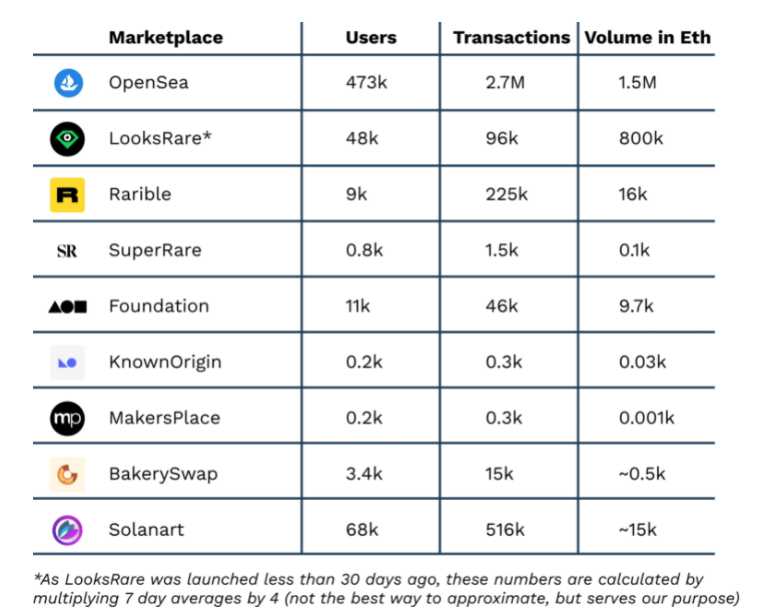
From the above, it's clear that OpenSea has left the competition in the dust—or I should say, in the droplets (get it?). Over the past 30 days, it facilitated around $4.5 billion worth of transactions (i.e., 1.5 million ETH), far surpassing all competitors. For context, eBay processed roughly $6.6 billion in transaction value per month last quarter. While they handle completely different products (OpenSea deals in blockchain-based digital assets, eBay in physical goods), I appreciate that OpenSea remains competitive with traditional markets despite operating in the crypto space.
What did they do right?
A project’s success cannot be attributed to just a few factors. It requires great product, great team, great timing, and a lot of luck. While OpenSea seems to have had all these, we can still try to assess exactly what they did right to reach their current position.
Quickly Build Supply and Demand
As Lenny Rachitsky (former product manager at Airbnb) discusses in his newsletter, one of the biggest hurdles in launching a marketplace is aptly called the “chicken-and-egg problem.” How do you convince suppliers to list their products if there are no buyers on the platform? And how do you attract buyers unless there’s already inventory available for them to browse?

Most successful traditional marketplaces overcome this by focusing first on building supply. OpenSea did the same. As reported by The Generalist, they went to great lengths to build initial supply. Richard Chen (general partner at crypto investment firm 1confirmation) perfectly summarized this in the quote below:
“Devin and Alex [OpenSea’s co-founders] excelled at discovering new NFT projects in Discords and outpaced Rare Bits [their then-close competitor] in getting those projects listed on OpenSea and capturing most of the trading volume on OpenSea instead of Rare Bits. When we invested in April 2018, OpenSea’s trading volume was already about four times that of Rare Bits.” – Richard Chen
All these efforts led to early collaborations with multiple projects/artists. This includes supporting Axies (arguably the most popular Ethereum-based game), enabling purchases of Decentraland (an Ethereum-based virtual world similar to Minecraft) using its native MANA token, partnering with Major League Baseball to sell MLB digital collectibles, offering official Deadpool digital collectibles, collaborating with German football club Bayern Munich to list player card NFTs, and facilitating trades of all the trendy .eth ENS domain names. This non-exhaustive list demonstrates the team’s enthusiasm for partnering with as many projects as possible to establish a steady supply flow, along with foresight in catering to NFTs across diverse categories such as gaming, art, sports, entertainment, and domains.
This momentum was complemented by user-centric features that made it easy for suppliers to enter the marketplace. Listing NFTs on OpenSea is permissionless—no approval or complex onboarding required. Additionally, OpenSea created a mechanism to shift the cost of minting new NFTs on Ethereum from the seller to the buyer. Both features significantly lowered the barrier to entry for emerging artists and projects, greatly boosting the inventory of NFTs on the platform.
Once a stable supply was established, traditional marketplaces typically begin focusing on building demand. For OpenSea, this step was simpler. After aggressively securing early partnerships and establishing themselves as *the* platform for listing NFTs, nearly every new project began listing their NFTs there—and bringing their customers with them. Projects themselves were incentivized to encourage customer use of OpenSea because they would earn royalties on every secondary sale of their original NFTs. Furthermore, the NFT craze starting in summer 2021 drove demand growth on OpenSea. Once the crypto world embraced this non-DeFi use case of blockchain, leading to record transaction volumes on Ethereum, guess who was ready to provide seamless access and enable wealth creation for everyone?

Maximize User Happiness
As Sarah Tavel discusses in her blog post, marketplaces shouldn’t just focus on increasing supply—they must also implement product features to maximize user *happiness*. Just as Uber reduced friction by auto-recharging credit cards, and Airbnb created a Superhost program that gave qualifying hosts special badges making them more attractive to new bookings, OpenSea has also excelled in this area.
One major achievement was implementing powerful filtering and sorting capabilities to make NFT discovery easier. This may seem trivial, but it’s not. Each NFT collection has unique traits and characteristics. OpenSea allows “custom” filtering and sorting that adapts depending on the collection being viewed, so users can refine their searches specifically for that collection.
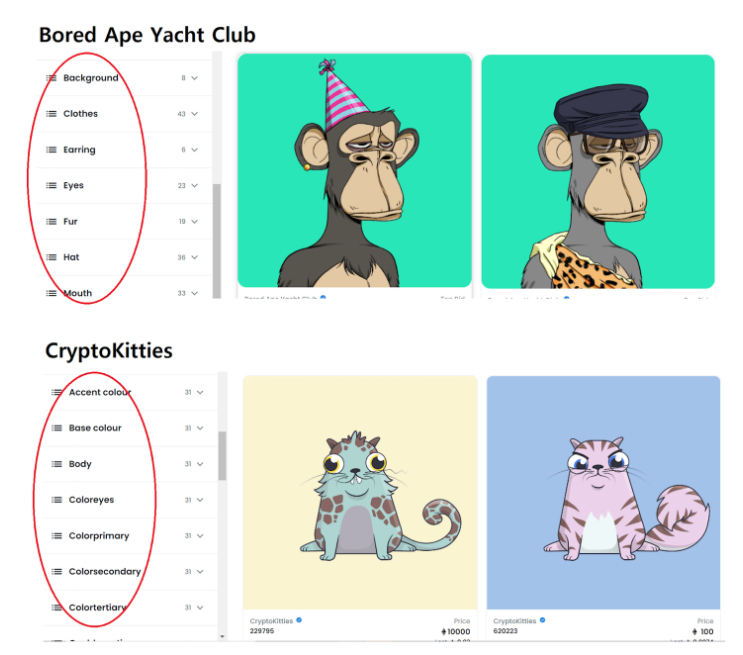
Different Filters for Different Collections
Next, they took concrete steps to address the biggest pain point for NFT enthusiasts and Ethereum users in general: prohibitively high gas costs. Gas fees are charges applied to every transaction on the Ethereum network, paid to individuals (miners) who run the network. However, due to extremely high demand for Ethereum and relatively low network capacity, these fees for each NFT transaction can range from dozens to hundreds of dollars (depending on network congestion). While OpenSea cannot control Ethereum’s underlying gas costs, they implemented several features to reduce these costs at least partially. They enabled auctions to occur off-chain, requiring gas only once during final settlement, allowed auction prices to be lowered off-chain so price changes don’t require gas each time, introduced “lazy minting” so artists can mint NFTs for free—with gas paid by the buyer upon first purchase—and integrated Polygon, another blockchain network that interoperates with Ethereum but has much lower fees.
On the financial side of the product, OpenSea also allows NFTs to be purchased with cryptocurrencies other than ETH, particularly stablecoins like Dai and USDC. This is especially useful because purchasing with ETH triggers taxable events in many countries, while using stablecoins offers a simple workaround. That said, assuming you actually pay taxes on your crypto. If you don’t, you should!!!
Making the Right Choices
A great product is just one driver of success—it’s important, but not the only factor. Every project faces countless decisions throughout its lifecycle, and the choices they make determine whether they sail smoothly or capsize. OpenSea made many correct decisions on its path to dominance.
First was their belief in their mission. According to The Generalist, their conviction stemmed from something called ERC-721—a standard built in parallel by core Ethereum developers to define how NFTs are created and transferred on Ethereum. The creation of this standard signaled that the field was significant enough to warrant attention from Ethereum developers, and that all future NFT projects would adhere to it. By building a marketplace atop the ERC-721 standard, OpenSea could support all future NFTs. In doing so, OpenSea provided a more convenient experience for buyers by aggregating NFT supply. Before this, each project had to create its own marketplace—for example, CryptoPunks and Axie each had their own (and still do).
This belief in NFTs is also what helped them survive the 2018 crypto winter. When the crypto market slumped and few projects survived, OpenSea operated with a lean team of just seven employees, continuously collecting transaction fees to stay afloat and keep building.
More recently, they faced tougher decisions when bugs in code caused many high-value NFTs to be sold at lower prices. They chose to compensate affected users for their losses. Similarly, in certain cases, they froze stolen NFTs. While criticized by some for contradicting the fundamental crypto principle of censorship resistance, these actions undoubtedly helped build trust with users.
What’s Next for OpenSea
After conquering the seas, what comes next? You crush every competitor daring to challenge your reign and continue your dominance. OpenSea is already the dominant force in its NFT marketplace category. However, they now face a very real threat from a newcomer on the block: LooksRare. This recently launched NFT marketplace has several advantages—lower fees than OpenSea, a native token that greatly increases appeal among crypto natives, and a model that shares all revenue with token holders. As seen in the earlier table, LooksRare has already surpassed all other platforms and is rapidly approaching OpenSea in both trading volume and ETH volume.
So is the answer for OpenSea to launch its own token? It’s not that simple. As a U.S.-based company, OpenSea values maintaining good relations with U.S. regulators and cannot risk launching a token that might provoke regulatory backlash and hinder operations. Therefore, OpenSea’s path forward lies in continuing to maximize user happiness and possibly expanding into other use cases. Here are some potential directions:
1) Go further mobile. OpenSea already has a mobile app, but it’s very limited—even lacking NFT trading functionality. The app needs to abstract away processes like wallet creation, seed phrase storage (which advanced users can still manage), and complex gas estimation. Essentially, make the experience seamless enough to onboard crypto newcomers.
2) Explore NFT fractionalization, where the original owner of an NFT can split ownership into multiple smaller tokens that others can buy. This enables shared ownership of NFTs. The opportunity to access blue-chip NFTs like BYAC and CryptoPunks—now unaffordable for most people—would unlock new demand. Original owners benefit from increased liquidity and potential “curator” fees from selling fractional shares. Win-win!
3) Consider partnering with DeFi protocols (or creating their own!) to allow NFTs to be used as collateral for loans, starting with blue-chip NFTs. This cross-pollination could unlock entirely new user segments and drive demand for OpenSea.
4) Vitalik recently discussed non-transferable NFTs, which could have potential uses such as issuing university degrees, land ownership, etc. While many considerations remain unresolved (e.g., what if the owner wants to transfer to a second wallet due to security concerns), OpenSea could lead community discussions and even draft an ERC standard for such use cases! They could also explore creating B2B solutions to help enterprises implement non-transferable NFTs.
Some of the options mentioned above—such as NFT fractionalization and utility as collateral—may attract scrutiny from regulators. So OpenSea must proceed carefully. Indeed, regulation remains a major potential obstacle that OpenSea must continuously monitor, given the overall uncertainty surrounding crypto regulation. In fact, as a leader in the crypto community, they could even consider lobbying for crypto-friendly legislation to help the ecosystem move forward. After all, with great power comes great responsibility!
Original link:
https://mirror.xyz/supreet.eth/5dRdAbJqGq3RoHvPG0DjzoANqw0xwXRlzDP8gZUoG7k
Join TechFlow official community to stay tuned
Telegram:https://t.me/TechFlowDaily
X (Twitter):https://x.com/TechFlowPost
X (Twitter) EN:https://x.com/BlockFlow_News






