








Nansen Research: Avalanche Chain in the Race
TechFlow Selected TechFlow Selected
Nansen Research: Avalanche Chain in the Race
Avalanche is an EVM-compatible Layer 1 platform focused on speed and low transaction costs, aiming to address the scalability issues currently faced by Ethereum.
 Navigating Web3 tides with focused insights
Author: Daniel Khoo, Jake Kennis, Beili Baraki, Seth Zhuo
Translation: Alex, TechFlow
Introduction
Avalanche is an EVM-compatible Layer 1 platform focused on speed and low transaction costs, aiming to solve Ethereum’s current scalability challenges. It achieves this vision through core features such as sub-second transaction finality, the upgraded Snowball++ consensus protocol, high throughput, and network validation via more than 1,200 full block-producing nodes. In short, Avalanche delivers at minimal cost the products users know and love.
To accommodate a multi-chain future, Avalanche has established one of the best bridging experiences via the Avalanche Bridge. This enables safer, cheaper, and faster transfers of assets from Ethereum, facilitating over $27 billion in token movements between Ethereum and Avalanche. Avalanche’s shared security model is also significant, handling transactions at the subnet level and allowing applications to choose their desired level of security—something that sets it apart from Ethereum, where applications often pay a premium for security.
Despite being just over a year old, Avalanche has gained recognition for fostering a vibrant ecosystem of native applications and users, particularly within the Ethereum community. The $180 million liquidity mining incentive program announced in July spurred significant activity, but we have also seen sustained growth in TVL, trading volume, bridge activity, and many other metrics. For instance, Avalanche’s TVL grew from less than $200 million in July to $13 billion today—an increase of 65x in under six months.
Among DeFi applications ranked by TVL, six out of the top ten are native to Avalanche. These applications are often forks of their Ethereum counterparts with clear yield farming incentives. The popularity of these native apps highlights the strong community forming around Avalanche as a Layer 1. Notably, Trader Joe is a native AMM that allows users to trade, farm, stake, and even receive LP pairs with a single click. Trader Joe consistently ranks among the top five DEXs globally, averaging around $750 million in daily trading volume. These features and user activities, along with its $2.5 billion in TVL, reflect a thriving developer ecosystem and a profitable environment for liquidity providers on Avalanche.
Major Ethereum projects like Aave and Curve have also migrated to Avalanche under farming incentive programs, further driving trading volume onto the chain. Avalanche is rapidly becoming a hub for DeFi, crypto dApps, and enterprise solutions.
Avalanche Landscape & Top dApps
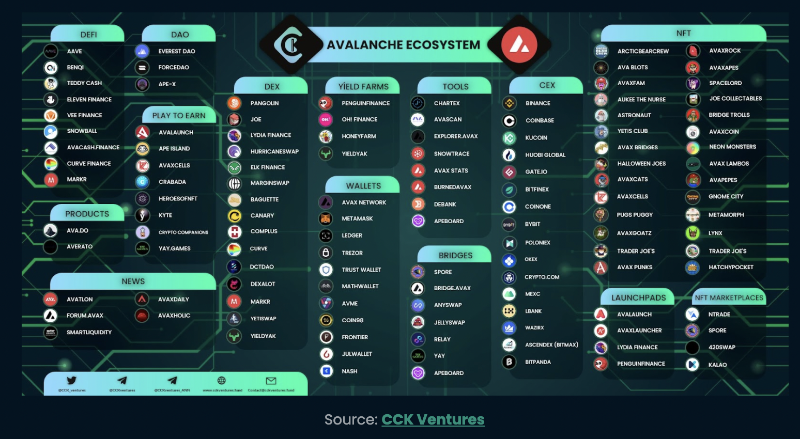
The Avalanche ecosystem is robust, spanning major blockchain sectors including DeFi, NFTs, DEXs, P2E, and more.
The diagram below, provided by CCK Ventures, illustrates Avalanche's ecosystem.
EVM compatibility has enabled major Ethereum DeFi projects like Aave and Curve to easily migrate to Avalanche, further boosting transaction volume on the chain.
Aave leads all Avalanche projects with a TVL exceeding $13.9 billion, capturing the largest share at 25.82%, or $3.59 billion. It is followed by Trader Joe and Benqi, both native to Avalanche.
Other notable native Avalanche dApps include Wonderland (the most successful OHM fork, with over $2 billion staked) and Crabada (a play-to-earn combat game centered around “a deep-sea world filled with fierce fighting hermit crabs”).
Avalanche Bridge
In light of a multi-chain future, accessibility is a critical feature for both L1s and L2s. Users must be able to transfer tokens between blockchains quickly, securely, and at low cost. This is achieved through blockchain bridges—connections that allow tokens or arbitrary data to move between chains, enabling interoperability across networks.
Users can leverage the Avalanche Bridge to transfer ERC20 tokens from Ethereum to Avalanche’s C-Chain. Supporting various ERC-20 tokens, including well-known ones like WETH, USDC, and WBTC, the bridge takes approximately 10–15 minutes and costs only $3 (from Ethereum to Avalanche).
Avalanche Bridge activity can be monitored via Nansen Dashboards. In mid-August, following the Avalanche Foundation’s announcement of $1.8 million in DeFi incentives, we observed a sharp spike in bridge volume, surpassing 370 on August 27 alone. The launch of more dApps has made Avalanche increasingly popular. Supported by reputable VCs and liquidity mining programs (Curve, Aave, Trader Joe, Benqi), bridge activity continues to grow with high transaction volumes, peaking at over $600 million on September 23.
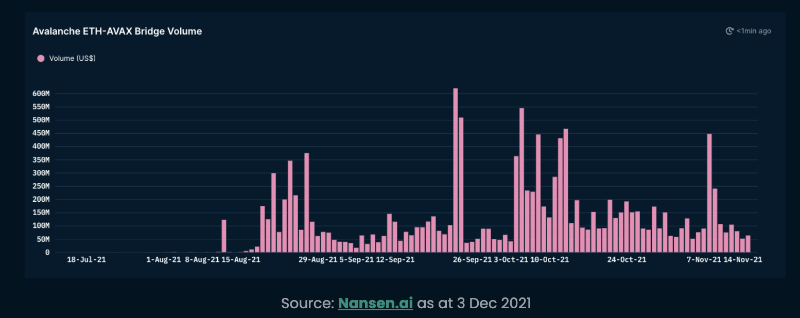
Avalanche Bridge Volume (Ethereum to Avalanche Only)
Transactions & Gas
Scalability issues remain a key constraint on the growth and usability of many blockchain networks. On Ethereum, congestion-driven high gas fees have prompted numerous developers to migrate to other L1s and L2s. When the cost of executing a simple transaction exceeds the value of the asset being transferred, high gas fees become prohibitive. They impose significant costs on retail participants, eroding business models. Large token holders and bots effectively price out retail users, forcing them to bear high gas costs and creating entry barriers (along with poor UX). This limits network growth and stifles broader innovation in the crypto space. The chart below reflects the rising gas prices over the past two years, which can be tracked live on Nansen.
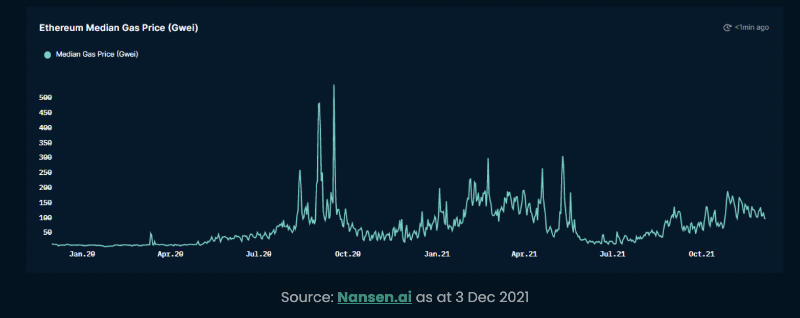
Median Ethereum Gas Price (Gwei)
Avalanche supports over 4,500 tps with transaction finality under two seconds—highly promising compared to other blockchain networks.
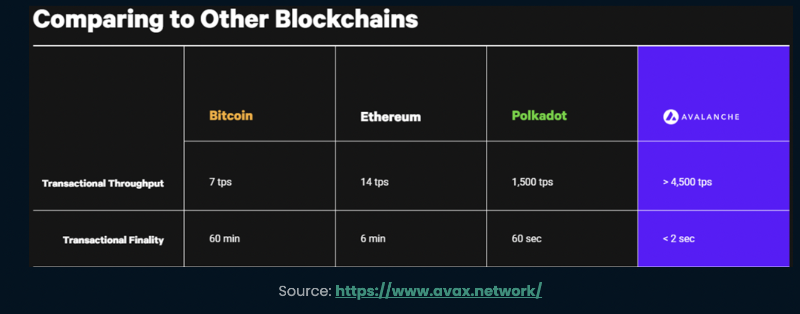
Transaction Throughput and Finality Comparison
The chart below highlights the steady growth in daily transactions on the Avalanche network over the past six months. This trend reflects the increasing number of projects joining the ecosystem—from DeFi primitives (such as DEXs, money markets, asset management protocols) to NFTs and enterprise adoption.
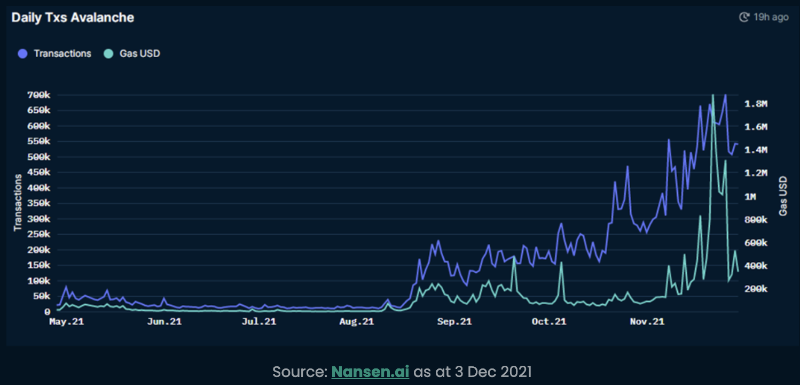
Avalanche Daily Transaction Volume
In early August, daily transaction volume surged significantly. This coincided with the announcement of “Avalanche Rush,” a $180 million DeFi incentive program that attracted blue-chip DeFi applications to deploy on Avalanche. Additionally, another major spike occurred in November due to a significant joint announcement with Deloitte. Recently, strengthened collaboration with Fireblocks, a leading digital asset custody and settlement solutions provider, is expected to drive a substantial increase in daily transaction counts in the coming months.
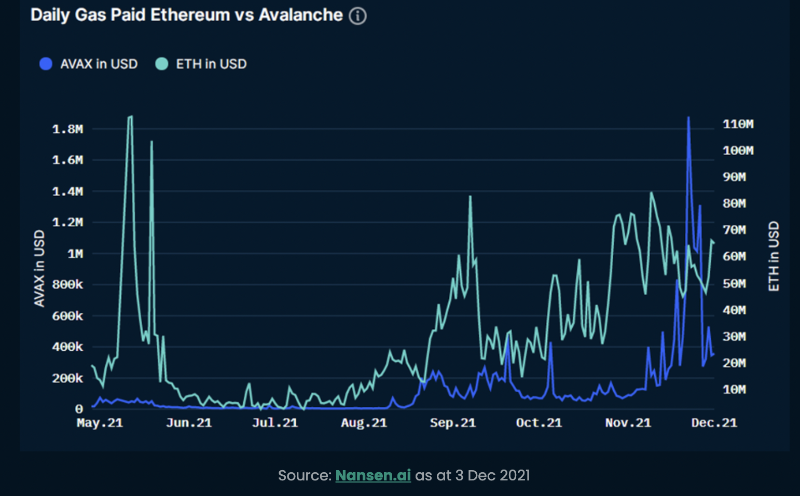
Comparison of Daily Gas Fees: Ethereum vs. Avalanche
As shown in the chart above, Ethereum’s daily gas expenditure began rising sharply in August, primarily driven by increased NFT project deployments during the summer. High Ethereum gas fees have pushed many projects to expand onto cheaper and more convenient networks.
Avalanche enables the creation of fast, low-cost, and robust EVM-compatible dApps. As a result, various NFT projects are leveraging the network for deployment. Examples include the Topps NFT marketplace (designed for scale and speed for global sports fans), Kalao (an NFT ecosystem unlocking the potential of metaverse experiences), Venly Marketplace (a peer-to-peer, blockchain-agnostic NFT marketplace), and Crabada (a play-to-earn NFT game). Moreover, part of the recently raised $200 million fund by the Avalanche Foundation will be dedicated to NFTs and cultural applications. However, it’s worth noting that the most active Avalanche applications remain DeFi dApps like Trader Joe and Pangolin (both DEXs), accounting for 23% and 7.5% of all on-chain activity, respectively.
The transaction ratio between Avalanche and Ethereum has been rising significantly, especially since August.
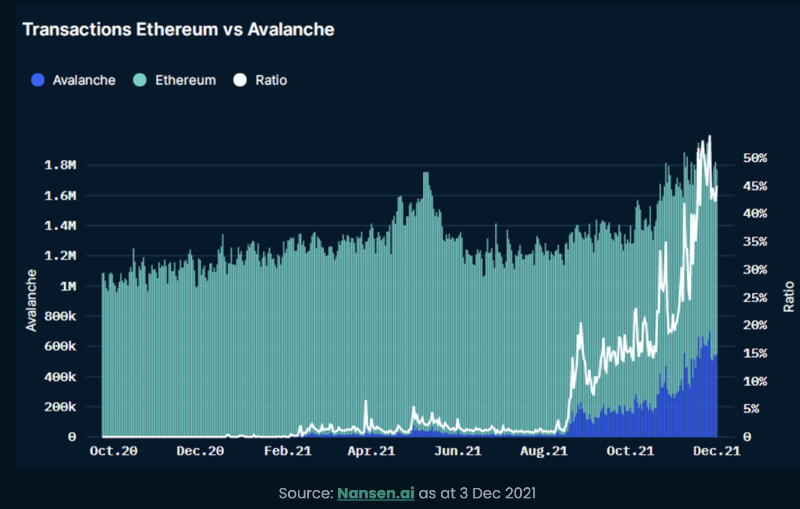
Transaction Comparison: Ethereum vs. Avalanche
This ratio rose from 1% in early August to a peak of 54% on November 26. Avalanche’s standout performance can be referenced against the earlier chart showing daily gas costs. On November 26, AVAX incurred $1,311,682 in daily gas fees, while Ethereum paid $51,389,748. Despite AVAX processing over half of Ethereum’s transaction volume that day, the cost was more than 20 times lower. This comparison underscores Avalanche’s network efficiency, delivering high performance at a fraction of the cost.
Conclusion
Given growing demand for block space, many L1s and L2s continue exploring new scalability designs. The defining characteristics of scaling solutions revolve around different consensus mechanisms and execution environments, enabling higher performance and lower fees.
Typically, liquidity mining incentives serve as a mechanism to bootstrap liquidity and encourage user adoption on these chains. As we’ve repeatedly seen, however, such liquidity is often fleeting. Once incentives are exhausted, it becomes interesting to observe which market participants will emerge as sustainable leaders. Avalanche has grown tremendously over the past 12 months, and we look forward to seeing its continued impact in the world of cryptocurrency.
Join TechFlow official community to stay tuned
Telegram:https://t.me/TechFlowDaily
X (Twitter):https://x.com/TechFlowPost
X (Twitter) EN:https://x.com/BlockFlow_News
 Nansen






