








Stacks: Bitcoin's Enhancement System
TechFlow Selected TechFlow Selected
Stacks: Bitcoin's Enhancement System
Stacks' core promise is simple: to build a programmable, composable ecosystem that inherits Bitcoin's security and decentralization.
 Navigating Web3 tides with focused insights
Author: Three body capital
Translation: MIM
We first came across the name Stacks in a book—specifically, we learned about its founder Muneeb Ali through George Gilder’s *Life After Google*.
Later, in 2019, we participated in the STX token sale—the first fully regulated and registered token offering—and yet we’ve held onto our allocation without touching it for years.
It turns out the STX team has been quietly building an exceptionally strong new protocol.
Ask your financial advisor what investment could yield massive returns. Full disclosure—we still hold a position in STX.
With that said, let’s dive into the exciting part. The core promise of Stacks is simple: build a programmable, composable ecosystem that inherits Bitcoin’s security and decentralization.
To be fair, this concept isn’t too far from the sidechain and rollup ideas popular in the Ethereum world. While Ethereum was designed to be programmable from the start, its base layer has long struggled with speed and cost—issues everyone knows about and complains about. In contrast to competing “Layer 1” chains like Solana and Avalanche, which exist as independent blockchains, rollups aim to offload most computation off-chain while settling results back on Ethereum, thus avoiding on-chain processing costs.
So one might say the relationship between Stacks and Bitcoin resembles that of sidechains/rollups and Ethereum—but that would be misleading.
Stacks has its own chain, compiler, and programming language called Clarity. It runs parallel to Bitcoin and anchors its transactions and integrity onto Bitcoin—the largest asset by market cap—ensuring ultimate security.
As usual, this event prompted us to revisit our old knowledge of Stacks and write it down. Why now? Because CityCoins—a use case with real potential—might just push Stacks into the mainstream.
In this article, we’ll clarify many things.
Bitcoin, Stacks, and PoX
We’ve written extensively on this blog about Ethereum’s composability because there’s so much happening there.
On the other hand, when writing about macroeconomics, we always mention Bitcoin—as digital gold, a store of value, something celebrities buy as an inflation hedge. But beyond that, it often seems less exciting than what’s unfolding in ecosystems like Ethereum.
This is understandable. Bitcoin hasn’t fundamentally changed much since its inception—while forks have emerged aiming to increase transaction speed or reduce fees, most have faded away, leaving only speculative ones like Bitcoin Cash or Bitcoin SV alive. As originally described in the whitepaper, Bitcoin remains a “peer-to-peer electronic cash system.” Though its use has evolved into a store of value, its core (the code it runs on) remains simple: no smart contracts, no dedicated computation, no frills.
If we accept the fact that “Bitcoin may be clunky but is arguably the most secure and immutable chain in existence,” then the question becomes: can there be a better blockchain—one that synergizes well, delivering all the expected benefits of decentralized computing (low cost, reasonable throughput, etc.) without increasing centralization risks or allowing history to be rewritten by a few validators?
This is exactly what Stacks promises: programmable, decentralized computation (like Ethereum), potentially cheaper and faster (like more centralized chains), yet retaining the censorship resistance of truly decentralized, immutable protocols like Bitcoin. Could it be the best of both worlds?
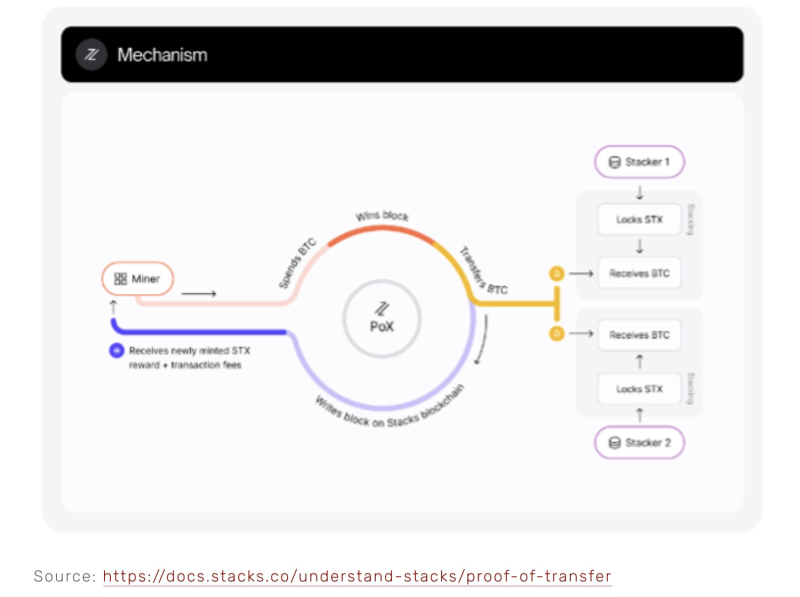
Without diving too deep into Stacks’ mechanics (details are available on their website), the simplified idea behind Proof-of-Transfer (PoX) is this: Stacks miners bid Bitcoin to become the next block producer, verifying transactions and sending the hash of the completed block header into the message field of a Bitcoin transaction, permanently anchoring it onto Bitcoin’s main blockchain.
The Stacks blockchain runs in sync with Bitcoin via this anchoring process. However, the ability to stream microblocks of transactions in near real-time allows Stacks to operate at speeds exceeding Bitcoin’s, which is highly desirable.
The Bitcoin transferred during this process goes to STX users’ wallets, with the majority serving as rewards for those who “stack” (lock up) their STX—very much in line with the “stack and sit” ethos. The remaining BTC is actually sent to a burn address, permanently removed from circulation (think EIP-1559-style burning). These transfers, part of PoX, constitute the “payment” that secures the Stacks consensus mechanism—just as Bitcoin uses electricity to mine blocks, Stacks uses burned Bitcoin to mine blocks.
As blocks are produced, more STX tokens are minted (though issuance decreases in line with Bitcoin’s halving schedule) and distributed as rewards to miners who validate blocks.
Interestingly, the existing incentive structure doesn’t rely on punitive slashing mechanisms, but instead encourages positive, honest behavior: the miner of the current block receives the reward from the previous block, subject to a short lock-up period—adding further protection against dishonest or suboptimal mining on newly mined STX.
Additionally, nodes are incentivized to vote (again via submitting proof of BTC burned) for miners they know to be honest and timely in block production. This encourages greater BTC participation.
The bottom line: you need Bitcoin to become a STX miner. The low barrier to entry fosters competition, ensuring fair and honest transaction processing. Ultimately, there are many ways to encourage good behavior—and this is one of them.
Overall, this diagram from the Stacks website provides sufficient context:
Is Stacks the Next Major Platform?
Fairly speaking, it might be too early to answer that. The Stacks ecosystem is just getting started, with several DEXs, DeFi, and NFT dApps under development and deployment. The most compelling project on the platform right now may be CityCoins, which aims to become a platform for city governance. So far, we’ve seen deployments for MiamiCoin and New York City Coin, with more likely to come.
Many will ask: “Why not build this on Ethereum?” To answer, put yourself in the shoes of mayors and local government officials managing these cities. Bitcoin enjoys broad public awareness and embodies powerful narratives around inflation hedging and censorship resistance. Most importantly, Bitcoin is easy to understand—so structurally, a smart contract system “built on Bitcoin” (even if technically indirect) is far easier for people to grasp.
The CityCoins model adopts a mechanism similar to STX’s use of BTC: individuals send STX to a contract to mine city coins; 30% of the STX goes to the city’s custodial wallet, while the remaining 70% is used to reward those staking city coins, enabling them to earn both STX and BTC. According to published documents, CityCoins holders can vote on how their city should be managed and developed. Over time, these coins might even become mediums of exchange for their respective cities.
Whatever the outcome, CityCoins could become the catalyst that propels the Stacks ecosystem into the spotlight. Could it become Stacks’ “killer app,” backed by municipal governments across the U.S. and eventually worldwide, unlocking a target market of hundreds of millions of potential users?
A large user base joining the Stacks ecosystem solves a common problem faced by new platforms. Many ecosystems bootstrap adoption by injecting cash incentives to drive usage.
For others, these incentives might be more political in nature.
Bitcoin’s Second Coming
All of this ties back to Stacks. We’ll continue watching what else gets built on the Stacks platform.
But perhaps the entire pursuit is about elevating Bitcoin beyond being just a static store of value. This small chart from the Stacks documentation summarizes the vision:
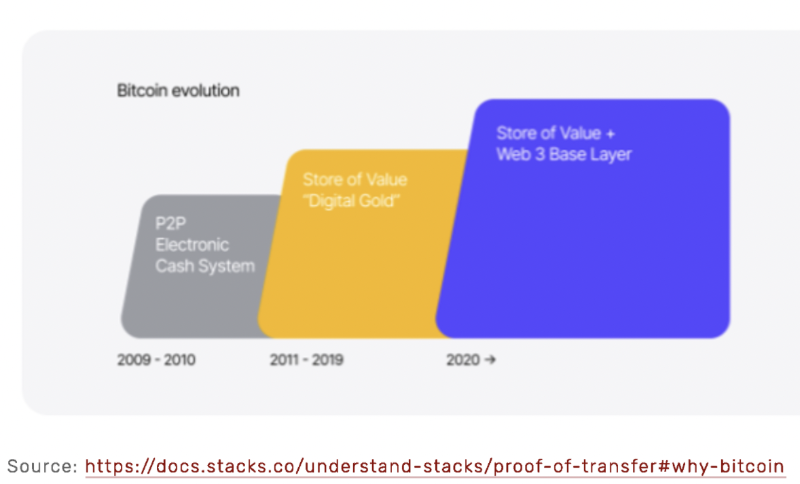
Beyond being a store of value, Stacks unlocks Bitcoin’s ability to participate in all activities across decentralized networks. Bitcoin isn’t programmable like Ethereum, so it’s been largely excluded until now.
But Stacks’ solution doesn’t modify Bitcoin in any fundamental way: Bitcoin continues to function exactly as before—mining blocks, halvings, store of value—all unchanged at the code level. So it’s not a fork, not another Bitcoin Cash or Bitcoin SV or Litecoin trying to “fix” Bitcoin and splitting the community in the process. If it ain’t broke, don’t fix it.
By pegging protocol security to Bitcoin’s immutability and incorporating a burn mechanism, every time a transaction occurs and a Stacks block is mined, Bitcoin is permanently removed from supply. This enables Bitcoin holders to earn yields from DeFi and other smart contract-based developments (just like on Ethereum), all while keeping their Bitcoin secured.
In other words, with Stacks, Bitcoin Maximalists can retain their identity (since Bitcoin itself hasn’t changed) while benefiting from composable, upgradable smart contracts—contracts capable of evolving and creating their own value.
By bridging multiple blockchains, Stacks brings the inherent value of Bitcoin—the largest cryptocurrency by market cap—into the DeFi world, enabling it to serve as collateral for lending, provide liquidity, and unlock all the other wonderful possibilities offered by decentralized networks. Projects like Thorchain operate on this premise, and perhaps the Stacks ecosystem will achieve even greater success.
Aside from wrapped Bitcoin (WBTC), which relies on a centralized custodian to issue ERC-20 tokens that represent Bitcoin on Ethereum and enable DeFi participation, Stacks offers a way to capture and transfer Bitcoin’s value into NFTs, gaming, and all the other decentralized applications that have emerged over the years.
Until now, Bitcoin has been left sitting in the boring corner. But that could change very soon.
Join TechFlow official community to stay tuned
Telegram:https://t.me/TechFlowDaily
X (Twitter):https://x.com/TechFlowPost
X (Twitter) EN:https://x.com/BlockFlow_News






