"Cobo Labs" Research Report: Ribbon Finance Project Analysis
TechFlow Selected TechFlow Selected
"Cobo Labs" Research Report: Ribbon Finance Project Analysis
Cobo Labs is the cryptocurrency research lab of Cobo, the most popular asset management service provider among institutions and the largest crypto custody platform in the Asia-Pacific region.
 Navigating Web3 tides with focused insights
Cobo Labs is the research lab of Cobo, Asia Pacific’s largest cryptocurrency custodian and the most preferred asset management service provider among institutional clients.
We focus on innovative projects, cutting-edge crypto technologies, global regulatory developments, market fundamentals, and volatility factors, aiming to lower the knowledge barrier for market participants and crypto enthusiasts.
We also welcome lifelong learners with a research-driven mindset and scientific methodology to join us in contributing insights and research perspectives to the industry!
Authors of this report:
- Ely, North America Research Director at Cobo, Founder of Blockchain Hardcore Research Group, Co-founder of Bay Area WSB Club
- Alex Zuo (Zuo Changbai), VP of Asset Management at Cobo, Former Co-founder of TokenInsight, Lead manager of the industry’s largest FOF
This is the 2nd article published by Cobo Labs.
Introduction: Ribbon Finance launched its V2 version on August 24. As a project that only went live on April 12, it has attracted over $100 million in total value locked within just four months and generated more than $4 million in returns for investors. Cobo Labs has cautiously participated in the project’s governance. The following is our internal early-stage analysis and does not constitute any investment advice.
Risk Warning
-
The exit fee for the T-USDC-P-ETH and T-YVUSDC-P-ETH pools in Put Selling is 1%; the other two pools have an exit fee of 0.5%;
-
Weekly withdrawal limit is 10% of total funds; if the weekly quota is exhausted, withdrawals are disabled.
-
Options are sold OTC to off-chain market makers, with settlement occurring on-chain. Losses depend on the delivery price, and each pool provides users with an estimated calculator to forecast profits and losses.
-
Key risk observations include: price feed mechanisms, token utility, and unpublished roadmap.
Project Scorecard
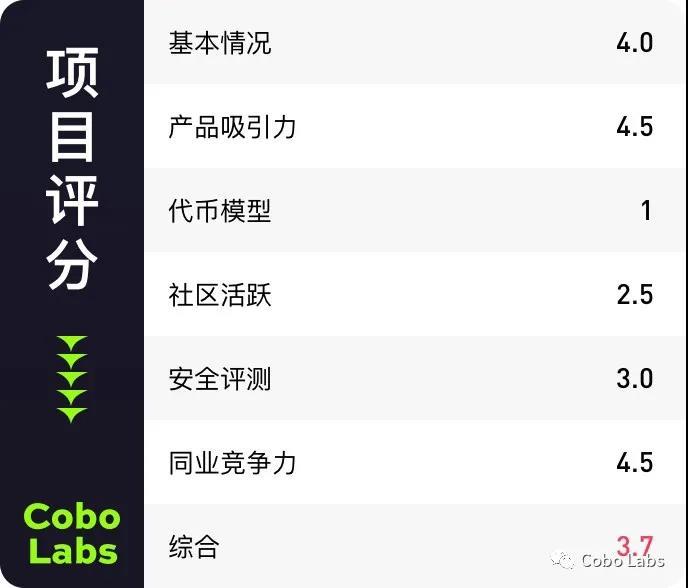
Mining strategy recommendation: ⚠️ High degree of centralization, unclear token appreciation logic, strong product innovation, leading project in the options category. Recommended for small participation by high-risk funds such as BloodyFish (a high-risk product type within Cobo DeFi funds).
Project Overview
-
Investors: Led by Dragonfly Capital; participants include Nascent, Coinbase Ventures, and Scalar Capital.
-
Core team: Ribbon Finance was founded by Julian Koh, former software engineer at Coinbase. According to LinkedIn, Julian worked at Coinbase from May 2019 to October 2020 and served as a consultant for cryptocurrency hedge fund MetaStable in 2018.
-
Code status:
-
GitHub link:
https://github.com/ribbon-finance/structured-products
ii. Number of code commits: 199
iii. Number of contributors: 8
Products
Ribbon Finance's first product, Strangle, has been deprecated (Strangle allowed users to profit by betting on ETH volatility through combinations of out-of-the-money put and call options). Currently, the project is upgrading to version V2, with key updates including decentralization of vaults, rebuilding the vault accounting system, and introducing configurable vault parameters. Migration from V1 to V2 is underway.
i. Covered Call
Theta Vaults are structured products focused on yield-enhancement strategies for assets. Currently, Ribbon Finance allows users to deposit ETH and WBTC into vaults to earn annualized yields of 20%-30% (depending on option pricing). To generate this APY, Ribbon employs a covered call strategy—selling out-of-the-money (OTM) call options on the underlying assets and collecting weekly premiums. This strategy suits long-term holders of the asset and is generally considered neutral to slightly bullish in options trading.
ⅱ. Put-Selling
This is an accumulation strategy designed for those who want to automatically buy the dip and/or generate yield on their USDC holdings. The vault runs an automated strategy selling ETH put options to earn yield on USDC deposits. Each week, the vault sells OTM put options via Opyn, collects premiums, and reinvests them to achieve compounding returns. If the options expire in-the-money, the vault is obligated to purchase the underlying asset at a predetermined strike price—effectively executing a "buy the dip" strategy.
ⅲ. Future Roadmap
According to the official website, Ribbon plans to launch four main modules in the future: volatility speculation, yield enhancement, principal protection, and compounding. The principal protection product will combine fixed-income instruments and options to offer upside potential while guaranteeing return of principal. This will likely be constructed using native crypto zero-coupon bonds combined with call options on relevant assets.
One of the most exciting roadmap items expected within the next 1–2 months is the use of interest-bearing assets as collateral. As founder Julian stated: “This is how DeFi ultimately wins in the long term.” It represents a powerful mental model for the entire sector and illustrates why open-source, composable protocols are so powerful. Ribbon plans to initially focus on Yearn tokens. For example, imagine your assets locked in an annuity vault earning a 10% annual interest rate. Ribbon intends to leverage these yield-generating assets to sell options on top, potentially creating the highest yields across all of DeFi.
Economic Model
Total Token Supply: 1,000,000,000 RBN
Token Distribution: Three months ago, the team’s updated Gitbook claimed the project would have no token. On May 25, they announced token airdrops and mining rewards, stating that the token would not be value-accretive. The current model involves distributing tokens via mining and airdrops first, then gradually revealing the full tokenomics.
Airdrop: On May 25, 2021, 3% of the RBN supply (30M RBN) was allocated to the community.
Liquidity Mining Campaign: Officially ended on July 19, distributing 10 million RBN (1% of total supply) in rewards.
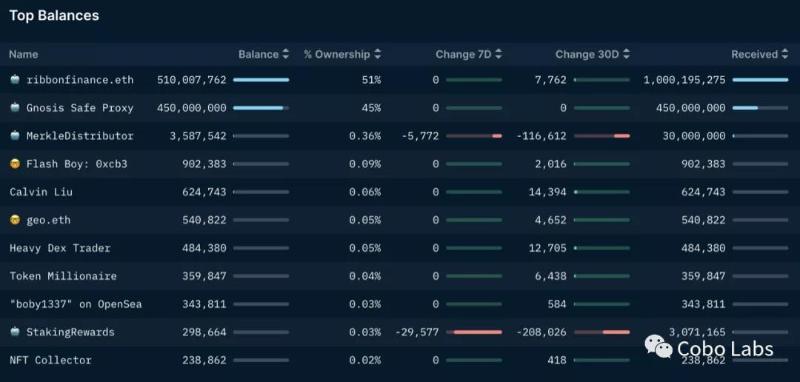
Data source: Nansen
Community Information
Twitter: https://twitter.com/ribbonfinance
Discord: https://discord.com/invite/85gcVafPyN
Medium: https://ribbonfinance.medium.com/
Follower details: Discord – 4,301 members, Twitter – 13.6K followers
Are project representatives actively answering questions?: Low activity on Twitter relative to follower count; Discord moderators respond actively.
Security Section
Security Rating: Medium Risk (not publicly disclosed)
Risk Observations include: Price feed mechanisms, token utility, unpublished roadmap, etc.
Competition
-
Sector analysis: In traditional finance, the derivatives market is several times larger than spot trading volume. In contrast, the crypto derivatives market remains significantly smaller than DeFi spot trading, indicating substantial growth potential.
-
Among all derivatives, options stand out as the most promising newcomer due to two main reasons and potentials:
-
Currently, most active crypto investors or traders behave more like speculators, seeking high leverage and high returns without fully considering the associated high risks.
-
Cryptocurrency exhibits extreme volatility—or, from a professional standpoint, very high implied volatility. This means protection or hedging is a strict necessity for all categories of crypto investors: miners, large holders (whales), and professional or amateur traders alike. In CeFi, multiple financial institutions have already achieved success, proving strong market demand for structured products.
Although Ribbon Finance’s overall vision is to build structured derivative products, its current offerings primarily focus on options trading. Ribbon operates as a structured derivative built atop existing options protocols such as Hegic and Opyn, meaning its scale and development are constrained by the progress of on-chain options markets.
*One of the key differentiators among DeFi options projects lies in how they solve liquidity challenges.
Order books appear to be one viable solution for DeFi liquidity. OPYN v2, Auctus, and Premia are currently exploring this path. OPYN v2 builds its liquidity on the 0x order book, while Auctus, Hedget, and Premia are building their own trading platforms. How they evolve to enhance order book liquidity will be worth watching. Opium, after experimenting with an order book model, recently introduced a concentrated liquidity pool insurance model.
Another major path to solving liquidity is the liquidity pool model. Broadly speaking, solutions fall into two categories: liquidity pools acting as option sellers, and AMM-based liquidity pools for options trading.
AMM (Automated Market Maker) is one of the greatest innovations in DeFi and has also been experimented with as a liquidity model in on-chain options trading. OPYN v1, Primitive, and Siren are platforms relying on AMM solutions to trade options, each featuring unique characteristics.
Join TechFlow official community to stay tuned
Telegram:https://t.me/TechFlowDaily
X (Twitter):https://x.com/TechFlowPost
X (Twitter) EN:https://x.com/BlockFlow_News
 Cobo
Cobo