








One-Click DeFi Mining: The Evolution and Beyond of Decentralized Wallets
TechFlow Selected TechFlow Selected
One-Click DeFi Mining: The Evolution and Beyond of Decentralized Wallets
The wallet is the gateway to decentralized finance and Web3.0—the one who controls the wallet controls the future.
 Navigating Web3 tides with focused insights
On August 2, Huobi Wallet announced the launch of its signature one-click mining rewards claiming feature.
Among various DeFi wallet applications, Huobi Wallet was one of the first to introduce the one-click rewards claim function, signaling a new round of competition in the wallet space—wallets must become more secure, easier to use, and closer to users.
Previously, amid continuous cryptocurrency market trends, wallets were repeatedly expected to play pivotal roles. The exciting vision of being “the gateway to all decentralized systems” was raised multiple times, only to fade back into silence as hype cooled down.
Since 2020, with the rise of DeFi and NFTs, wallets have taken on increasingly important roles. Sentiment around wallets has also improved: wallets are gateways to decentralized finance and Web3.0; whoever controls the wallet controls the future.
Now, as digital wallets return to the spotlight, how far are they from achieving their ultimate goal as the “traffic gateway to the blockchain world”?
You Can Always Trust Wallets
In the off-chain world, Alibaba and Tencent fought a fierce battle in payments, changing real-world transaction rules through online payment tools.
In the on-chain world, where money and transactions are even closer, wallets flourished during the PoW mining era. However, after going through mining, ICOs, DApps, and other waves, countless wallets emerged riding these trends, yet only a few survived. To date, no dominant leader like Alibaba or WeChat has emerged in the decentralized wallet space, nor has any product truly fulfilled the mission of channeling traffic into the blockchain ecosystem.
Finally, in 2021, the long-underestimated decentralized wallet sector returned to the spotlight.
On one hand, under increasing regulatory pressure on centralized exchanges, decentralized wallets offer a new solution for trading. On the other hand, the DeFi wave is surging forward.
According to data reports from Santiment, the amount of ETH held by centralized exchanges has been steadily declining since June 2020. By June 2021, it dropped to 18%, down 8 percentage points from 26% the previous year—the lowest level since November 2018.
Where did this capital go? The answer lies in decentralized exchanges and decentralized wallets.
New demand driven by lending, yield aggregators, staking, and other activities has pushed an industry-wide shift in trading habits—from an exchange-centric model to a wallet-centric one.
Wallets are gradually evolving from simple tools for storing and transferring coins into gateways for DeFi, DApp, and NFT projects. Combinations such as wallet+exchange, wallet+DeFi, wallet+mining, and wallet+NFT represent some of the clearest opportunities today.
From a data perspective, DeFi, NFTs, and blockchain games are bringing scalable traffic to wallets. By late April this year, MetaMask reached 5 million monthly active users, with rapid adoption spikes in emerging economies across Asia, Africa, and South America—an increase of fivefold compared to six months prior.
In the past, investors overlooked wallets because, in a market flush with opportunities, sectors like exchanges, public chains, and DeFi offered much more compelling investment narratives than decentralized wallets. Lengthy user education requirements and repeated failures in establishing viable business models discouraged most investors.
Today, however, the investment community is responding positively.
TechFlow estimates, based on publicly available information, that since the beginning of 2021, the wallet sector has raised over $500 million across primary and secondary markets, with prominent participants including a16z, Galaxy Digital, Hashed, Polychain Capital, 10T Fund, and Auzera Investment.
All signs indicate that a new era for decentralized wallets has arrived.
The Core Mission of Wallets: Simpler and More Efficient
The story of wallets as “blockchain traffic gateways” has been told for years but remains unfulfilled. Why?
Perhaps the market still lacks a product good enough to meet real needs. "Understanding user demands and lowering usage barriers" remains the shared challenge for all wallet entrepreneurs.
Security, speed, and efficiency are three fundamental criteria users apply when judging whether a wallet is worth using.
Security is the foundation of any decentralized wallet; speed refers to the ability to quickly respond to user needs and capture value; efficiency means the tool shouldn’t hinder transaction performance.
Based on these three standards, Huobi Wallet is gradually standing out among a crowded and inconsistent field of competitors.
Huobi Wallet is focused on addressing users’ most urgent needs—efficiently and securely participating in the DeFi and NFT waves.
Currently, the popularity of DeFi has increased the frequency with which users open wallets to participate in mining. Yet, due to varying protocols, users often rely on inefficient management methods—they must open different websites via their wallet to check and manage their portfolio of DeFi applications.
Additionally, differing designs across DApps create obstacles for many users trying to locate specific entry points. Given the fast-moving nature of cryptocurrency markets, every second counts.
Fragmented management approaches often leave investors at a disadvantage. There’s an urgent need to improve the efficiency of DeFi asset management.
Recognizing this pain point, the Huobi Wallet team acted swiftly, aiming to provide faster and more convenient experiences while ensuring asset security.
To better serve users, they decided to transform into a DeFi-friendly wallet.
With this goal in mind, the founding team conducted user research and identified three core functional needs among DeFi mining users:
-
Choosing quality investment products;
-
Using a unified platform to monitor invested projects after investing;
-
Claiming investment returns.
Huobi Wallet moved quickly. At the end of March this year, it launched a new “Real-Time Mining Rewards Tracking” feature—a high-efficiency DeFi asset management tool for users on public chains such as ETH, HECO, and BSC.
Users can now view their investment portfolio returns directly on the wallet homepage.
Five months later, Huobi Wallet introduced another innovation—the “one-click mining reward claiming” feature—which received widespread market acclaim.
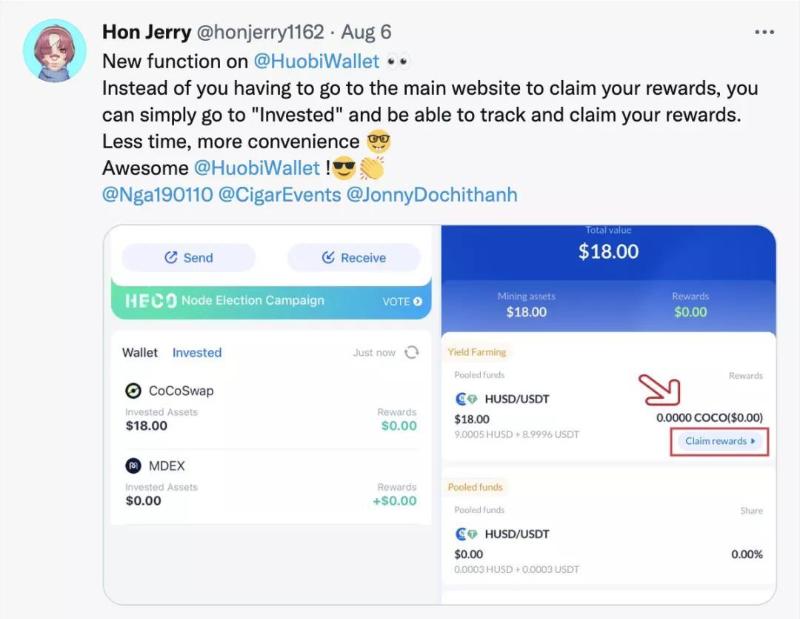
One user, Hon Jerry, praised the new feature on Twitter: “Less time, more convenience.”
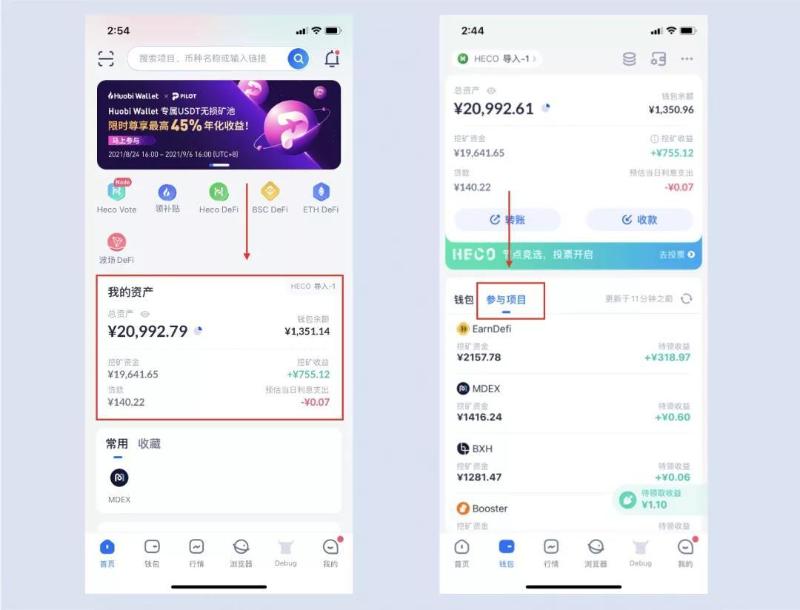
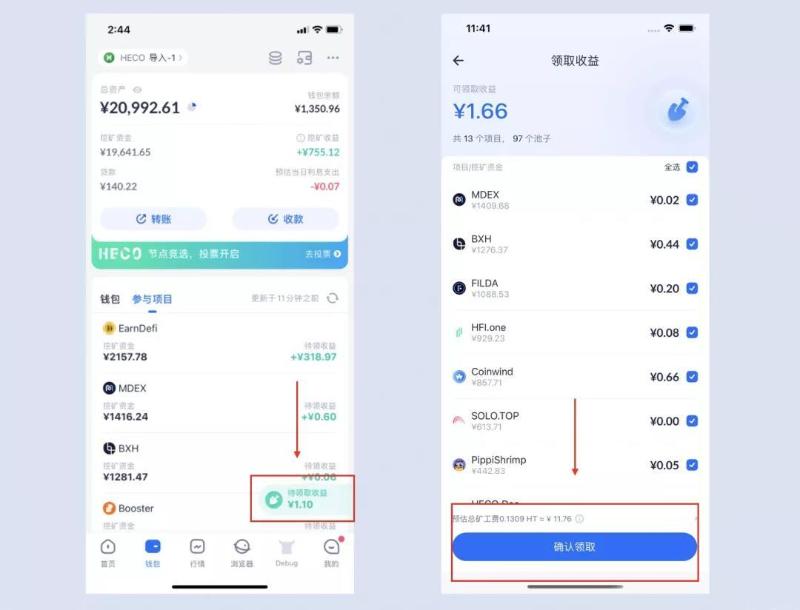
How does the “one-click claim” feature impress users?
Users can open the “My Assets” section in the wallet, go to the “Participated Projects” tab, and see total assets, fund distribution, and earnings across various projects. By clicking the “Pending Rewards” pop-up window, they can instantly claim DeFi rewards from all projects at once.
This means users no longer need to visit individual project websites to find claim portals, greatly improving operational efficiency.
52 seconds to simultaneously claim DeFi rewards from 8 projects and 17 pools.
While this feature may seem small, it required massive technical effort behind the scenes.
According to Huobi Wallet, the process of claiming rewards varies significantly across chains and DApps. Technically, enabling users to claim rewards from various DApps within a single wallet app requires developing a unified compatibility framework for all DApps—an extremely challenging task.
After persistent efforts by developers, Huobi Wallet successfully built a technical architecture capable of supporting reward claims across all types of DApps.
Currently, the initial release of the “one-click claim” feature supports reward collection from multiple pools of 18 HECO-based projects including MDEX, FilDA, and EarnDeFi. Huobi Wallet stated it will support more mainstream DeFi projects within the next two months.
The “one-click claim” and “real-time tracking” features are named “HClaimer” and “HTracker,” respectively. Both belong to Huobi Wallet’s exclusive “HXX” series, which will roll out additional innovative features in the future.
“For users, this is just our first step toward providing professional DeFi services. Going forward, we’ll continue expanding support for more chains and DApps. We hope our small step inspires others in the industry to move in this direction—unifying assets across wallets and smart contracts to deliver more professional service and seamless user experience to DeFi users,” said the Huobi Wallet team.
What Else Can We Expect?
In the past, wallets may not have had as many application scenarios as trading platforms, but the DeFi movement has opened up infinite possibilities for wallets.
With tangible use cases now evident in the DeFi boom, the narrative of decentralized wallets becoming the traffic gateway to the blockchain world is already halfway realized. In the future, everyone could potentially own both a digital wallet and a traditional wallet.
Current competition among cryptocurrency wallets may still be in early stages, but in the specific context of DeFi mining, the introduction of one-click reward claiming and real-time mining tracking has enabled Huobi Wallet to carve out a differentiated path.
In today’s increasingly tiered wallet market, these two user-centered innovations are opening doors for Huobi Wallet. After lying low for three years, Huobi Wallet now has the opportunity to compete head-to-head with high-market-share rivals like MetaMask, TokenPocket, and Math Wallet, potentially boosting its user base, engagement, and future prospects.
Moreover, wallets are ultimately about facilitating transactions.
As digital wallets gradually enter the mainstream, we can envision them surpassing payment tools like Alipay and WeChat Pay—not only functioning in offline transaction scenarios but also integrating building blocks like cryptocurrencies, stocks, and bonds, enabling users to trade various financial products through a single digital wallet.
Although these scenarios may seem distant for today’s digital wallets, they remain well within foreseeable expectations.
Additionally, some industry insiders believe both digital wallets and trading platforms should proactively pursue compliance strategies and secure policy approvals, turning both virtual and non-virtual assets into tradable ones.
For example, Facebook’s Novi wallet is currently seeking licenses or approvals in every U.S. state, aiming to leverage compliance and its corporate scale to challenge the existing payment industry. Meanwhile, Huobi Wallet is accelerating its pace—having obtained Hong Kong's trust or company service business license on August 19, 2020—and continues exploring compliance pathways.
From centralized exchanges to decentralized wallets, the shift in user trading behavior is forcing all centralized platforms to transform early and seek entry points into the next era.
Born on the eve of transformation, Huobi Wallet represents both a decentralization attempt by a centralized exchange and a critical strategic move for Huobi Global to secure its position in the next era of trading.
Beyond being more user-friendly and convenient, there’s every reason to expect that Huobi Wallet and other decentralized wallets will bring further surprises and possibilities to the market.
Join TechFlow official community to stay tuned
Telegram:https://t.me/TechFlowDaily
X (Twitter):https://x.com/TechFlowPost
X (Twitter) EN:https://x.com/BlockFlow_News


