The rise in Bitcoin may be due to supply tightness in China.
TechFlow Selected TechFlow Selected
The rise in Bitcoin may be due to supply tightness in China.
According to QCP Capital, imbalances in the spot market have driven prices, keeping leveraged funding markets stable throughout the recent bull run.
 Navigating Web3 tides with focused insights
The surge in Bitcoin's price may be driven by a depletion of supply and rising demand.
This is because Chinese miners, facing government crackdowns on local exchanges, are struggling to sell their cryptocurrency in ways that allow quick access to urgently needed cash.
"A lack of supply has greatly contributed to the trendiness of this rebound, with no sign of the typical large-scale selling seen during previous miner activities," Singapore-based trading firm QCP Capital noted in its Telegram channel.
QCP’s explanation for the rebound is simpler and less exciting than other popular theories, which cite macro factors such as demand for hedging against monetary and fiscal irresponsibility, rising inflation across developed economies, and yield-seeking behavior as primary drivers behind the price surge.
Miners typically operate in cash and unload their Bitcoin holdings onto the market almost daily to fund expenses, primarily electricity bills—which must be paid in local currency (Chinese miners pay in yuan). This results in constant selling pressure, influencing market prices.
However, Chinese miners control over 70% of Bitcoin’s hashrate or mining capacity and have faced increasing challenges converting their crypto holdings into cash, as many have found their bank accounts and cards frozen—a result of China’s nationwide campaign against telecom fraud and money laundering via cryptocurrency transactions.
Currently, 74% of miners face difficulties liquidating assets to meet electricity costs, according to QCP Capital, with one Chinese crypto observer mentioning this on his WeChat public account. Thomas Heller, formerly global business director at mining pool F2Pool and now COO at mining and media company HASHR8, confirmed the struggles of Chinese miners earlier this week, stating that converting Bitcoin and Tether into cash is currently a "challenge."
The sector has been suffering since Chinese authorities began freezing bank accounts in June, with conditions worsening over recent months.
"Mining pools sold large chunks of Bitcoin through exchanges in early September, but this was abruptly halted when key figures like Xu Mingxing, head of a major exchange, and other OTC brokers were arrested, disrupting their final remaining fiat off-ramp," QCP Capital said.
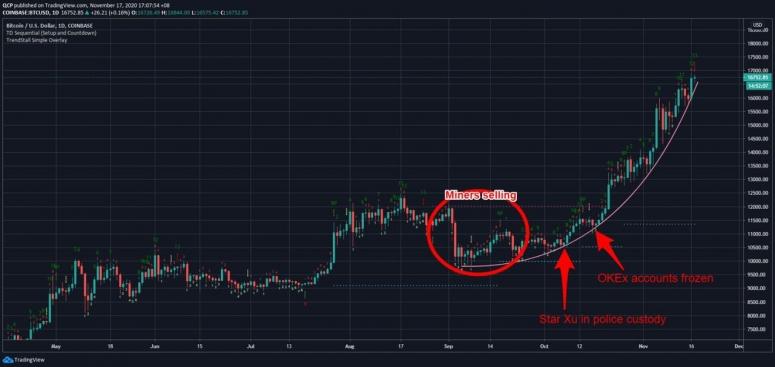
QCP Capital's analysis of Bitcoin price movements, April 18 to November 18. Source: QCP Capital
According to QCP Capital, miner selling drove Bitcoin lower—from around $12,000 down to $10,000. However, supply dried up after OKEx froze user accounts in October.
Combined with increased institutional participation—or heavy buying—in the spot market, this created tight supply conditions, amplifying the bull run.
Bitcoin is currently trading at $17,700, up more than 140% year-to-date. The price remains $2,500 short of the nearly $20,000 all-time high reached in December 2017.
Overdone Rebound?
Sharp price increases are often accompanied by surging funding rates—the mechanism used by exchanges offering perpetual contracts (futures without expiry) to balance markets and align perpetual prices with spot prices.
A positive funding rate—where longs pay shorts—occurs when perpetuals trade at a premium to spot, indicating strong buying pressure. Conversely, a negative rate occurs when perpetuals trade at a discount, and shorts pay longs.
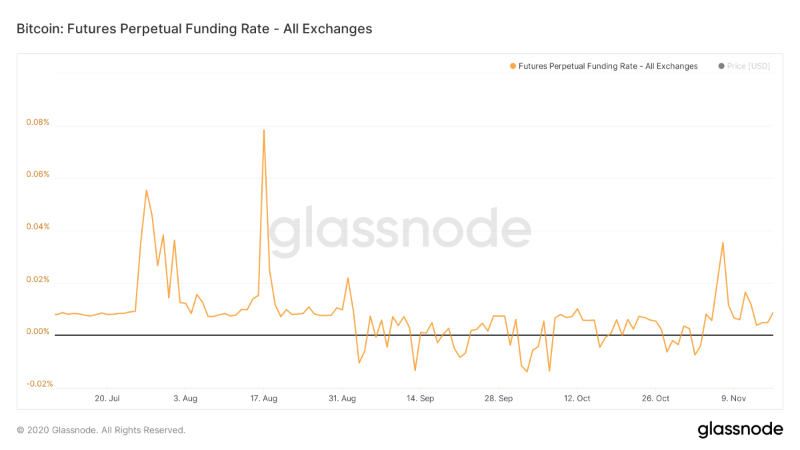
Perpetual-BTC, Bitcoin perpetual futures funding rate (all exchanges), Source: Glassnode
High funding rates are widely seen as a sign of excessive bullishness, often paving the way for price corrections. For example, in mid-August, funding rates surged from 0.008% to 0.078% as Bitcoin rose to a multi-month high above $12,450. By the second week of September, the coin dropped sharply to $9,800 on high volume.
This time, funding rates have remained steadily below 0.010%, meaning the cost of holding long positions remains significantly lower than in mid-August. As a result, any meaningful correction may remain distant, leaving room for further upside in the near term—potentially beyond the record high.
According to QCP Capital, imbalances in the spot market have driven prices, keeping the leveraged funding market stable throughout the recent bull run.
Join TechFlow official community to stay tuned
Telegram:https://t.me/TechFlowDaily
X (Twitter):https://x.com/TechFlowPost
X (Twitter) EN:https://x.com/BlockFlow_News
 CoinDesk