








The cornerstone of encrypted digital assets: where does the value of NFTs lie?
TechFlow Selected TechFlow Selected
The cornerstone of encrypted digital assets: where does the value of NFTs lie?
This article will provide a comprehensive analysis of NFTs from the perspectives of value proposition, application scenarios, and technical aspects, and conduct a comparative analysis of mainstream NFT asset standards.
 Navigating Web3 tides with focused insights
What Is an NFT?
NFT stands for non-fungible token, known in Chinese as "non-homogeneous token." Common tokens such as BTC and ETH are fungible—each unit is identical and interchangeable (like two 100-yuan banknotes). In contrast, a key feature of NFTs is that each one has a unique and distinct identifier. They are non-interchangeable and indivisible, with the smallest unit being one whole token.
In CryptoKitties, each cat corresponds to an NFT on the blockchain, possessing a unique ID and genetic code. More importantly, each has independent value. The secondary market for CryptoKitties is highly active—one cat sold for 750,000 RMB, proving that virtual items represented as NFTs can gain market-recognized value.
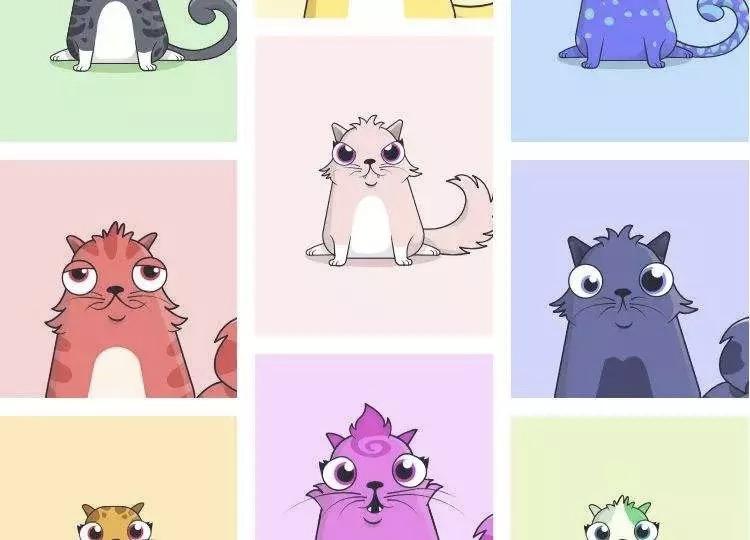
CryptoKitties was revolutionary in proposing and implementing NFTs—demonstrating that value can be carried not only by cryptocurrencies but also through this entirely new and unique form.
The Value of NFTs
We know that money is essentially a medium of exchange—a universally accepted store of value. In modern society, personal wealth is no longer measured solely by cash holdings, but increasingly by assets under one’s name. These assets include real estate, vehicles, stocks, bonds, and other items with established market value. For most individuals today, the value held in assets far exceeds their liquid cash.
However, physical assets in the real world often suffer from two major drawbacks:
-
Most tangible assets have poor liquidity;
-
High anti-counterfeiting costs, and certain high-value assets require centralized verification. For example, property ownership depends on registration with government housing authorities; it's difficult to prove ownership without seeing the actual document or visiting the registry.
In the blockchain world, we have cryptocurrencies to represent monetary-value assets. Naturally, we also need a medium to represent non-monetary assets—and thus NFTs emerged. Leveraging blockchain features like decentralization, immutability, and cryptographic verification, NFTs solve several key problems faced by real-world assets:
-
Improved liquidity, enabling efficient and atomic transactions;
-
Cryptographic proof of ownership, eliminating forgery.
Moreover, NFTs offer functionalities beyond what cryptocurrencies can achieve—such as representing negative assets (debts), identity or entitlement proofs, and virtual in-game items. NFTs fill a critical gap in the crypto asset ecosystem, allowing independently valuable assets to enter the scope of encrypted economics while benefiting from blockchain protection.
Yet, when applying NFTs to empower real-world economies, we encounter current challenges—particularly the issue of mapping physical asset value onto the chain, commonly referred to as “value-on-chain.” How do we ensure participants trust that an NFT truly represents the promised underlying asset? How is this proven? Who provides the backing? We believe that since most physical assets are currently centralized in nature, until NFTs gain broader consensus, their on-chain value must rely on endorsement by central institutions. For instance, if real estate is tokenized as an NFT, in today’s system, the housing authority would still need to back the validity of that NFT’s value.
Nonetheless, it should be emphasized that NFTs are data protocols—they exist and circulate on-chain, secured via cryptography. Their applications don’t necessarily have to be fully decentralized.
Applications of NFTs
NFTs can represent digital assets themselves, or serve as credentials for specific purposes (property deeds, passports, tickets, coupons, etc.), making their use cases extremely broad. Below, we focus on NFT applications in gaming and collectibles.
In-Game Items
Broadly defined, in-game items include all assets owned by players within games. These share a common trait: they must be earned through gameplay or purchased with money.
In-game items are particularly well-suited for representation via NFTs. First, these items originate on-chain and are used on-chain, with their value supported directly by the game environment—thus bypassing the centralized “value-on-chain” challenge. Second, most equipment and characters are unique and freely transferable, aligning perfectly with NFT characteristics. Additionally, NFT-based game items can be authenticated and reused across different scenarios, servers, or even games—transforming isolated game assets into truly interoperable hard currency within ecosystems.
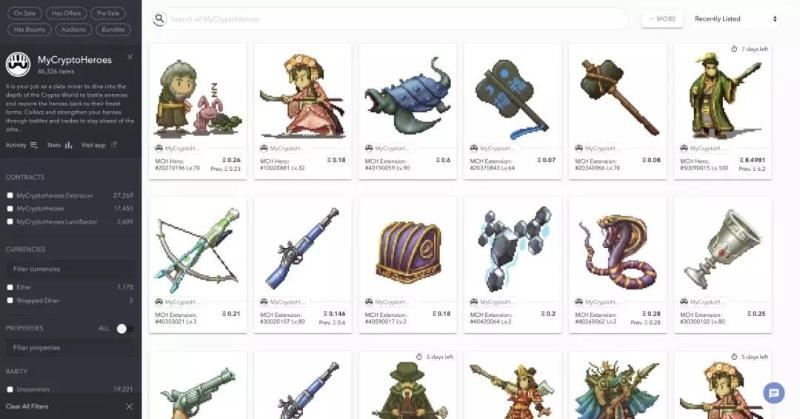
OpenSea, the largest NFT marketplace, supports NFT trading for over 100 products, most of which are freely tradable in-game items and hero characters. Thanks to blockchain and smart contract capabilities, item trading no longer requires intermediaries like the old 5173 platform—where payment happened online but delivery occurred manually in-game. With NFTs, peer-to-peer instant settlement becomes possible, greatly enhancing the liquidity of virtual items and improving user experience in item trading.
Collectibles
NFTs can represent ownership of various collectibles.
Collectibles possess two core traits: uniqueness and non-forgeability. In today’s centralized digital world, there's been no effective way to digitally represent such assets. NFTs precisely fill this void. For example, in the art world, ownership rights to paintings, sculptures, and other artworks can be stored on the blockchain as NFTs, while physical pieces remain securely held by trusted custodians (such as museums or vaults). This allows authentication, trading, and transfer of ownership without needing physical access. Artworks could even be securitized into more liquid investment instruments.
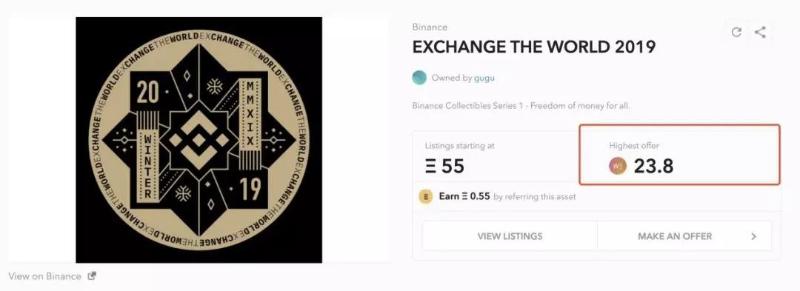
In December 2019, Binance issued a limited series of NFTs based on the ERC1155 protocol—the first industry-wide NFTs primarily carrying brand value. The image below shows some listed prices for these NFTs on OpenSea at the time of writing. The cheapest was around 0.075 ETH (~73 RMB), while the highest sale reached 23.8 ETH (~22,900 RMB). This demonstrates that NFTs as collectibles derive value from brand premium and scarcity, earning strong market recognition.
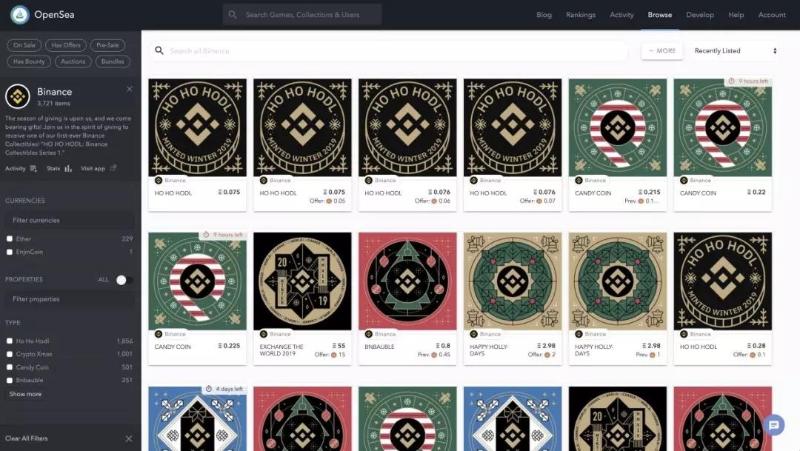
Binance NFT Marketplace on OpenSea
Mainstream NFT Protocols
ERC721
The ERC721 standard originated from CryptoKitties and was the first NFT protocol recognized by the Ethereum community. It remains the most widely adopted standard today. It defines four key metadata fields for NFTs: ID (global identifier), NAME (name), SYMBOL (symbol), and URI (Uniform Resource Identifier)—which later became foundational metadata for subsequent NFT standards. The ERC721 interface resembles ERC20, supporting issuance, trading, and authorization of NFTs, meeting basic needs for blockchain applications.
However, ERC721 has a critical limitation hindering its scalability: one contract can only issue one type of NFT. Combined with Solidity’s lack of elegant solutions for unified management of assets across multiple contracts, ERC721 struggles in complex gaming environments where thousands of item types may exist.
ERC1155
Proposed by Enjin, ERC1155 is an NFT standard designed specifically for gaming use cases. Its main differences from ERC721 are threefold:
It allows issuing any number and variety of NFT assets within a single contract, and enables bundling different asset types into one transaction. This significantly reduces transaction fees and improves user experience.
Through an ID-splitting mechanism, it can simultaneously represent both FTs (fungible tokens like BTC, ETH) and NFTs. This is useful in gaming—for example, representing stackable consumables like health potions or mana potions, which are inherently fungible.
It removes the NAME and SYMBOL fields from metadata, retaining only ID and URI. This reduces inherent descriptive capacity but delegates asset description to higher layers—allowing DApps to customize parsing logic for the URI field as needed. For gaming, sacrificing some decentralization for greater convenience and extensibility is worthwhile, enabling developers to reuse NFT items across diverse scenarios.
By design, ERC1155 prioritizes lightweight and interoperable NFTs. In Enjin’s implementation, the entire ID field is sometimes used directly to denote FT types, leaving interpretation of IDs to upper-layer systems.
EOSIO.NFT
EOSIO.NFT is the NFT standard on the EOSIO blockchain, developed by the community and now widely used. It retains the four core metadata fields: id, name, uri, symbol, and allows issuing any type and quantity of NFTs within a single contract—making it a highly versatile standard. However, it suffers from data redundancy and lacks support for batch transferring multiple NFTs in a single contract call.
OASIS.ASSET
OASIS.ASSET is part of THE OASIS Protocol—an internally developed cross-game, cross-contract NFT transfer protocol by DegameLabs tailored for gaming. Drawing lessons from the above three standards, we've created a new universal asset protocol. Developers can use OASIS.ASSET to issue any kind and amount of both FTs and NFTs.
Assets issued under OASIS.ASSET contain only three metadata elements: UUID, URI, and SYMBOL. The URI carries the primary responsibility for interpreting the meaning of the NFT. We’ve designed a concise, game-focused URI format capable of richly describing NFT-related information (optional—we're also exploring using PPK&ODIN protocols to define URI structures).
Like ERC1155, OASIS.ASSET delegates detailed asset descriptions to upper layers, but provides richer metadata—offering self-descriptive capability while preserving extensibility. Design documentation is available on GitHub. (Click "Read Original" to access the link)
When combined with OASIS.WORLD and OASIS.MAIN, OASIS.ASSET enables cross-contract NFT transfers—meaning an NFT from Contract A can be moved and stored in Contract B, with full lifecycle verification, anti-counterfeiting, and location tracking. This differs from traditional asset reuse methods (calling the same contract repeatedly). Under THE OASIS Protocol, developers can customize and deploy individual contracts, define custom mapping logic, and freely choose which assets to receive or transfer. This eliminates centralization risks inherent in single contracts (bugs, hacks) and offers greater flexibility for evolving business needs.
THE OASIS Protocol has been fully developed and is already compatible with both Ethereum and EOSIO blockchains. It will be open-sourced at an appropriate time and made freely available to the community.
The Future of NFTs
At DegameLabs, we firmly believe that the encrypted digital economy is built upon both NFTs and FTs—FTs act as flowing blood, while NFTs serve as solid bedrock.
How should NFTs be properly used? We advocate a layered approach: At the data layer, NFTs should be immutable—once issued, they cannot be altered, ensuring persistent ownership and asset security. At the application layer, the focus should be on defining how to interpret NFTs—establishing rules for correctly identifying them. This identification logic can be centralized—it's acceptable because it enables diverse use cases for the same NFT, embodying the concept of “asset reuse.”
As the idea that “data is asset” continues to deepen, more and more digital assets will take the form of NFTs. Ultimately, we envision arriving at a seamless, frictionless digital economic world—as smooth as milk.
Join TechFlow official community to stay tuned
Telegram:https://t.me/TechFlowDaily
X (Twitter):https://x.com/TechFlowPost
X (Twitter) EN:https://x.com/BlockFlow_News






