If headquartered in Hong Kong or Singapore, how should DAC8 obligations be determined when serving EU users?
Author: FinTax
Original Link: https://mp.weixin.qq.com/s/IL4UeLfZ4mS3REW-xiAFlg
Key Takeaways
· The applicability of DAC8 to non-EU platforms depends on whether they provide relevant crypto-asset services involving reportable users and whether they have a connecting factor prescribed by an EU Member State. The mere presence of EU users does not automatically trigger a reporting obligation.
· Group headquarters, client contracting entities, actual service providers, and trade execution entities may belong to different legal entities. Enterprises need to map service relationships, authorization status, and reporting responsibilities by entity.
· Whether a user qualifies as a reportable user is primarily determined based on tax residency status and due diligence findings. IP addresses, nationality, and account registration location can only serve as verification leads.
· Hong Kong and Singapore have completed their local CARF legislative procedures, with relevant rules set to take effect starting in 2027. Local CARF reporting, MCAA information exchange, and DAC8 equivalent exemptions remain distinct layers of legal assessment.
Introduction
In November 2026, Hong Kong promulgated the Inland Revenue (Amendment) (Crypto-Asset Reporting Framework and Revised Common Reporting Standard) Ordinance 2026, with the local CARF rules scheduled to take effect on January 1, 2027. Singapore also published its CARF implementation regulations in August 2026, confirming their effective date as January 1, 2027. Both jurisdictions plan to begin exchanging tax information on crypto-asset transactions with relevant partner jurisdictions starting in 2028.
For crypto-asset platforms headquartered in Hong Kong or Singapore that serve global users via websites and mobile applications, local CARF is entering the implementation preparation phase. Meanwhile, the EU's DAC8 has been applicable since January 1, 2026, and data collection for the first reporting year has begun. If an enterprise completes registration and obtains a local license in Hong Kong or Singapore, does it no longer need to consider DAC8? If a group holds EU users, must it register and report in the EU? Can local CARF satisfy DAC8's equivalent reporting conditions?
These questions require assessment based on the services actually provided by the enterprise, the group's legal entity arrangements, the tax residency status of EU users, and information exchange arrangements between non-EU jurisdictions and relevant member states. The location of the group headquarters merely indicates a portion of the enterprise's operational connections and cannot independently determine its tax information reporting obligations in the EU.
Identifying Reporting Entities from Service Activities
DAC8 applies reporting obligations to Reporting Crypto-Asset Service Providers (RCASPs). According to Annex VI Section IV, RCASPs include two categories of entities: those that are Crypto-Asset Service Providers (CASPs) authorized or permitted under MiCA; and those that qualify as Crypto-Asset Operators under the definition of DAC8. Both categories must meet the relevant service and transaction conditions, namely providing crypto-asset services that facilitate conversion transactions for reportable users or on behalf of reportable users.
Assessing Whether the Platform Facilitates Reportable Transactions
The platform's external branding, such as exchange, wallet provider, broker, or digital asset management platform, does not directly dictate its DAC8 classification. Enterprises must verify whether the actual services provided involve relevant crypto-asset transactions, including conversions between crypto-assets and fiat currency, conversions between different relevant crypto-assets, and other qualifying transactions. DAC8 references MiCA for its definition of Crypto-Asset Services and explicitly includes staking and lending services. However, whether a specific service renders a company an RCASP still depends on whether it facilitates relevant conversion transactions for reportable users. Affiliated companies that only provide technology development or general auxiliary services will not automatically become reporting entities simply by participating in group operations.
For example, a Singapore-based platform simultaneously offers spot trading, stablecoin conversion, asset custodial services, and staking services. Spot trading and stablecoin conversion directly involve asset conversions, requiring the platform to identify the legal entities facilitating these transactions and their customer relationships. Custodial and staking businesses should be assessed based on specific service arrangements, related transactions, and the DAC8 definition, rather than lumping all operations into the reporting scope solely based on product names.
Distinguishing MiCA Market Access from DAC8 Reporting
MiCA regulates market access and operational requirements for enterprises providing crypto-asset services in the EU, while DAC8 governs qualified service providers in conducting tax due diligence and information reporting. The reverse solicitation exception under MiCA Article 61 pertains to the authorization assessment for third-country enterprises. ESMA interprets this exception strictly; marketing or solicitation by the enterprise itself, its affiliates, or third parties acting on its behalf toward EU clients generally cannot be classified as client-initiated merely through contractual declarations. The MiCA transitional period ended on July 1, 2026, and unauthorized CASPs must orderly cease relevant EU operations in accordance with ESMA requirements.
The client-initiated service exception does not constitute an independent exemption under DAC8. Enterprises should separately assess whether they can provide services to EU clients pursuant to MiCA and whether they meet DAC8's requirements for reporting entities and connecting factors.
Confirming Reporting Responsibilities Along the Group Structure
Cross-border crypto-asset platforms typically adopt multi-entity operational structures. Group holding companies handle strategic management, Hong Kong or Singapore entities manage client contracting and daily operations, other affiliates oversee custody, technology development, or trade execution, and certain EU markets are served by local subsidiaries or branches. When assessing DAC8 obligations, the focus must fall on specific legal entities to determine which establishes service relationships with clients, which actually provides the services, and which facilitates the relevant transactions.
Verifying EU-Authorized Entities and Non-EU Operational Entities
If the group operates a CASP authorized or permitted under MiCA within the EU, that entity falls under the category stipulated in DAC8 Section I A(1), and its reporting obligations must be identified based on its actual services and client transactions. The existence of one MiCA-authorized entity within the group does not mean the authorization automatically covers all affiliated companies.
For Crypto-Asset Operators that lack MiCA authorization or permission in the EU, DAC8 Section I A(2) prescribes four types of connecting factors. These include: the enterprise or individual being a tax resident of a Member State; the enterprise being formed or organized under the law of a Member State with legal personality or relevant reporting obligations; the enterprise being managed in a Member State; and the enterprise or individual maintaining a permanent place of business in a Member State. Non-EU operational entities must evaluate these connecting factors to determine whether they bear reporting and due diligence obligations in the Member States.
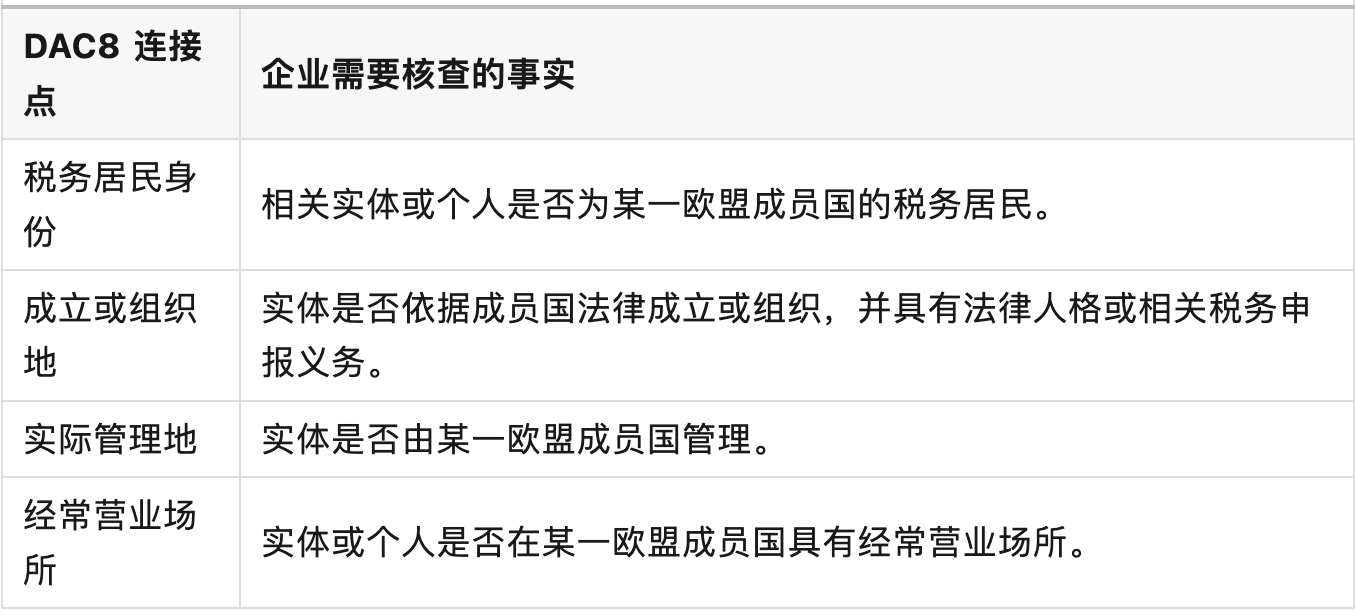
Figure: DAC8 Connecting Factors and Corporate Due Diligence Checklist
The mere presence of EU users is not one of the four connecting factors listed above. Consider a scenario where a Hong Kong exchange accepts registrations from French and German users via a global website, where client agreements, management teams, and actual operations are all handled by the Hong Kong entity, which has no branches or other statutory connecting points in the EU. The residence of users in France or Germany alone does not automatically necessitate that the Hong Kong entity registers under DAC8.
Separately Verifying EU Branches
Branches fall under a separate independent assessment. DAC8 Annex VI Section I B stipulates that when a reporting service provider facilitates relevant transactions through a branch established in a Member State, it must fulfill local reporting and due diligence requirements for those transactions facilitated by the branch. Branches differ from independent subsidiaries in their legal relationships: the former is subject to branch-specific rules, while the latter must identify its reporting responsibilities based on its own service activities, authorization status, and connecting factors.
For eligible Crypto-Asset Operators, DAC8 also establishes an EU single-registration mechanism. Enterprises must determine the registering Member State based on the relevant connecting factors and complete registration according to that country's requirements. A group organizational chart only illustrates legal relationships; enterprises should also map client agreements, product services, personnel arrangements, trade execution, and asset custody to specific entities to create auditable records for entity identification.
Distinguishing EU Users from Reportable Users
After confirming that an enterprise qualifies as a reporting entity under DAC8, it must further identify which customers constitute Reportable Users. Generally, reportable users are individuals or entities identified through due diligence as tax residents of an EU Member State; for qualifying corporate customers, it is also necessary to determine whether their controlling persons qualify as reportable persons. This determination relies on tax residency status, not account registration location or the country from which the platform is accessed.
Identifying Users Through Tax Residency Declarations
Suppose a Singapore-based exchange discovers a large volume of users registering via IP addresses from France, Germany, and Spain. While this information serves as a lead for verifying client profiles, it does not directly prove that these users are tax residents of those countries. A user long residing in Singapore might access the platform via a French network; an account registered in Germany could belong to a tax resident of another country. Enterprises must obtain tax residency self-certifications and cross-reference them with existing client due diligence materials to verify their reasonableness.
Self-certifications for individual users should cover information such as name, address, tax residency jurisdiction, corresponding Tax Identification Number (TIN), and date of birth. For corporate users, it is additionally necessary to determine whether they qualify as excluded persons or active entities; for other entities, controlling persons must be identified and assessed to see if they constitute reportable persons. Enterprises should align customer declarations with KYC/CDD documentation and address discrepancies between tax residency information and existing identity records.
Differentiating Due Diligence Timelines for Existing versus New Users
For newly established customer relationships, reporting service providers must obtain self-certifications at the time of onboarding. For existing individual and corporate users, DAC8 requires that relevant declarations be obtained before January 1, 2027, and verified against available records for reasonableness. If an enterprise identifies changes in a client's circumstances that render previous declarations inaccurate or unreliable, it must obtain valid new declarations or retain reasonable explanations and appropriate supporting evidence justifying the continued validity of the original declarations.
This means existing KYC processes must integrate with tax due diligence requirements. Current identity information, proof of address, and corporate controlling person data can be used for verification, but enterprises must still confirm whether they encompass the tax residency information mandated by DAC8. For clients using different accounts across multiple regions, it is also essential to ensure alignment among user identities, tax residency declarations, and the actual service-providing entities.
Assessing the Applicability of CARF Equivalent Arrangements
For platforms that have already established CARF reporting frameworks in Hong Kong or Singapore, further assessment is required to determine whether local reporting arrangements can satisfy DAC8's equivalent requirements. DAC8 Annex VI introduces concepts such as Qualified Non-Union Jurisdictions and Effective Qualifying Competent Authority Agreements. These mechanisms allow qualified reporting service providers to avoid duplicating certain due diligence and reporting obligations across both the EU and non-EU jurisdictions, provided statutory conditions are met.
Local CARF Legislation Does Not Automatically Grant DAC8 Exemption
Consider a Singapore-based platform that has already established client due diligence and annual reporting procedures under the CARF Regulations 2026 and intends to submit reports to IRAS. The platform must still verify whether it meets the eligibility criteria for DAC8's equivalent mechanism and whether an effective Qualifying Competent Authority Agreement exists between Singapore and the relevant EU Member States. Local CARF registration, MCAA execution, and DAC8 exemptions constitute distinct legal statuses and cannot substitute for one another.
DAC8 sets specific conditions regarding redundant due diligence and reporting at the reporting service provider level, as well as duplicate reporting of reportable user information. Enterprises must confirm whether the relevant non-EU jurisdiction qualifies as a Qualified Non-Union Jurisdiction under DAC8, whether the information exchange agreement is valid, whether reported information satisfies correspondence requirements, and whether the enterprise has already completed relevant reporting in that jurisdiction.
Verifying Information Exchange Agreements and Reporting Years
According to DAC8 Annex VI Section IV, a Qualified Non-Union Jurisdiction refers to a non-EU jurisdiction that maintains effective Qualifying Competent Authority Agreements with all Member States listed in its published list of reporting jurisdictions. DAC8 Article 8ad further stipulates that if the OECD CARF is designated as the minimum standard or an equivalent standard, relevant information may be deemed compliant with correspondence requirements, provided that competent authority agreements exist between the relevant Member States and the non-EU jurisdiction.
The Revenue Commissioners' published CARF/DAC8 list of reporting jurisdictions categorizes Hong Kong and Singapore as jurisdictions expected to begin first-time exchanges in 2028, with the agreement type marked as MCAA. This indicates that Ireland's published CARF exchange arrangement covers both locations; however, this list alone does not prove that Hong Kong or Singapore fulfills all DAC8 conditions for Qualified Non-Union Jurisdictions, nor does it presume that other EU Member States have established identical arrangements with them. Enterprises must verify each target Member State, agreement validity status, and reporting year item by item.
Implementation Progress of CARF in Hong Kong and Singapore
As of November 2026, both Hong Kong and Singapore have completed their local CARF legislative procedures, with relevant rules taking effect on January 1, 2027. Both jurisdictions plan to commence initial information exchanges with partner jurisdictions in 2028; however, domestic reporting arrangements and technical requirements must still be confirmed according to the latest guidelines issued by their respective local competent authorities.
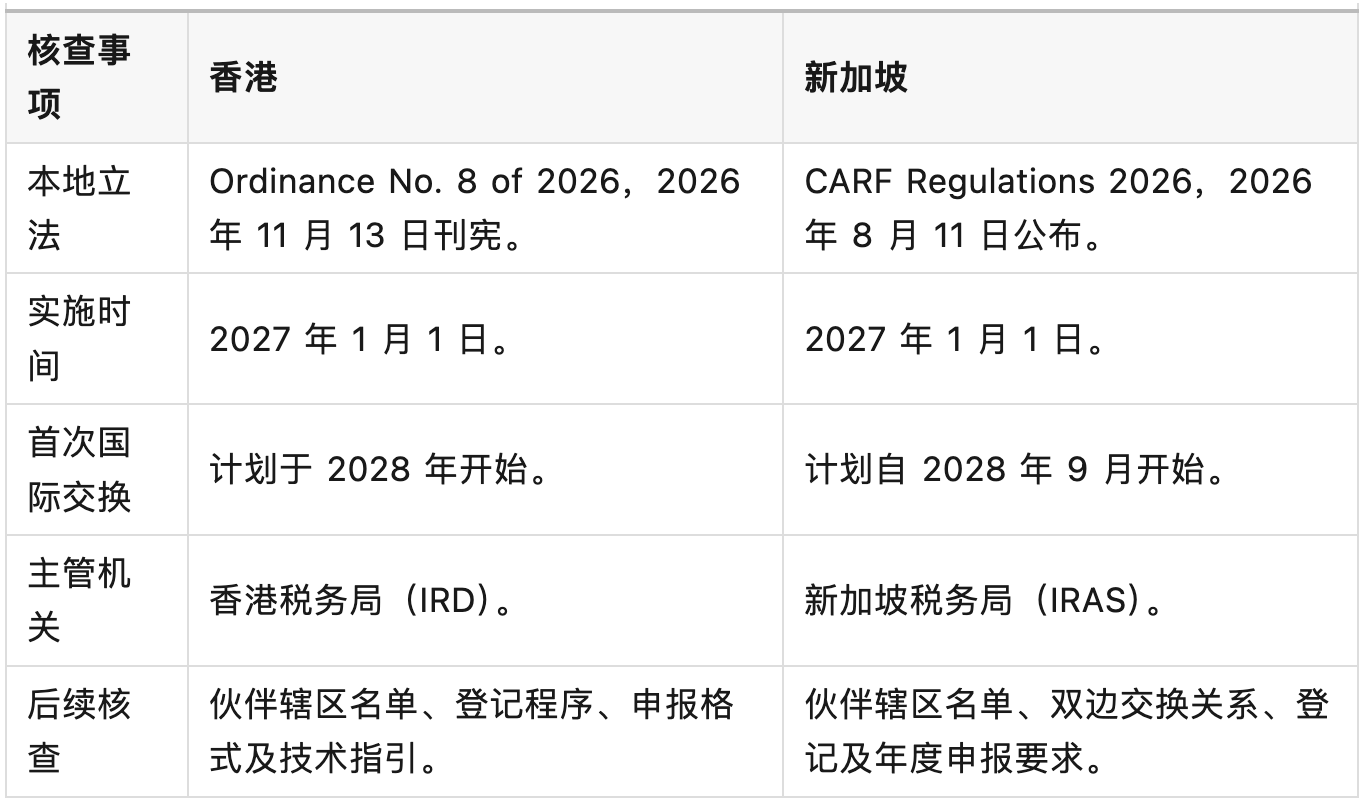
Figure: Comparison of CARF Implementation Progress and Key Elements in Hong Kong and Singapore
Enterprises should continuously monitor the partner jurisdiction lists and exchange relationships published by both locations. The 2028 initial exchange date for local CARF does not independently demonstrate that arrangements for the 2026 reporting year already satisfy DAC8 equivalence conditions. For platforms serving multiple EU countries simultaneously, it is also necessary to individually verify the competent authority agreements and local implementation requirements of the relevant Member States.
Translating Applicability Assessments into Group Operations
For platforms simultaneously operating in Hong Kong, Singapore, and the EU markets, DAC8 assessments must be mapped to legal entities and actual business operations. Consider a group headquartered in Hong Kong with its main operating company in Singapore, offering trading services to EU clients via a local website; the group also establishes a subsidiary in Germany authorized under MiCA. The enterprise must respectively confirm the service scopes of the Hong Kong, Singapore, and German entities, identify which entity contracts and serves the clients, and then determine whether each entity constitutes a reporting entity under DAC8.
If the German subsidiary qualifies as an authorized or permitted service provider under DAC8 Section I A(1), it must fulfill relevant reporting obligations based on its actual business. The Singapore entity must assess its obligations based on its own service activities, EU connecting factors, and branch arrangements, while further verifying CARF equivalence conditions. The Hong Kong parent company should also conduct an independent assessment based on its actual services and legal relationships. Completion of CARF or DAC8 reporting by one entity within the group does not automatically extend to other independent legal entities.
Enterprises can consolidate these applicability assessments into continuously updated internal working papers, recording at least the following contents:
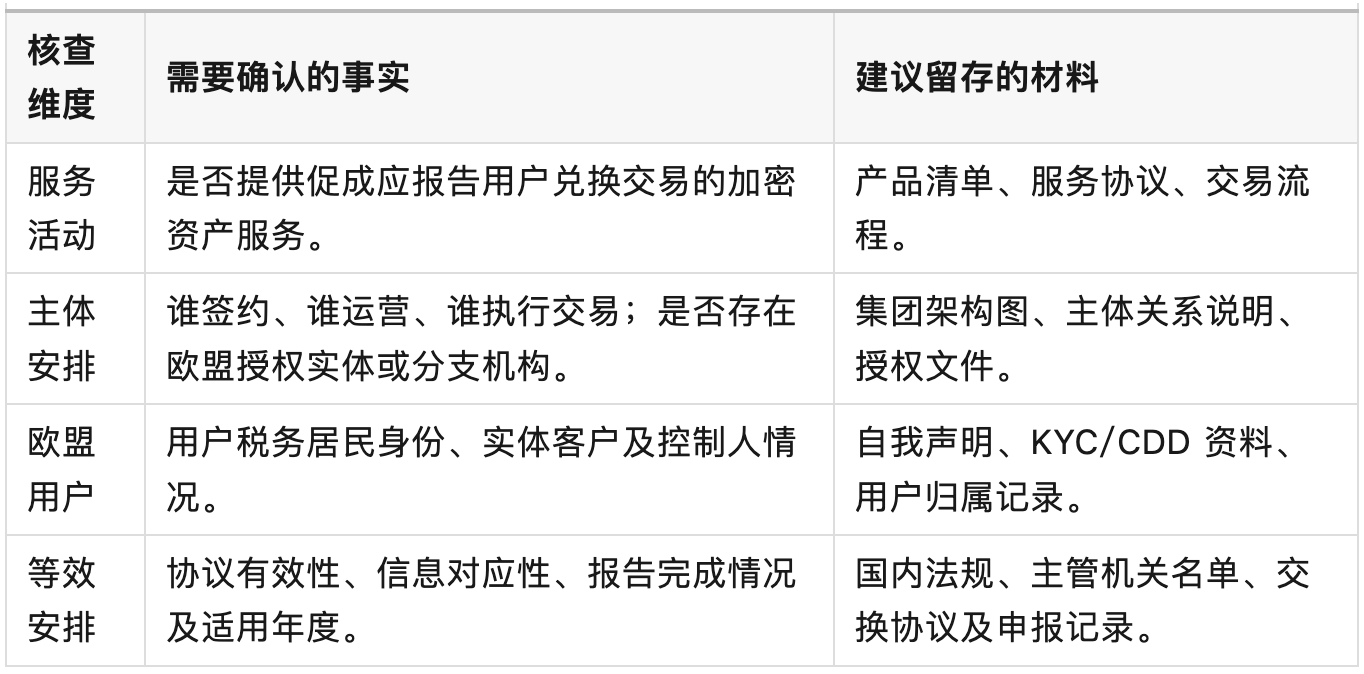
Figure: DAC8 Applicability Verification Dimensions and Retention Materials for Cross-Jurisdiction Platforms
When the group expands into new EU businesses, establishes local subsidiaries, adjusts client contracting entities, or modifies trade execution arrangements, prior DAC8 assessments may change accordingly. Enterprises should synchronously update entity relationships, reporting connecting factors, and information exchange arrangements, and implement conclusions into client due diligence, data aggregation, and reporting processes.
Conclusion
For crypto-asset platforms headquartered in Hong Kong or Singapore targeting the EU market, DAC8 applicability assessments involve service activities, legal entities, user tax residency status, and cross-border information exchange arrangements. Enterprises must first confirm the entity actually providing the services, then verify its statutory connecting factors with EU Member States, subsequently identify reportable users, and finally determine whether local CARF satisfies DAC8's equivalent reporting conditions.
Hong Kong and Singapore CARF will enter the implementation phase in 2027; enterprises can integrate local client due diligence, transaction data aggregation, and annual reporting preparations into existing compliance frameworks. Meanwhile, the group must separately maintain EU legal entities, branches, and related reporting responsibilities, verifying effective exchange arrangements against target Member States and reporting years.
For cross-border operating platforms, the ability to map specific legal entities, service activities, client tax residency statuses, and reporting jurisdictions forms the foundation for conducting tax due diligence and reporting preparations. Enterprises should incorporate this assessment into go-live processes, entity restructuring, and annual compliance review workflows.
Frequently Asked Questions
Q1: Do crypto exchanges headquartered in Hong Kong or Singapore necessarily need to fulfill DAC8 obligations when serving EU users?
Not necessarily. Enterprises must make determinations based on actual service activities, MiCA authorization status, and the connecting factors prescribed in DAC8 Annex VI Section I. The mere presence of EU users does not automatically constitute a reporting connecting point for non-EU Crypto-Asset Operators.
Q2: If CARF registration is already completed in Hong Kong or Singapore, is there still a need to assess DAC8?
Yes. Local CARF registration and reporting cannot automatically replace DAC8 obligations. Enterprises must also verify whether effective Qualifying Competent Authority Agreements exist between the local jurisdiction and relevant EU Member States, and confirm information correspondence, reporting completion status, and applicable reporting years.
Q3: Can the reverse solicitation exception under MiCA exempt enterprises from DAC8 reporting obligations?
No. The exception under MiCA Article 61 pertains to market access requirements for third-country enterprises. DAC8 establishes independent rules for reporting entities, connecting factors, and duplicate reporting exemptions, which enterprises must assess separately.
Join TechFlow official community to stay tuned
Telegram:https://t.me/TechFlowDaily
X (Twitter):https://x.com/TechFlowPost
X (Twitter) EN:https://x.com/BlockFlow_News
 @FinTax_CN