What Does South Korea’s Draft Digital Assets Basic Act Mean for Four Categories of Market Players?
Author: Tiger Research
Compiled by: TechFlow
TechFlow Summary: Following the implementation of the 2024 Virtual Asset User Protection Act, Korean regulators have launched the second phase of legislation: the draft Digital Assets Basic Act. This landmark bill codifies previously unwritten market conventions into law for the first time, establishing a clear four-tier licensing system for digital asset businesses, while introducing groundbreaking institutional arrangements for KRW stablecoin issuance and domestic ICO regulations.
The Tiger Research team conducts an in-depth analysis of the profound impacts of this legislation on four core market entities: centralized exchanges, traditional financial institutions, overseas stablecoin issuers, and Web3 foundations. From liability for listing false statements and a 20% cap on major shareholders' stakes at exchanges, to bank-dominated stablecoin consortia and offshore tax considerations, the article comprehensively dissects the turbulent transition pains as the Korean crypto market enters an era of stringent regulation.
Key Takeaways
- Comprehensive Legislative Framework: The bill clearly defines four types of digital asset business models and establishes rigid compliance frameworks for KRW stablecoin issuance, domestic token initial coin offerings (ICOs), and centralized exchanges.
- Centralized Exchanges (CEX): Listing disclosure reports are officially upgraded to statutory obligations. Exchanges will face strict legal liability for material misstatements, while the shareholding ratio of major shareholders is capped at a strict 20% ceiling.
- Korean Local Financial Institutions: In the initial phase of KRW stablecoin issuance, licenses will only be accessible to consortiums with absolute bank majority control. However, license segmentation also opens new opportunities for custody and brokerage services for brokerages and trust companies.
- Overseas Stablecoin Issuers: Foreign issuing institutions already licensed in their home jurisdictions must establish registered branches in South Korea and meet a statutory minimum capital requirement of 5 billion KRW, along with equivalent segregated reserve requirements.
- Web3 Foundations & Projects: The ban on domestic ICOs in South Korea is substantially lifted. However, given significant tax advantages in overseas crypto hubs like Singapore and Dubai, the likelihood of projects returning en masse remains low, alongside facing extremely rigorous disclosure thresholds.
Elevating Market Unwritten Rules to National Legal Frameworks
About two years after the formal implementation of the Phase One Virtual Asset User Protection Act in July 2024, Kim Jae-seok, a member of the ruling People Power Party in South Korea, officially spearheaded the draft Digital Assets Basic Act (representing the second phase of digital asset legislation) in February 2026. Before receiving final ratification by the National Assembly, the bill still faces lengthy legislative debates and intense clause negotiations.
Nevertheless, the core significance of this draft lies in elevating previously administrative-guidance-dependent "unwritten market conventions" to national statutory provisions, clearly defining the legal boundaries for various market activities, and filling long-standing legal gaps in stablecoin regulations and domestic issuance mechanisms.
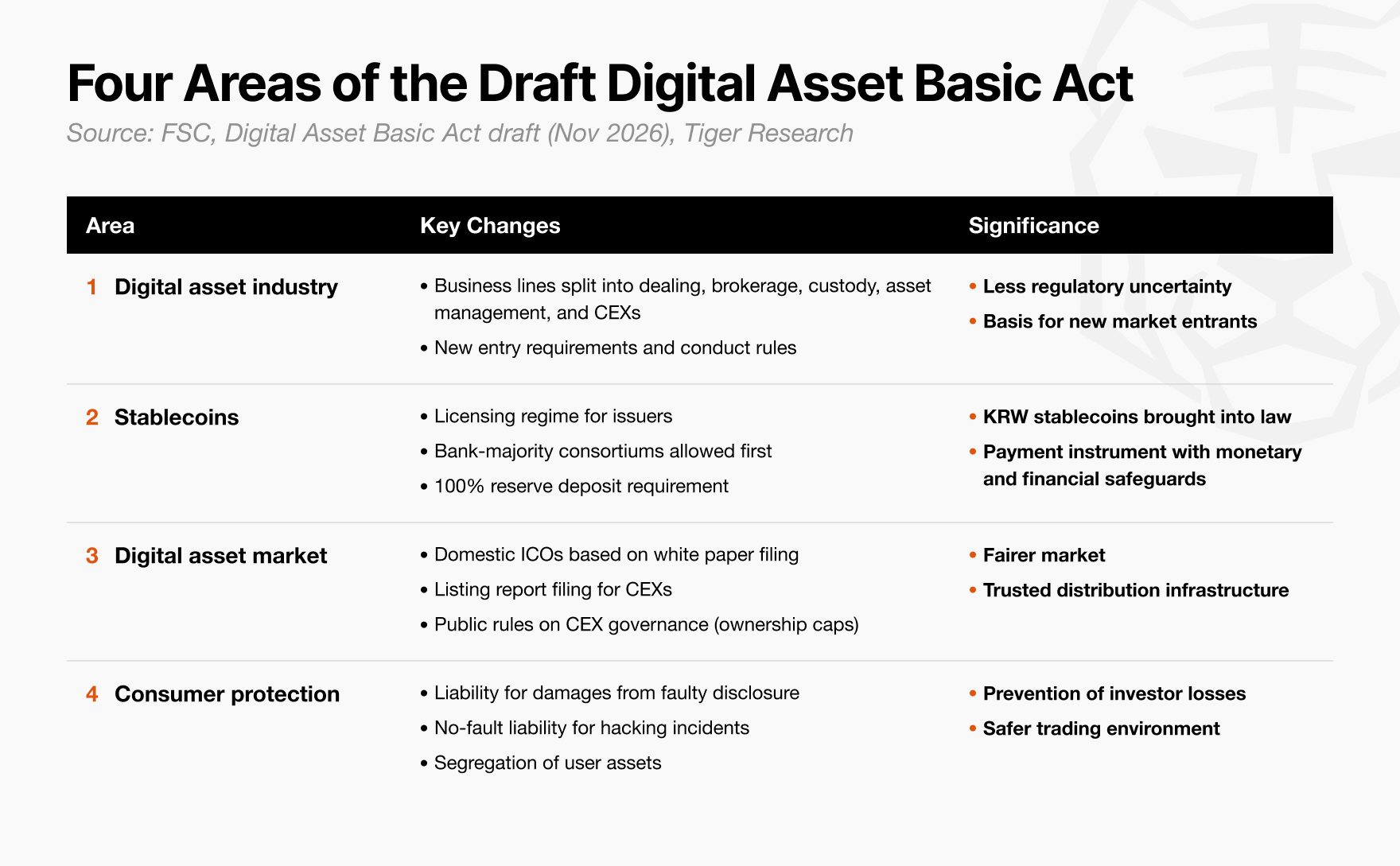
Impacted by this legislation, four core participants in South Korea's digital asset market must radically restructure their long-term strategies: 1) Centralized Exchanges (CEX), 2) Local Financial Institutions, 3) Overseas Stablecoin Issuers, and 4) Web3 Foundations & Projects. This article aims to transcend dry statutory parsing to deeply project the strategic maneuvers and industry reshaping of these four key players under the new regulatory framework.
Centralized Exchanges (CEX): Codifying Listing Liabilities and the 20% Equity Ceiling
Under the new regulatory framework, centralized exchanges must not only submit official listing verification reports and mandatory public disclosures to the Financial Services Commission (FSC) for every listed token, but also bear joint civil liability for damages caused by any false statements or material omissions within those reports. The sharp increase in legal risks for listing reviews has directly triggered a drastic tightening of exchange listing strategies.
1 Mandatory Disclosure of Listing Verification Reports
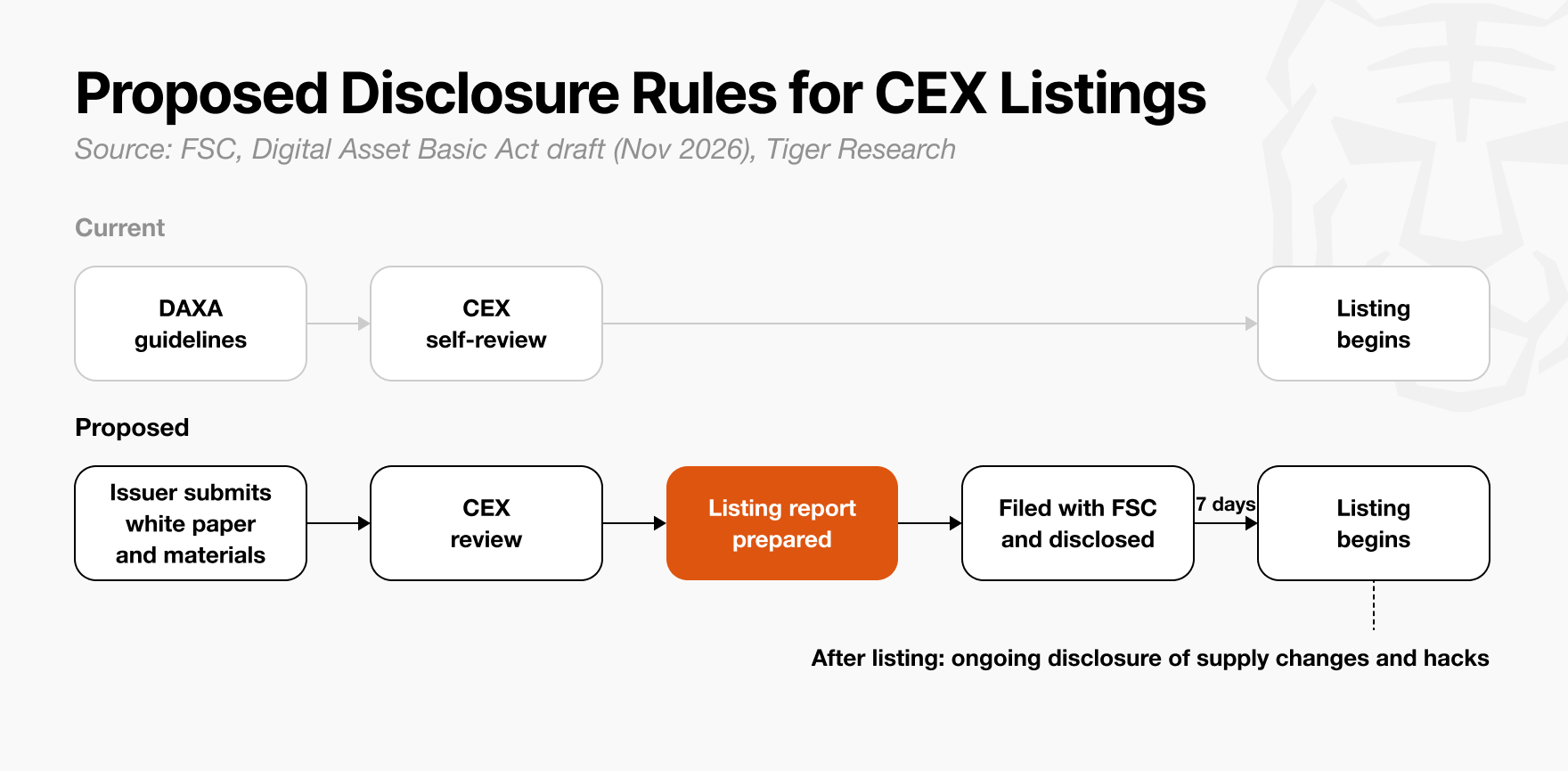
Article 11 of the draft explicitly mandates that digital asset exchanges (defined in the bill as "digital asset trading intermediary business entities") must submit listing review reports covering the issuing entity, technical whitepapers, tokenomics distribution, and potential conflicts of interest to regulatory authorities upon deciding to list any asset, and make these reports publicly available.
Even more critically, Paragraph 1 of Article 15 establishes an extremely stringent civil accountability mechanism: should a listing report contain fabricated records, material misstatements, or omit crucial facts, the exchange must assume legal liability to compensate investors who suffer losses as a result.
This clause directly dismantles the "Fast-track Listing" model that was commonplace among Korean exchanges. Previously, when faced with overseas viral tokens or trending meme assets, platforms like Upbit and Bithumb would often execute lightning-fast listings to capture massive trading fees. Going forward, since every newly listed asset could become a potential trigger for investor class-action lawsuits, exchange legal and compliance departments will be forced to conduct protracted due diligence, compelling them to retract from speculative assets and focus on more stable, battle-tested mainstream coins.
2 Designated Exchange System and 20% Shareholding Cap
Paragraph 1 of Article 42 introduces the highly impactful "Designated Exchanges" system: top-tier platforms meeting specific thresholds for trading volume and market influence can be directly designated by the Financial Services Commission as systemic importance exchanges, subjecting them to public governance standards as strict as those applied to traditional stock exchanges.
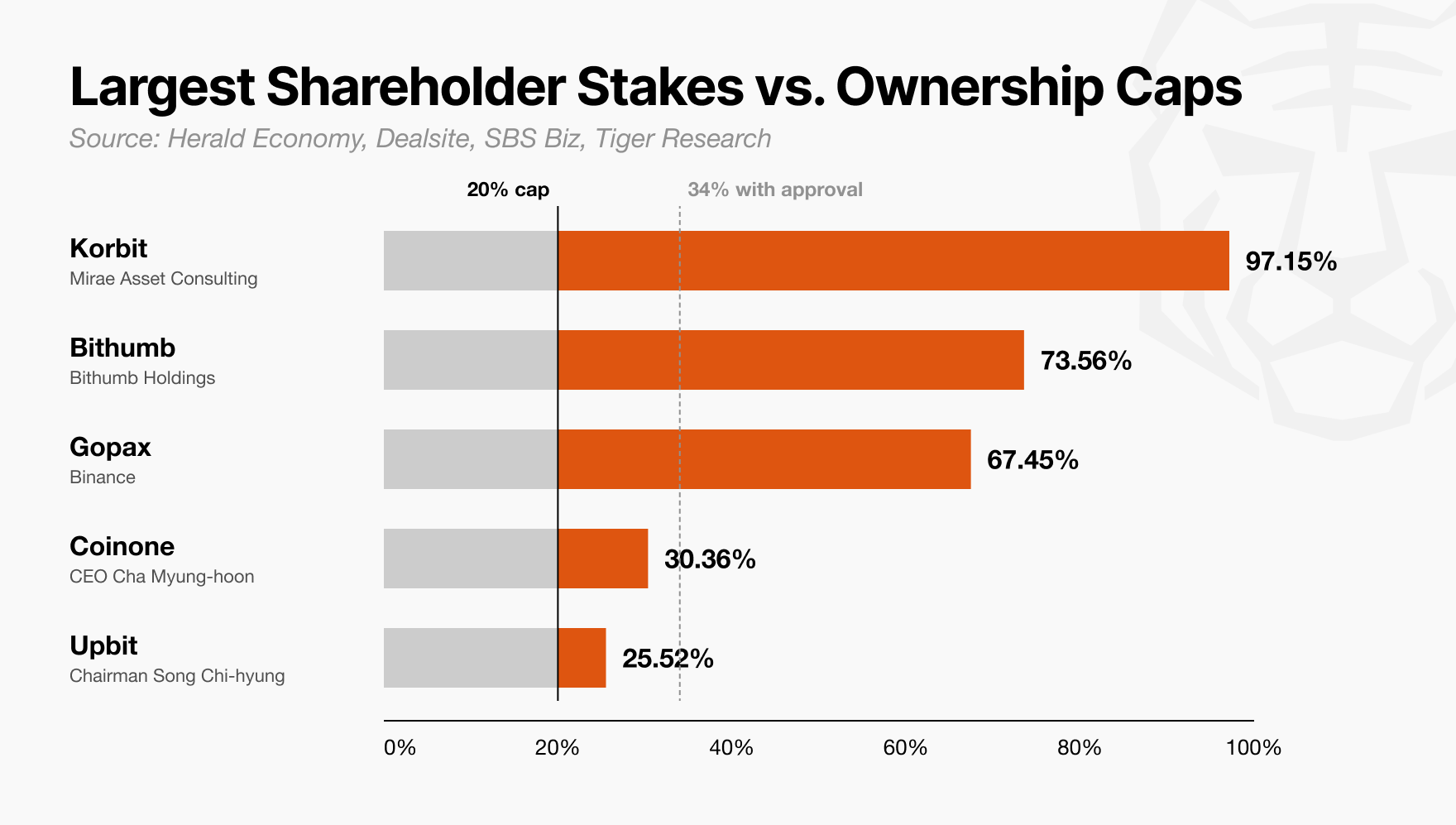
The most industry-shaking provision is undoubtedly Paragraph 1 of Article 43: Any single shareholder (including parties acting in concert) may hold no more than a 20% direct or indirect stake in a designated exchange.
This equity ceiling directly targets the two dominant players in Korea's exchange landscape: Upbit operator Dunamu (where founder Song Ji-hyung and affiliates hold nearly 30%) and Bithumb (whose largest single shareholder, Lee Jeong-hoon, holds over 30%). If the bill passes without amendments, the core founders of both platforms will be forced to legally dilute or offload massive equity stakes within stipulated deadlines. This will not only shatter the longstanding oligopolistic governance structure of Korean crypto exchanges but also open a massive capital breach for traditional financial chaebols and tech giants to strategically invest in crypto trading hubs.
Korean Local Financial Institutions: A New Multi-Business Map Beyond Stablecoins
Traditional commercial banks, securities brokers, and trust companies, which have long been firmly excluded from the digital asset sector, will experience historic institutional breakthroughs under this legislation.
1 KRW Stablecoins: Bank-Dominated Consortia and FinTech Access
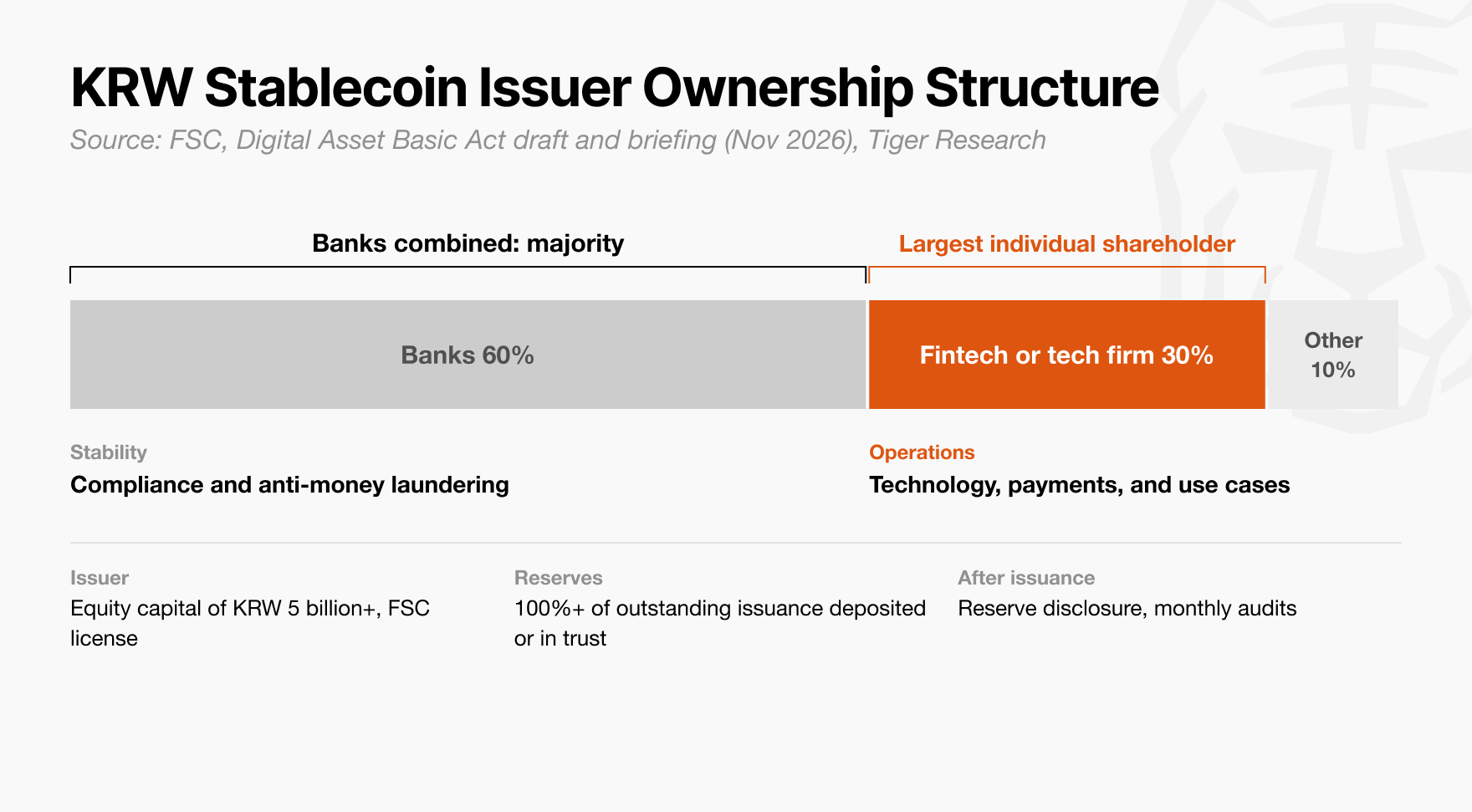
Paragraph 1 of Article 21 formally establishes the issuance licenses for fiat-collateralized stablecoins (particularly KRW-backed stablecoins). To prevent systemic financial risks akin to the Terra-Luna algorithmic collapse, regulators have set almost stringent capital and governance red lines:
Issuers must possess at least 5 billion KRW (approximately $3.7 million) in paid-in capital and maintain a 100% independently segregated fiat currency liquidity reserve account at a commercial bank designated by the Bank of Korea. The core institutional design stipulates that during the initial phase of implementation, only consortiums featuring absolute bank majority control (Bank-majority) in both equity contribution and voting rights will be eligible to apply for licenses; pure fintech firms or Web3-native enterprises will only gain entry tickets by forming deep alliances with large commercial banks.
2 Diverse New Tracks Catalyzed by the Four-Type License Segmentation
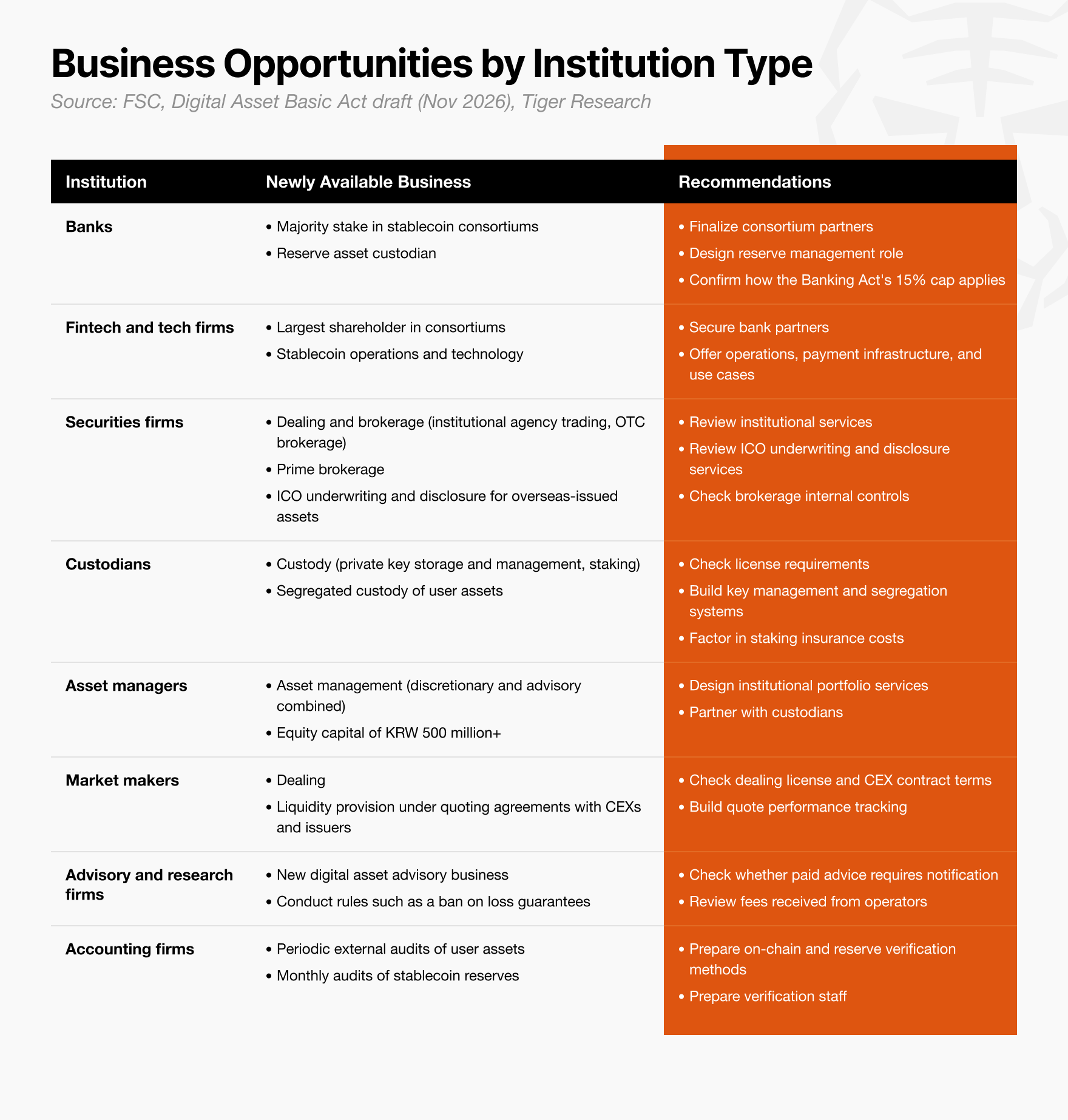
The draft completely abandons the previously broad and imprecise single concept of "Virtual Asset Service Provider (VASP)." Drawing inspiration from traditional capital market laws, it meticulously segments the digital asset industry into four independent licensed business categories:
- Digital Asset Trading Intermediary Business: Responsible for matching and order execution (i.e., pure order-book exchanges);
- Digital Asset Custody Business: Independently safeguarding client assets;
- Digital Asset Brokerage Business: Executing trading instructions on behalf of clients;
- Digital Asset Advisory Business: Providing investment analysis and asset allocation recommendations.
This fine-grained segmentation of licenses allows traditional brokerages to integrate crypto trading modules directly into their existing securities apps by applying for independent brokerage and advisory licenses, without the need for costly self-built exchange infrastructure. Meanwhile, large trust companies and commercial banks can leverage their high sovereign credit backing to rapidly seize custody dominance for institutional-grade capital within the independent custody license track.
3 Pending Issues Yet to Be Clarified in the Draft
While the overall framework is taking shape, the bill leaves significant voids in many critical operational details: Are commercial banks permitted to directly allocate spot digital assets to their balance sheets using proprietary capital? Can traditional financial institutions ultimately use KRW stablecoins directly for cross-border payments and clearing/settlement? These unresolved red lines still await final determination through subsequent Enforcement Decrees to be issued by the Financial Services Commission.
Overseas Stablecoin Issuers: Applying South Korea's Localization Entry and Registration Procedures
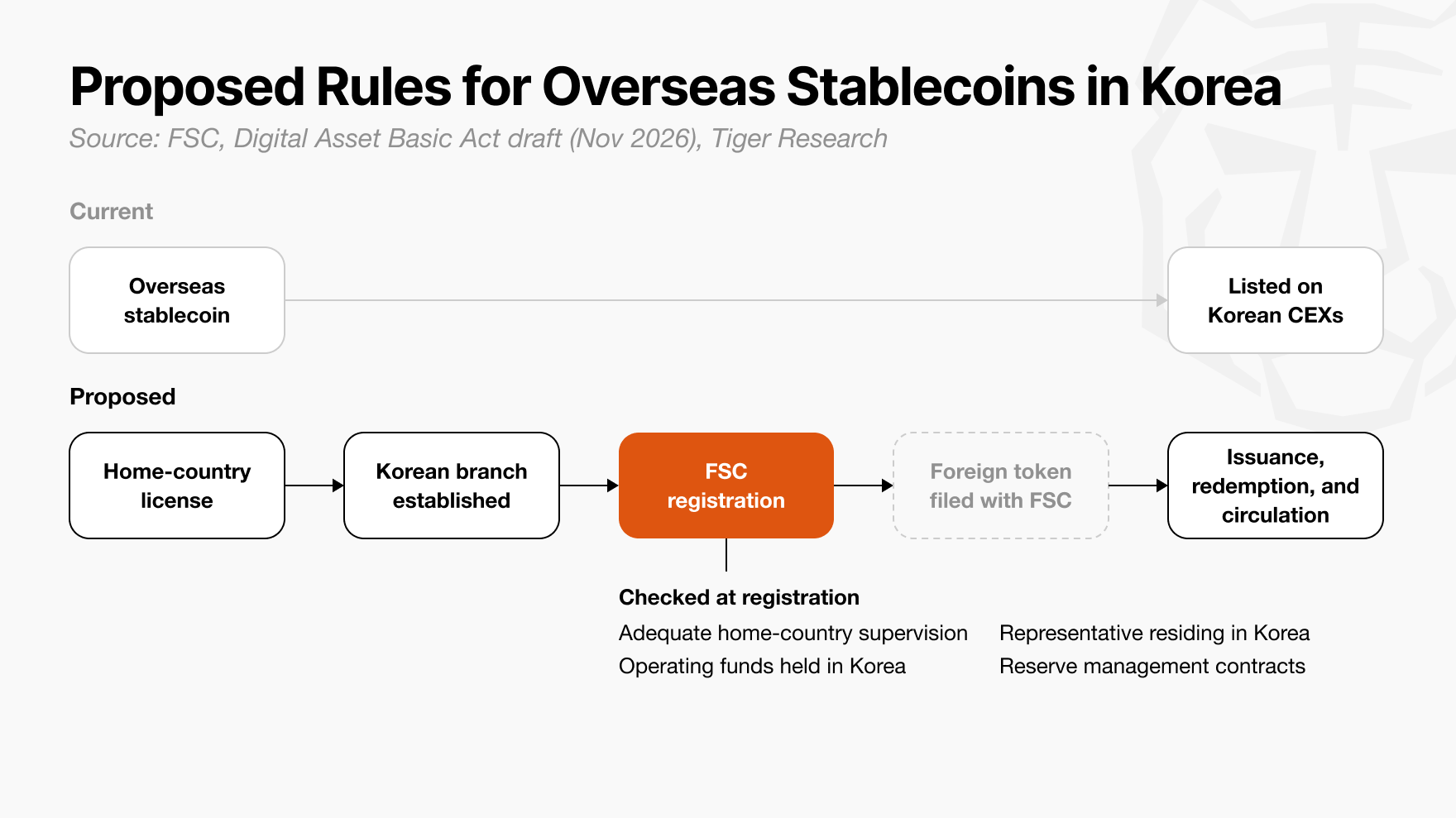
Aiming at foreign dollar-pegged stablecoins currently dominating the Korean trading market (such as USDT issued by Tether and USDC issued by Circle), Article 28 of the draft establishes a highly targeted cross-border regulatory extraterritorial jurisdiction mechanism:
For overseas issuing institutions to maintain compliant trading of their stablecoins across major Korean CEXs and achieve lawful circulation among Korean residents, they must establish formal registered branches in South Korea or designate statutory local agents. Additionally, issuers must already hold equivalent compliance licenses in their home jurisdictions and regularly report reserve adequacy ratios and audit reports to the Financial Supervisory Service (FSS) of South Korea.
The introduction of this regulation means overseas giants must accelerate the construction of localized corporate entities in Seoul and the integration of banking settlement networks. Should certain unregulated offshore stablecoins refuse to meet the aforementioned localization compliance requirements, Korean regulators will have the authority to directly order major exchanges to enforce forced delistings and isolation.
Web3 Foundations & Projects: Domestic ICO Ban Lifted, But Tax Havens Remain Hard to Displace
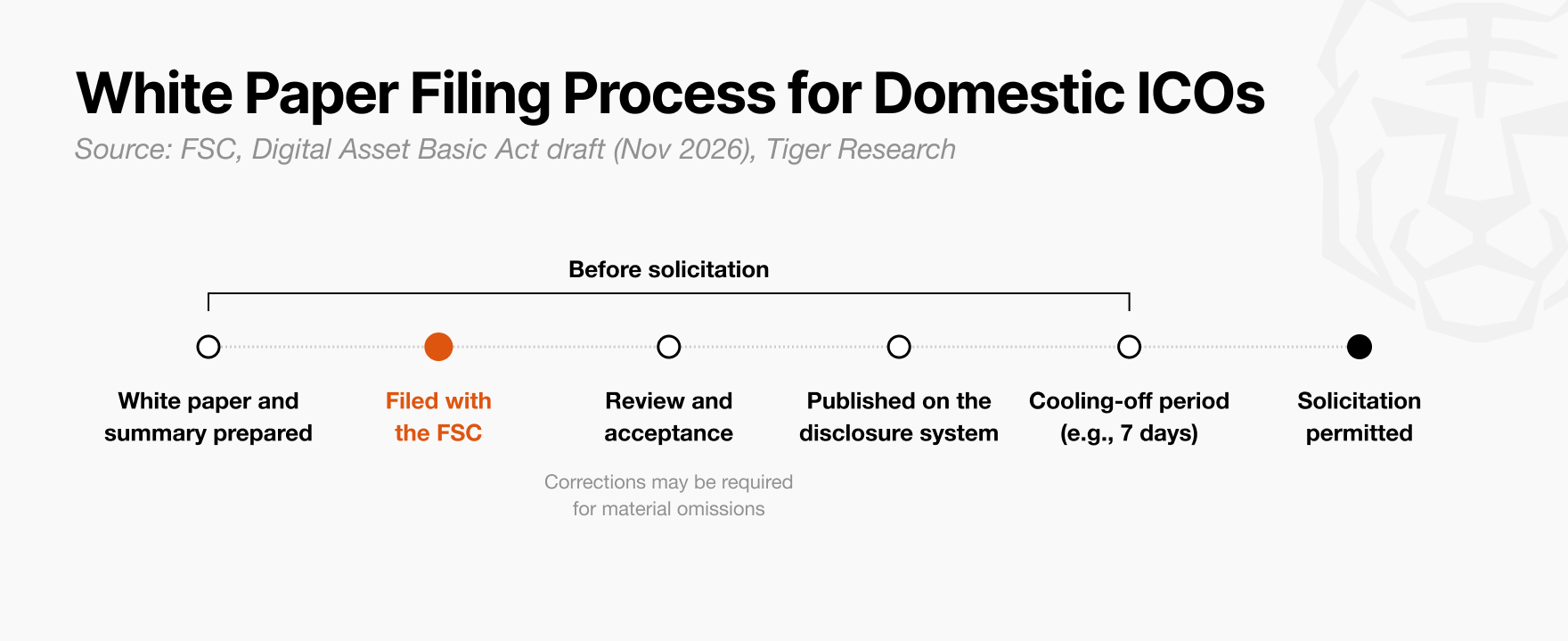
Since the September 2017 blanket ban on domestic ICOs by the South Korean Financial Commission, nearly ten years have passed during which the vast majority of outstanding Korean startup teams were forced to go abroad, establishing offshore foundations in Singapore, Switzerland, the UAE (Dubai/Abu Dhabi), or the Cayman Islands to issue tokens indirectly. Article 7 of the draft finally lifts this seal for domestic compliant ICOs at the legal level.
However, Tiger Research research suggests that this policy relaxation is unlikely to trigger a large-scale wave of overseas foundation repatriation in the short term. Core constraints stem from heavy tax burdens and stringent disclosure responsibilities:
- Significant Tax Haven Gap: Foundations in Dubai, UAE, or the Cayman Islands benefit from near-zero offshore tax rates; whereas relocating a token issuance entity back to Seoul would immediately subject the foundation to South Korea's standard corporate income tax network, which reaches up to 24%.
- Cumbersome Statutory Whitepaper Disclosure Burden: The draft requires domestic issuing entities to submit detailed technical code audits, token vesting schedules, treasury fund flows, and executive holding details to regulators, bearing comprehensive joint legal liability for the authenticity of disclosures.
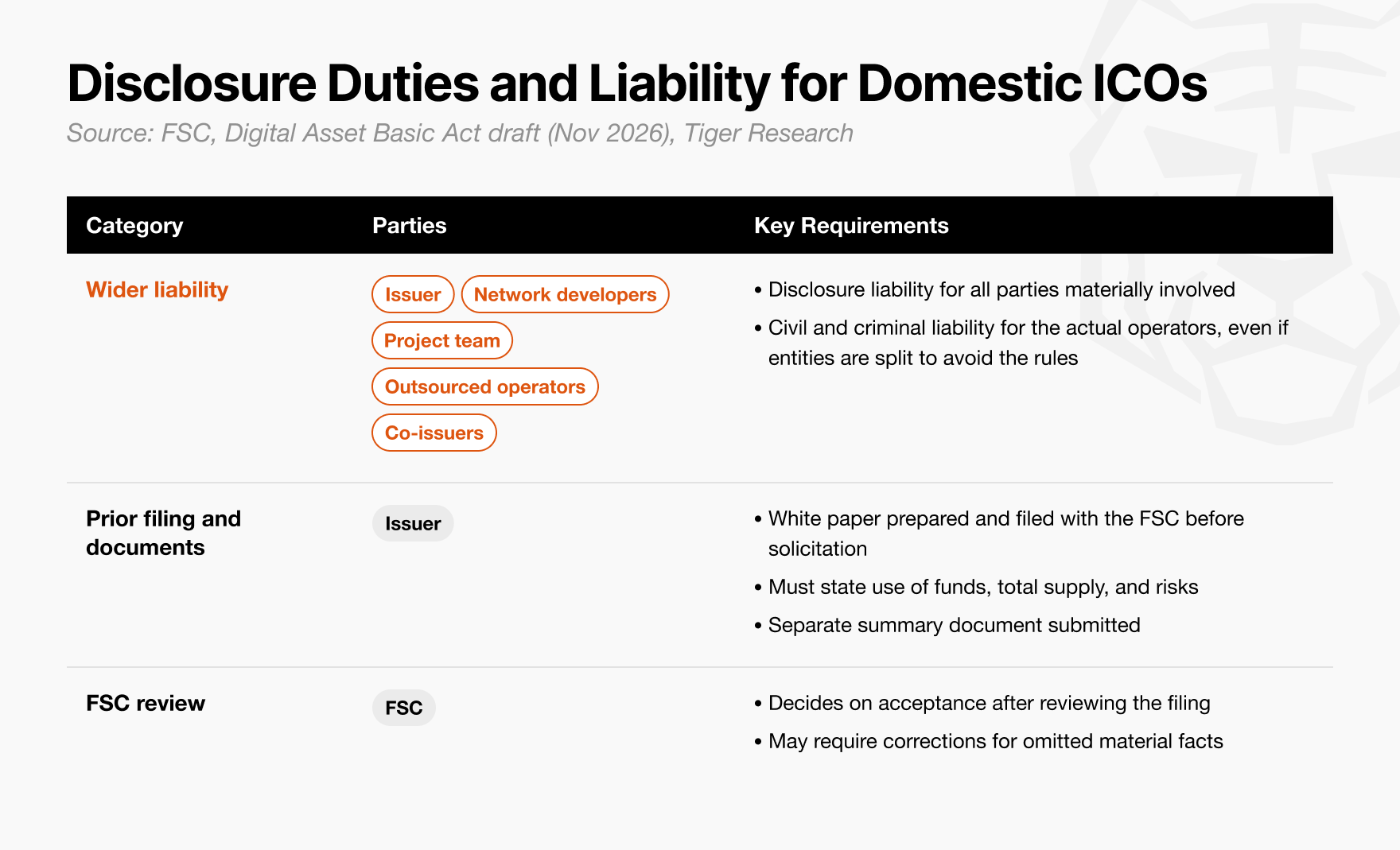
Therefore, for the vast majority of top-tier Web3 teams with a global perspective, maintaining a dual-track architecture of "offshore foundation issuance + local South Korean technical subsidiary R&D" remains the most rational and pragmatic optimal solution today.
Digital Assets: A Critical Step Toward Integrating with the Compliant Traditional Financial System
The proposal of the Digital Assets Basic Act signals that South Korea's crypto market has finally bid farewell to years of unsophisticated expansion and gray-area operations, formally entering a modern rule-of-law era characterized by rigorous alignment with traditional capital markets. Although fierce debates within the National Assembly will continue over property rights disputes regarding the 20% equity cap, bank monopoly tendencies in KRW stablecoins, and the crowding-out effect of high taxes on local innovation, the irreversible trend toward institutionalization, transparency, and compliance across the entire industry has been firmly established.
Disclaimer: The content of this article is intended solely for frontier industry research and compliance policy analysis. It absolutely does not constitute any investment advice, legal opinion, or commercial endorsement.
Join TechFlow official community to stay tuned
Telegram:https://t.me/TechFlowDaily
X (Twitter):https://x.com/TechFlowPost
X (Twitter) EN:https://x.com/BlockFlow_News
 @tiger_research