Is the U.S. government about to "seize" the $1.1 billion stolen from Binance?
By Daisy, TechFlow
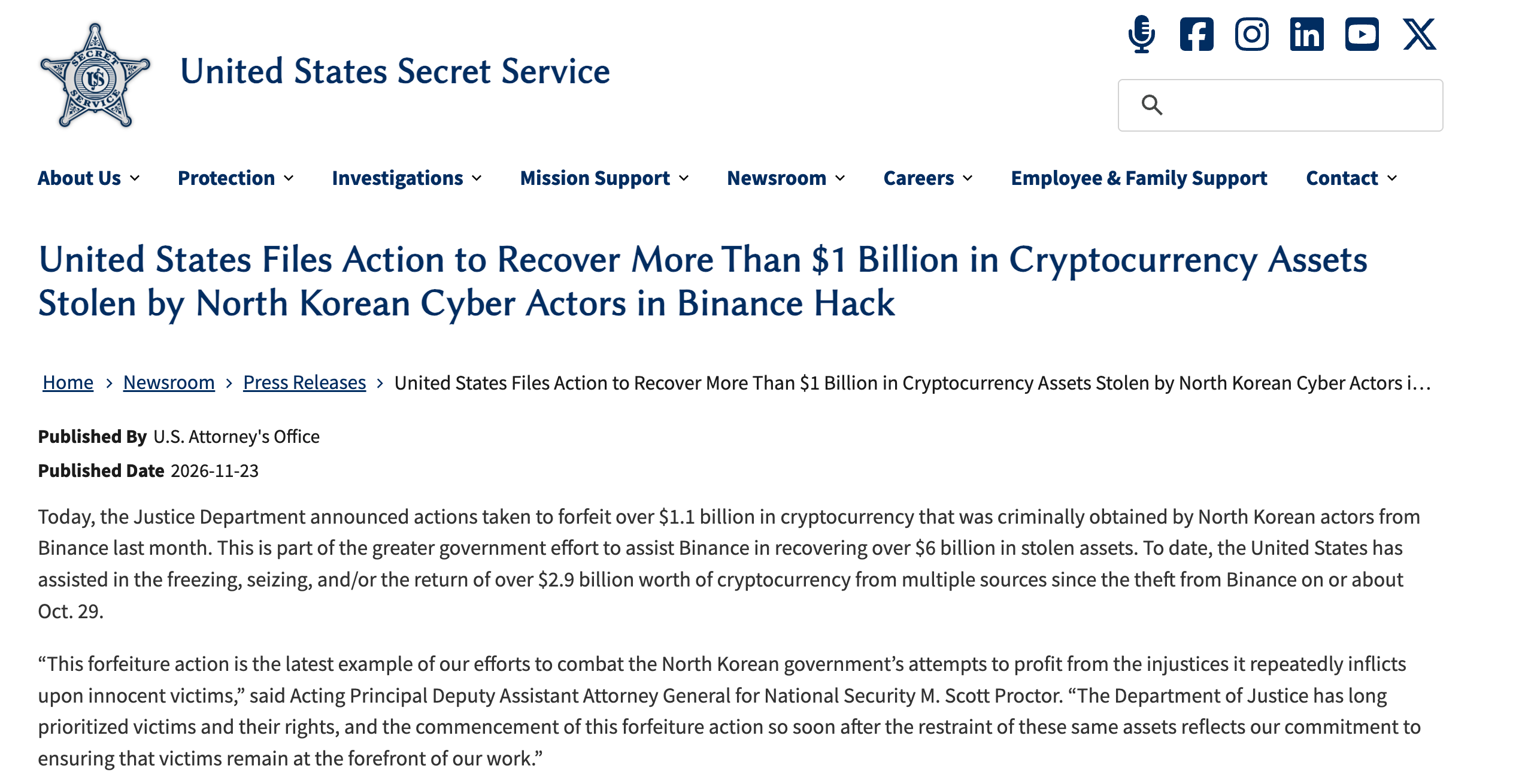
On November 23, 2026, the U.S. Department of Justice and the Secret Service issued a joint press release announcing a civil forfeiture lawsuit filed in the U.S. District Court for the District of Columbia, formally seeking to seize more than $1.1 billion in cryptographic assets stolen from Binance by North Korean cyber hackers.
Following the news, the most confusing aspect for observers was why the U.S. government would step forward to sue for forfeiture when it was Binance’s assets that were stolen. Many wondered if, once the funds were ruled to belong to the U.S., they would never be returned.
However, under federal court rules for asset recovery, this forfeiture proceeding is not about confiscating the money for the state, but rather the first lawful step toward restitution.
Forfeiture is the Only Legal Key to “Thawing and Liquidating”
To understand why the U.S. prosecution must file this forfeiture suit, one must first clarify what these over-$1.1 billion actually are.
Going back to around October 29, North Korean hackers stole over $6 billion in assets during an attack on Binance. After gaining access, they quickly converted a large portion into decentralized native assets like Bitcoin and Ethereum and dispersed them. Once leaving hot wallets, no entity can freeze these assets at the protocol level, and over $3 billion remains actively circulating on-chain.
What remained firmly locked down were centralized stablecoins. Within minutes of the incident, Secret Service investigators identified and froze part of the funds, then collaborated with the FBI, IRS Criminal Investigation, and industry partners to trace them. By November 23, over $2.9 billion had been intercepted, nearly half of the total stolen amount.
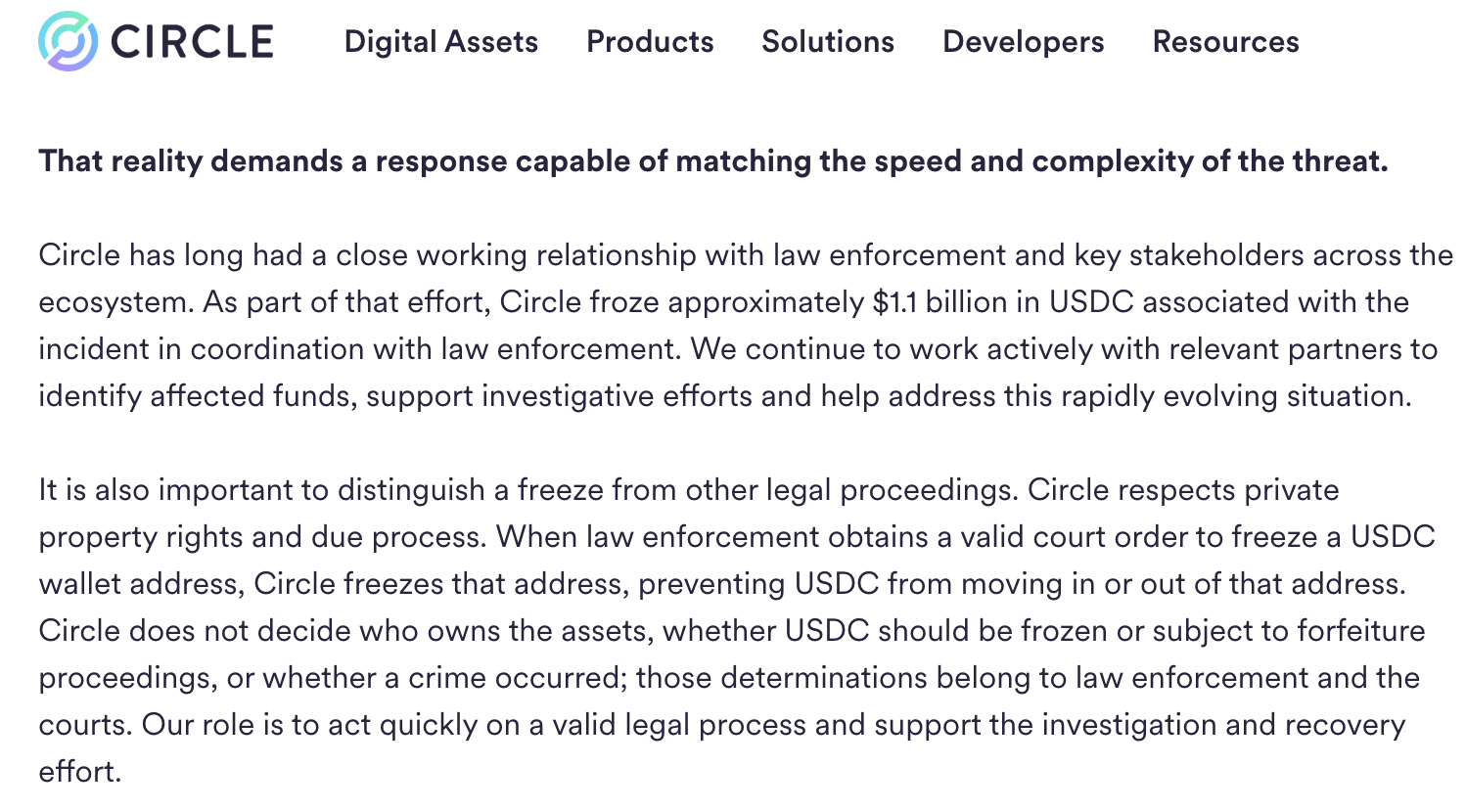
The breakthrough came from Circle, whose headquarters are in the U.S. Leveraging Circle’s backend permissions and technical assistance, over $1.1 billion in USDC was pre-frozen as early as early November based on a court restraining order obtained by the U.S. government.
But freezing is only a temporary lock.
Without a final judgment, the USDC sitting in blacklisted addresses is merely a string of immovable chain code. It cannot be transferred to the hackers, nor can it be directly returned to Binance. Since Circle cannot unilaterally transfer assets from a hacker’s wallet to a third party without a judicial ruling, U.S. prosecutors filed an in rem civil forfeiture action, where the defendant in the case files is not the North Korean hackers, but the assets themselves worth over $1.1 billion.
Once the federal court rules the forfeiture valid, Circle will directly burn the old tokens in the hacker’s address on-chain and simultaneously mint equivalent new USDC to a U.S. government-designated address. This technical re-minting takes just seconds and is the only lawful way to convert dead assets into usable funds.
After Government Seizure, How Are Funds Returned to Victims?
In the federal judicial system, a “court-ordered forfeiture” and “returning money to victims” are two sequential, independent procedures.
Under U.S. law, after winning a civil forfeiture case, ownership of the over-$1.1 billion does indeed temporarily transfer to the U.S. government, entering the Department of Justice’s Asset Forfeiture Fund. But this is not the end. M. Scott Proctor, Deputy Assistant Secretary of the DOJ’s National Security Division, explicitly stated in the press release that the prosecutor’s office swiftly initiated forfeiture after the freeze precisely to prioritize victims’ rights.
Once assets are brought under the government’s name, a victim return procedure immediately follows.
At this stage, all applicants seeking to reclaim the funds must pass the DOJ’s crucial financial verification hurdle, proving they suffered direct, quantifiable financial losses and have not received compensation from other sources.
This directly brings the issue to Binance’s ledger. If Binance used its own capital to cover stolen principal for platform users before the incident, then in the subsequent return review, ordinary depositors are no longer uncompensated victims. Binance itself must provide itemized evidence to U.S. prosecutors regarding its actual financial advances to apply for the return of the funds as the claimant.
The Two Possible Destinations of the Funds
The U.S. District Court for the District of Columbia has just accepted this complaint. The moment the on-chain addresses are completely locked, there are essentially only two direct outcomes for this over-$1.1 billion.
The first, and most ideal outcome, is that the court smoothly rules the forfeiture valid, Circle completes the burn and re-mint, and then Binance passes the DOJ’s loss documentation review, allowing it to reclaim the full or most of this over-$1.1 billion to fill the previous massive financial shortfall.
The second scenario involves prolonged dispute and partial retention. Since civil forfeiture requires a statutory notice period, if other claiming third-party institutions or individuals raise ownership claims during this time, or if parts of Binance’s advance ledger fail the prosecutors’ strict review, then only the verified portion will be refunded. The remaining disputed funds will stay in the federal government’s forfeiture fund.
Beyond this sued $1.1 billion in USDC, there is still over $1.7 billion out of the cumulative $2.9 billion intercepted by U.S. authorities distributed across other stablecoins and jurisdictions. This Washington complaint is merely a starting point; subsequent cross-border asset recovery and ownership settlement between U.S. law enforcement and Binance will continue along this path.
Join TechFlow official community to stay tuned
Telegram:https://t.me/TechFlowDaily
X (Twitter):https://x.com/TechFlowPost
X (Twitter) EN:https://x.com/BlockFlow_News
 深潮TechFlow