Principia Research: From a $557 Million Subscription Refund to Building Its Own Stock Exchange, Binance’s 'On-Chain Nasdaq' Ambition
Author: Principia Research
In June 2026, a slightly awkward "refund incident" accidentally tore open a crack in the great migration of global capital market infrastructure.
At the time, Musk's SpaceX was listing on NASDAQ. To capture the crypto world's frenzy for this century-defining tech stock, Binance Wallet partnered with third-party tokenization platform xStocks (under Backed) to launch an On-chain IPO subscription event named SPCXx. Chain data captured a stunning scene: within days, 27,689 independent wallet addresses flooded in, pouring in as much as $557 million in USDC.
However, the outcome was a bucket of cold water. Due to the highly closed nature of Wall Street's traditional primary market underwriting syndicates, upstream third-party asset providers couldn't secure sufficient underlying physical shares of SpaceX. Binance ultimately had to announce the cancellation of the event, refunding the $557 million directly back along the same path, and urgently deployed its own ADGM entity to airdrop $1 million worth of SPCXB tokens to users as compensation.
Most bystanders dismissed this as a routine operational hiccup; but if you zoom out and piece together Binance's series of capital, licensing, prospectus filings, and team recruitment moves in the Abu Dhabi Global Market (ADGM) from 2025 to late 2026, you will see a completely different picture:
That refunded $557 million proved that on-chain capital is extremely hungry for high-quality equity assets; and the supply cutoff from third-party channels made Binance make up its mind: rather than acting as a traffic funnel for external small RWA packaging firms, it would be better to personally build an "On-chain Stock Exchange" in Abu Dhabi with complete underwriting, clearing, custody, and trading licenses.
I. Why Abu Dhabi? Dual Anchors of Personnel and Sovereign Capital
The crypto industry never lacks slogans about "putting stocks on-chain." As early as 2021, Binance and FTX experimented with early Stock Tokens, but quickly failed under the pursuit and blockade of US and European regulators. Five years later, why is Binance able to set up a full suite of securities infrastructure so openly this time? The answer lies in the personnel DNA and sovereign ledger of Abu Dhabi (ADGM).
The first pillar is the institutional imprint of its leadership. Binance's current Co-CEO Richard Teng (who began serving alongside He Yi as Co-CEO at the end of 2025) is not a rough-and-tumble crypto entrepreneur. Before joining Binance, he served as Chief Regulatory Officer at the Singapore Exchange (SGX), and subsequently led the ADGM Financial Services Regulatory Authority (FSRA) for six years between 2015 and 2021. The ADGM regulatory framework for digital assets and Ledger-Based Securities, now hailed as the gold standard by global institutions, was largely built on the institutional foundation he personally laid during his tenure.
The second pillar is the interest binding with sovereign capital. In March 2025, MGX, a sovereign AI and technology investment fund chaired by core member of the Abu Dhabi royal family Sheikh Tahnoon bin Zayed Al Nahyan, invested $2 billion in stablecoins into Binance to acquire a minority stake. This marked the first time since Binance's founding that it brought in an external institutional shareholder.
This $2 billion transaction rewrote Binance's fundamental character: it is no longer just a crypto company wandering among offshore islands, but has formally embedded itself into the UAE's national fintech and capital market landscape. Just nine months later (approved in December 2025, officially effective January 5, 2026), Binance announced that its global operating structure for Binance.com would bid farewell to the Cayman Islands and move entirely under the ADGM regulatory umbrella.
II. Dissecting Abu Dhabi's Compliance "Four-Piece Set"
If you review the public license registry and prospectus disclosure documents of the ADGM FSRA, you will find that what Binance is doing in Abu Dhabi is far from conventional "crypto exchange compliance" (simply applying for a standard VASP license). Instead, strictly following the segmented standards of traditional financial market infrastructure (FMI) in London or New York, its Irish holding parent company Binance Holdings (IE) Limited has fully laid out a closed-loop matrix consisting of "three licensed entities + one issuing SPV + one on-chain service agent":
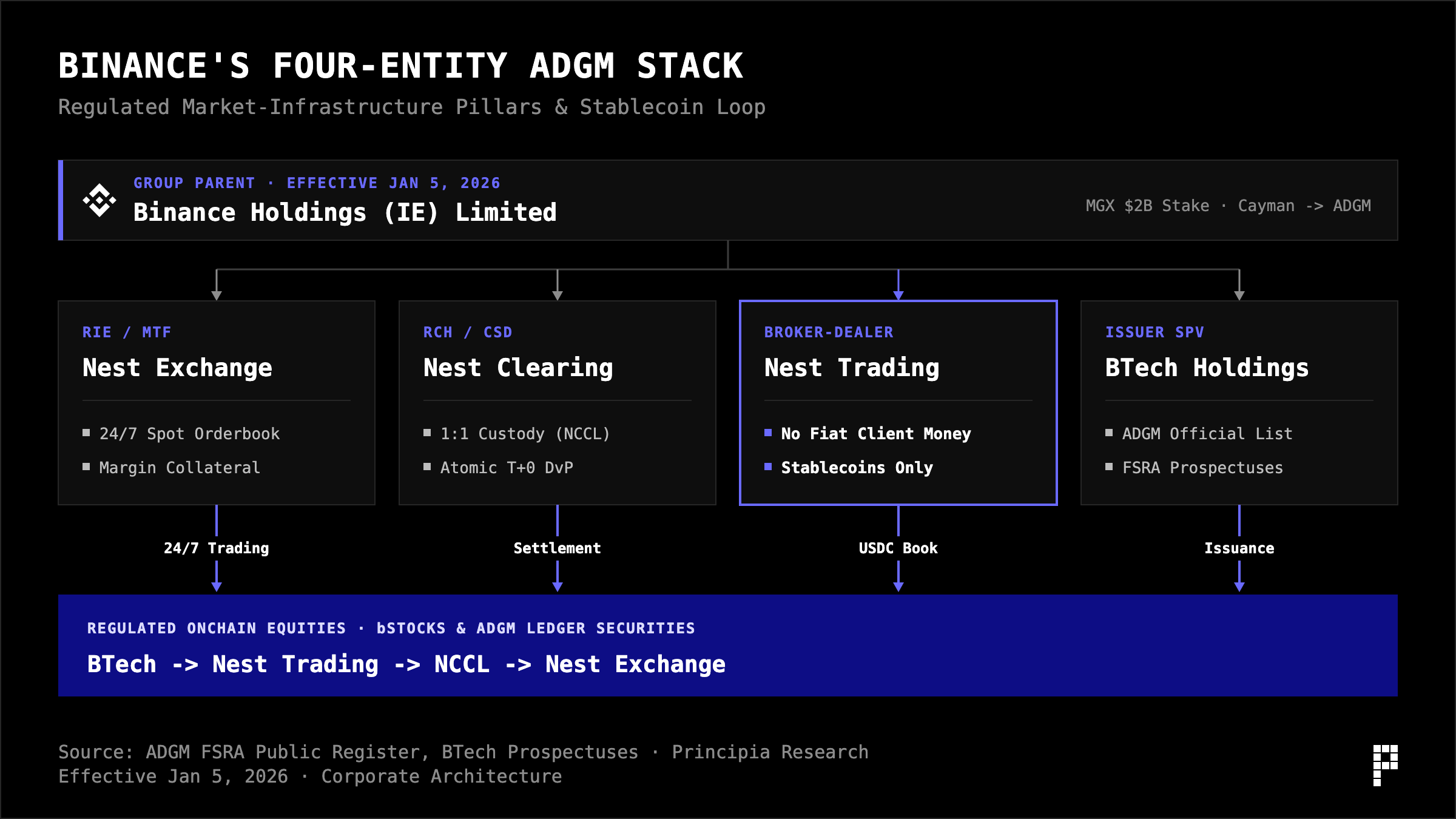
How exquisite is this architecture? It becomes obvious at a glance when compared to traditional Wall Street:
▪ Nest Exchange Limited holds licenses for Recognized Investment Exchange (RIE) and Multilateral Trading Facility (MTF); it plays the role of NASDAQ or NYSE;
▪ Nest Clearing and Custody Limited (NCCL) holds licenses for Recognized Clearing House (RCH) and Central Securities Depository (CSD); it plays the role of the Depository Trust & Clearing Corporation (DTCC);
▪ Nest Trading Limited holds a Broker-Dealer license, approved to trade as principal, trade as agent, and arrange investment transactions. It plays the role of investment bank underwriting and distribution desks;
▪ BTech Holdings Limited (alongside minting and disclosure agent BTech Services Limited) is specifically responsible for submitting prospectuses to the FSRA and applying for inclusion in ADGM's statutory official listing directory.
The "abnormal" details in the licenses expose the true intent: on the FSRA public registry, Nest Trading Limited's license comes with two thought-provoking restrictions: First, it is strictly prohibited from holding or controlling traditional client fiat funds; Second, its fund service permissions are strictly limited to "Recognized Fiat-Anchored Tokens (such as USDC)." In the eyes of traditional brokers, this is a shackling castration; but from an on-chain capital market perspective, this is precisely a native design tailor-made for the On-chain IPO. It cuts off lengthy bank wire transfers and fiat custody accounts at the legal foundation, locking in a pure on-chain closed loop of "compliant stablecoin subscription payment + Central Depository (NCCL) on-chain T+0 Delivery versus Payment (DvP) atomic settlement."
Meanwhile, the job postings released by Binance in the UAE corroborate this assessment: its official recruitment system quietly launched recently Business Development and research analyst positions for a "0-to-1 Equity Capital Markets department, i.e., traditional investment bank IPO underwriting," with duties straightforwardly stating "seek and engage prospective issuers and investment banks, conduct issuer due diligence, build transaction pricing models, and submit approval memorandums to internal investment committees." If it were merely continuing to buy US stocks in the secondary market for mapping, there would be absolutely no need to assemble an investment banking team that directly interfaces with prospective listed companies.
III. From "US Stock Porter" to "Weekly-Update Regulatory Assembly Line"
Before formally entering the primary market's new stock underwriting, Binance used its proprietary tokenized securities product, bStocks, in the second half of 2026 to complete a closed loop of "regulatory and infrastructure stress testing" in ADGM.
On June 11, 2026, jointly orchestrated by international law firm Gibson Dunn and Middle Eastern law firm Al Tamimi & Co., the first batch of bStocks issued by BTech Holdings was officially approved for inclusion in the official listing directory and began trading on Nest Exchange. This marks the first time in Abu Dhabi's history that tokenized digital securities running on a public chain (BNB Smart Chain, BEP-20 / BEP-677 standards) have been incorporated into the official securities directory.
But this raises the most core market question: real US stocks like Tesla and Nvidia are clearly locked in the US DTCC system; on what basis does ADGM claim they are "1:1 custodied"?
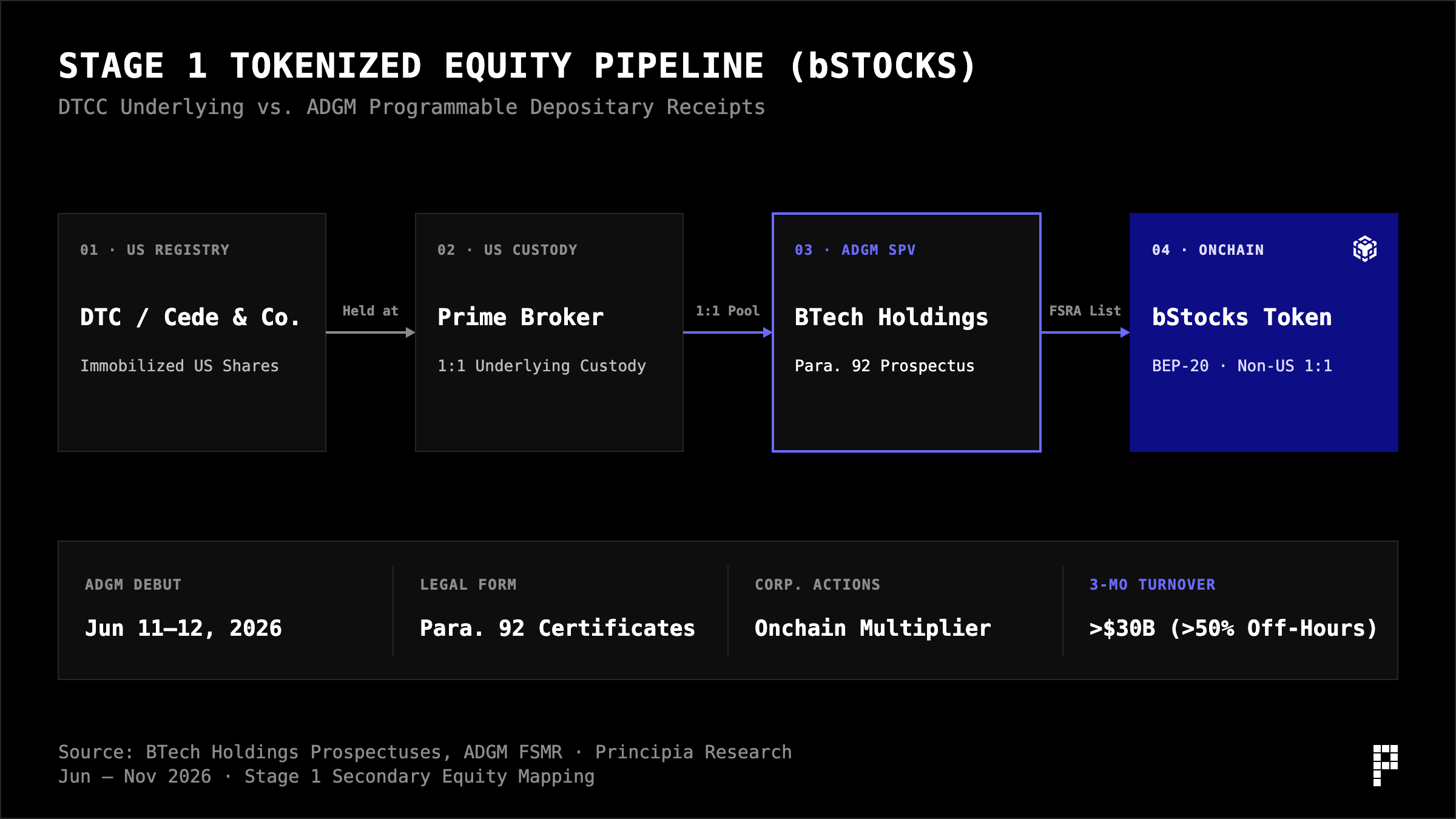
The answer lies in honest and penetrating legal characterization: in Phase One (tokenizing existing stocks from the secondary market), the actual stocks indeed never left the US DTCC system. Under ADGM's Financial Services and Markets Regulation (FSMR, Schedule 1, Paragraph 92), the statutory identity of bStocks is a "certificate representing a specific financial instrument," essentially an on-chain depository receipt. The ADGM regulator does not "endorse" asset existence on behalf of the issuer, but instead, through prospectus approval, turns 1:1 fully segregated custody, periodic reconciliation, and reserve proof into statutory information disclosure and contractual obligations with severe criminal and civil liability; and at the technical layer, BTech Services uses a multiplier adjustment mechanism built into the contract to make stock splits/consolidations and net cash dividend reinvestment turn into on-chain automation components without requiring currency swaps.
More intriguing is the accelerated approval rhythm over the following five months. Traditionally, approving a prospectus for a securities market takes months, making it impossible to keep up with the two-week window of an IPO roadshow; but reviewing the official ADGM admission announcements from June to November 2026, BTech Holdings forcibly turned this regulatory channel into a "weekly-update assembly line":
▪ Early July: Italian tech group Bending Spoons just rang the bell at NASDAQ on July 1 (ticker BSP, priced at $29). BTech swiftly passed its independent prospectus to launch BSPB, and integrated Binance's cross and portfolio margin collateral functions, rehearsing the "rapid follow-up to newly listed IPO stocks + collateralization of derivatives";
▪ Late July to August: Passed approvals for the 3x Long Nasdaq ETF (TQQQ) and high-volatility target GameStop (GME), successfully navigating complex leverage structures and high-volatility risk control templates;
▪ September: Listed Hims & Hers and Salesforce on the 9th, CEA Industries on the 14th, and Forward Industries on the 29th. Not only did the approval interval shrink to 5–15 days, but it also included small-cap Digital Asset Treasury (DAT) companies for the first time, proving that non-bluechip mid/small caps can also pass review quickly;
▪ October to early November: On Oct 13–14, single-batch approved BlackBerry, MongoDB, Penguin Solutions, and the Volatility Index ETF (UVXY). Just 6 days later (Oct 20), it again approved Berkshire (BRKB). On Nov 6, it rapidly approved the supplementary prospectus for the 2x Long Intel ETF (INTW).
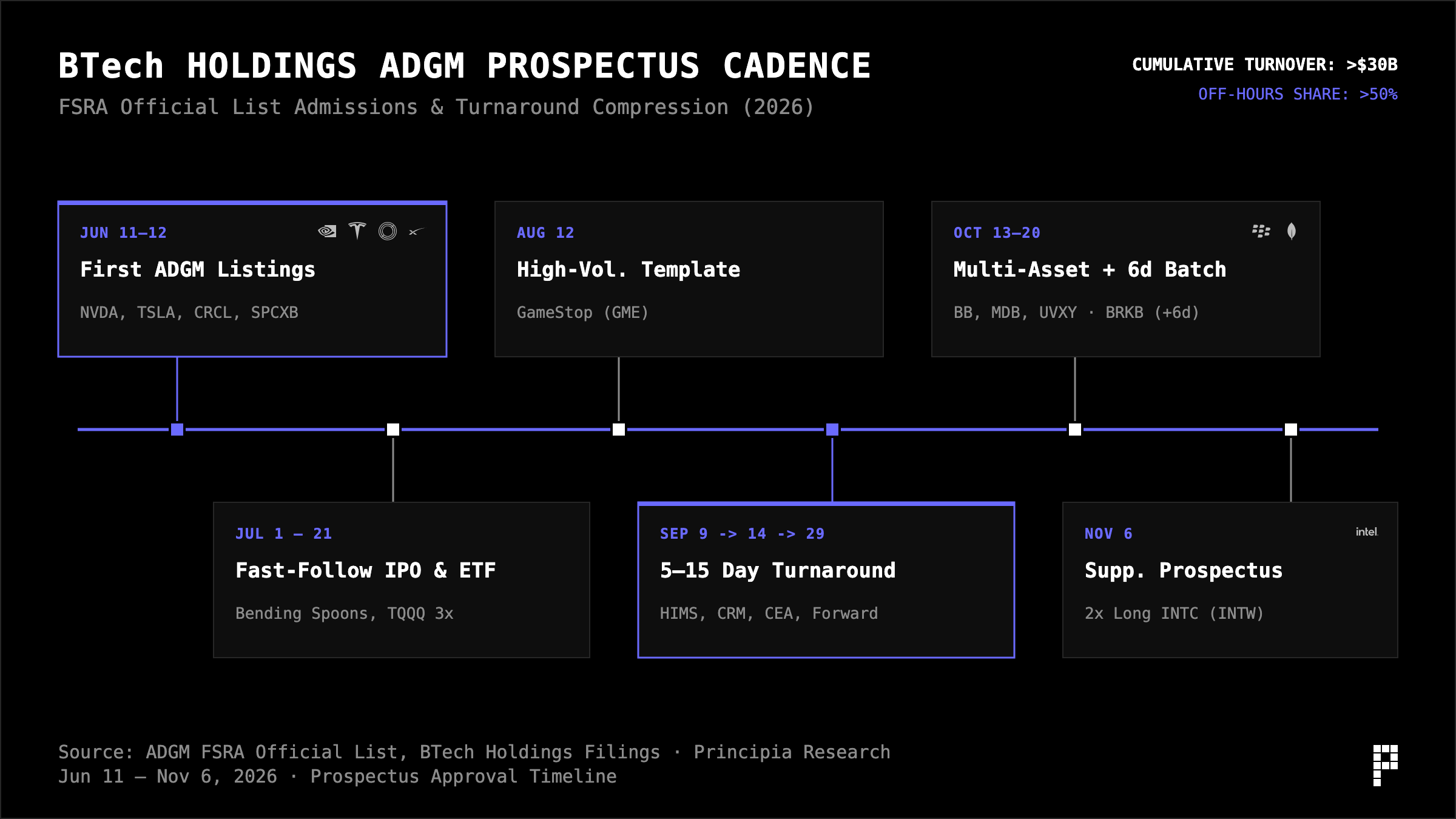
In just three months (as of early September 2026), bStocks cumulative trading volume directly surpassed $30 billion, with over 50% of trading volume occurring during US stock market holiday periods (Asia daytime, Middle East sessions, and weekends). Pipelines, liquidity, market makers, and regulatory synergy are all in place. The only remaining puzzle piece is crossing from "secondary market mapping receipts" to "primary market native On-chain IPOs."
IV. The IPO Dilemma and Global Exchange Liquidity Reordering
Why are global retail investors and issuers all seeking a "third channel"? According to comprehensive empirical data on the Principia data terminal, the allocation in traditional capital markets has become imbalanced, while the liquidity siphon effect of crypto trading platforms is evident.
1. The "Structural Plunder" of Traditional IPOs
Among the 650 traditional IPOs tracked by Principia (raised ≥ $50 million, excluding SPACs, total raised amount $441.33 billion), two highly polarizing sets of data emerge:
▪ Fragmentation between surging first-day returns and retail bag-holding: Traditional IPOs show an average gap-up return from the issue price to the first-day opening price of +29.6%, with "Money Left on the Table" calculated at the first-day closing price reaching $329.14 billion. This almost risk-free primary premium was almost entirely allocated by Wall Street investment banks to institutional old-money clients. Once retail investors in the public market enter after the first-day open, 64.1% of companies ultimately break below their issue price, seeing their median return from the first-day open to date plummet to -36.0%.
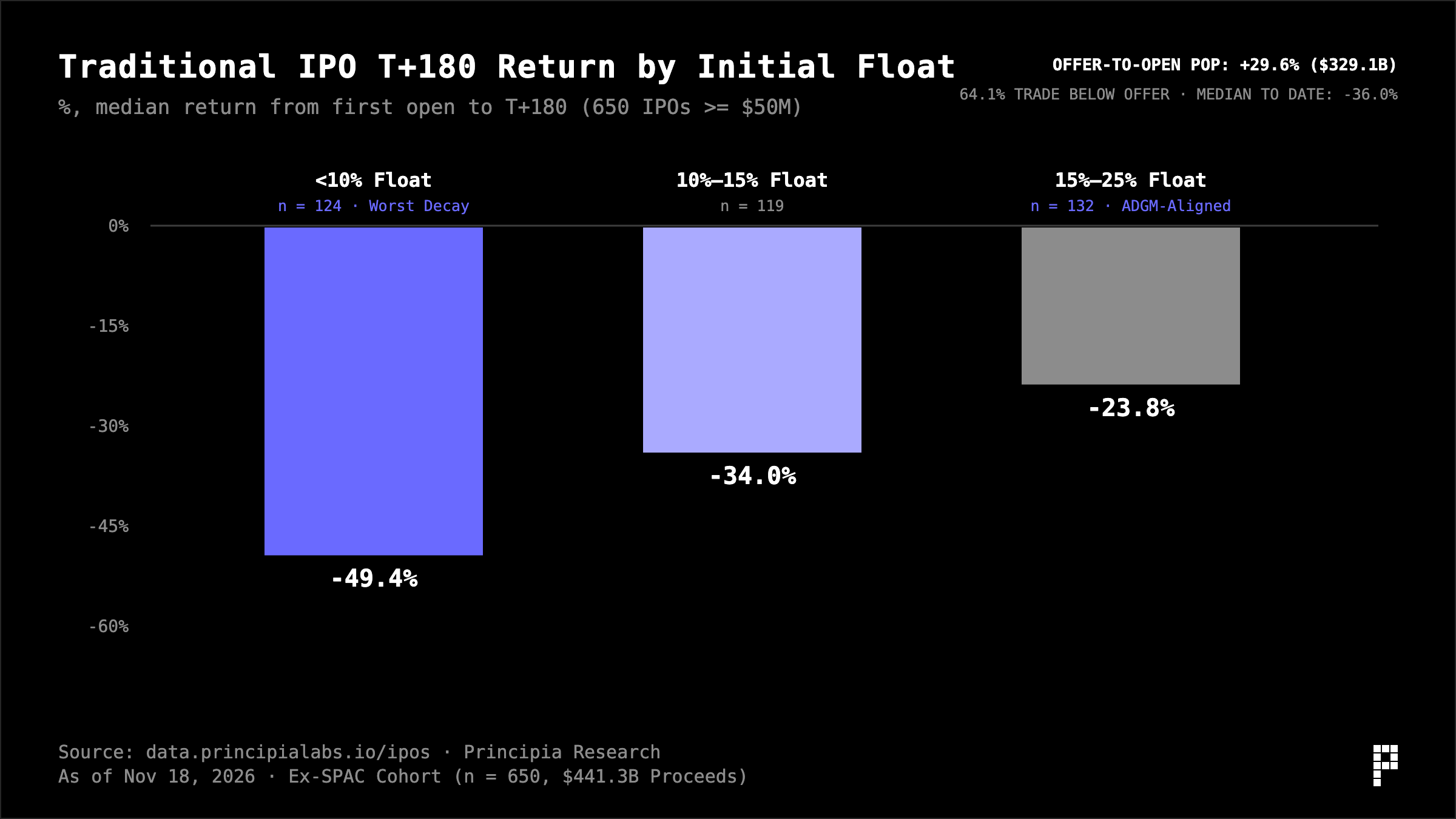
▪ The "slow bleeding" pattern of low float: Tracking the median drawdown after open for these 650 IPOs grouped by initial free float percentage (Float %), the pattern is remarkably consistent:
▪ <10% ultra-low float (124 cases): Median drawdown hits -49.4% on Day 180 post-listing (currently -44.4%);
▪ 10%–15% float (119 cases): Median drawdown of -34.0% on Day 180;
▪ 15%–25% float (132 cases): Median drawdown converges to -23.8% on Day 180, halving the decline rate compared to the <10% group;
▪ Meanwhile, around the 180-day lock-up expiration period (Lock-up Cliff, n=319), low-float stocks (Float <15%) face the most intense selling pressure shock of -10.5%.
This set of empirical data not only explains why on-chain capital frantically poured $557 million to snap up primary shares when SpaceX listed (only securing the Offer Price avoids the secondary market's -36.0% structural bag-holding trap), but also statistically validates the scientific rationale behind ADGM MKT Rule 2.3.10 mandating 15%–20% genuine public float.
2. Where Does Binance's Actual Volume Stand?
Many traditional finance professionals subconsciously believe "crypto exchange volumes are far inferior to mainstream stock exchanges." The truth is far more shocking than the stereotype:
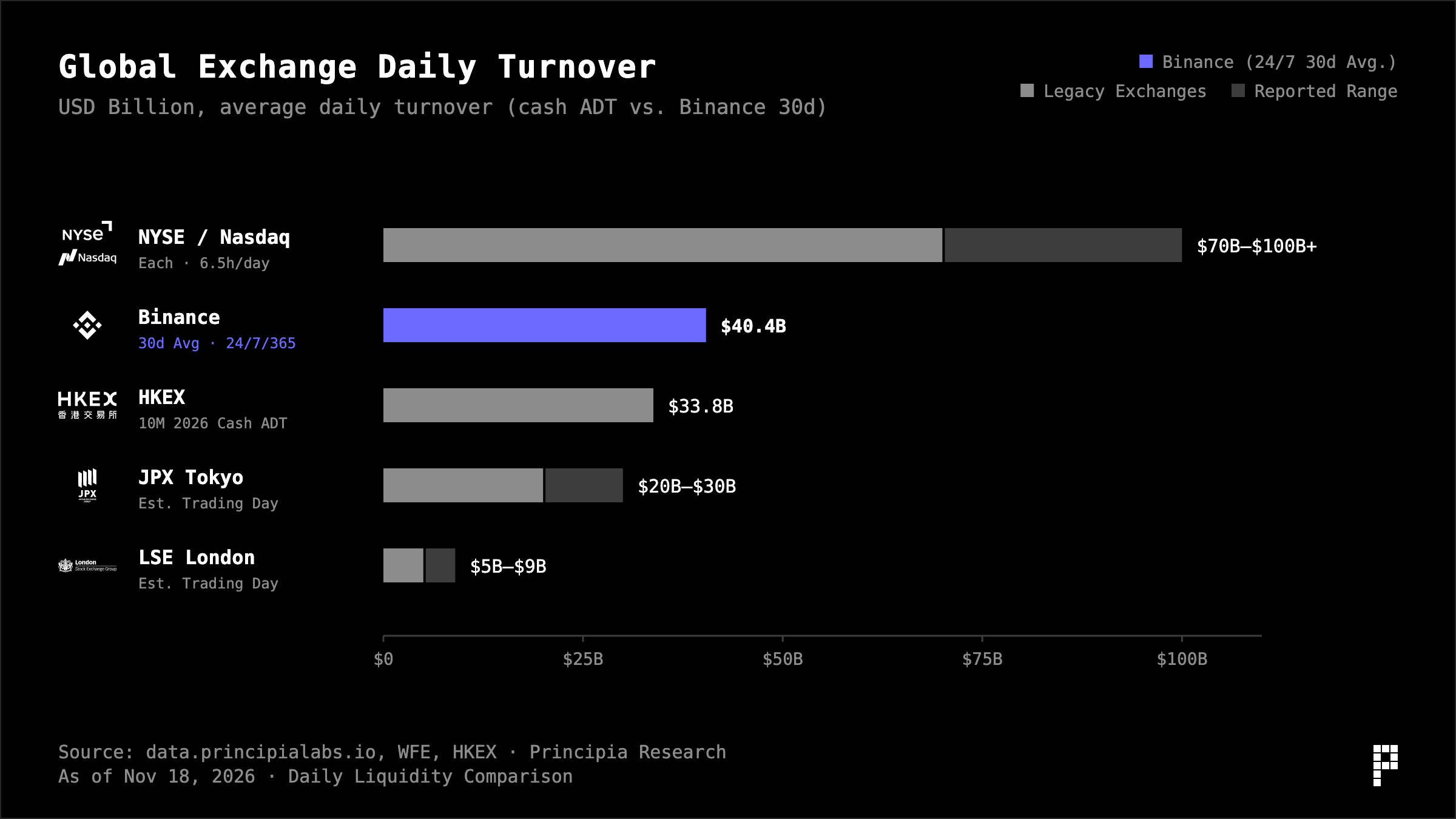
Throughout 2025, Binance traded volume exceeded $7.1 trillion (on par with HKEX's $7.88 trillion). Binance's 2025 full-year spot volume already rivaled HKEX, and its comprehensive liquidity and 30-day average daily trading volume have surpassed HKEX's spot average daily level.
More noteworthy is our tracking of the specialized tokenized stock/ETF/commodities sector (as of November 18, 2026, network-wide tokenized market cap $8.59 billion, 804 active targets, covering 187 trading venues globally):
▪ The entire sector saw 24-hour spot trading of $1.79 billion, derivatives trading of $50.52 billion (derivatives are 28.3x spot), and open interest of $11.22 billion;
▪ Of which Binance alone monopolizes 41% of global trading share (24-hour RWA spot $470.6 million + derivatives $20.9 billion + open interest $3.47 billion, with spot reserves soaring to $112.71 billion), making its volume 4.3 times that of second-place OKX (9.5% share).
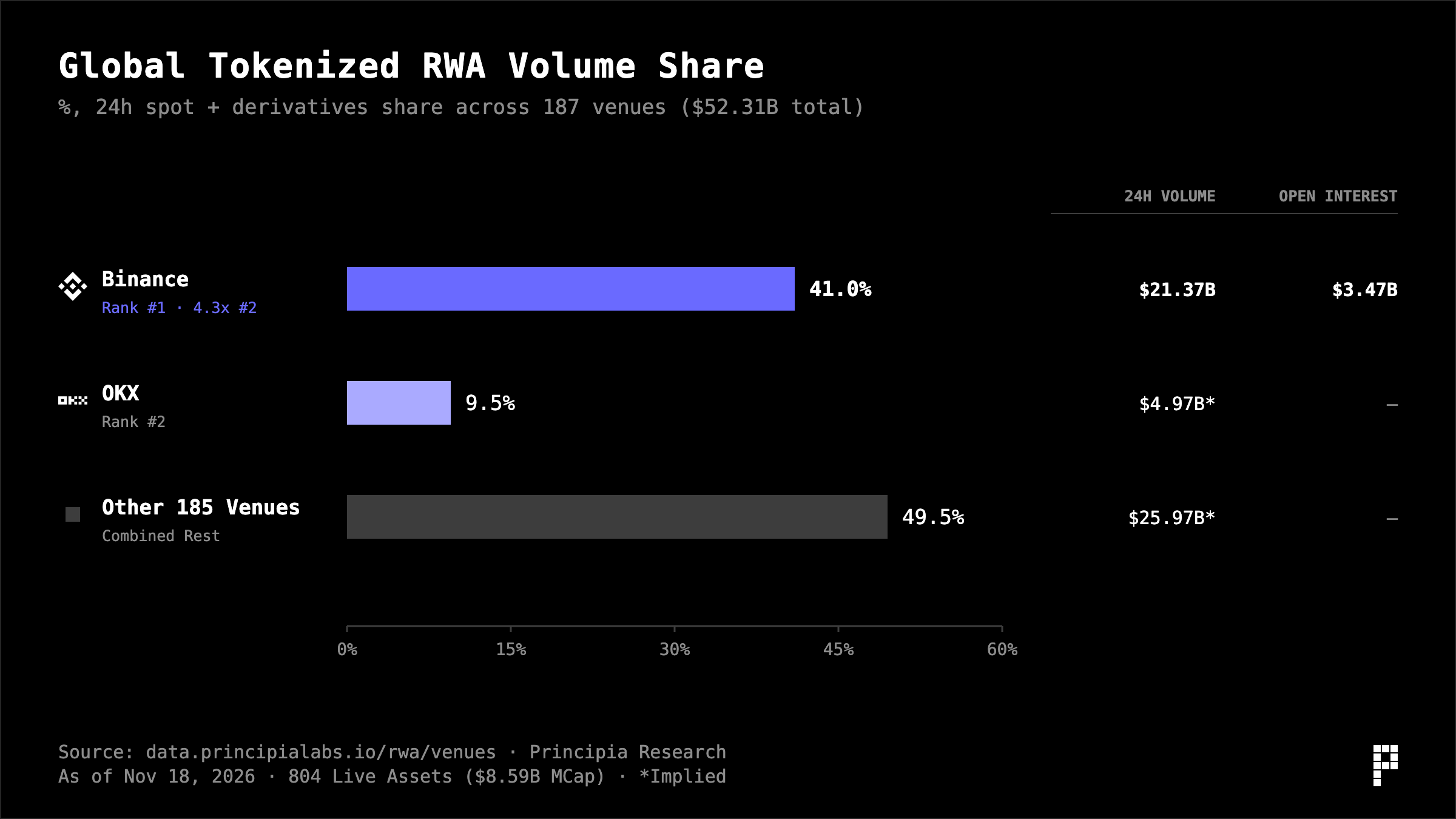
When a super-exchange that operates 365 days a year, boasts over $40.4 billion in 30-day average daily volume, and holds 41% of the global tokenized asset share, officially obtains full legal stock exchange and broker-dealer licenses in ADGM, its dimension-reducing shock to traditional regional exchanges has only just begun.
V. Small and Mid-Cap Issuers Forgotten by Wall Street
In the second half of 2026, CZ publicly asserted "IPOs will move on-chain," and Binance Research successively released heavyweight reports such as "From IPO to Internet Capital Markets," pushing the global on-chain equity market into a head-on clash of three routes:
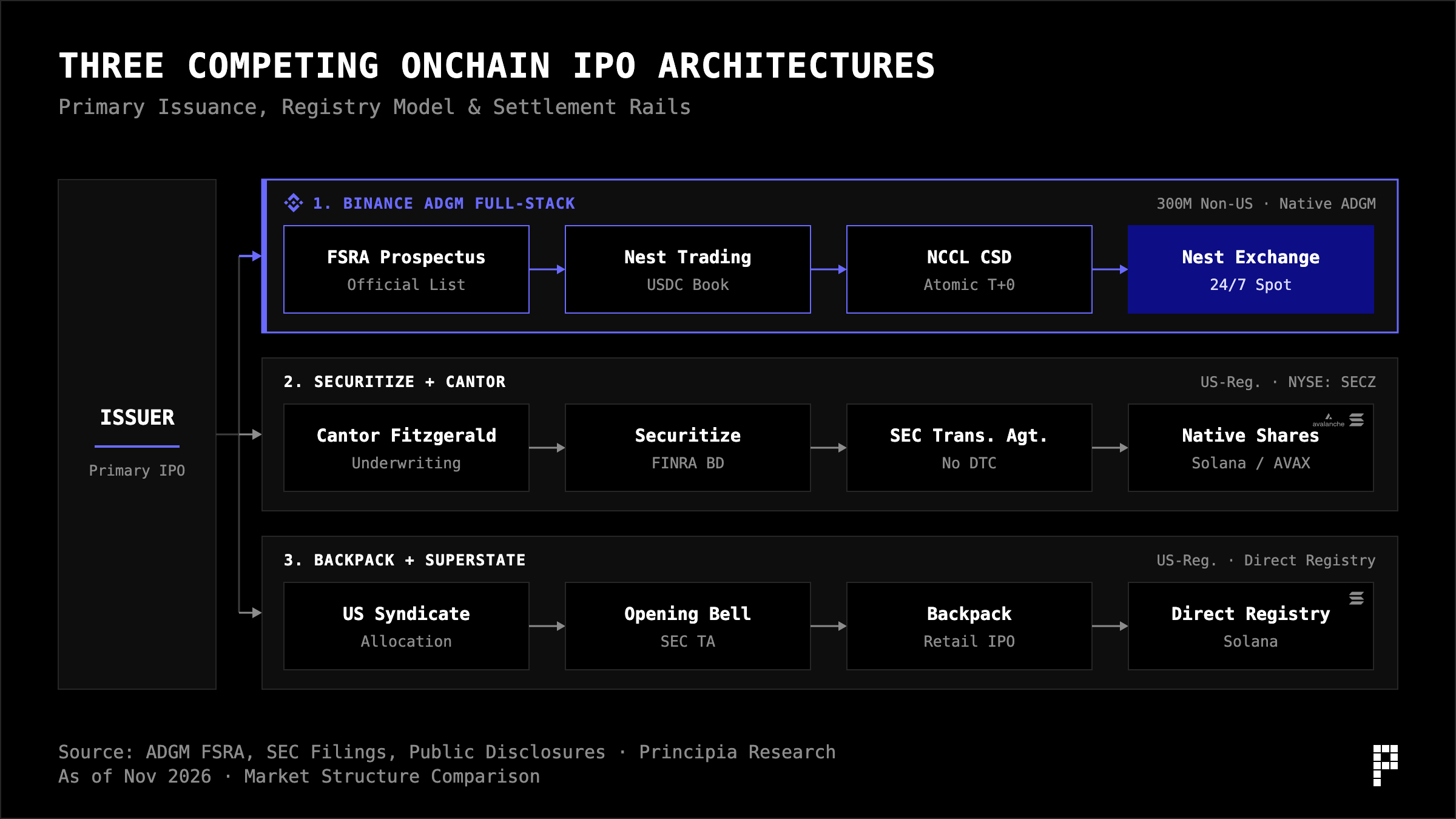
Comparing these three routes side-by-side, many fall into a misconception: assuming Binance will compete with Wall Street for the lead underwriting rights of SpaceX or Anthropic (ticker ANT), which is currently in a sprint phase to raise $74 billion.
Quite the opposite. The true main battlefield that will allow Binance's ADGM On-chain IPO platform to truly explode does not lie with multi-billion dollar giants, but in the "mid-cap cash cow orphan belt" valued between $1 billion and $3 billion.
Doing a quick accounting of capital market microstructure makes it clear:
1. "Structural Orphans" in Traditional Markets vs. Institutional Dividends in ADGM
Today at NASDAQ or HKEX, a high-quality company with an annual net profit between $3 million and $30 million and a valuation between $100 million and $800 million (whether it's an overseas AI application, cross-border payment Fintech, game publisher, or high-cash-flow crypto infrastructure) finds itself in a highly awkward position:
▪ Going to the US market is too expensive and ignored: Goldman Sachs and Morgan Stanley basically don't take IPOs under $1 billion; hiring second-tier small investment banks burns through $2 million–$3 million upfront just on lawyers, auditors, and compliance hard costs, plus a 7% underwriting fee is cut away, and after listing there's no Wall Street research coverage, institutions won't buy, and maintaining compliance still costs another $1.5 million annually;
▪ Going to HKEX/SGX results in becoming "zombie stocks": Although HKEX's overall average daily turnover reaches $23.2 billion–$33.8 billion, the vast majority is absorbed by top-weighted giants like Tencent and Alibaba. Mid-cap tech valuations are chronically suppressed at single-digit P/E ratios, with daily turnover often dropping to tens of thousands of dollars, completely losing refinancing and shareholder exit functions.
If this company switches to an ADGM-native primary listing, the threshold and costs will undergo a cliff-like reconstruction:
▪ Statutory admission is clear and mild: According to ADGM MKT Rule 2.3.15 (Profit Test), as long as there is a cumulative profit of $1 million over the past 3 years of continuous operation, and combined profit of $500k over the last 12 months (unprofitable tech companies can even switch to MKT 2.3.16 Asset/Market Cap Test: total market cap of $10 million, tangible net assets of $3 million, and pro forma working capital of $1.5 million), it can legally cross the threshold for the official listing directory;
▪ Official fees are nearly zero: The prospectus approval fee ($20,000) paid to the ADGM regulator plus the official directory admission fee ($3,000) totals only $23,000; even including international law firms, auditors, and market structure consultants, the total hard cost before ringing the bell requires only one-quarter to one-third of the US market equivalent.
2. New Wealth Effects
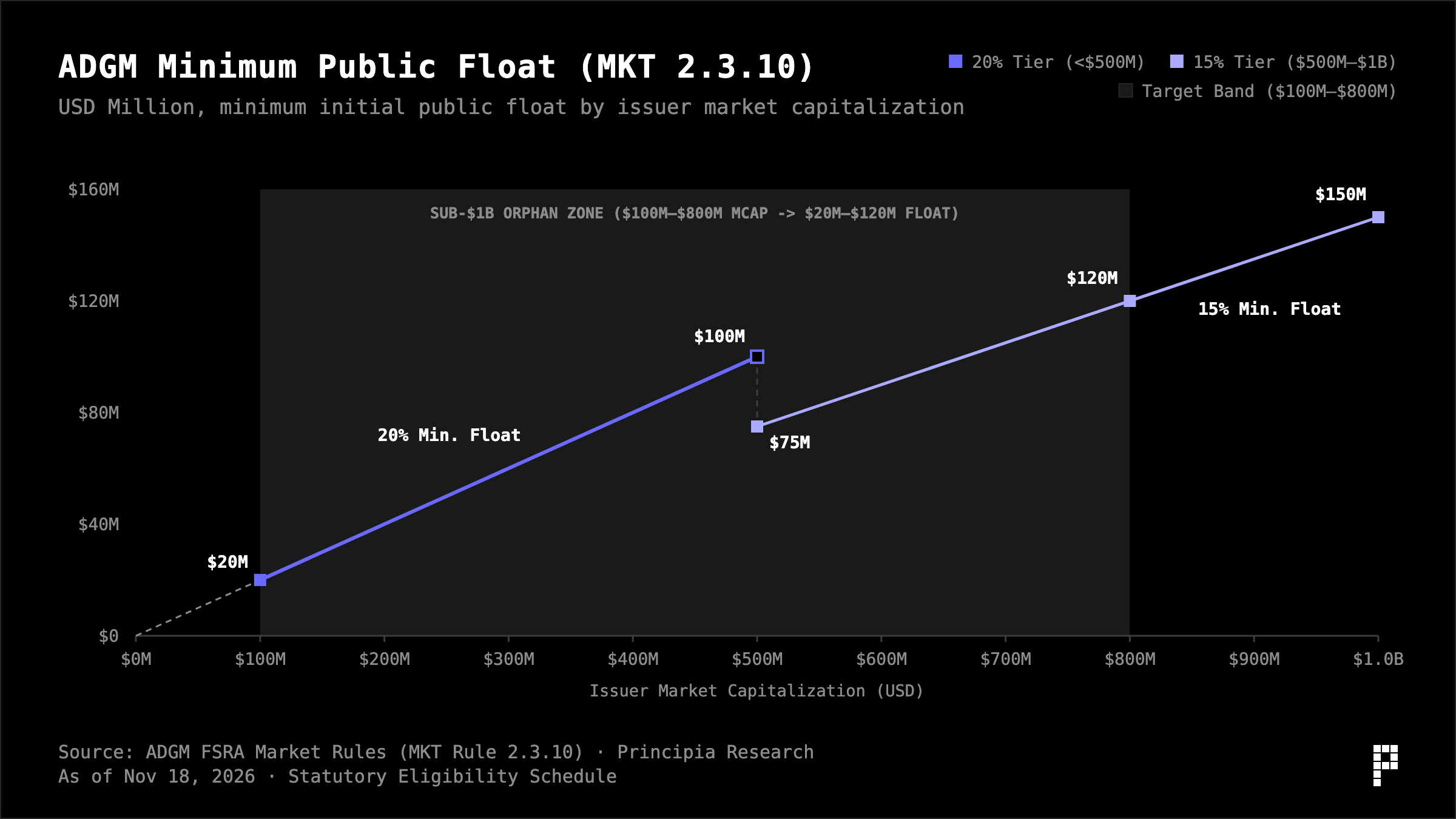
More ingenious is the volume matching. According to the tiered public holding rules of ADGM MKT Rule 2.3.10:
▪ For issuers with a market cap under $500 million, the statutory public float ratio (Public Float) must be ≥ 20%;
▪ For issuers with a market cap between $500 million and $1 billion, the statutory public float ratio must be ≥ 15%.
This means that for a mid-small company valued between $100 million and $800 million coming to ADGM for a native On-chain IPO, its first-day public fundraising and free float will land exactly between $20 million and $120 million in USDC. In traditional markets, this is merely a neglected micro-cap stock; but for the Binance ecosystem with 300 million registered users and a staggering 30-day average daily volume of $40.4 billion, an initial circulating market cap of $20 million–$120 million is precisely the "golden sweet spot" that can easily generate multiple-times oversubscription, won't drain in-floor liquidity, and can achieve extremely high 24/7 turnover rates.
Paradigm shuffle from "pseudo-float" to "genuine public holding": For practitioners accustomed to Web3 token issuance, the On-chain IPO will bring a complete reshaping of rules. In past token issuances, projects routinely stuffed "tokens lent to market makers + team/ecosystem incentive pools + unvested foundation allocations" into initial circulating chips to pad numbers; but under ADGM MKT Rule 2.3.10(3) securities regulations, director and affiliate holdings, ESOP trust pools, major shareholders above 5%, and non-bought-out market maker borrowings are explicitly excluded from "public holding". Only shares genuinely subscribed with real money by unaffiliated external investors (or unlocked shares held by independent pre-listing minority shareholders) count, completely eliminating the crypto market's notoriously plagued issues of "high FDV, fake float, and soft rug pulls".
VI. Will Binance Ever Join the Table Itself?
Surrounding Binance's major moves in Abu Dhabi, the industry continues to circulate another layer of more imaginative speculation: aside from building an On-chain IPO underwriting platform for others, might Binance itself (or its Abu Dhabi division) also host a native On-chain IPO in ADGM?
Objectively speaking, Co-CEO Richard Teng has repeatedly stated publicly between 2025 and 2026 that Binance's cash flow is ample and there are no plans for a financing IPO in the short term. If you review the underlying equity structure disclosed in BTech Holdings' prospectus, the Irish parent company Binance Holdings (IE) Limited remains controlled by founder Changpeng Zhao as the controlling shareholder and ultimate beneficial owner. If the group as a whole aims to directly offer common shares to the public, whether due to the sensitivity of consolidated financial reporting disclosures worldwide or historical compliance baggage, the short-term resistance remains enormous.
Yet, "the group as a whole not listing" does not prevent "licensed divisions spinning off to test the waters."
There are two main changes driving this: First, the $2 billion sovereign shareholder MGX, which entered in 2025, naturally harbors institutional demands for medium-to-long term valuation benchmarks and capitalized exits; Second, in July 2026, US tokenization leader Securitize listed on the NYSE (NYSE: SECZ), simultaneously issuing its own stock natively on the Solana and Avalanche public chains, proving the feasibility of on-chain public equity to the world.
Conversely, Binance's four ADGM entities (the Nest trading/clearing system and bStocks business segment) have been operating independently and compliantly under strict FSRA audits since January 2026, shedding historical offshore baggage while wielding real trading cash flows scaling into the hundreds of billions annually. If one day in the future, Binance chooses to separately package a regulated financial business or joint venture division in Abu Dhabi and initiate a dual-listed native On-chain IPO on both the Abu Dhabi Securities Exchange (ADX) and its own Nest Exchange, it will be a perfectly logical stroke of genius, whether addressing sovereign shareholders or establishing authority for its own on-chain capital markets.
VII. The Birth of a New Species Often Accompanies the Rise of a New Ecosystem
Looking back over the past decade, the crypto capital market has traversed a violently swinging pendulum: from the unregulated, wild West ICOs of 2017, swinging toward the distorted "high-valuation VC coins" of 2021–2025, and finally settling back in 2026 at the intersection of "real corporate cash flows + statutory securities prospectuses + 24/7 stablecoin on-chain settlement."
This infrastructure of "exchange + central depository + stablecoin brokerage + modular prospectus" laid by Binance in ADGM is, in essence, carving out a third public capital formation channel (on-chain capital markets) for global growth-oriented companies outside of Wall Street and HKEX.
And on this forming industrial chain, opportunities extend far beyond the exchange itself. After all, when the gong of a stock exchange rings for the first time on an all-nighter, sleepless blockchain ledger, every pricing language, underwriting paradigm, and liquidity rule will be rewritten, and new wealth effects may quietly arrive. Binance's next goal is to serve 3 billion people, and this will be a brave attempt sufficient to change humanity's entrenched financial rules.
Join TechFlow official community to stay tuned
Telegram:https://t.me/TechFlowDaily
X (Twitter):https://x.com/TechFlowPost
X (Twitter) EN:https://x.com/BlockFlow_News
 @PrincipiaRes