Behind the $6 Billion Binance Theft Case: Who Actually Holds On-Chain Freeze Rights Beyond Legal Reach?
Author: Jon Reiter, Blockhead
Edited by: TechFlow
TechFlow Editorial: Following Binance's major hack exceeding $6 billion, several centralized institutions quickly moved to freeze on-chain assets, sparking intense policy debates over whether the Clarity Act can effectively empower law enforcement. Proponents claim the bill would provide legal immunity for emergency freezes, while opponents argue that judicial remedies are largely unworkable on-chain.
Jon Reiter, founder of ChainArgos, writes in a deep dive that this debate exposes a profound misunderstanding within U.S. regulation regarding offshore realities. Both Binance and Tether are offshore entities completely outside U.S. jurisdiction. So-called lightning interceptions have never been the product of legal procedures, but rather unilateral exercises of discretion by private institutions.
The article further points out that in on-chain security crises requiring second-level responses, cumbersome statutory law is becoming irrelevant. National governments are experiencing a de facto retreat of power in such emergency handling, while centralized commercial giants, who truly control the ledger, are quietly taking over the law enforcement powers of traditional sovereign states.
Following the massive heist exceeding $6 billion at Binance, multiple centralized institutions swiftly acted to freeze assets, attempting to recoup enormous losses for users and the exchange. The fact that digital asset holders must now rely on a handful of traditional commercial companies to protect their on-chain property constitutes a profound irony.
A deeper question arises: how do these institutions reconcile their occasional exercise of discretion to preserve assets with their historically hands-off approach toward sanctions and mid-to-small-scale hack incidents?
These are thought-provoking topics. But this piece focuses more on a perplexing public debate: would the outcome of this Binance theft have been different if the Clarity Act had already passed?
Although the bill ultimately failed and seems unlikely to pass in the future, rigorously testing its underlying logic remains highly illuminating. There are no real-world double-blind controlled experiments for legal systems, making this thought experiment our best tool for clarifying regulatory boundaries.
We begin by examining the clash between two prominent figures: Senator Cynthia Lummis, who advocates for crypto-friendly policies, and Amanda Fischer, Policy Director and Chief Operating Officer at the pro-regulation advocacy group Better Markets.
The two engaged in a heated public debate on social media. It should be noted that this is merely column observation, not a rigorous law school academic discussion.
Public Debate: Lummis and Fischer Clash Head-On
The day after the hack, Senator Lummis posted a public statement on platform X:
"Hackers stole over $6 billion from Binance in under four hours, setting the record for the largest theft in human history. The Clarity Act would have provided legal cover for crypto businesses to freeze suspicious transactions the moment law enforcement called. Every lost minute meant funds evaporated completely."
Fischer immediately rebutted that Lummis's claims were completely false, citing specific provisions from the bill:
"That is not the case. The Clarity Act requires stablecoin issuers to execute freezes only pursuant to a court order. For exchanges, the relevant legal wording is as follows; please read subsection (1) below carefully."
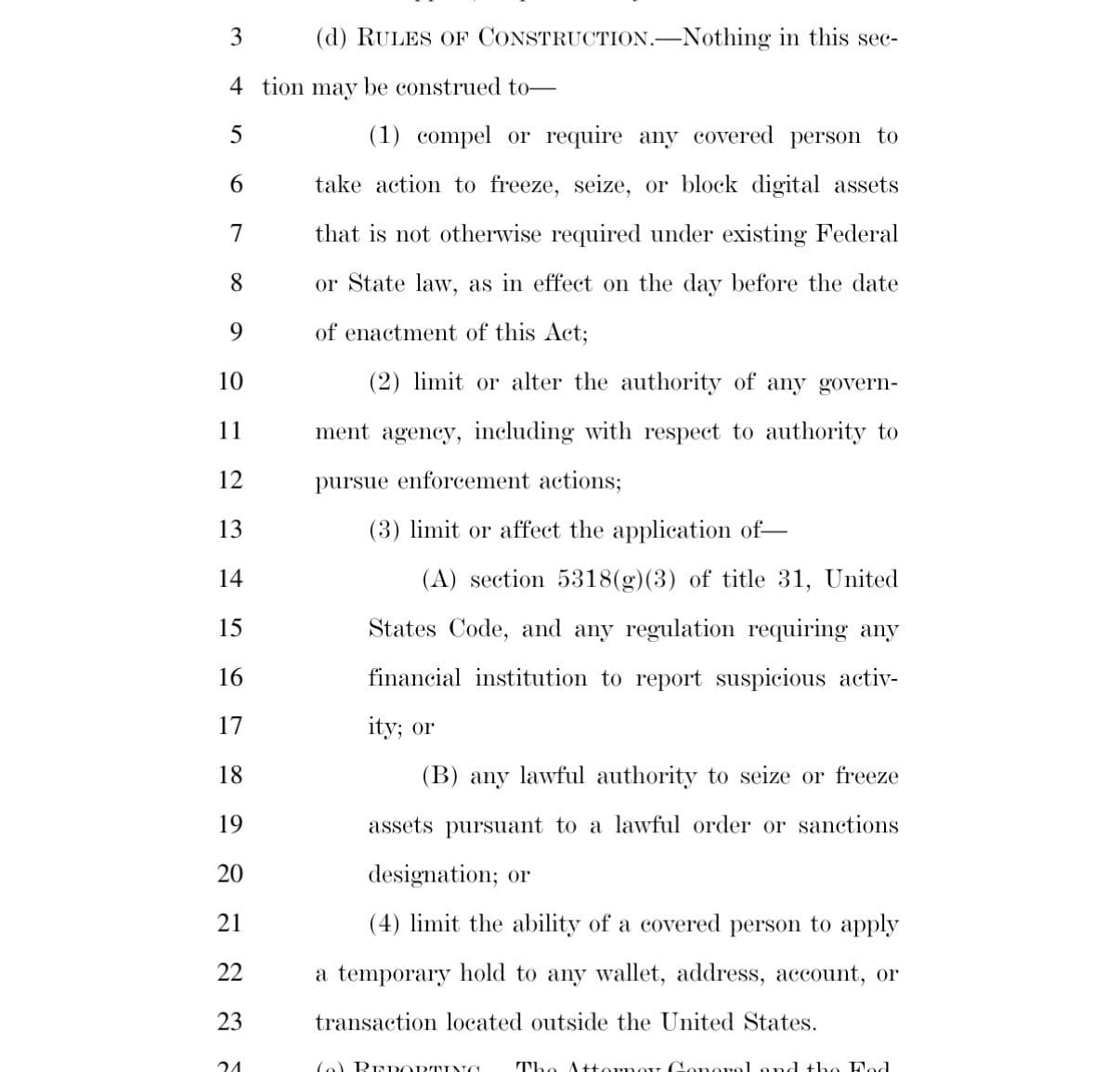
Figure: Screenshot of the original Clarity Act interpretive rule provision cited by Amanda Fischer
Senator Lummis then fired back:
"Good idea, but you are only citing a savings clause. It merely preserves existing financial and sanction laws without erasing the rest of the section. You fail to grasp the core of the Clarity Act: it would classify Binance as a 'Covered Person' because it operates as a digital asset service provider."
"No law can stop every wrongdoer, but the Clarity Act would have provided better tools and faster response capabilities for those combating crime. Your party voted against it, and you must bear the consequences."
Certainly, these contentious legal interpretations have never undergone genuine judicial review, and likely never will. Nevertheless, we can still draw profound insights from the contours of this debate. As with past analyses in this column, we agree with certain aspects of both arguments while questioning others.
The Jurisdictional Illusion: Does U.S. Law Really Apply to Binance?
The primary question before us is: do all these debates actually apply to Binance? Binance is not an American company at all. As part of its 2023 settlement agreement with the U.S. government, Binance committed to completely exiting the U.S. market.
Binance does own a small U.S. subsidiary named Binance.US, which is undoubtedly subject to U.S. law. However, its business scale is extremely minor and negligible in the context of this entire incident. Barely anyone discussed Binance.US because its size was utterly incapable of shifting the overall landscape. We can therefore safely disregard the marginal impact of the Clarity Act on Binance.US.
For this reason, when Lummis asserted that "the Clarity Act would list Binance as a Covered Person because it is a digital asset service provider," the statement appears wildly detached from reality. The Clarity Act cannot possibly sweep every digital asset service provider worldwide into U.S. long-arm jurisdiction without justification.
As long as Binance does not legally conduct this core business within the United States, U.S. regulations simply do not reach it. The most charitable reading of Lummis's position is that she presumes a parallel universe where the Clarity Act has taken effect, and Binance has relocated back to the U.S. under its framework to operate its main business in compliance.
If we accept that hypothetical, we concede that Lummis's judgment on U.S. jurisdiction holds in that scenario. But her initial core claim was that "the Clarity Act could have given crypto businesses legal cover to freeze assets the instant law enforcement called."
If Binance were already operating compliantly in the U.S., cooperating with U.S. law enforcement investigations would hardly count as a boastworthy additional victory. What drove cooperation and compliance was not the bill itself, but rather the actual success of forcing Binance to submit to regulatory jurisdiction. That battle was decisively won the moment Binance bowed to regulation, not on some morning after a hack when police arrived demanding frozen funds.
In the harsh reality of the real world, Binance voluntarily decided to suspend parts of its operations following the hack, halting withdrawal functions for approximately two days. The existence—or absence—of so-called legal protection is obviously irrelevant to the real Binance. Binance would never magically cross the ocean to surrender and accept U.S. judicial jurisdiction solely because a bill passes. Lummis's claim crumbles on its logical premises.
Voluntariness and Discretion: Giants Never Need Legal Endorsement to Freeze Assets
While Fischer's response diverges somewhat from our perspective, its substantive implication points to the same absurdity. She emphasizes that the legal protections for asset freezes in the bill primarily target stablecoin issuers, not exchanges themselves.
We agree that stablecoin issuers captured the vast majority of attention in legislative discussions, and that the bill's provisions for non-issuer service providers are indeed more obscure and lengthy. Senate draft Section 305 does permit stablecoin issuers and digital asset service providers to temporarily intercept suspicious transactions upon receiving written requests from law enforcement, offering safe harbor protection from civil lawsuits. However, we believe this debate completely misses the core issue.
Lummis argues the bill allows service providers to freeze funds more easily, while Fischer counters that the law may not apply to specific entities or grant Binance any additional privileges. From our perspective, however, the reality is that Circle, Tether, and the Arbitrum Safety Council froze funds lightning-fast without any formal judicial proceedings. Given that reality already operates this way, what exactly could so-called additional legal cover change?
Consider an analogy: suppose someone kills an attacker in self-defense during an assault. Whether self-defense constitutes a valid affirmative defense depends on complex case facts across different jurisdictions. Now imagine a pending bill aimed at legally codifying this act as self-defense. Supporters might cite this very case to lobby heavily.
Yet if you interview the involved parties, they admit complete ignorance of the new bill and rarely follow news cycles. In that case, whether the bill is pending, recently passed, or vetoed makes zero difference to their immediate decisions. All actions taken by Binance, Circle, Tether, and the Arbitrum Safety Council were entirely made without Clarity Act protection. Even if it had passed, could they have acted 15 minutes faster than reality dictates? Obviously not. Lummis made a clearly exaggerated and unverifiable claim.
Circle has long claimed it would never freeze funds without a court order. But reality shows that this principle is no longer an inviolable ironclad rule during major emergencies. The Arbitrum Safety Council has now intervened unilaterally to freeze funds twice, entirely bypassing statutory procedures.
As for the other core freezing entity, Tether, it has historically approached freeze and seizure requests from law enforcement with a voluntary, non-precedential, and highly discretionary attitude. While Circle and the Arbitrum Safety Council may have complex legal attributes, absolutely no one characterizes Tether as a traditional corporate entity that constantly seeks legal cover and insists on statutory backing for every action.
The more crucial reality is that these institutions directly froze billions of dollars in assets without any statutory procedure backing. Lummis might be right or wrong that in some hypothetical world they could obtain more legal cover. But does that genuinely make a substantial difference in practice today? The answer is clearly no.
Onshore vs Offshore Game: Why Dares the U.S. Not Force Execution Against Tether?
Let us step back now. Assume Fischer's point is completely correct and these rules apply solely to the stablecoin sector. Even so, they clearly can only bind onshore stablecoins subject to U.S. law. Therefore, this bill might constrain Circle, or perhaps affect the Arbitrum Safety Council (given many of its members are U.S. citizens or companies).
But like Binance, Tether is fundamentally a pure offshore construct. The U.S. cannot simply declare Tether subject to its jurisdiction and logically expect obedience. Of course, the U.S. could attempt coercive measures, and dissecting the deduction process of this geopolitical game proves highly enlightening.
The Tether case demonstrates remarkable representativeness here. The U.S. openly relies on Tether's voluntary assistance. However, past public reports and our independent research clearly indicate: Tether frequently refuses voluntary assistance, or repeatedly demands the U.S. government provide additional evidence before making decisions.
The U.S. government could naturally try to impose mandatory compliance on Tether. For example, the U.S. could sue Tether in domestic courts, claiming under some theory of long-arm jurisdiction that the company is bound by U.S. law, and then await the judicial ruling.
The U.S. could also sanction Tether or issue ultimatum-style pressure statements, threatening to completely sever its connection to the U.S. financial system if it fails to comply. The Financial Crimes Enforcement Network (FinCEN) recently cut off access for cryptocurrency exchange MEXC, mirroring the sanction tactics previously deployed against Huione.
However, the U.S. might lose in court; or even if it wins legally, unleashes a regulatory crackdown through FinCEN, Tether could still straddle confidently within the offshore world.
This would constitute a devastating collapse of authority for the U.S. Because once this occurs, numerous economic entities worldwide will fully realize one fact: publicly defying U.S. government demands will not trigger substantial existential risk. Regardless of how outsiders view the scale of the U.S. economy and state apparatus, it is evidently not an insular authoritarian machine capable of guaranteeing flawless courtroom victories and commanding unconditional compliance from global economic entities.
We have to infer that U.S. decision-makers internally weighed pros and cons long ago, concluding that securing Tether's voluntary cooperation is already a sufficiently satisfactory compromise, utterly unworthy of risking total confrontation that might cause a catastrophic breakdown of deterrence. Multiple rounds of private conversations with relevant individuals fully corroborate this deduction.
Even if you believe the probability of losing is low, consider what it means for the legal team launching this lawsuit: if they lose, causing a severe shrinkage of the U.S.'s long-accumulated deterrent and persuasive power, these lawyers may find it nearly impossible to establish themselves in the industry going forward. Of course, they might secure plenty of high-paying speaking engagements in offshore financial hubs. The game theory behind this reality warrants deep reflection.
Generational Shift of Power: Legal Retreat and the Rise of Private Sovereignty
Although passage of the Clarity Act might theoretically tweak the balance of the aforementioned game, such possibility is minimal. Lummis has clearly fallen into a serious misjudgment, because neither the Clarity Act nor any bills of similar nature could ever fundamentally shake the foundations of offshore giants like Binance and Tether.
They might voluntarily relocate to the U.S. under some unknown regulatory framework in the future, or they might never do. Evaluating an impending law with "passage leads to X" is a concise and intuitive analytical model; but if the deduction becomes "if the bill passes, combined with countless future chain events, Binance and Tether will eventually move back to the U.S. voluntarily," it devolves into pure science fiction fantasy. The chasm between them is so vast that any serious speculation here appears utterly baseless.
In short, we believe Lummis is disconnected from practical common sense, while Fischer is overly consumed by criticizing industry-led initiatives, resulting in both sides failing to see the core truth: the U.S. government is far less omnipotent in this emerging arena than imagined.
This reflects a broader macro-era dilemma: it is not merely the U.S. government losing power, but rather sovereign states globally and traditional bureaucratic institutions attached to them are irreversibly declining; conversely, certain private sectors and centralized commercial entities controlling foundational technologies are seeing their influence and control expand rapidly.
Where this grand evolution of power ultimately heads remains to be seen. But what we firmly believe is only this: only those who profoundly comprehend and acknowledge that this power shift is underway stand a chance of holding onto truly meaningful cards in the subsequent stages of this lengthy historical process.
The truly vivid reality lesson the Binance heist teaches global policymakers is this: when facing massive on-chain emergencies, traditional governments are fundamentally not central actors in the emergency response chain, and statutory law has essentially become decorative in this financial frontier.
This isn't even remotely a problem of sluggish legal system response. In split-second on-chain asset interception battles, slow movement directly equates to meaningless delay. The entire defensive architecture currently rests wholly on the spontaneous actions and discretion of a cluster of unregulated private commercial entities. This is the cold hard reality. And under current conditions, what motivation do these private entities possess to voluntarily cede their near-absolute actual sovereignty and bow instead to sluggish official bureaucratic oversight? At least presently, we see no rationale whatsoever.
Join TechFlow official community to stay tuned
Telegram:https://t.me/TechFlowDaily
X (Twitter):https://x.com/TechFlowPost
X (Twitter) EN:https://x.com/BlockFlow_News
 @blockhead_co