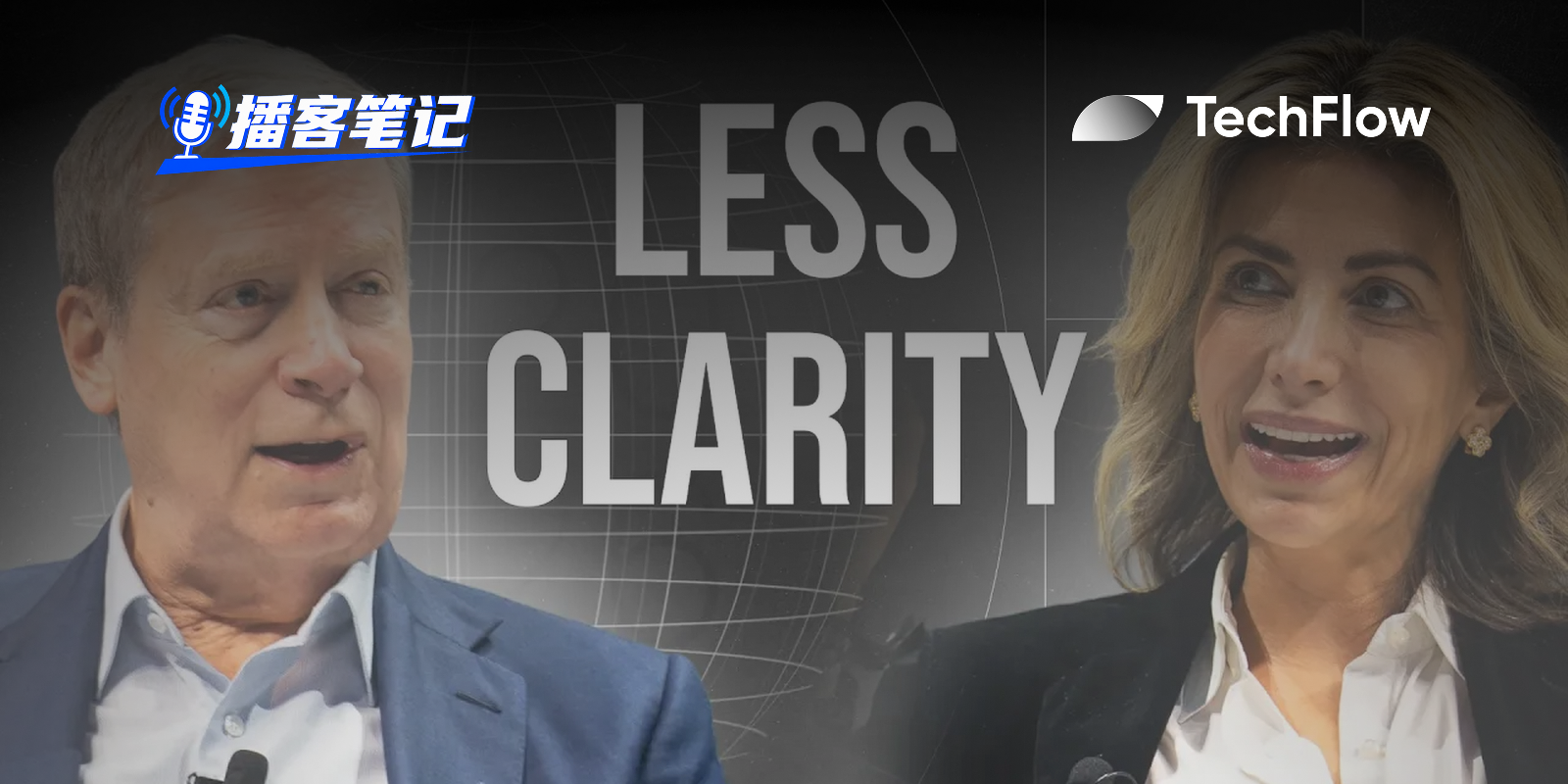
Podcast Notes | Conversation with Investment Master Druckenmiller, Who Has Profited for 30 Consecutive Years: If the Outlook for the Next 12 Months Is Unclear, the Wisest Strategy Is to Completely “Stay Out”
Compiled & Edited: TechFlow
TechFlow Guide: As Wall Street's most legendary macro hedge fund manager over the past four decades, Stanley Druckenmiller once created the myth of delivering compound annual returns exceeding 30% for 30 consecutive years, with zero loss recorded in any single calendar year. However, in this latest conversation, the macro godfather known for his sharp and ruthless precision has rarely issued such a highly cautionary statement: In his 50 years in the industry, he has never seen a macroeconomic environment with such blurred visibility for the next 12 months.
Facing a Federal Reserve policy pivot, renewed liquidity contraction, commodities topping out, and unconstrained fiscal deficits conspiring together, Stanley Druckenmiller has chosen to fully activate an "auto-reply mode: don't look for me, I'm out." From liquidating stock positions to shorting copper, from subverting traditional intuition-based methods of "size the position first, research later," to candidly admitting the painful lesson of chasing highs at the peak of the 2000 internet bubble due to FOMO, he dissects the survival rules of capital markets with utmost candor: The biggest trump card in investing isn't IQ or contrarian thinking, but the absolute discipline to go all-in when clarity arrives, and to exit decisively when visibility fades.
Guest: Stanley Druckenmiller (Founder and Chairman of Duquesne Family Office, former Chief Investment Officer of Quantum Fund)
Hosts: Gavin Baker (Chief Investment Officer and Managing Partner of Atreides Management), Eliana (Head of Global Derivatives at Morgan Stanley)
Podcast Source: iConnections (https://www.youtube.com/watch?v=6r3D-CMJkuI)
Original Title: Stan Druckenmiller: Why He's 'Not Playing' Right Now | TomorrowX Summit
Air Date: Beijing Time: 2026-11-19
Key Takeaways
- Half-century unseen macro confusion and the "stay on the sidelines" strategy: Stanley Druckenmiller bluntly states that in his 50 years in the industry, he has never experienced a period with such low visibility for the next 12 months. His portfolio has pivoted entirely to capital preservation, net stock exposure is nearly neutral, USD holdings are minimal, and he has completely entered an "off-market observation" state.
- The real truth behind three decades without an annual loss: His long-term exceptional track record does not rely on predicting stocks, but stems from cross-asset class trading (commodities, bonds, equities, and interest rates). Bonds and FX often launch major trends during stock bear markets, and when all four asset classes lack clear logic, the discipline to step back is the fundamental tool to prevent drawdowns.
- Discarding traditional risk models, using actual P&L as the only compass: Stanley Druckenmiller firmly rejects academic and bank risk control models like VaR, believing historical correlations break down completely during liquidity crises and chaotic markets. His core risk management relies solely on actual P&L; once trade performance diverges from expectations, he cuts positions immediately.
- Macro reversal from frantic longs to full retreat: Compared to the tailwinds earlier this year with loose liquidity, commodity breakouts, and Fed rate cut expectations, the current environment has been completely overturned: The Fed is shifting back toward tightening, inflation remains stubbornly above target for five years, commodities like copper have topped and reversed (we've established counter-copper shorts), the advance-decline line shows divergence, and credit spreads are widening.
- The next stop for AI investment: Moving from selling Tokens to a "Tasks Economy": Compute infrastructure trading has become highly crowded and entered a washout phase. Future maximum excess returns will come from vertical application deployment. Top AI labs will no longer stop at cheaply providing API interfaces and Tokens; instead, they will package and sell complete Tasks directly, reconstructing business models in high-barrier fields like cybersecurity and biomedicine.
- The hidden chronic gray rhino: Declining basic education and bipartisan deficit collusion: Surface prosperity masks the deterioration of K-12 basic education quality and threats to top talent inflow due to tightening immigration policies. Meanwhile, both US parties turn a blind eye to a $5 trillion massive deficit. Over the next decade, a severe financial restructuring will almost certainly be forced out by a crisis in financial markets.
- The smartest man's biggest trap and the painful warning bell of FOMO: High-IQ investors often over-rely on deep research reports, fall in love with their own arguments, and lose flexibility. Looking back at the 2000 internet bubble, after clearing positions in January, he chased highs on the day it peaked due to uncontrollable FOMO, missing the historical peak by just one hour, proving that emotional loss of control is every investor's ultimate enemy.
- Non-consensus predictions for the next decade: Clearly assigns over a 70% probability that humans will deploy data centers in space, and within the next 10 years, AI and gene sequencing will completely conquer cancer, demoting it to a controllable chronic disease.
Highlight Quotes
- "In my entire fifty years in investing, I can hardly recall a time when I lacked such clarity on the direction for the next twelve months. It's like an auto-reply now: Don't look for me, I choose not to play."
- "Many think our thirty years of zero annual losses stem from divine stock-picking skills, but actually, it's because we trade across asset classes. When stocks are unreadable, FX and bonds often see big moves; when all areas are shrouded in fog, protecting principal and not losing money is the greatest way to make money."
- "I have absolutely no faith in VaR models; they are useless when markets plunge into chaos and panic. My only risk signal is my actual P&L. Once the numbers deviate abnormally, I cut positions immediately."
- "I don't believe top AI labs will continue the cheap business of selling Tokens in the future. They will sell Tasks directly. If you hold the world's pinnacle intelligence, you become the strongest cyber defense army; you don't just define the problem, you are the only one who can solve it."
- "The most common mistake among top-tier intellectuals is falling in love with their own logic. They know to put all eggs in one basket, but forget to watch the basket closely. True winners must possess an almost pathological desire to win, while simultaneously keeping their minds wide open."
- "In January 2000, I had already liquidated my Nasdaq positions, but on the day it topped and crashed, due to severe FOMO, I chased back in, ending up buying just one hour away from the absolute peak. When asked what I learned, I said nothing, because despite knowing clearly in my heart that it was wrong, I simply couldn't control my greed."
Main Content
From Offense to Exit: Why Choose to Fully Activate "Auto-Reply" Right Now?
Gavin Baker: Looking back at our conversation at a similar event this past January, you were highly optimistic about the macro economy. You were long equities, hedging with short US Treasuries, long copper, and firmly believed the healthcare sector was poised for a breakthrough explosion. Nine months later today, how much of those original positions do you still hold?
Stanley Druckenmiller: Nearly zero, basically completely liquidated. When we spoke in January, it was a very special window. Throughout my investment career, sometimes I have extremely high conviction on the setup, and other times none at all. When I see the direction clearly, I like to place heavy bets; when I can't see clearly, I'd rather opt out completely.
At that time, the US economy was incredibly robust, the federal funds rate was around 3.5%, nominal growth hit 6%, and monetary conditions were extremely loose. The Fed's dot plot even hinted at more rate cuts within the year. Commodities led by copper broke out sharply upward, the market's advance-decline line hit new highs, and credit spreads were extremely tight. Given that highly stimulative monetary environment, a recession erupting within six to twelve months was virtually impossible. Coupled with the accelerating evolution of foundational models since last autumn, the entire industry was feverish about capex, and all signals supported our long stance.
However, a series of subsequent external shocks forced us to adjust. Fortunately, as we quickly corrected and bought back core assets, the logic behind the AI infrastructure boom became even clearer. We took the opportunity to cleanse all redundant, non-explosive positions from our portfolio.
But looking at today, the situation has been completely overturned. Economic data superficially still appears resilient, but every macro pillar that drove our bullish stance at the start of the year has undergone a reverse reversal: The Fed has not only halted rate cut expectations but faces renewed tightening pressure; inflation has run above target for five consecutive years; commodities broke out early in the year only to form a comprehensive top and turn downward, and we have even flipped to establish copper shorts; although broad indices hit new highs, the advance-decline line topped out back in mid-August, and credit spreads continue to widen.
This is where my alertness lies. All leading indicators have moved to the opposite side of where they stood in January. Therefore, I am neither long nor short equities right now. I enjoy shorting, but against such surging technological innovation, I dare not blindly short the broad market. Lacking clear guidance, I am doing what I have done for the past fifty years: turning on auto-reply and choosing not to participate.
Gavin Baker: I heard you set an auto-reply on your phone that literally says "Don't call me, I'm done playing." What exactly is your current positioning?
Stanley Druckenmiller: That's correct. We currently hold only a negligible long USD position, our net equity exposure is essentially flat after long-short hedging, and overall we are in a completely hands-off observational state.
Many people mention my thirty years without a single annual loss when introducing my track record, which is partly down to luck with calendar cutoffs. I've endured extremely brutal drawdowns, but I never closed the year on December 31st in the red. More importantly, we trade across four major asset classes simultaneously: commodities, bonds, equities, and FX/rates. We never feel compelled to cling to any single market.
Because of this multi-asset toolbox, when equities enter a bear market chaos phase, bonds and FX often embark on magnificent large-scale trends. This allows us to calmly leave equities on the sideline. Right now, not only do stocks lack certainty, but other major asset classes are equally shrouded in fog. We have fully switched to a defensive posture centered on capital preservation. Our primary goal now is to avoid losing money, not to make big money.
The Core of Risk Control in Macro Trading: Why P&L Far Surpasses All Theoretical Mathematical Models?
Gavin Baker: You have a very distinct personal style in managing risk, never using Wall Street's mainstream VaR (Value at Risk) or stress testing models. Could you share with everyone how you judge whether you are in a tailwind or headwind cycle?
Stanley Druckenmiller: We indeed never rely on those academic risk metrics. Back when I managed Quantum Fund for George Soros, major Wall Street banks actually refused to lend us leverage at one point because we couldn't provide a VaR report. Finally, to satisfy compliance, I had to casually toss them a so-called mathematical model.
In the real world, my only risk compass is my actual P&L. Since we employ a multi-asset matrix approach, if my portfolio's P&L performance starts detaching from expected logic, and yields across different assets no longer resonate according to established patterns, I immediately start cutting positions.
Why is P&L more effective than VaR? Because once the market plunges into panic and disorder, all correlations derived from historical data shatter instantly. Earlier this year, many top quant and multi-strategy funds blew up in their software and AI compute infrastructure hedging trades precisely because mechanical hedge models failed completely against black swans, whereas actual profit-and-loss curves sound the alarm immediately.
Another core aspect is recognizing one's own "hand feel" cycle. Just as streaks happen in baseball hitting, investment trading features strong winning and losing streaks. Sometimes your vision is sharp, seeing every pitch crystal clear; other times you swing and miss repeatedly, completely off-station.
One of my most important duties is clearly knowing whether I am currently hot or cold. When my hand feel is scorching and logic flows smoothly, I place heavy bets without hesitation; when I hit a valley and feel lost, I only probe with tiny positions. If these probe trades start consistently yielding positive returns, it indicates my perception is recovering, and only then will I gradually ramp up power.
The AI Valuation Tipping Point: Shifting from Compute Infrastructure to a "Tasks Economy"
Gavin Baker: Although you remain on the sidelines regarding the broader market right now, within the radar of equity assets, what ongoing changes still keep you deeply interested?
Stanley Druckenmiller: Observing commodity price action and the sudden shift where defensive sectors are broadly outperforming pro-cyclical ones, I am highly wary of the possibility of an unexpected economic stall in the next two to three years, which directly impacts my foundational judgment on interest rate trends.
Within the stock market itself, our focus is shifting comprehensively from "AI Infrastructure" to "AI End-Use Cases." While compute hardware and infrastructure might still offer tactical trading bounces—since recent chip structures have undergone deep washouts—I believe hard infrastructure will rarely deliver explosive main wave returns like it has over the past four years. Real alpha will belong to specific deployed applications.
In my view, the most disruptive business model evolution may occur within the top foundational model labs themselves. Personally, I completely doubt these labs will stay stuck in the low-margin pass-through business of selling base Tokens for the long term.
My judgment is that they won't even easily publish model weights publicly in the future. If you command the world's most powerful intelligence engine, you can directly sell specific business Tasks rather than cheap compute Tokens. Take cybersecurity as an example: who can compete with top model vendors in this field? They personally engineered complex problems in code and attack dimensions, and their exclusive agent armies are the only force capable of providing round-the-clock automated defense. From healthcare to cyber defense, tasks economies that deliver direct outcomes represent the final form of AI.
The Hidden Gray Rhino Behind the Glamour: Educational Regression, Immigration Policy, and Massive Fiscal Black Holes
Gavin Baker: Social media often focuses excessively on immediate noise, but many events truly deciding a nation's fate slowly and quietly evolve beneath the surface. Currently, what deeply overlooked crises deserve everyone's vigilance?
Stanley Druckenmiller: The first thing quietly happening—and terribly heartbreaking—is the avalanche of K-12 basic education quality in this country. For decades, the US maintained its tech hegemony by bypassing shortcomings in local basic education, relying entirely on continuously absorbing the world's top immigrant geniuses. Look at the top ten global tech giants today; the vast majority of their helmsmen are first-generation immigrants.
And the most dangerous signal now is that basic education continues to deteriorate, while tightening immigration policies threaten to sever the pipeline of top-tier external talent flowing into the US. If these two trends solidify simultaneously, the foundational soil for tech prosperity will be thoroughly eroded.
The second slow-evolving gray rhino, as that classic proverb goes: "How do you go bankrupt? Gradually at first, then all at once."
Back in 2011 and 2012, I spent two full years crisscrossing major universities nationwide, trying to warn the younger generation: Our generation is looting our descendants' wealth through unrestrained welfare promises. Just flip open demographic statistics charts, and everyone can see that between 2020 and 2030, aging demographics and debt deficits will inevitably face ultimate reckoning.
Even with such grim predictions back then, I never imagined the government would outright squander $5 trillion during the public health crisis, and subsequently escalate fiscal deficit expansion under the cover of zero rates. If this trajectory doesn't undergo a fundamental reversal, the US will sooner or later face French-style debt rating turbulence. While I firmly believe the US will eventually push through serious fiscal reform, as a macro investor, that reform will almost certainly be forced out by a financial market liquidity crisis, at which point pricing systems for all asset classes will look completely different from today's.
The Underlying Code of Investing Masters: Bet First, Research Later, and Curbing Fatal FOMO
Gavin Baker: You've famously said, "My alpha doesn't come from IQ, but from the decisiveness to pull the trigger." You've also discussed how top intellectuals often lose themselves through over-analysis. In your observations, what fatal mistakes do high-IQ groups most easily make in investing?
Stanley Druckenmiller: This industry demands near-harsh intellectual humility, requiring you to maintain radically open-mindedness at all times.
I highly revere a quote by Mark Twain: Put all your eggs in one basket, and then watch that basket like a hawk. I fully support building highly concentrated core positions. But many hyper-intelligent elites often only remember the first half, completely forgetting the second half: watch the basket closely.
They tend to fall too deeply in love with their carefully deduced logical hypotheses, so when objective reality drifts away, they remain entrenched and refuse to adjust. Having a superior logical framework is one thing, but random events happen in the market every single day, and high IQ often breeds fatal stubbornness and inflexibility.
The gap between truly excellent investors and top masters lies in the combination of four dimensions: a near-pathological extreme passion for the market; an tireless thirst for knowledge; a competitive drive with zero tolerance for failure bordering on paranoia; and most centrally, investment discipline rigorously adhered to for decades regardless of the strategy adopted. This is absolutely not an industry that emphasizes so-called "work-life balance." Every trading counterpart is going all-out, and any slackening will result in being swallowed by the market.
Gavin Baker: If a team shadowed your daily decision-making process over the past few months, what would surprise them the most?
Stanley Druckenmiller: Probably our internal decision mechanism called "size the position first, research later."
I am also a technical analysis practitioner. When I see a highly attractive chart pattern, hear a macro narrative aligning with business intuition, and find that the person pitching the idea is passionate and authoritative in their field, I will build a heavy position enough to cause physical pain, doing so while holding only 15% of the information traditional fund managers require.
Subsequently, I hand this asset to our research team, tasking them with conducting a carpet-bombing exhaustive deep dive over the next two to three weeks, to decide whether to add to the position or take a stop-loss and exit. This decision-making carries immense intuition and betting attributes, but it is precisely this fast-strike mentality that has allowed me to prevail repeatedly over long stretches of time.
Gavin Baker: What human weakness caused you your most devastating losses?
Stanley Druckenmiller: Losing emotional control shattered trading discipline. It happened in very rare moments of my career. The most brutal one was twenty-six years ago, but I still remember it vividly, as if yesterday.
In January 2000, I had already cleared all Nasdaq dot-com stocks based on macro insights. But by March that year, watching the market skyrocket wildly, I fell into extremely severe FOMO. On the exact day the Nasdaq topped and crashed, I actually bought the whole batch of stocks back near the absolute peak.
Post-trade review showed that the moment I bought in differed from the Nasdaq's historical peak by merely one hour. When people asked me what lesson I learned afterward, I said none, because in that split second of chasing high, though I knew clearly in my heart it was wrong, I simply couldn't control my greed and inner demons.
Non-Consensus Predictions for the Next Decade: Space Data Centers and Conquering Cancer
Gavin Baker: If asked to give a few non-consensus predictions for the next decade that sound unbelievable but you believe have at least a 20% or higher probability of coming true, what would you list?
Stanley Druckenmiller: I have three very firm non-consensus expectations:
First, the probability of commercial fusion technology landing is absolutely above 20%, even a necessary trend;
Second, due to extreme bottlenecks in ground power grids and cooling resources, there is at least a 70% probability over the next decade that humanity will deploy and operate large-scale orbital data centers in space;
Third, I served as a director at Memorial Sloan Kettering for a full thirty years. During the first decade, medical research struggled painfully forward; but with the geometric intervention of gene sequencing, immunotherapy, and today's AI foundation models, cancer is being precisely deconstructed into personalized cellular mutations. I firmly believe that within the next ten years, humanity will completely conquer cancer, demoting it to a fully preventable and controllable chronic disease. This progress absolutely does not require twenty years.
Join TechFlow official community to stay tuned
Telegram:https://t.me/TechFlowDaily
X (Twitter):https://x.com/TechFlowPost
X (Twitter) EN:https://x.com/BlockFlow_News
 深潮TechFlow