Conversation with Bridgewater's Ray Dalio: Why Great Technology Is Often Not a Great Investment?
Compiled & Edited: TechFlow
TechFlow Highlights: As financial markets celebrate trillion-dollar AI valuations and wealth-creation myths, Bridgewater Associates founder Ray Dalio issued a calm, cycle-transcending macro warning in an exclusive interview with Sourcery: one must strictly distinguish between "wealth" and "money." Wealth is merely a paper valuation on an account; asset bubbles typically rupture completely when wealthy individuals are forced to liquidate assets to raise cash. From the electricity grids, automobiles, and radios of the 1920s to the internet in 2000, every great technological breakthrough in history has triggered capital frenzy, but very few have ever directly translated into superior investment returns.
In this extensive 51-minute interview, Ray Dalio unreservedly delineated the five macro forces driving historical evolution, America's deep-seated wealth polarization and public education crisis, and detailed his AI decision-making system that algorithmically encodes a lifetime of investment principles and causal logic. He deeply dissected how Bridgewater’s "Dot Collector" mechanism achieves radical truth and radical transparency, pointing out that the traditional human method of weighing decisions purely within one's head is obsolete, and explained why exceptional leaders must possess the mental humility of "knowing what you don't know." Facing the unknown macro cycles of history, he not only reconstructed macro investment logic but also shared ultimate reflections on the three stages of life, peer confrontation, and the meaning of life.
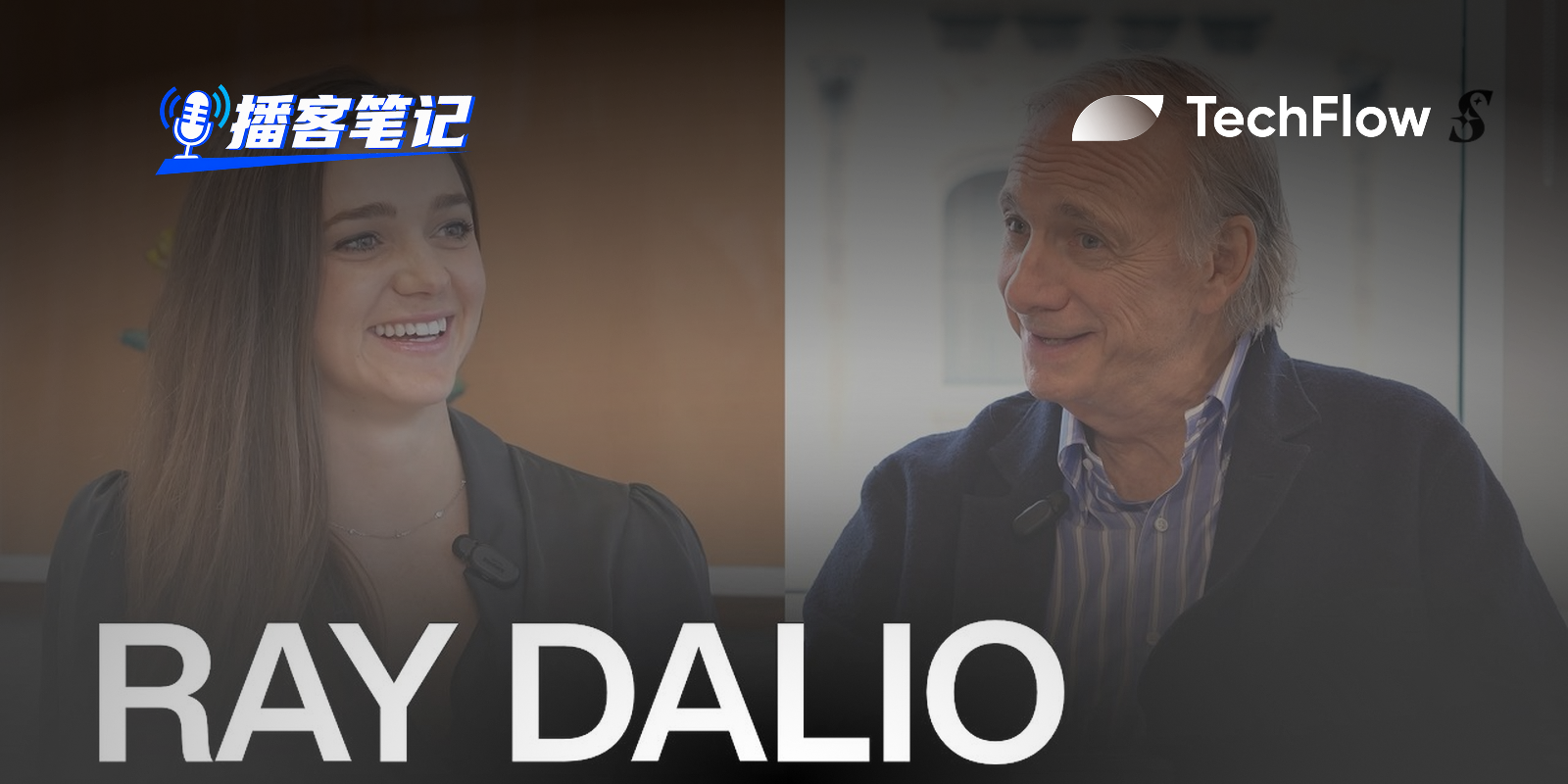
Guest: Ray Dalio (Founder of Bridgewater Associates, Author of Principles)
Host: Molly O'Shea (Host of Sourcery Podcast)
Podcast Source: Sourcery with Molly O'Shea (https://www.youtube.com/watch?v=X5FuYnLtB6k)
Original Title: I Finally Interview Ray Dalio
Broadcast Date: Beijing Time: 2026-11-23 22:00
Key Takeaways
The Essential Divide Between Wealth and Money: Paper Valuations Are Not Liquid Cash: Wealth cannot be consumed directly; it must be sold and converted into fiat money before it can be spent. Creating $1 billion in paper wealth through a $50 million investment round is straightforward, but bubbles typically burst completely when wealth holders face liquidity crunches, debt repayment pressures, or rigid tax obligations and are forced to liquidate. There is simply not enough money and credit in the market to absorb simultaneous liquidation by everyone.
Great Technology Does Not Equal Great Investments: Beware of History's Ruthless Repetition: The proliferation of home electrical grids, radios, automobiles, and airplanes in the 1920s possessed a technological disruptive power far exceeding today's AI. However, after frenzy-driven blind credit expansion inflated valuations, the market's deleveraging phase ultimately drove assets into fragile hands. Markets overly concentrated on a single new technology are extremely vulnerable; eventually, 90% of companies will go bankrupt and be cleared out amid fierce competition.
The Five Macro Forces Driving Historical Evolution Are at the End of a Long Cycle: The monetary and credit debt cycle, internal political order and wealth gap, external geopolitical games among major powers, natural disasters, and technological innovation are five intertwined forces. The current global order is at the end of a long cycle dating back to 1945; soaring debts and social polarization are testing the resilience of institutions, and history is repeating classic patterns humanity has witnessed countless times.
Wealth Polarization Is Not Just About Inequality: It’s Also Unequal Access to Opportunity and Education: Taking Connecticut, a state with top-tier per capita income, as an example, a staggering 22% of high school students statewide are on the verge of dropping out or falling off the radar. If lower-income groups lose fair access to education and upward mobility across class lines, the foundational trust of society will crumble, making populist confrontation inevitable.
The Traditional Human Brain Decision-Making Model Is Obsolete: Building a Symbiotic System of Extraordinary Human Wisdom and AI: At 77, Ray Dalio is coding a lifetime of investment principles and causal logic into algorithms. The world has become too complex; the traditional "test-taker" model of weighing pros and cons solely in one's head can no longer cope with volatile environments. The future belongs to decision-makers who can algorithmize causal logic and achieve symbiotic evolution between machine and human wisdom.
Mental Humility and Confronting Ignorance: Arrogance and Mistakes Are Humanity's Greatest Tragedy: True excellence does not lie in giving standard answers in traditional exam-oriented education, but in "knowing what you don't know." Bridgewater achieves radical truth and radical transparency through its "Dot Collector" system. Only by embracing thoughtful disagreement can one pierce through bias to reach objective truth.
Key Insights
"You must distinguish between Wealth and Money. You cannot consume wealth directly; you must sell it and convert it into money to spend it. Asset bubbles typically burst precisely at the moment those holding wealth urgently need to liquidate their assets for cash."
"A fatal error people often make is mistaking a great new technology for a great investment. In the 1920s, electrical grids reached homes, and cars and planes emerged; technological breakthroughs were even more shocking than today, yet blindly credit-inflated assets still faced catastrophic clearance."
"The traditional method of an individual simply weighing pros and cons within their own mind to make decisions is completely obsolete today. The future belongs to decision-makers who write causal logic into code, achieving symbiotic evolution between extraordinary human intelligence and artificial intelligence."
"Elite education rewards students who memorize and know the answers, which is the worst selection mechanism. The deepest tragedy of humanity is harboring arrogant biases while remaining blissfully unaware that you are wrong."
"More important than finding mentors is finding peers who can engage you in thoughtful disagreement. They bring different perspectives and will challenge you without superficial politeness, pushing you closer to true reality."
"If someone spends their entire life staring only at making money, yet never thinks about genuine connections between people, meaningful work, and meaningful relationships, that is truly incomprehensible."
"So-called spirituality is not religion, but empathy born from putting oneself in another's shoes. Recognizing that you are merely a tiny part of the whole, and seeing the world through others' eyes, is how you attain true, lasting health and peace."
"What you truly need is little more than a bed, an apartment, and three meals a day. Beyond that, you possess absolute freedom. Dare to take the risk; after all, how much actual risk are you really taking?"
Full Dialogue Transcript
Origin & Macro Framework: The 500-Year Cycle and the Five Forces Driving the World
Molly O'Shea: Ray Dalio, welcome to the Sourcery podcast! You have always been among my top 100 dream guests for interviews, as our show focuses on venture capital, cutting-edge technology, and macro investing. We actually chatted before we started recording, discovering a fascinating connection: not only are we fellow townspeople from Westport, Connecticut, but we share the same birthday, August 8th. Today we are recording in the Pro Se office, and we deliberately placed a shark model behind us to pay tribute to your longstanding dedication to ocean exploration. As a top-tier global macro investor, you've always been explaining the underlying mechanics of how the world operates to the public. First, to lay the foundation for our entire conversation, could you systematically outline the five core forces that drive the evolution of human history?
Ray Dalio: It's a pleasure to speak with you and all the listeners. Indeed, Bridgewater was born in Westport, so meeting here on the same birthday and in the same hometown is a wonderful thing.
As a global macro investor, my job is to see all the variables that might affect the market and economy, and then get real money down based on what I see. Looking back at my experience, in 1971 I worked as a clerk on the floor of the New York Stock Exchange. One Sunday evening, President Nixon suddenly appeared on television to announce that the US would stop converting dollars into gold. At that time, gold was the true fiat money, so this was essentially a debt default, even though he didn't use that word at the time. On Monday morning, when I walked into the NYSE trading floor, I thought it would be a cataclysmic disaster and the stock market would crash and plummet. But the exact opposite happened; the stock market went up instead of down, embarking on a massive rally. That left me completely bewildered, unable to understand the mechanism behind it.
This drove me to systematically study history. I discovered that in March 1933, President Roosevelt did the exact same thing. Through this, I thoroughly understood the mechanical transmission mechanism of currency devaluation and liquidity injection. I deeply reviewed the Great Depression and the historical period from 1930 to 1945; it was that research that helped me accurately predict the 2008 global financial tsunami decades later. Subsequently, I conducted cross-cycle studies on 500 years of human history and found that similar events constantly repeat themselves, driven primarily by five core forces.
Behind these five forces lies strict physical-mechanical logic: First is the operating mechanism of the money, credit, and debt markets; second is the internal political order—how we treat each other, specifically the wealth gap and values divide, and whether the existing system resolves or fails to resolve these divisions; third is the international geopolitical order. In the past, we relied on so-called multilateral mechanisms to resolve disputes, such as the UN, WTO, and even the International Court of Justice, but that was actually a naive assumption. As major powers rise and fall, these multilateral constraints have vanished, and we have entered a classic pattern of power confrontation; fourth is natural force—the lives lost to droughts, floods, plagues, and the reshaping of the world order far exceed human imagination and absolutely cannot be ignored; fifth is science and technology—the ability of humanity to improve total factor productivity and change living conditions through learning and innovation. The key lies in whether this technology is used for war and destruction or for enhancing human well-being.
These five forces intertwine, usually forming a long-term macro cycle spanning a person's lifetime. 1945 marks the starting point of the current round of world order. With emerging powers rising to challenge established ones and global debts accumulating like a snowball, turbulence inevitably follows. History always oscillates between disorder and prosperity, rebuilding order, and then moving from prosperity to severe polarization, major conflict, and back into disorder. These five forces interact, forming the underlying framework for everything we discuss today.
US Political Turning Points & Deep Fractures: The Rise of Moderates, Historical Fate of Extremism, and the Debt Deadlock
Molly O'Shea: Tying into the most timely topic right now, the US election has just concluded, which is exactly the second force you mentioned. Could you break down the underlying mechanisms for us and tell us what happens next as power shifts in America? What do you think is the most unexpected possible outcome in this博弈?
Ray Dalio: I believe we must first recognize a core reality: we have merely changed the people handling the problems, but the problems themselves remain entirely unchanged. Those issues are still objectively there. We still face a heavy debt crisis, still face the vast wealth gap and value divide between left and right wings, and still face severe challenges like climate change and geopolitical confrontation. We have only changed the specific decision-makers sitting at the table to handle these challenges.
History repeatedly proves that for a democratic system to run smoothly, there is often only one successful path. On the political spectrum, there are left and right wings, forming a continuous gradient: extreme left, moderate left, moderate right, and extreme right. Within this gradient, there is not only confrontation between the left and right, but after one side wins an election, intense internal strife will also erupt between moderates and extremists within the winning party. We will soon see how they handle real-world dilemmas, such as the debt ceiling issue coming to the table in the economic sphere. Around December 11, debates will fully erupt, and the博弈 during this transition phase will be incredibly fierce. For instance, Elizabeth Warren may very well chair the Senate Banking Committee; since their ideologies differ radically, contradictions will continue to escalate.
If I had to name the most unexpected yet most hoped-for outcome, it would be genuinely seeing a cross-party force of moderates rise up and collaborate effectively. When I observe the swing-state candidates who flipped in this election, the situation is highly revealing: although they are nominally called Democrats, they bear no resemblance to radical leftists with socialist leanings. Their governing style is nearly identical to that of moderate Republicans, favoring a rational, pragmatic centrist path. In essence, there are four parties currently operating in America. The only effective way to resolve these conflicts is for moderate Democrats and moderate Republicans to bridge party lines and join hands to jointly curb extremist impulses. Because the vast majority of ordinary citizens actually reside in the moderate center.
And the biggest political deadlock behind this is: facing unsustainable, trillion-dollar-level debt, no one in either party is willing to bear the political cost of raising taxes, nor anyone willing to voluntarily cut public spending.
Molly O'Shea: Do extremists usually eventually mean-revert? Is extremism merely a political tool to win elections, or will it become permanently entrenched?
Ray Dalio: Generally speaking, when divides exceed the threshold of reconciliation—meaning when factional interests supersede reverence for and adherence to the political system—the entire institution plunges into extreme danger. This is almost invariably followed by some form of civil strife or intense confrontation, until one side utterly overwhelms the other and imposes its will upon society. In a博弈 involving four political factions, once one side claims a surface victory, a life-and-death struggle for dominance will inevitably erupt between moderates and extremists within the winning camp. This is precisely the historical stage we find ourselves at.
Hidden Ulcers Beneath Prosperity: Connecticut's 22% High School Dropout Rate and the Social Crisis of Unequal Opportunity
Molly O'Shea: I want to follow up on the first force. In our recent discussions, societal class opposition and the wealth gap have become glaringly obvious. For example, California's previous proposal for a wealth tax sparked massive debate, and socialist sentiments are clearly surging across America. I previously interviewed David Friedberg, and you also discussed K-shaped economic divergence with him. Where exactly does the root of this wealth divide lie? How will this massive debt ultimately resolve?
Ray Dalio: The core root of all this lies in the severe lack of productivity across society. When you look across history, if a country wants to maintain enduring prosperity, it must fundamentally accomplish three or four things: First, it must provide quality basic education to all citizens, ensuring the vast majority possess skills to create productivity and maintain basic civilized standards in interpersonal interactions; second, people must be able to efficiently cooperate to create productivity within legal and rule-based frameworks, because living standards are entirely determined by productivity; third, it must stay away from the devastation of war, whether internal撕裂 wars or external military conflicts. Scanning human history, as long as these three things are done well, a prosperous and powerful society can be built.
However, over the past few decades, this educational foundation has largely failed. Here's a shocking example: In the US, nearly 60% of adults read below a sixth-grade level. I feel this intuitively because I've lived long in Connecticut, and my wife has dedicated herself to helping disadvantaged groups. In Connecticut, which consistently ranks first or second nationwide for per capita income, a staggering 22% of public high school students are completely dropping out or facing academic failure due to absentee rates exceeding 25%! This means a massive portion of our society lacks both the skills to create productivity and the civilized discipline to follow rules.
Right-wing capitalists often emphasize: Everyone must strive to create value based on merit, and self-interest is the greatest motivator. But history shows this single logic, pushed to its extreme, inevitably leads to uncontrollable wealth gaps. The Industrial Revolution birthed the Gilded Age and robber barons, which in turn spawned financial bubbles and the Panic of 1907, eventually sliding into World War I. Meanwhile, the left contends: We can't even secure basic education funding; budget gaps between districts are sky-high, food and drug crises continuously deteriorate low-income communities. Grassroots populations deeply feel the current system isn't serving them. When they see the wealthy flashing designer bags worth $1,200 while they can't even afford their children's basic tuition and lunch, class hatred and conflict become an unavoidable inevitability.
The Physical Essence of Wealth & Money: Why Asset Bubbles Always Burst When Liquidation Is Needed?
Molly O'Shea: Following this topic, the wealth-creation myths of tech giants are undoubtedly widening this gap further. For instance, SpaceX's valuation is approaching two trillion dollars, and Anthropic is rumored to have expectations of one to two trillion. More notably, Anthropic specifically incorporated as a Public Benefit Corporation (PBC) for this purpose. Do you view this as a defensive remediation strategy? Are they trying to shield themselves from moral judgment and prove to the public that "we are actually benefiting humanity"? What is the essence of this practice?
Ray Dalio: We must strictly separate Wealth and Money in physical mechanisms. You cannot consume wealth directly; you must sell it in the market and convert it into fiat money before you can actually spend it.
In capital markets, creating账面 wealth is relatively easy. For example, through a $50 million tranche of marginal financing, you can push a company's overall valuation to $1 billion. In an instant, $1 billion in账面 wealth is created out of thin air, and you instantly become a账面 billionaire. But until you actually dump these equities on the open market to exchange for cash, this so-called wealth has zero practical utility.
The reason asset bubbles burst lies in their physical-mechanical nature: People holding massive账面 wealth, at a certain moment, due to debt repayment pressure, liquidity drying up, or mandatory tax burdens, are forced to liquidate their assets into money. This often happens because they borrowed heavily to leverage up in order to create those assets initially. Going back to the PBC you mentioned, they indeed sit on enormous账面 wealth, but can those账面 valuations smoothly convert into real cash? Because expenses require actual currency. Doing charity and giving back to society is certainly a wonderful virtue, but账面 valuations will never automatically transform into liquid money. We ultimately must face the core question: Where does the actual cash to absorb the liquidation come from?
Why Great Technology Isn't a Great Investment: From 1920s Automotive & Electrification Frenzy to Today's AI Bubble
Molly O'Shea: Many believe we are currently in some form of AI asset bubble. How are bubbles fundamentally formed? Approximately where are we in this cycle right now?
Ray Dalio: Many people harbor a massive misunderstanding about asset bubbles, believing that any asset price exceeding the reasonable range of discounted future cash flows constitutes a bubble. That is not the essence of a bubble, because no one can accurately forecast far-off cash flows decades down the line. Historically, even industries that ultimately generated enormous cash flows experienced brutal bubble bursts. Take the 1920s industry bubble and the subsequent Great Depression; even though those technologies completely changed the world decades later, the bubble still could not escape the fate of bursting.
The core mechanism of a bubble lies in people mistakenly equating a "great new technology" with a "great investment." Think back to the 1920s: It was the first time in human history that electrical grids were wired into homes, giving households electric lights and refrigerators; movies, commercial broadcasting, assembly-line automobiles, and civilian aircraft sprang up like mushrooms. The shock and disruption of that technological revolution to ordinary people's lives was even more visceral and grand than the AI we see today. Everyone in society firmly believed in these new technologies,疯狂 borrowing and leveraging to go buy related stocks and assets. Frenzied demand created astonishing账面 wealth.
But ultimately, you still need cash to repay loans. Once interest rates rise, debt service costs skyrocket, or the government starts imposing capital gains taxes, everyone needs cash simultaneously. Where does the cash come from? Your only choice is to dump stocks. At this juncture, asset ownership has already shifted to the most fragile speculators. As we see today, the entire hope of capital markets and macroeconomics is overly pinned on the single narrative of AI. This extreme concentration makes assets incredibly fragile and volatile. Once a minor breeze blows, the positive feedback loop instantly reverses into panic selling, deleveraging stampedes erupt, and the market rapidly slides from one extreme of blind confidence to another extreme of desperate withdrawal.
The Human Brain's Decision-Making Is Obsolete: Algorithmizing Principles to Build a Human-AI Symbiotic Decision System
Molly O'Shea: How personally involved are you in AI? You've proposed that "the era of humans relying on flesh brains to make decisions is over." Does this imply a fundamental paradigm shift in human decision-making? Will over-reliance on AI damage human critical thinking?
Ray Dalio: I am thrilled by the development of AI. Back when I founded Bridgewater in 1975, my core working method was deeply reflecting on my investment decision criteria, writing these thoughts down systematically, and converting them into computer code. Since the Dartmouth Conference first coined the term AI in 1956, although technical forms have shifted multiple times, the core essence has remained unchanged: coding human deep-thinking logic, allowing computers to execute at speeds and objectivity surpassing human biological limits.
I am now 77 and fully stepped away from frontline management at Bridgewater. My current passion is algorithmically encoding the decision criteria and principles I've accumulated over a lifetime, building a decision-making machine that empowers the masses. I believe traditional decision-making—that a single person merely weighing pros and cons inside their own brain—is completely obsolete today. The world is too complex and vast; personal cognitive capacity is extremely limited when facing the unknown and volatility.
Humans and machines must form deep synergy. You must deeply distill your decision guidelines for investments or life, then put those guidelines into century-long historical data for stress testing, observing whether they remain robust under inflation, deflation, booms, or crises. The human brain simply cannot complete such cross-dimensional validation alone. We are entering a brand-new era where top-tier intellectual professionals and top-tier AI are deeply fused.
As for whether it will weaken critical thinking, it entirely depends on who uses it. I expect a large portion of the population will completely stop actively thinking, habitually saying "just tell me the answer," entirely abandoning exploration of underlying causal mechanisms and how the machine works behind the scenes. Simultaneously, another group of outstanding people will use AI to dramatically leap in cognitive dimension, exploring how reality operates as a supermachine. AI is an amplifier; it makes active truth-seekers extraordinarily powerful while rendering passive recipients increasingly mediocre.
Molly O'Shea: You are evidently a scholar deeply versed in history and intensely curious. Do you think asking "why" is the most important question when facing a complex world?
Ray Dalio: Always ask "why"! You must relentlessly pursue underlying causal relationships. Because everything in the world operates like a precisely engineered machine; every result has a preceding cause driving it, and causes always precede results. Only those who profoundly洞察 causal laws can truly gain first-mover advantage in future changes.
Bridgewater's Dot Collector & Radical Transparency: Achieving Idea Meritocracy Through Objective Data
Molly O'Shea: You created the famous "Dot Collector" system at Bridgewater. How does this mechanism help teams transcend subjective bias and see the real world? What was the toughest evaluation you ever experienced at Bridgewater?
Ray Dalio: My core creed is achieving meaningful work and meaningful relationships through radical truth-seeking and radical transparency. In a traditional meeting, usually only one person speaks; you have no idea what others are thinking internally. Traditional hierarchical evaluations are extremely subjective; a simple "I think you performed poorly" only breeds defiance and internal friction.
So I designed the Dot Collector. During meetings, everyone can use tablets to instantly rate speakers on logical clarity, analytical depth, open-mindedness, or leadership. This data is systematically aggregated, gradually outlining each person's long-term strengths and weaknesses, forming an objective personal "Baseball Card." By doing this, we transformed interpersonal evaluation into objective data-driven processes, establishing a true idea meritocracy.
I have endured many brutally harsh critiques. I remember once after a client meeting, a team member straight-up told me: "Ray, you performed terribly today. You were babbling aimlessly and never seriously listened to the client's core questions." For anyone, confronting your own weaknesses and being criticized face-to-face is intensely challenging, but overcoming emotional instincts and treating criticism as a gift to sharpen cognition is exactly the watershed for whether a person can continuously evolve. Bridgewater has exceptionally high selection standards; we pursue exceptional talent and pure culture. But frankly, throughout the grueling trial, many ultimately failed to persevere.
Candid Confrontation & Interview Anecdotes: The Elite Test-Taker Blind Spot & "Knowing What You Don't Know"
Molly O'Shea: Actually, I was one of those who couldn't persevere! It was one of my earliest interviews right after college. I was working at a growth-stage PE firm and desperately wanted to enter a top hedge fund, so I interviewed at Bridgewater. During the interview, I intellectually overcomplicated the entire exchange, frantically guessing what standard answer the interviewer wanted to hear, trying to prove how smart I was. By the end, I was utterly exhausted because I hadn't shown my authentic self at all.
Ray Dalio: In reality, there is no right or wrong, only objective facts. Hearing your experience back then makes me sincerely regret our selection system at the time; it was genuinely a missed opportunity for us. You honestly never needed to be so nervous. You just had to stay calm and simply tell us how you think. But here we are today, and I heartily congratulate you on your brilliant achievements in podcasts and VC!
Molly O'Shea: Thank you, Ray. So when selecting exceptional leaders and core team members, what core trait do you value most?
Ray Dalio: Everyone possesses inherent Nature, which dictates每个人的 strengths and weaknesses. Some excel at strategic big-picture vision, others at meticulous execution. The essence of life is constant trial and collision to find the optimal alignment between one's Nature and objective reality.
When picking talent, I value character and ability above all, and the core of that is the humble mindset of confronting ignorance and knowing what you don't know. In traditional exam-oriented education systems, elite schools often only reward test-takers who memorize content and deliver standard answers. But this is the worst selection mechanism; it breeds an arrogant illusion that getting answers right means omniscience. The deepest tragedy of humanity is harboring arrogant biases while remaining blissfully unaware you're wrong. I seek fellow travelers possessing intense curiosity, open minds, and self-reflection capabilities, who constantly examine themselves: Am I right or wrong? Only by casting aside ego and embracing external challenges can we truly transcend individual cognitive limits and march forward together in an idea meritocracy.
The Three Stages of Life & The Power of Peers: Finding Fellow Travelers Who Engage in Thoughtful Disagreement
Molly O'Shea: In past Bridgewater interviews, there was a classic open-ended question: "Do you think social media is ultimately good or bad?" What was your intention in designing such open-ended questions? Additionally, you often discuss life having different chapters. Could you deeply analyze the evolutionary logic of these macro life cycles? How should contemporary young people break through confusion and powerlessness?
Ray Dalio: The core intent of designing these questions remains assessing character and ability. The key is examining whether a candidate, absent arrogance, can efficiently collaborate with others in an idea meritocracy environment, and whether they can achieve meaningful work and relationships through radical truth-seeking and transparency for a shared mission.
Regarding life cycles, a person's life can roughly be divided into three chapters: The first third of life is basically a dependency phase where you learn. You receive education in school, follow preset instructions, and haven't truly lived your own autonomous life yet.
When you graduate and enter society, you formally cross into life's second phase. In this stage, others begin to depend on you. You become an independent decision-maker, freely choosing where to settle and what work to pursue. In this phase, you must confront realistic challenges like work-life balance, forming the core learning and evolution process. This phase usually begins around ages 23 to 25 and extends to around 40. At this juncture, you begin deeply comprehending how reality's machine operates; your leadership and external influence steadily grow. The most crucial task here is achieving a smooth transitional handoff, empowering and helping the younger generation flourish, thereby transcending individual limits and passing on a lifetime of learned wisdom.
Then you cross into life's third chapter. In this ultimate phase, you have accumulated profound wisdom and cognition, remain healthy, and can completely freely pursue what burns brightest in your heart. But as years pass, health will inevitably decline, and you must eventually calmly face life's endpoint. Whether you successfully tackle the core assignment of each stage determines the kind of life you will live.
The so-called powerlessness many young feel in the first or second stages exists largely only in their own heads. You must bravely step out and try, verifying reality's possibilities. The worst life state is being trapped in a job you despise, unable to move, complaining while swallowing grievances. Think carefully: What do you physically need? Just a bed to sleep in, an apartment for shelter, and three meals a day. These are the survival baseline. Beyond that, you possess absolute freedom to pursue genuinely loved endeavors and companions. Go for it; even in the worst case, how much actual risk are you truly bearing?
Molly O'Shea: Many believe you eventually become a composite of the five people you spend the most time with. Throughout your long career in investing and management, who influenced you the most?
Ray Dalio: It entirely depends on your own choices and actions. Young people today can fly anywhere globally, meeting wildly varied fascinating individuals. The only barrier is the psychological fence you construct yourself.
Looking back at my life, two types of people deeply influenced me: First, mentors, who can be elders or teachers guiding your direction; but compared to one-way mentorship, the second type is far more precious to me: peers capable of engaging in thoughtful disagreement with me. They possess entirely different perspectives, intellects equally matched, daring to challenge you in unvarnished logical clashes until you jointly逼近 objective reality's truth.
In early life, my parents and teachers undeniably shaped my foundational character. Later in my career, numerous figures at the power centers or holding profound philosophical views inspired me, such as Deepak Chopra, Bill Gates, and others. Discussing life's meaning or navigating complex choices alongside such brilliant minds always brings immense nourishment.
Cognitive Bias in Global Relations, Ultimate Empathy & The Meaning of Life
Molly O'Shea: You've built remarkably deep mutual trust globally. Looking back at your decades of deep engagement with China and Asia overall, what do you consider the biggest Western misunderstandings and cognitive biases toward other nations? It's incredible that the legendary figure managing the world's largest hedge fund is passionately discussing empathy. Doesn't that seem bizarre to many?
Ray Dalio: The biggest pitfall is people habitually judging the world purely from their own perspective, never bothering to empathize or view reality through another's eyes. Narrow arrogance and bias constitute the deepest cognitive barriers. If you completely drop inherent prejudices and lectures, and approach with pure curiosity, attempting to penetrate another's history and circumstances to understand their thoughts, you discover a radically different world. If you始终保持 superiority and conduct moral judgments, communication forever degenerates into playing lute to a cow. Ultimately, it all circles back to curiosity, and ultimate empathy.
So-called spirituality is absolutely not narrow religious dogma; it refers to cross-civilizational empathy. The underlying wisdom of all great civilizations is connected: You must realize you are merely a minuscule fragment of the vast whole. When you comprehend the whole's operation and build harmonious, sincere connections around you, you attain true physical and mental health. Putting oneself in another's shoes, seeing the world through others' eyes, is a vastly powerful spiritual practice.
I find nothing bizarre about discussing empathy. Conversely, I find it bizarre that so many people never ponder how to sincerely connect with others? Never consider pursuing meaningful work and relationships? Society普遍 holds a prejudice that finance investors should only coldly chase profits. In my view, if someone's sole lifelong obsession is staring at账面 profits, never caring about partners nearby, or ever thinking how earned wealth should translate into societal meaning, that life state strikes me as truly incomprehensible and bizarre.
Molly O'Shea: To close the interview, what are you most looking forward to in the next 12 months? Also, a personal curiosity: How exactly should I celebrate my birthday next year?
Ray Dalio: Several important things: First, I still deeply love the game itself. To me, global macroeconomics and financial markets evolve like a mesmerizing mega-game; regardless of顺逆 environments, my mission and joy lie in diving right into it. Second, I eagerly desire to impart my accumulated cognition and tools, empowering more youth wanting to play this game. Third, naturally, my family. I'm blessed with an incredibly outstanding wife and 9.5 grandchildren. The 0.5 is because another grandson is on the way, arriving any day now. Being with family and nurturing deep friendships with cherished friends remain what I value most in life.
As for birthdays, I know you're deliberately steering me there, since my video dancing at a nightclub in Ibiza, Spain, went viral globally last year, and I genuinely had an absolute blast. So my advice is simple: Be with whoever you love most and who brings you the most joy. Fully enjoy life and friendship, wherever in the world.
Molly O'Shea: Brilliant! Ray Dalio, thank you so much today. This conversation is unforgettable!
Ray Dalio: Thank you sincerely for the invitation.
Join TechFlow official community to stay tuned
Telegram:https://t.me/TechFlowDaily
X (Twitter):https://x.com/TechFlowPost
X (Twitter) EN:https://x.com/BlockFlow_News
 深潮TechFlow