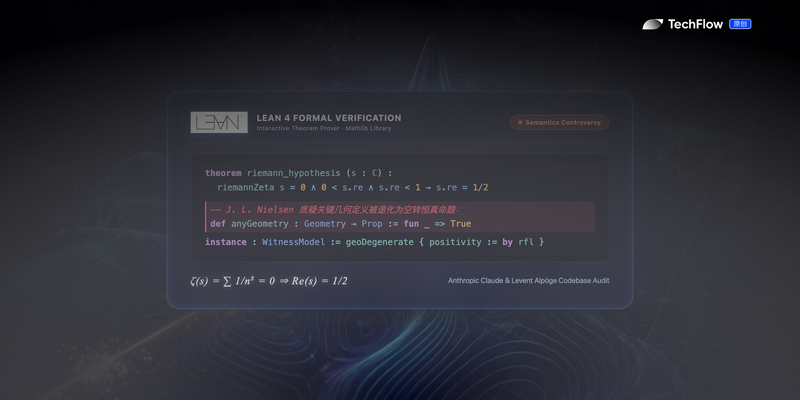
What would it actually mean for the global economy if mathematics were truly solved by AI?
Author: Campbell Ramble (Macro & Technology Analysis Column)
Translated by: TechFlow
TechFlow Summary: With the deep integration of breakthrough reasoning in large language models and Lean formal proof verifiers, mathematical holy grails that have plagued humanity for decades—such as the Riemann Hypothesis and Navier-Stokes equations—are being systematically tackled by AI. Macro-technology researcher Campbell Ramble begins with the profound analogy of “chess being solved by computers,” constructing a micro-ledger that connects mathematical theory with physical reality.
Model estimates show that if advances in applied mathematics achieve industrial penetration within twenty years, they could save the global economy $3.62 trillion annually in expenditures and preserve 280 million healthy life-years. However, the author warns that while Silicon Valley is intoxicated by the frenzy of algorithmic ascension, it often underestimates the lengthy physical engineering cycles required to “turn formulas into reinforced concrete.”
Foreword: Mathematics Is Being “Solved” Like Chess
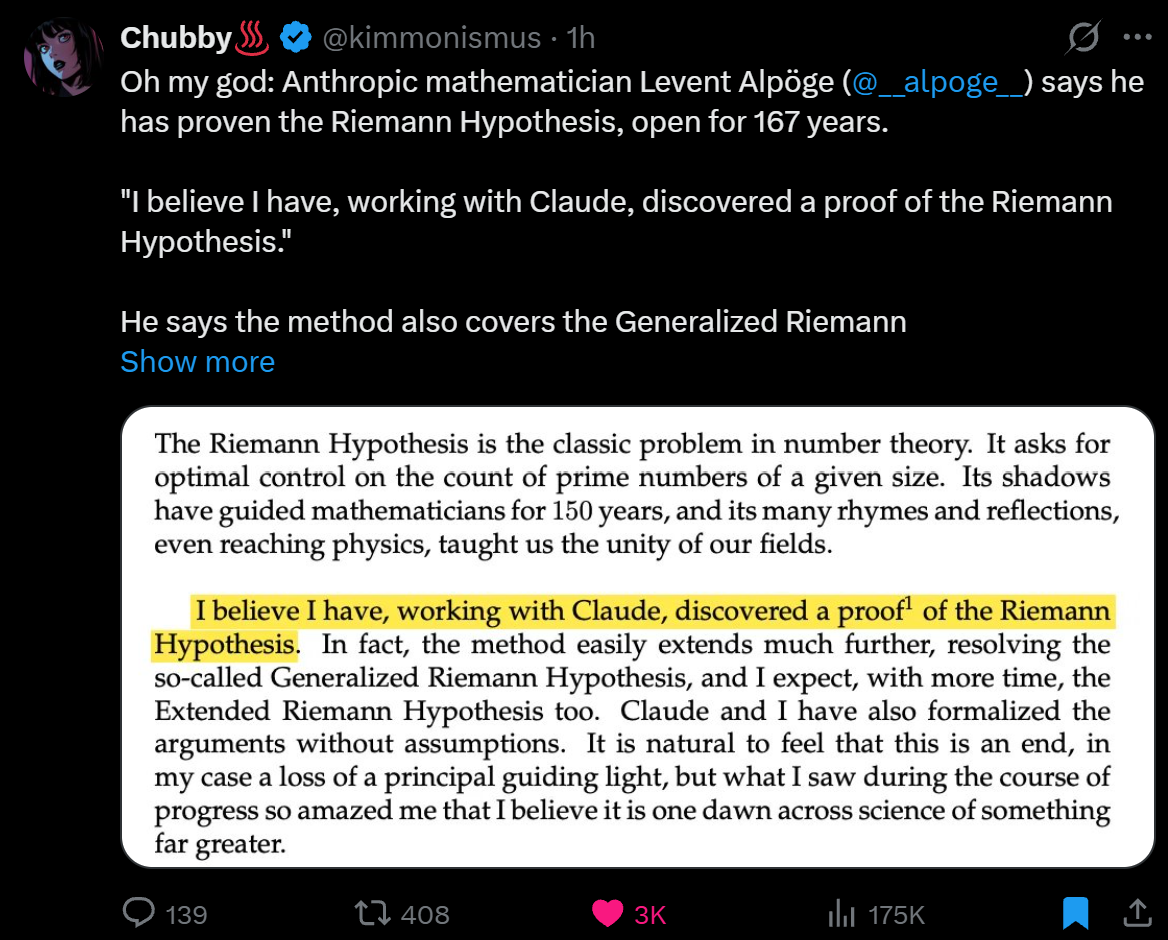
You may or may not have heard about it, but it appears we are witnessing mathematics being progressively solved by AI.
Beyond the Riemann Hypothesis lies the Exponential Time Hypothesis; before that, the Navier-Stokes equations; and further back, the Erdős conjectures, unresolved since 1946. The trend is remarkably clear: more powerful frontier reasoning capabilities, combined with automated code and formal proof checkers (such as Lean and Mathlib), are tackling problems that top mathematicians have struggled against for decades at an unprecedented pace in human history.
Faced with such breakthroughs, people often ask: “So what? How does this relate to the real world?”
To understand what this truly means, we need to start with chess.
Years ago, when Deep Blue defeated Kasparov, and later AlphaZero swept across the chessboard, many argued that chess was not yet “completely solved” because we haven't compiled a perfect exhaustive rulebook covering every possible board state. But in an engineering and practical sense, when I say chess has been solved, I mean that all of humanity's knowledge of the game is now sufficient to be condensed into a minuscule algorithmic program, allowing machines to consistently uncover deep structural patterns and winning vulnerabilities on the board that humans simply cannot perceive.
Today, mathematics is entering the same territory. Formal proof verifiers are converting centuries of accumulated mathematical axioms into structured systems that machines can rapidly traverse, solve, and verify. The ultimate question that follows is: What is this actually worth in real, hard economic terms?
The Math-to-Atoms Ledger: $3.6 Trillion and 280 Million Healthy Life-Years
How do you measure the economic value of an equation? And what is its solution worth?
To answer this, I built an empirical model: the “Math-to-Atoms Ledger”. This model cross-maps 18 applied mathematics subfields and 60 specific physical engineering challenges with 10 core economic outcomes in the real world, estimating the actual productivity unlocked by mathematical breakthroughs on a logarithmic scale.
Under highly conservative baseline assumptions (assuming mathematical breakthroughs only penetrate 50% of existing economic cost pools, with only half of those truly adopted by industry, and an average efficiency gain of 10% during application), and giving the global economy a 20-year absorption period, we arrive at a staggering set of figures:
- $3.62 trillion saved annually: avoiding global resource waste and disaster losses, representing roughly 3% of the model's $120 trillion reference economy;
- 280 million healthy life-years preserved annually (DALYs): equivalent to reducing 10% of the current global disease burden;
- 3.84 billion metric tons of CO2 emissions reduced annually: roughly 10% of total global energy-related carbon emissions, significantly lowering projected 2046 emission levels;
- Engineering R&D cycles shortened by 10%: complex industrial projects originally taking a decade can be completed in nine years through mathematical optimization.
This isn't solely about the energy revolution. Of the annual $3.62 trillion in savings, energy accounts for only $1.2 trillion (roughly one-third), while the remaining $2.4 trillion is widely distributed across complex industrial manufacturing, global logistics scheduling, and extreme disaster mitigation.
Silicon Valley's Illusion and Reality's Lag: Someone Ultimately Has to Pour the Concrete
But there is a major cognitive bias here that tech enthusiasts easily overlook.
If ranked by potential impact, the most prominent titles are undoubtedly the exhilarating grand narratives: room-temperature superconductivity, controlled nuclear fusion, and universal cryptographic breaking. However, if weighted by feasibility based on what actually deserves priority right now, the priority of fusion and room-temperature superconductivity drops sharply instead.
Why? Because they lack not only mathematical solutions, but also the massive foundational physical hardware and engineering infrastructure to support them.
Conversely, what truly deserves immediate investment today are often seemingly mundane real-world domains: insurance tail-risk pricing, adaptive complex grid scheduling, grain warehousing, and supply chain allocation. In these fields, mathematical optimization is already virtually at our fingertips, while the physical atomic world carrying them long existed.
Just as Maxwell's equations, proposed in 1865, took a full 36 years of arduous exploration before evolving into Marconi's commercial radio communication. A mathematical proof merely tells you something is logically true, but in this world, someone ultimately has to pour the concrete.
Conclusion: Uncertainty and Cross-Cyclical Real-World Grounding
In the world of software and bits, AI iteration speeds exhibit exponential compounding growth; but in the world of physical atoms, tightened capital expenditure, the construction of tangible physical equipment, and depreciation always adhere to the objective iron laws of Newtonian physics.
Just as financial markets excel at pricing risk but are extremely poor at weighing true uncertainty. The economic dividends brought by AI overcoming mathematics are undoubtedly immense, but they will not explode instantly like downloading a software update. Instead, over the coming decades, they will slowly reshape the underlying industrial landscape of human civilization like still waters running deep.
Join TechFlow official community to stay tuned
Telegram:https://t.me/TechFlowDaily
X (Twitter):https://x.com/TechFlowPost
X (Twitter) EN:https://x.com/BlockFlow_News
 @abcampbell