How to Build a "Knowledge Factory" for AI Agents?
Author: Harrison Chase, LangChain CEO
Compiled by: TechFlow
TechFlow Summary:The biggest bottleneck for enterprises implementing AI has long ceased to be underlying models or context windows; rather, it lies in the scattered, tacit, and deeply ingrained operational experiences within employees' minds. If these tacit cognitions cannot be systematically consolidated and supplied to Agents, no matter how powerful the model, it will struggle with complex real-world business tasks.
LangChain founder Harrison Chase proposed the "Knowledge Factory" architecture. By decoupling skills, domain knowledge, and data guidance, and introducing curator Agents along with human-AI collaborative feedback loops, it creates a continuously self-evolving knowledge production line.
To make AI truly create value for your enterprise, the currently missing key puzzle piece is absolutely not more powerful underlying models, nor merely cramming in more context, but higher-quality knowledge. This includes how your company actually operates, what the current business operational standards are, where your data is stored, and how to efficiently retrieve it.
Your most efficient core employees at the company are filled with this type of knowledge. They know who to communicate with, where to find answers to problems, and why certain things must be advanced in a specific way. This knowledge is often tacit, implicit, and scattered; sometimes it exists only in their memories, and other times it lies dispersed across various messy document fragments.
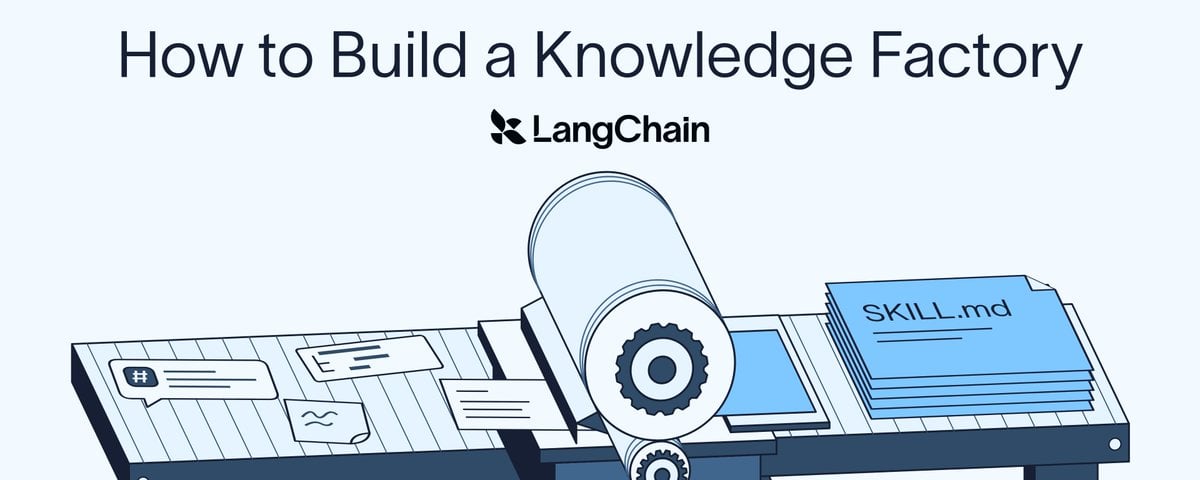
To let AI smoothly take over business operations, you must establish a mechanism to systematically collect, refine, and maintain this knowledge long-term so it can be precisely delivered to Agents. The system that assists you in completing this closed loop is what we call the "Knowledge Factory."
We have already implemented this framework internally at LangChain through multiple approaches. Our internal Go-to-Market (GTM) and content studio Agents are both powered by the Knowledge Factory; LangSmith Engine (the intelligent proxy used to analyze traces and propose repair suggestions) also maintains a dedicated Knowledge Factory for each Agent. This article will share our core practices and insights in depth.
Context vs Knowledge
Context is all information currently and instantly available when an Agent executes a specific task.
Knowledge is the continuously maintained, cross-task reusable understanding system designed to enable Agents to execute tasks accurately. Examples include the precise definition of a business metric, which data source to trust, or what guiding principles to follow in special situations. This knowledge is sometimes documented in writing, but far more often it remains unwritten.
The core mission of the Knowledge Factory is to distill scattered documents and tacit experiences from various sources into systematic knowledge, allowing them to be transformed into high-quality instant context whenever needed in future work.
Therefore, knowledge itself is a highly evolved form of the context acquired by Agents, but it should generally not be, and cannot realistically be, the sole source of context. Many other types of instant data in an enterprise can already be stably stored and ingested; these contents can be directly fed into databases and passed to Agents (see the later section on rapidly changing data).
From Software Factory to Knowledge Factory
Over the past year and a half, the concept of the "Software Factory" has been highly acclaimed. Its core logic is simple: rather than having your top engineers write software code line by line yourself, it is better for them to build a "factory system" that empowers the entire company to produce software more efficiently, while the actual code writing and software construction tasks can be fully handed over to Agents.
Today, general knowledge-based work is embarking on the same evolutionary path. Current Agents are already fully capable of creating presentations, publishing promotional videos, and drafting outreach emails. In these scenarios, you should leverage them as much as possible. But to deliver results at a truly high standard, they must master those tacit, implicit, and highly dispersed internal corporate knowledge assets.
This is exactly where enterprises should focus their heaviest resource investment today: you must build this knowledge, and more importantly, create a factory capable of continuously collecting, curating, and maintaining it. Only then can you confidently entrust more knowledge-intensive tasks to Agents.
The Three Core Modules of Knowledge
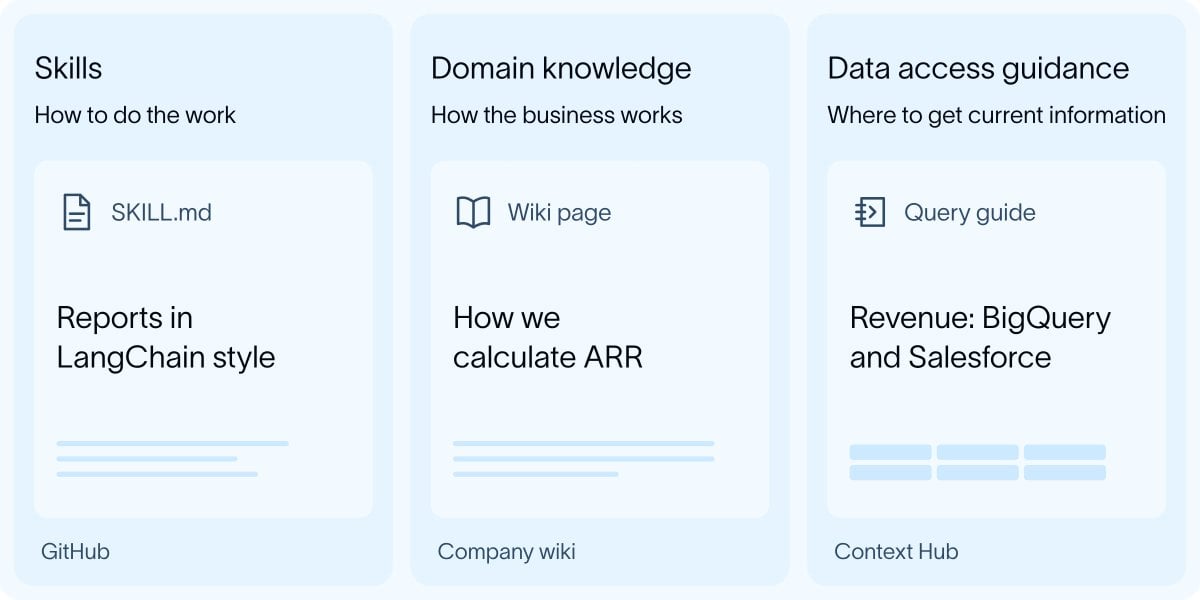
In daily operations, enterprises typically need to maintain three core knowledge modules:
• Operational Guidelines (Skills): How work gets done. Includes workflow standards, operational guides, and execution scripts for completing tasks according to company-established standards.
• Business Logic (Domain Knowledge): How the business operates. Covers explicit definitions, policy standards, and established facts regarding product features, customer personas, competitor dynamics, and organizational structure.
• Data Guidance (Data Access Guidance): Where to retrieve the latest information. Provides clear directives on which data sources to call in specific scenarios, where different datasets are stored, and how to write query statements.
Operational Guidelines (Skills): These are the specific operating procedures for "doing things right" within your enterprise. They consist of operational guides and scripts that meet specific company requirements and habits. In the past, these techniques were rarely recorded systematically, relying instead on informal mentorship passed down orally. Enterprises should now make the firm decision to consolidate them into written standards.
Domain Knowledge: This is core knowledge with a longer shelf life that is less prone to frequent obsolescence. It typically contains basic information about team organization, product mechanisms, and competitive comparisons. While this type of knowledge was previously documented, due to its extreme complexity, it often suffers from omissions or even outdated errors.
Data Access Guidance: Enterprises must possess a mature data infrastructure strategy (such as unified integration into data warehouse platforms like Snowflake or Databricks), which forms the cornerstone of building highly available Agents. If a reliable single source of truth is already in place and data is complete and up-to-date, there is absolutely no need to separately maintain a data replica. Instead, what you truly need to maintain is a clear and explicit calling guide that directs Agents on where specific data resides and how to query it efficiently.
System Components of the Knowledge Factory
To generate actual productivity from Agents, none of the aforementioned knowledge modules can be omitted. Never attempt to rely on purely manual maintenance; that would be an unsustainable burden of heavy labor. You should build an automated system for continuous maintenance. Typically, this factory system consists of the following key components:
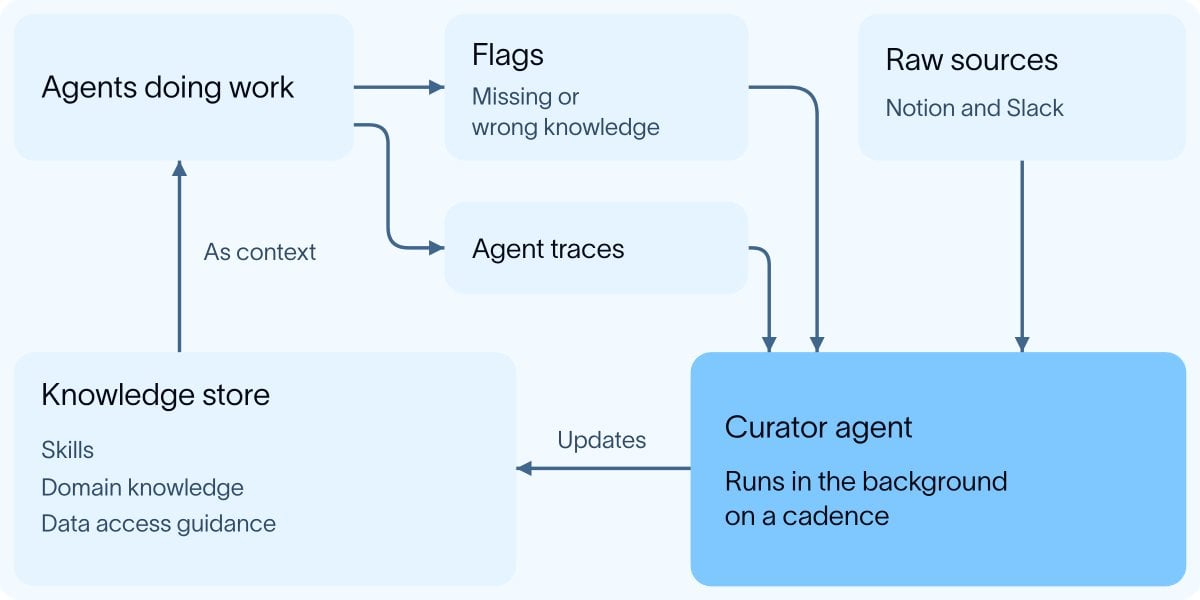
1. Real-time error reporting channel for missing knowledge: The best time to identify knowledge gaps is by empowering business Agents to proactively flag them during actual work processes. When an Agent is tasked with executing something but cannot find corresponding information, or discovers contradictions/errors in existing data, it should trigger an alert immediately! Enterprises must at least equip Agents with a dedicated tool to report anomalies, allowing them to autonomously attach modification suggestions.
2. Knowledge Curator Agent: An intelligent proxy specifically responsible for refining, updating, and maintaining knowledge. Knowledge bases cannot be updated manually due to the overwhelming workload; nor should they be directly modified by ordinary business Agents handling specific tasks. While business Agents excel at flagging errors, fixing knowledge gaps requires a deep understanding of global underlying knowledge and multi-channel data. If business Agents focused solely on single objectives are allowed to freely modify the knowledge base, the entire system will quickly fall out of control and become riddled with logical conflicts. Therefore, you need a "Curator Agent" running independently in the background that updates the knowledge base at fixed intervals. It has permissions to read various underlying raw sources (Notion, Slack, etc.), can retrieve full run traces from each Agent to observe human-Agent interaction patterns and codify them into skills, and is responsible for centrally processing all error flags reported by business Agents.
3. Knowledge Storage Medium: From one perspective, storage is actually the least critical component. You can store knowledge in GitHub using standardized skill formats, keep it as a single document in Notion, adopt the OKF format from LangSmith Context Hub, or save it into a Neo4j graph database. Interaction between the Curator Agent and these common formats is not complex. However, from another perspective, this is currently the least explored area in the industry: how exactly should we formally represent an intelligence's "memory"? The industry has largely converged on Operational Guidelines (Skills) for "procedural memory"; for the more complex "semantic memory" layer, new standards (such as OKF) will likely emerge in the future. Since a unified standard has not yet been established, the wisest approach now is to remain pragmatic and flexible, avoiding overly rigid or complex format specifications from the very beginning.
End-to-End Practical Workflow
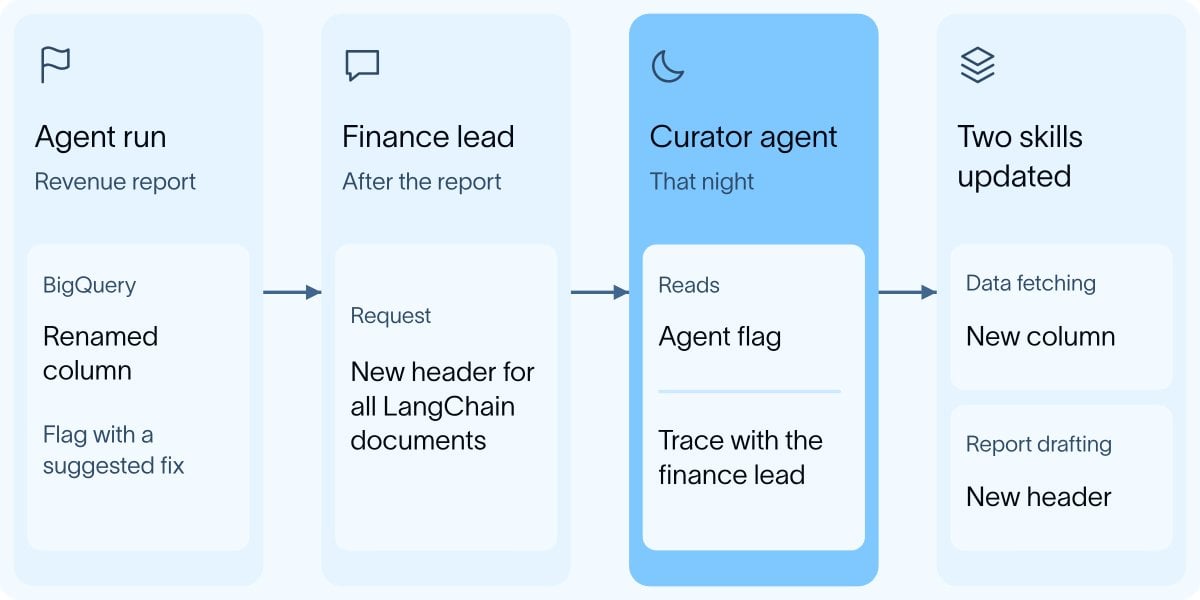
We will conduct a complete review using a real end-to-end case study: automating the compilation of a company revenue analysis report via a business Agent.
First, the Agent needs to acquire foundational instant context: raw revenue transaction data stored in BigQuery and Salesforce.
Second, the Agent needs to retrieve systematic professional knowledge, primarily covering the following dimensions:
• Operational Guidelines (Skills): How to generate and layout reports according to LangChain's standard style. This knowledge is stored in a GitHub repository in a standard skill format.
• Long-duration Knowledge: The specific financial accounting standards and formulas the company uses to calculate Annual Recurring Revenue (ARR). This knowledge is consolidated in the company's internal Wiki.
• Dynamic Knowledge Acquisition Guidance: How to query raw data in BigQuery and Salesforce. This is similarly consolidated in skill format and stored in the Context Hub.
When the Agent starts running, it might keenly notice that a certain data field name in BigQuery was recently renamed. The Agent can dynamically infer the correct data column during runtime, simultaneously use the built-in error reporting tool to flag this anomaly immediately, and proactively attach a suggestion to update the field name to match the latest standards.
After the initial draft of the report is generated, the finance director will collaborate with the Agent for joint review, manually correcting a few formatting details, such as instructing it to switch to the document header style newly standardized across the entire company.
Nightfall brings the background Curator Agent online. It captures the field anomaly reported by the daytime business Agent, while thoroughly tracing back that Agent's run history to discover the new header instruction provided by the finance director during interactions. Subsequently, the Curator Agent automatically updates the corresponding skill library: it will directly use the latest database column names on the next data pull, and default to applying the brand-new header style when drafting reports.
Conclusion
The goal of building a Knowledge Factory is absolutely not to meticulously document every trivial matter of the entire company before Agents even start working; the true core lies in establishing an agile system: automatically exposing knowledge gaps during actual work execution, and making future work more efficient by continuously patching these loopholes. We recommend starting with a single high-frequency and repetitive business process, closely observing where Agents encounter bottlenecks, and then firmly closing this loop.
We have already fully validated this architecture internally at LangChain and are currently assisting several deep-tier clients in deploying it within their respective Agent initiatives. If you are interested, please feel free to reach out to us anytime!
Join TechFlow official community to stay tuned
Telegram:https://t.me/TechFlowDaily
X (Twitter):https://x.com/TechFlowPost
X (Twitter) EN:https://x.com/BlockFlow_News
 @hwchase17