Goldman Sachs Research Report Analysis: Tight Supply and Demand Expected in 2027, Lowers Price Targets for Samsung Electronics and SK Hynix
Author: Chaoxiang Research
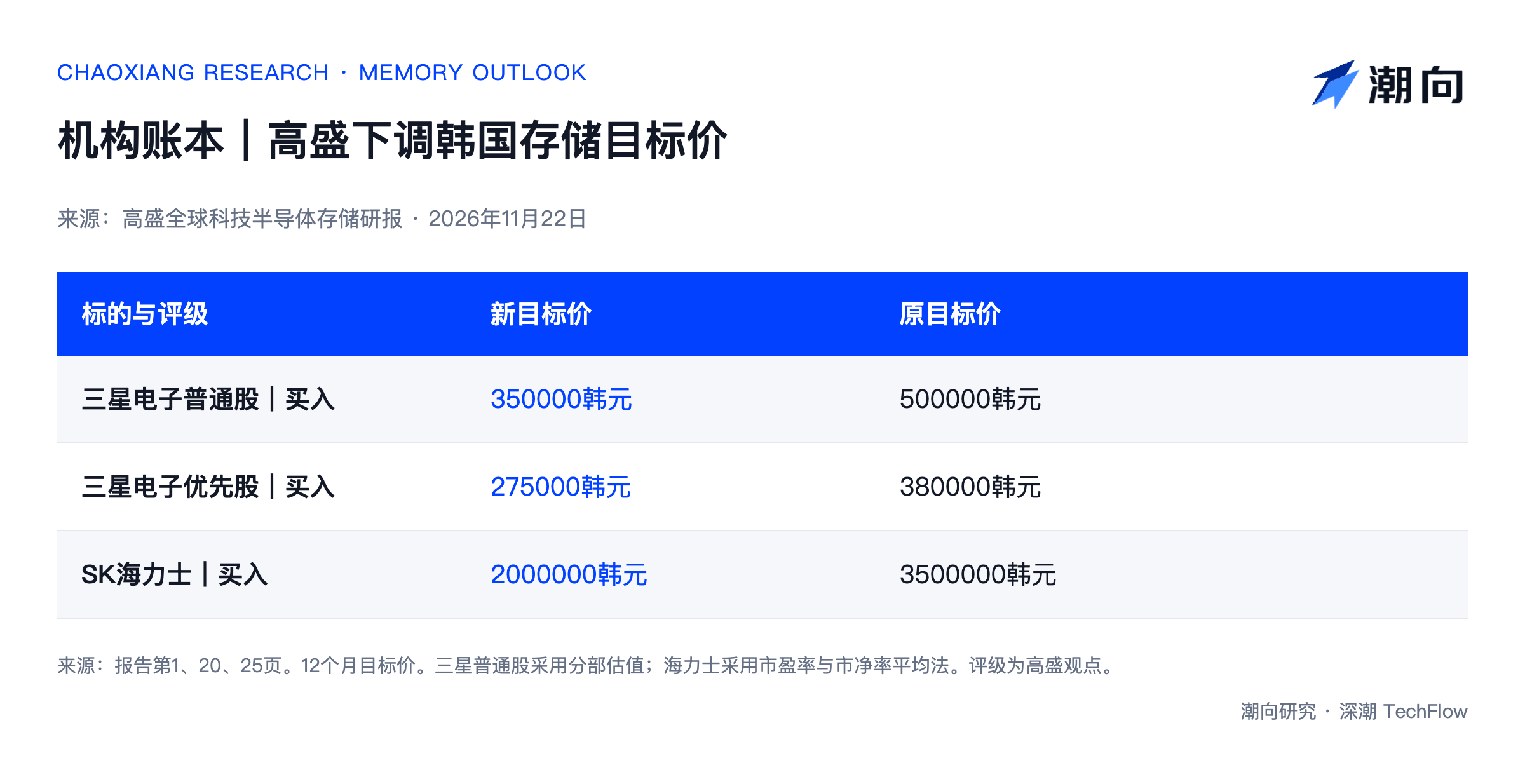
The storage supercycle driven by AI computing power continues, but long-term concerns for 2028 have already crushed stock prices. In its Global Semiconductor Memory Industry Report released on November 22, 2026, Goldman Sachs lowered Samsung Electronics' target price from KRW 500,000 to KRW 350,000, and significantly cut SK Hynix's target price from KRW 3.5 million to KRW 2 million. However, the Goldman Sachs team noted that current stock prices have already priced in extremely pessimistic expectations of zero AI capex growth in 2028 and a sharp drop in storage prices. A solid safety cushion is provided by the two giants' shareholder returns of up to approximately 20%.
Tight Market in 2027, Supply-Demand Gap Narrows in 2028
Demand for AI servers remains robust, but weakness in consumer electronics is dragging on growth.
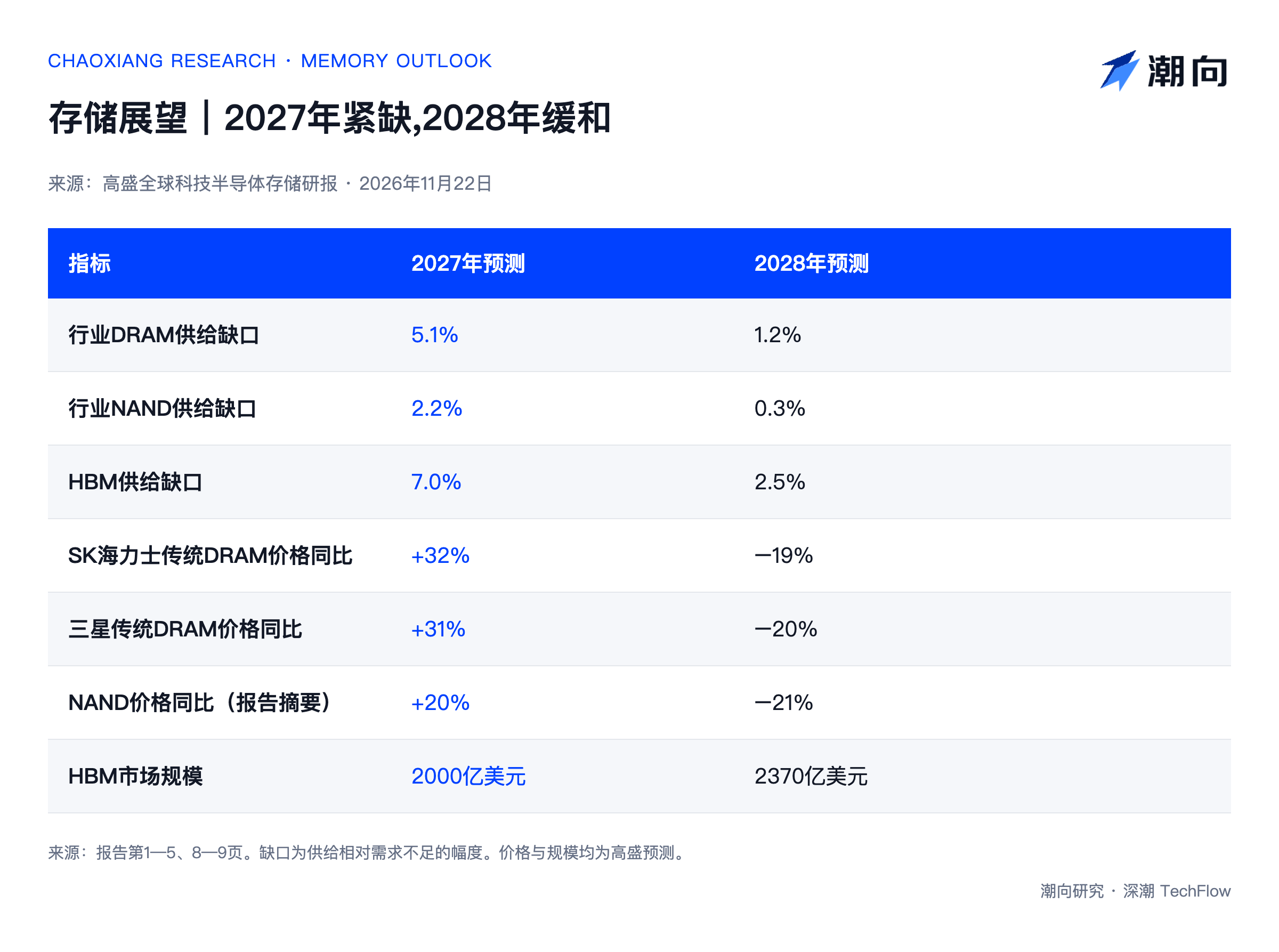
Goldman Sachs' semiconductor analysis team (Giuni Lee, James Schneider, etc.) updated the industry supply-demand model following the Q3 earnings reports. They forecast that the DRAM industry will still face its most severe supply shortage in 15 years in 2027, with a supply-demand gap of 5.1%. However, by 2028, due to sluggish smartphone and PC demand and capacity expansion by Chinese manufacturers, the DRAM supply-demand gap will narrow significantly to 1.2%, while NAND flash will shift from a 2.2% shortfall in 2027 to near equilibrium (a 0.3% shortfall).
The demand landscape shows extreme divergence. Goldman Sachs raised its server DRAM demand growth forecasts for 2027 and 2028 by 17% and 18% respectively, projecting year-on-year growth of 32% and 21%. However, high storage costs are suppressing upgrades in consumer electronics configuration. Goldman Sachs lowered its DRAM demand forecasts for PCs and smartphones, expecting PC DRAM demand to even contract by 2% year-on-year in 2027.
The main variable on the supply side stems from capacity expansion by Chinese manufacturers. Goldman Sachs' model accounts for CXMT's bit supply growth rates of 48%, 36%, and 32% in 2026, 2027, and 2028, respectively. As a result, Goldman Sachs lowered its 2028 price forecasts for conventional memory chips, anticipating that SK Hynix's average price for conventional DRAM will fall 19% year-on-year in 2028 (previously expected to drop only 5%), and NAND average prices will decline by 21%.
In contrast, HBM remains highly robust. Driven by explosive demand for custom chips (ASICs) and average prices doubling significantly, Goldman Sachs sharply increased its total addressable market (TAM) forecasts for HBM in 2027 and 2028 by 72% and 41%, reaching USD 200 billion and USD 237 billion, respectively.
Stress Tests: Stock Prices Already Price in the Worst-Case Scenario
In response to market concerns about AI capital expenditures peaking, Goldman Sachs subjected the two memory giants to three rigorous extreme stress tests.
The first test addresses cuts in AI capex. Goldman Sachs' base case projects hyperscaler cloud capex at USD 1.2 trillion to USD 1.3 trillion in 2028, representing slightly over 10% year-on-year growth. Calculations show that the current stock prices of Samsung Electronics and SK Hynix have fully incorporated an extremely pessimistic scenario of zero AI capex growth in 2028, coupled with a 40% further drop in average storage prices below the base case forecast.
The second test targets Long-Term Agreement (LTA) default risk. Markets fear that if storage prices plummet, downstream customers may breach long-term contracts to purchase on the spot market. Goldman Sachs estimates that customers would only have the economic incentive to default if traditional DRAM prices fall by more than 32% to 54% below the base case forecast over the next two years. Even assuming a 50% default rate triggers, leveraging forfeited advance payments and spot resale, the two giants' conventional DRAM revenues in 2028 would still be 49% to 55% higher than in a scenario without LTA protection.
The third test simulates a historic cyclical downturn. Even if DRAM and NAND average prices both plunge by 50% in 2028 (replicating the brutal declines seen in 2019 and 2023), Samsung Electronics' operating profit would still reach KRW 234 trillion, maintaining an operating margin above 35%, corresponding to a P/E ratio of just 4.7x.
Historical Patterns and High Returns Support Buy Ratings
Historical cyclical experience shows that memory stock prices often bottom out well ahead of earnings.
Goldman Sachs reviewed two downtrend cycles from 2017 to 2019 and 2021 to 2023. Data indicates that SK Hynix and Samsung Electronics' stock prices typically bottomed out and rebounded several quarters, or even a full year, before quarterly operating profits hit rock bottom. When stock prices undergo significant pullbacks prior to earnings downgrades, subsequent earnings forecast cuts tend to have a very limited marginal impact on share prices.
Based on downward revisions to 2028 price and earnings forecasts, Goldman Sachs lowered its 2028 operating profit estimate for Samsung Electronics by 26% to KRW 509 trillion, cutting its target price from KRW 500,000 to KRW 350,000 (maintaining it on the Asia-Pacific Conviction Buy list); it also reduced SK Hynix's 2028 operating profit estimate by 23% to KRW 380 trillion, lowering the target price from KRW 3.5 million to KRW 2 million.
Despite the significant target price cuts, Goldman Sachs maintains buy ratings for both companies. The core support lies in generous cash returns—Goldman Sachs expects Samsung Electronics' shareholder return (dividends plus buybacks) to reach 17% and 19% in 2027 and 2028 respectively, while SK Hynix's could hit 20% and 22%. Current valuations (with a 2027 P/E ratio of just 2.0x to 2.4x) offer an exceptionally favorable risk-reward profile.
This article is a compilation and interpretation by Chaoxiang Research of third-party brokerage research reports. The ratings, target prices, earnings forecasts, and related judgments cited herein represent the views of the respective brokerage analysts, reflecting only their institutional stances, not those of Chaoxiang Research, and do not constitute any investment advice.
Markets carry risks; decisions should be independent. This article should not serve as the basis for buying or selling any securities.
Join TechFlow official community to stay tuned
Telegram:https://t.me/TechFlowDaily
X (Twitter):https://x.com/TechFlowPost
X (Twitter) EN:https://x.com/BlockFlow_News
 @chaoxiangooo