
Goldman Sachs Broadcom Earnings Preview: Maintains Buy Rating, Lowers Target Price to $460
Broadcom (AVGO) is set to release its latest earnings report, with Goldman Sachs lowering its 12-month price target from $540 to $460 while maintaining a "Buy" rating.
Earnings Expected to Slightly Beat Estimates; Downward Valuation Adjustment Lowers Price Target
The market's overall expectations for Broadcom's upcoming earnings are relatively low.
However, buoyed by outperforming the broader market over the past week, market sentiment has already warmed up. Goldman Sachs expects both earnings and guidance for Broadcom's fourth quarter of fiscal 2026 (FY4Q26) and first quarter of fiscal 2027 (FY1Q27) to slightly beat consensus estimates.
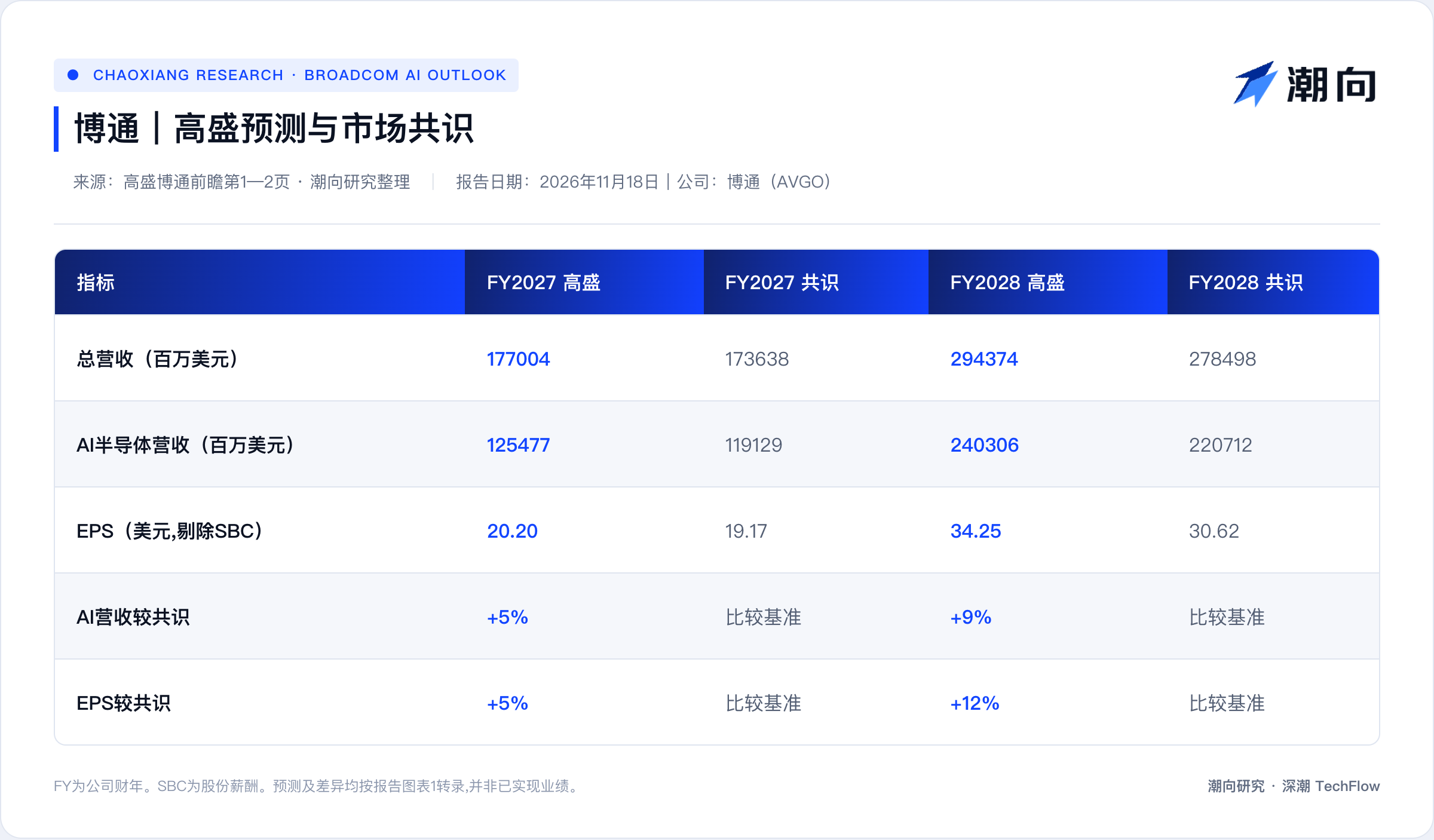
In specific financial forecasts, Goldman Sachs projects Broadcom's total revenue for FY2027 to reach $177.004 billion, surpassing the market consensus estimate of $173.639 billion; EPS is expected to be $20.20, 5% above consensus. By FY2028, Goldman Sachs forecasts total revenue will climb to $294.374 billion, with EPS reaching $34.25, exceeding consensus by 6% and 12%, respectively.
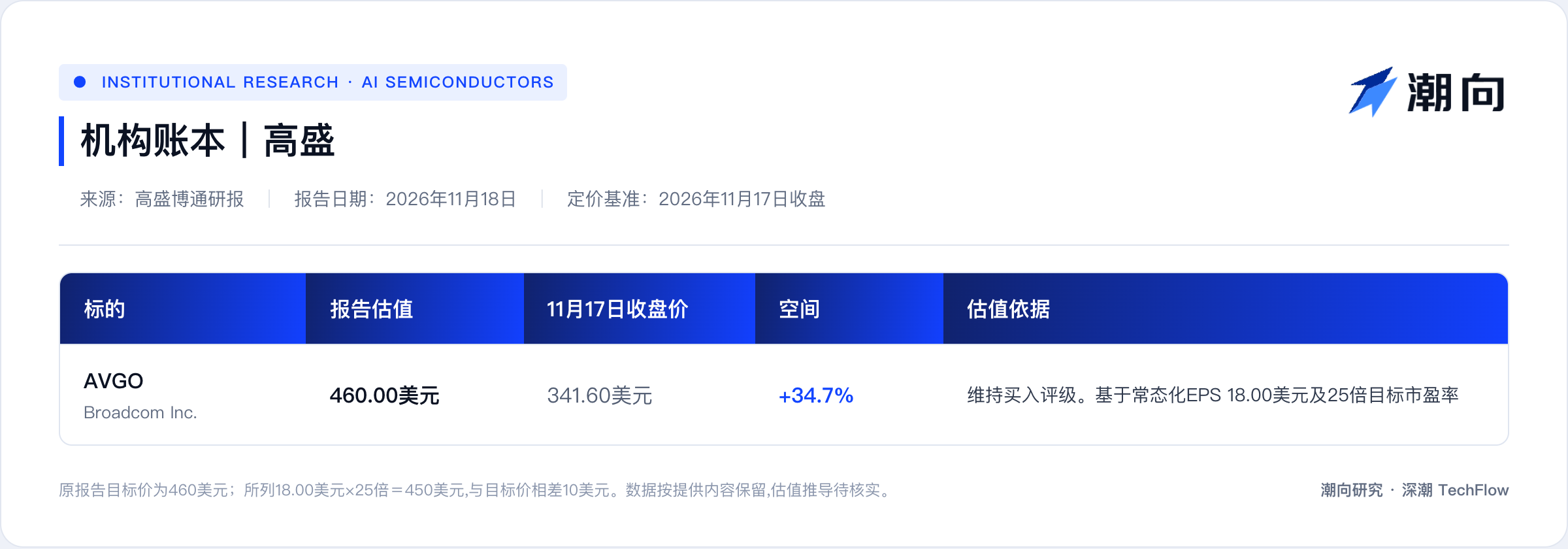
Earnings expectations remain strong, yet the price target has been downgraded. Goldman Sachs cut Broadcom's 12-month price target from $540 to $460, implying a 34.3% potential upside based on the Nov. 17, 2026 closing price of $341.60.
The downgrade stems from a downward shift in peer valuation medians. Goldman Sachs maintains its normalized EPS forecast of $18.00 for Broadcom unchanged, but lowers the target valuation multiple from 30x to 25x.
New Clouds Account for 70% of Custom Chips; Financing and Power Become Key Variables
Whether the earnings call provides clearer long-term visibility will directly influence stock price volatility.
AI business remains Broadcom's core growth engine. Goldman Sachs expects Broadcom's AI semiconductor revenue to reach $125.477 billion in FY2027, more than doubling to $240.306 billion in FY2028, exceeding market consensus by 5% and 9%, respectively. Non-AI semiconductor and infrastructure software businesses remain relatively flat, with Goldman Sachs forecasting FY2027 revenues for these two segments 5% and 3% below consensus estimates, respectively.
Underpinning this high growth is a massive deployment plan for custom accelerated processing units (XPUs), but buyers' funding and infrastructure bottlenecks are triggering market concerns.
Goldman Sachs disclosed that among Broadcom's planned ~10 GW of custom XPU deployments for FY2027, emerging hyperscalers account for approximately 6.3 GW. By FY2028, Broadcom's targeted custom XPU deployment doubles to 20 GW, with emerging cloud providers further increasing their share to roughly 75%.
Following the U.S. midterm elections, investor scrutiny on supply constraints for 2028 data center land, power, and shell space (LPS) has notably intensified. Meanwhile, emerging cloud providers rely heavily on external financing, and the stability of their capital chains directly impacts whether orders can be delivered on schedule. Goldman Sachs believes that if management provides substantive details during the call to alleviate market concerns regarding 2027 shipments and the feasibility of the 2028 20 GW target, it will serve as a key catalyst for the stock price.
MediaTek Entry Intensifies Competition; Google's Share Under Scrutiny
Beyond physical infrastructure and financing constraints, the competitive landscape in the custom chip arena is also shifting.
As AI compute demand shifts toward customization, competitors like MediaTek are accelerating their entry into the ASIC market. Goldman Sachs notes that investors are closely watching Broadcom's customer retention through the next-generation XPU product cycle, particularly how securely it holds share among core enterprise customers like Google.
If management can provide further disclosure on the long-term cooperation progress of next-gen custom chip projects, it would help mitigate market worries about share loss.
Looking ahead at post-earnings market themes, Goldman Sachs believes investors will continue to focus on two core challenges: the actual pickup capacity of emerging cloud providers in FY2027 under tighter external financing conditions, and the pace of easing data center power and site bottlenecks by 2028. The report simultaneously flags four downside risks, including a slowdown in AI infrastructure spending, share erosion in the custom compute business, slower-than-expected inventory digestion for non-AI chips, and intensifying competition for VMware's software business.
This article is compiled and interpreted by TechFlow based on third-party broker research reports. The ratings, price targets, earnings forecasts, and related judgments cited herein represent the views of the respective broker's analysts, reflect only the stance of their affiliated institutions, do not constitute the opinions of TechFlow, and are not intended as investment advice.
Markets carry risks; decisions must be independent. This article should not be used as the basis for buying or selling any securities.
Join TechFlow official community to stay tuned
Telegram:https://t.me/TechFlowDaily
X (Twitter):https://x.com/TechFlowPost
X (Twitter) EN:https://x.com/BlockFlow_News
 @chaoxiangooo