
Why Is Gold Falling Alongside Tech Stocks? It Has Become the "ATM" of the Liquidity Crisis
Author: Gao Zhimou, Wallstreetcn
International gold prices plummeted nearly 10% in a single week, sold off in tandem with crashing tech stocks. As the retreat of AI trading triggers cross-asset margin calls, traditional safe-haven assets have turned into "ATMs" for the market to raise cash.
Over the four trading days from November 17 to 20, gold prices plunged 9%, breaking below the $3,600/ounce level for the first time since September 2025; according to JPMorgan's Friday morning report, spot gold traded at $3,588/ounce. Silver witnessed an even steeper decline, shedding 15% for the week.
This precious metals sell-off heavily coincided with turbulence in U.S. equities. On November 20 (Friday), dragged by market aftermath following Anthropic's initial public offering (IPO), the Nasdaq 100 index fell sharply by 4.9% during intraday trading.
Both Goldman Sachs' trading desk and UBS Global Research's latest reports indicate that selling pressure is heavily concentrated in the gold futures market; Goldman further noted that the fear gauge in the options market has reached multi-year extremes.
Two-Phase Sell-Off: From Fed Hawkishness to Tech Stock Liquidation
The first phase of the decline from November 10 to 17 still followed classic macro interest rate logic. The U.S. October consumer price index (CPI) came in above expectations, prompting a flurry of hawkish comments from Federal Reserve officials. According to Goldman Sachs' daily market monitor, St. Louis Fed President Musalem stated that the economy might need "multiple rate hikes" before spring. During this window, the dollar index surged 1.2%, the 10-year real yield rose 11 basis points, and December 2027 SOFR futures dropped 7 basis points.
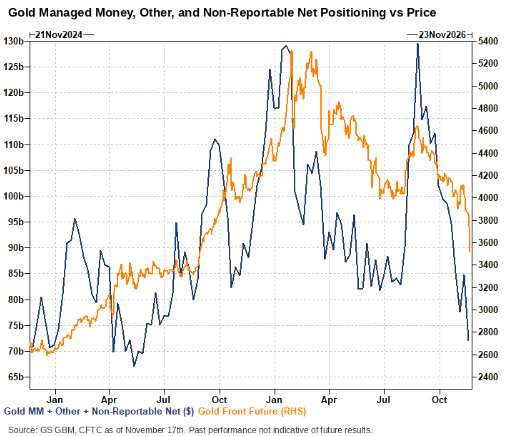
Interest-sensitive asset gold subsequently came under pressure. The latest Commitments of Traders (COT) report showed that speculative capital massively fled as gold prices fell 4.1% between November 10 and 17. In a November 21 report, Goldman Sachs senior futures trader Robert Quinn reported that managed money, other reportables, and non-reportables combined to sell $9.3 billion, substantially wiping out prior-week buying; long liquidations accounted for $5.8 billion, while new shorts totaled $3.5 billion.
By then, the scale of gold's net speculative longs had plummeted from a peak of approximately $130 billion in September to around $72 billion, hitting a near 18-month low.
However, during the second phase from November 17 to 20, macro headwinds no longer explained the price action. Quinn pointed out that while gold prices crashed 9% over these four trading sessions, December EFP (exchange for physical) weakened, and total open interest in futures contracts shrank by $7.3 billion, the dollar's gains largely consolidated, and real yields even saw a pullback. The vast majority of gold's decline coincided directly with the Nasdaq index's steep downtrend.
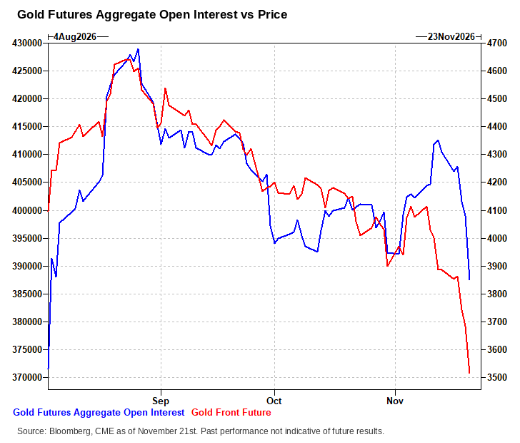
This anomalous divergence exposed the transmission mechanism of a liquidity crisis: the margin call channel.
As the retreat of AI trading triggered sharp equity drawdowns, leveraged investors faced massive margin call pressures and urgently needed to raise cash to cover losses. Goldman Sachs Investment Strategists Lina Thomas and Daan Struyven previously warned of this path in their 2027 Precious Metals Outlook report titled "It's 2022 Again": if uncertainty from the AI cycle triggers a stock market crash, margin calls will force investors to liquidate assets to raise funds, initially dragging gold lower.
Gold bore the brunt not because its fundamentals changed overnight, but due to two "liquidation traits": exceptional market liquidity, and investors still holding substantial floating profits after the bull run. When risky assets prove difficult to offload or suffer heavy losses, selling gold becomes the path of least resistance for raising cash.
Bloomberg's Simon White analyzed common misconceptions regarding safe-haven attributes: gold was never, and is still not, a liquidity hedge tool. When the market needs to plug losses elsewhere, gold is often the first "piggy bank" dismantled for liquidation. Goldman's Quinn had issued a similar warning back in March, stating that amid market scramble for cash, gold "may not be the safest haven."
Pricing signals in equity markets further corroborated a shift in market narrative. Rich Privorotsky, head of Goldman's Delta One business, stated on Friday that the long end may already be pricing in a "policy error," with yields declining and breakeven inflation rates narrowing, yet both equities and gold face simultaneous liquidation. In his view, the market is transitioning from "inflation issues" to "growth and liquidity concerns," where earlier position rotations in the AI sector have evolved into outright liquidation.
Once passive, "ATM-style" liquidation smashes through key price defenses, quantitative and trend-following funds amplify the downward momentum. UBS noted that behind the sharp drop in futures open interest lies potential systematic shorting triggered once gold breached critical technical levels; meanwhile, CTA strategies follow suit in selling, compounded by market rumors of renowned investor Druckenmiller shorting silver, transforming what was originally a liquidity drain into a stampede-driven plunge.
Futures Lead Selling Pressure, ETF Resilience and Buying Capacity Under Stress
As gold prices accelerate toward the critical $3,500 level, whether selling pressure has fully exhausted remains a point of contention in the market.
UBS Global Research strategist Joni Teves noted in a November 20 report that market positions were relatively lean prior to this sell-off, explaining why panic feels comparatively muted despite the magnitude of the decline. UBS judges that selling remains concentrated in the futures space: since last week, gold futures open interest has contracted by over 6 million ounces (equivalent), potentially mixed with systematic shorting triggered by gold breaching key technical levels.
Potential selling in the futures segment may not have been exhausted. Citing ANZ's midweek estimates via The Market Ear, although CME speculative positions have liquidated nearly 200 metric tons of gold, net longs remain elevated at 533 tons—well above the ~200-ton lows seen in 2022 and 2023—leaving roughly another 200 tons available for liquidation.
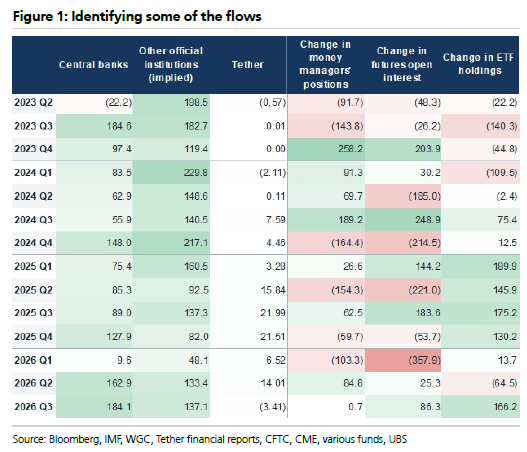
The resilience of gold ETFs is about to face a stress test. UBS pointed out that gold ETF holdings have remained significantly stable so far, but given reporting lags, capital flows over the coming days are crucial. Last quarter, gold ETFs recorded inflows of approximately 166 tons when gold primarily traded between $4,000 and $4,500; this round of pullback has pushed many of those positions deeply underwater, directly testing investors' conviction to hold.
While selling floods in, dip-buying capacity is generally absent. UBS noted that aside from investors' attention being diverted by other markets, discussions have begun regarding the possibility of the Fed's FOMC meeting raising rates by 50 basis points, further dampening bargain-hunting enthusiasm.
Physical buyers and official institutions alike have opted to temporarily step back. Although China's Lunar New Year consumption peak approaches in early February 2027, the speed of gold's decline is too rapid, leading physical buyers to prefer waiting for signs of stabilization and bottoming. While central banks and other official entities have generally bought on dips in past quarters (UBS compiled data showing central banks purchased a net 184.1 tons in Q3 2026, with other official entities indirectly buying 137.1 tons), historical behavior shows they actively avoid periods of high volatility.
With gold's one-month implied volatility rising from below 20% in October to above 25% this week, and realized volatility climbing from ~18% last month to nearly 22%, UBS expects official buyers to wait for volatility to subside before re-entering.
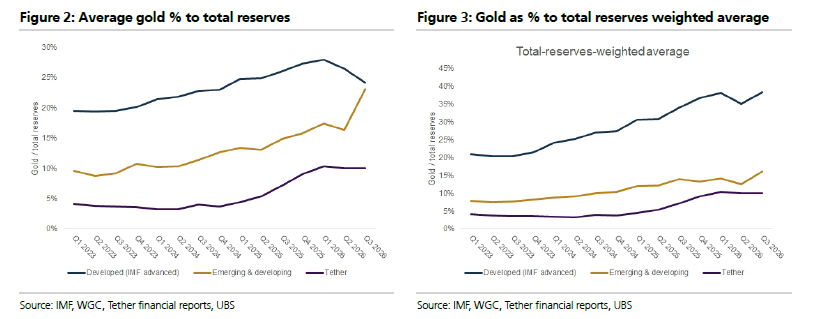
The moves of major non-official holders also remain a market wildcard. Citing public filings, UBS noted that Tether held approximately 143 metric tons of gold as of the end of Q3 2026 (a slight sequential drop of ~2%), with gold accounting for roughly 10% of its total assets this year (steadily rising from ~3% to 4% over recent years). All else being equal, a 15% pullback in gold prices mechanically reduces its weighting; whether Tether chooses to top up positions to maintain its ~10% allocation or strategically accept a lower weight (holding unchanged or having already reduced) awaits disclosure in its next report.
Options Hit Extremes: Rebound Anticipated, Bottom Unclear
After accumulating nine consecutive trading day declines totaling $600, data from The Market Ear shows gold's Relative Strength Index (RSI) has fallen to one of its lowest levels in decades, with derivative markets also flashing rare oversold signals.
Quinn noted that on November 20, gold's three-month standardized 25-Delta put-call skew and implied volatility both exhibited extreme anomalies ranging from 4 to 5 standard deviations (sigma). Specifically, the three-month implied volatility skyrocketed from ~19 at the end of October to ~27.6; while still below the 34–35 peak during this year's February surge, the pace of the spike is particularly unprecedented.
More emblematic is the complete reversal of the skew. For most of this bull run, markets chased call options, resulting in a gold bullish skew; today, relative demand for downside protection (puts) has surged to multi-year highs. Quinn's statistics show that since late 2022, whenever gold's put-call skew spikes dramatically, there is roughly a 70% probability of mean reversion within the following week.
Nevertheless, skew repair does not directly equate to the spot price finding a bottom. Technically, gold's next major support sits at the lower boundary of a descending channel near $3,400, leaving roughly a 5% downside gap from Friday's $3,588 spot quote. As long as the source triggering margin calls—the de-leveraging process in tech stocks and AI trading—is unfinished, gold will struggle in the short term to escape the pressure of liquidity drainage.
The mid-to-long-term allocation thesis remains unshaken among major investment banks. Despite cutting target prices twice within two weeks, Goldman still anticipates gold will climb to $4,650/ounce by the end of 2027, supported by central bank purchases, and reach $5,600/ounce by the end of 2028 after the Fed resumes rate cuts. UBS similarly believes short-term market pressures have not undermined gold's underlying narrative as a core component of structural diversification portfolios, allowing long-term investors to begin scouting entry opportunities.