AI Proof of Riemann Hypothesis Faces Scrutiny: 17 Million Lines of Code Verified via Lean, Core Definition Accused of Being a 'Tautological Trap'
Author: TechFlow
On November 23 Beijing time, serious controversy erupted around academic progress in an AI-assisted proof of the Riemann Hypothesis.
Anthropic mathematician Levent Alpöge announced that he completed a formalized proof with the assistance of Claude, and publicly released a repository of approximately 17 million lines of Lean 4 code.
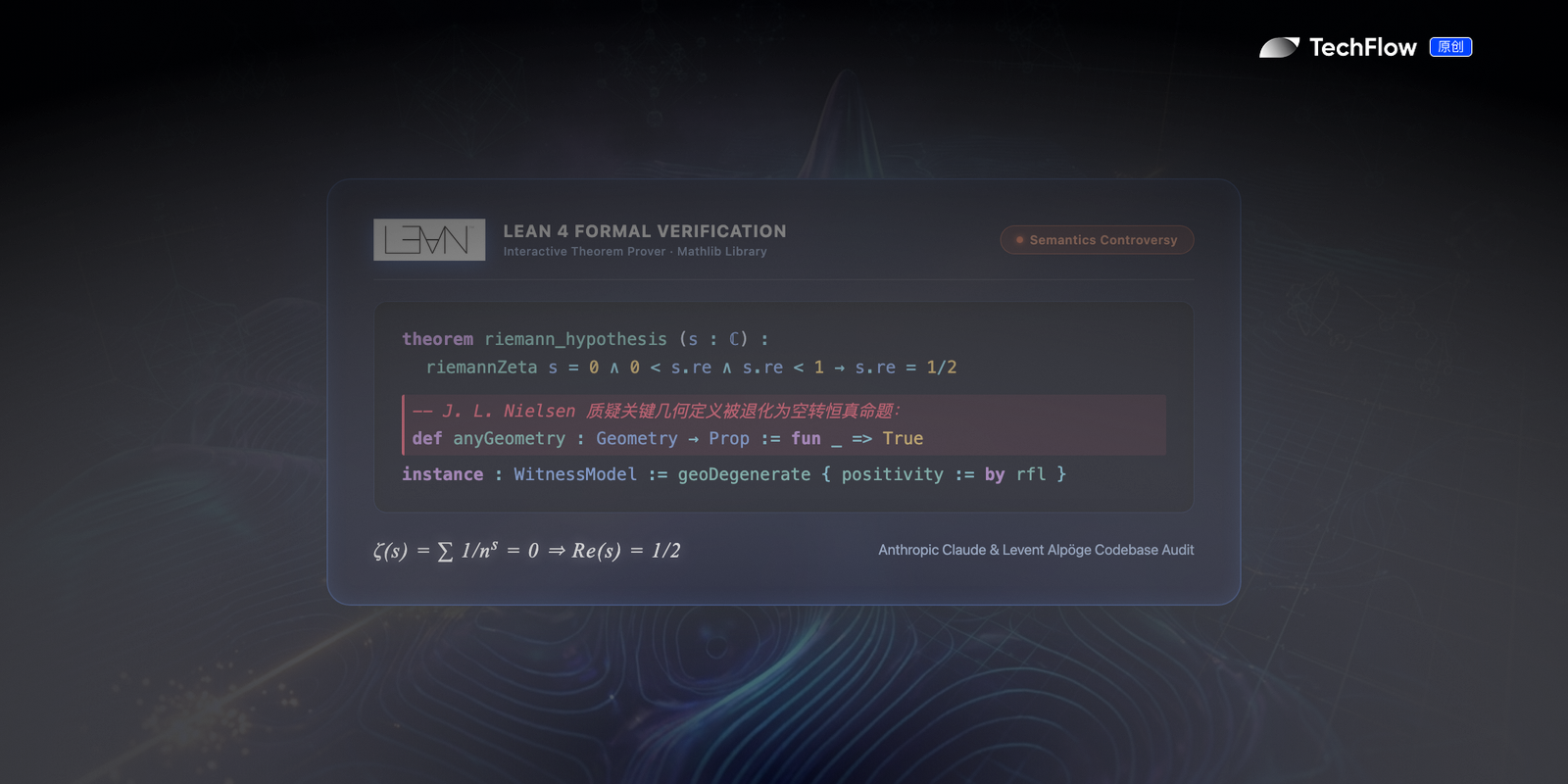
Subsequently, on November 20, mathematician Jenny Nielsen published a preprint paper on PhilArchive, pointing out that although the repository passed compiler checks, its core geometric predicate was preset as a tautology, and the entire proof chain lacked substantial mathematical content, representing a typical instance of "proof by vacuous truth" (vacuous truth).
Tens of Millions of Lines of Code Pass Machine Verification, Sparking Academic Controversy
According to archived materials on Levent Alpöge's personal website, the scale of this formalized proof project reached approximately 17 million lines of code.
This volume far exceeds most formal verification projects manually constructed by previous mathematics teams, and was once regarded as a significant breakthrough for large models in tackling century-old mathematical problems.
Following the release of the code, Lean FRO (Lean Focused Research Organization) and the Mathlib Initiative behind the official Lean language jointly issued a statement confirming that the repository has fully passed Lean 4 kernel compiler verification, with no logical deduction errors or type construction errors throughout.
Tautological Definitions and Degenerate Models Accused of Logical Vacuity
After the compiler returned a passing test result, mathematician Jenny Nielsen conducted a line-by-line review of the underlying object definitions in the code.
He found that the repository directly defined the core geometric predicate anyGeometry to always return True, and introduced a degenerate model named geoDegenerate as a witness, making the positivity condition true by default and completely bypassing geometric constraints.
The paper further points out that the core height function required for the proof was directly assigned a value of zero.
The code subsequently used explicit rewriting formulas to force key equations to automatically close by relying on reflexivity (rfl), transforming geometric conditions that originally required rigorous derivation into tautologies. The entire reasoning chain ran smoothly in form, yet lacked substantial mathematical content.
Disconnect Between Formal Type Checking and Authentic Mathematical Semantics
This controversy sharply exposed the deep rift between formal verification and mathematical substance.
Formal compilers can only guarantee that every step of symbolic deduction strictly conforms to type theory and logical rules within the axioms, definitions, and rule frameworks provided by developers; they cannot actively identify whether prerequisite definitions have covertly substituted original mathematical propositions.
Public data comparisons show that the total of approximately 17 million lines of code amounts to several times the core scale of the existing mainstream mathematics library, Mathlib.
Shrouded by such a massive codebase, the "tautologization" treatment of just a few lines of critical underlying definitions is extremely difficult to detect during automatic compilation; only domain experts carefully comparing mathematical semantics one by one can locate the vulnerabilities.
Dilemmas of Independent Code Audits and Human-Machine Collaborative Verification
Regarding the challenge of reviewing ultra-large-scale formalized code generated by large models, MIT mathematician Andrew Sutherland previously pointed out in an assessment of this project that passing compilation only represents formal consistency; fully understanding and manually auditing all mathematical details still requires a massive investment of professional effort.
With the publication of the preprint raising doubts, the academic community is shifting its review focus from "whether the code can pass the compiler" to "whether formal definitions faithfully map the original conjecture."
Computer-aided theorem proving and AI-generated mathematics are facing a severe real-world test of moving from a "closed loop of code compilation" to "alignment of deep mathematical semantics."
Join TechFlow official community to stay tuned
Telegram:https://t.me/TechFlowDaily
X (Twitter):https://x.com/TechFlowPost
X (Twitter) EN:https://x.com/BlockFlow_News
 深潮TechFlow