Has the AI Bubble Burst? US Stocks Evaporate $9 Trillion, Core Pillars of AI Frenzy Collapsing
Author: Scott Galloway, Prof G Media Team
Compiled by TechFlow
TechFlow Guide: Within a week, nearly $9 trillion evaporated; Nvidia's stock price has nearly halved from its historical peak, and the Nasdaq is approaching a technical bear market. The team of renowned business commentator Scott Galloway points out in an article that although core financial reports remain strong, the two most fundamental pillars underpinning this wave of AI mania are undergoing structural loosening.
From Nvidia's sudden halt to the $250 billion revolving financial lifeline for the startup ecosystem, to Anthropic's historic largest IPO where only 7% of float was deliberately constrained to prop up the price, capital markets have shifted from corporate buybacks to massive liquidity siphoning. This valuation retreat not only reveals the fragility of excessive financialization but also marks the definitive end of the era of blind accumulation.
Nvidia's Frenzy and Fractures: Questioning the Revolving Lifeline Beneath the Performance Myth
Nvidia's management turmoil continued to brew last week. Just six hours before Tuesday's earnings call, and less than a week after Jensen Huang stepped down, the former CEO released a statement saying that many have called for his return and that he would "be honored" to come back if the board needed him. However, the board clearly did not accept this; Nvidia's new chairman stated outright during the call that there are no plans to reappoint Jensen Huang.
Shortly after, on Friday, Reuters reported that the U.S. Securities and Exchange Commission (SEC) was investigating Nvidia over potential accounting compliance issues. Nvidia's stock price promptly dropped 13%, accumulating a decline of nearly 50% since peaking on October 6, wiping out nearly $3 trillion in market value.
Objectively speaking, the company's core fundamentals remain extremely strong. In the previous quarter, Nvidia's revenue and net profit exceeded Wall Street expectations for a continuous 16th quarter: net profit surged 105% year-over-year to $65 billion, and total quarterly revenue jumped 103% year-over-year to $116 billion. This marks a sustained year-over-year revenue growth rate above 50% for 14 consecutive quarters. In modern commercial history, no mega-cap superpower exceeding $500 billion in market value has sustained such a steep trajectory for so long.
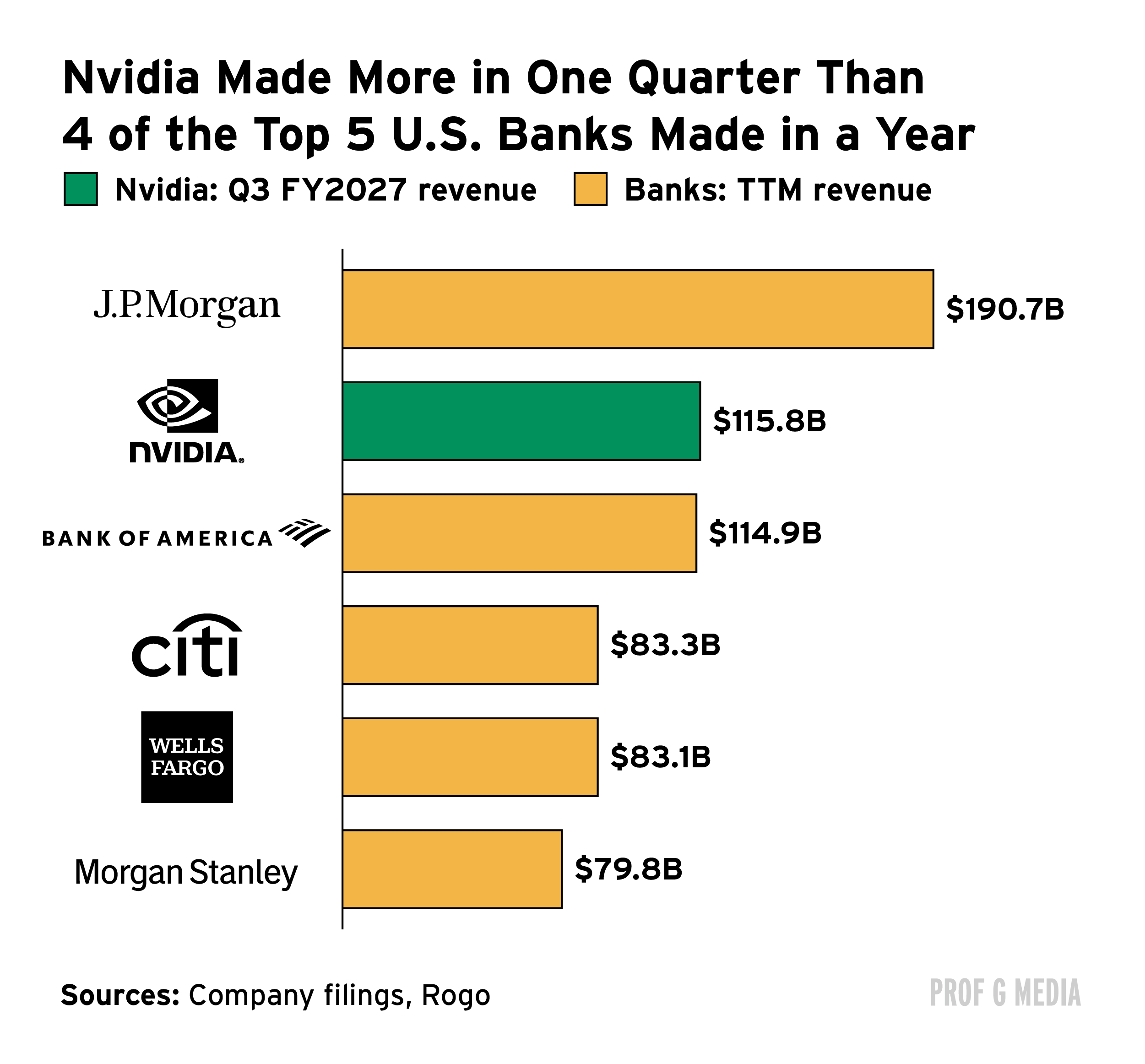
Figure: Nvidia's single-quarter revenue has surpassed the full-year total revenue of four out of America's top five banks
Nvidia also significantly raised its Q4 revenue guidance to $130 billion (this forecast even conservatively assumes zero compute revenue from Chinese data centers), and increased its FY2028 revenue growth guidance to 75%, primarily driven by robust market demand for computing power and readiness in data center deliveries.
However, under the new management's helm, certain deep operational models of the business are undergoing critical shifts. Most notably, Nvidia CFO and interim CEO Colette Kress explicitly told investors that Nvidia's future investments in the AI ecosystem will be more "cautious and selective." Under Jensen Huang, Nvidia effectively acted as the "lead financier" for the entire AI boom: from direct equity investments in AI startups and performance guarantees for data center leases, to commitments to repurchase idle compute capacity from emerging cloud providers (Neoclouds), Nvidia carried forward-looking commitments nearing $250 billion, alongside an additional massive $390 billion order book issued to its own suppliers (primarily memory chip manufacturers).
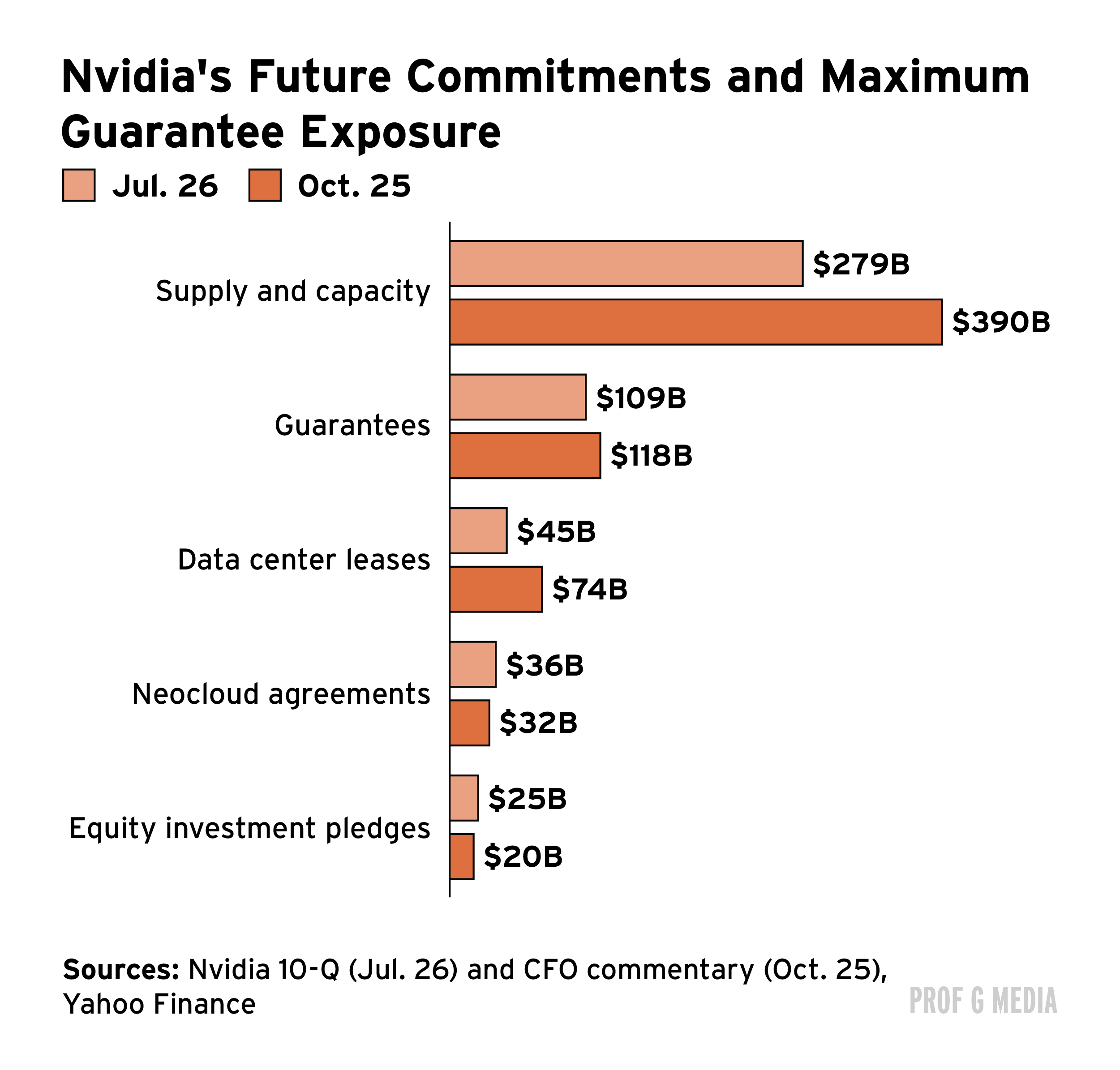
Figure: Details of Nvidia's future business commitments and maximum risk exposure gaps
Furthermore, Nvidia's moves to purchase other companies' stocks in the secondary market have been equally aggressive. Over the nine months ending October 25, Nvidia spent $58 billion acquiring shares of other enterprises, roughly 12 times the nearly $5 billion spent at the same time last year, nearly matching the scale of its own $61 billion stock buyback program.
For a long time, investors have widely worried that Nvidia's circular trading and affiliated financing artificially inflated the apparent demand of the AI ecosystem, leaving it exposed to dual risks during potential industry downturns. Ironically, as of now, precisely Nvidia itself has found itself at the center of the vortex, rather than those fledgling emerging compute service providers or startups.
Anthropic's Record-Breaking IPO: The Liquidity Illusion Under Tight Control
Anthropic officially etches its name in financial history with the largest IPO ever. The AI giant listed on U.S. stocks on Thursday under the ticker ANT. Its opening price was $111.50, 34% higher than the $83 offering price, briefly pushing its market cap past $2 trillion during intraday trading. It closed the first day up 17%, capping its market value at $1.8 trillion, instantly becoming the seventh-largest publicly traded company in the U.S., trailing only Apple, Microsoft, Nvidia, Alphabet, Amazon, and SpaceX.
However, the euphoria was extremely short-lived. On Friday, Anthropic plunged over 14% intraday, narrowing the decline but still closing down 8.5% for the day. As the syndicate exercised the overallotment option ("greenshoe") to purchase an additional 147 million shares at the offering price, selling pressure in the market surged. Factoring in the $26 billion private placement from strategic investors including Nvidia, Google, and AMD, Anthropic and its co-founders collectively raised a massive $119.5 billion.
On paper, subscription demand was nearly boiling: the issuance received approximately 7 times oversubscription, with institutional subscription intentions reaching around $500 billion—equivalent to the sum of all U.S. IPO proceeds over the past six years. The frenzied scramble for shares resulted in over half of the participating institutional investors receiving zero allotments.
But similar to SpaceX, Anthropic imposed extremely strict artificial restrictions on actual supply: this listing only released 7% of the company's equity, far below the common 15% to 20% float ratio for standard U.S. IPOs. Listing with an exceptionally small float often significantly amplifies the surging effect on the first day. Empirical statistics from University of Florida professor Jay Ritter show that companies with a float ratio under 10% see average first-day gains of 32%, whereas companies with floats exceeding 40% average merely 7.6%.
Anthropic also made an exception by allocating a high retail allocation rate of approximately 15% (typically only 5% to 7%). However, retail enthusiasm noticeably cooled: Google Trends shows its search volume in the U.S. was merely one-third of what SpaceX initially saw, further diverted by the blockbuster release of GTA VI on the same day. Data from Vanda Research indicates that despite retail turnover hitting a historical record of $772 million on the first day, retail sell orders and buy orders almost perfectly offset each other, resulting in a net retail purchase of only $60 million—half that of SpaceX.
At its peak market cap of $2 trillion, Anthropic's Price-to-Sales (P/S) ratio soared to 57x, comparable to Palantir (51x) and SpaceX (59x), vastly exceeding Amazon (3x) and Alphabet (7x). However, whether ordinary investors can profit entirely depends on entry timing: institutions secured at the $83 allotment price undoubtedly posted a 17% unrealized gain on day one, but all retail investors who chased the rally at the secondary market open have already suffered a massive 20% paper loss by Friday's close.
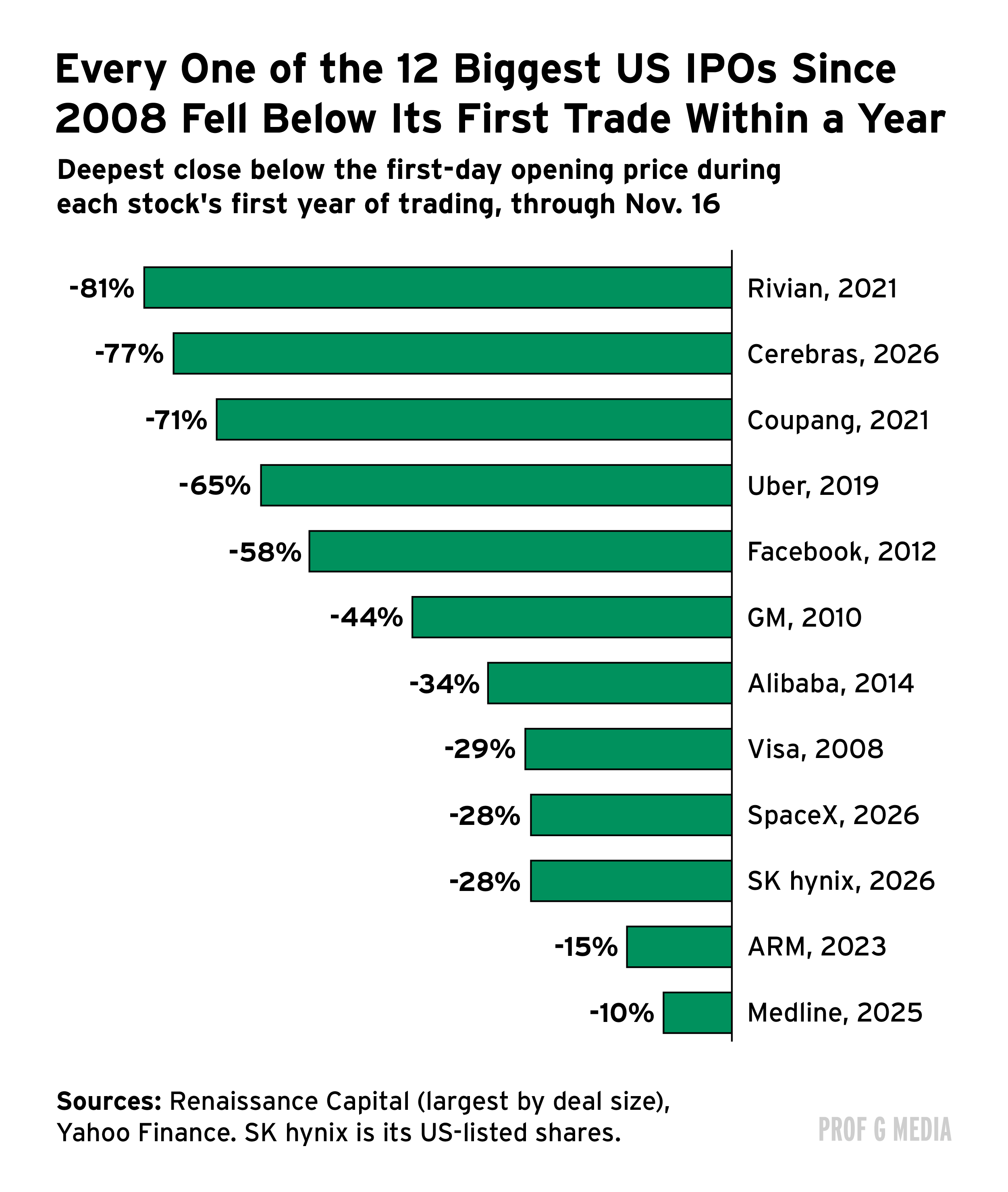
Figure: All 12 largest U.S. IPOs since 2008 fell below their opening prices within one year
This is a cruel pattern repeatedly verified in the U.S. stock market. Yahoo Finance data shows that all 12 largest U.S. IPOs since 2008 fell below their first-day opening prices within a year. Prominent listings this year are no exceptions: SpaceX fell 5% below its offering price, SK Hynix's U.S. ADR dropped 30%, and Cerebras plummeted as much as 55%.
This is essentially a liquidity experiment meticulously engineered by investment banks. The syndicate's primary duty is to ensure a gap-up opening on the first day by severely compressing floating supply. But current market pricing is far from genuine price discovery. According to the unlock schedule, approximately 20% of shares will become tradable by February next year, surging to 75% by the end of May. Only when facing full, real-world selling pressure will the true touchstone of value arrive.
Valuation Bubble Officially Bursts: The Supply-Demand Reversal From Hundred-Billion Buybacks to Trillion-Dollar Siphoning
The localized frenzy of AI assets fails to mask the deeper chill across the overall market, as the three major U.S. indices are comprehensively entrenched in technical corrections. Both the S&P 500 and the Dow Jones Industrial Average have pulled back 12% from their yearly peaks, Russell 2000 small caps declined 16%, and the Nasdaq Composite edges toward bearish territory with a cumulative drop of 18%. Last Friday, the Nasdaq 100 index plummeted nearly 6%, posting its worst weekly performance since March 2020 amid the pandemic outbreak.
The U.S. stock market has cumulatively erased nearly $9 trillion in total market value since its October highs; in other words, just six weeks of intense deleveraging have completely wiped out all the gains painstakingly accumulated over the past six months. The semiconductor sector endured its darkest week since 2001, with the Philadelphia Semiconductor Index dropping 17% for the week. Besides Nvidia, AMD was also caught in an audit storm after short-sellers questioned claims that its firmware appeared in products from sanctioned Chinese server manufacturers, despite AMD firmly denying these allegations.
Many former core holdings have already halved and halved again from their peaks: Intel is down 64%, Oracle plunged 71%, and rising star CoreWeave has retraced 79%. At its core, the driving force behind this severe correction lies in the fundamental reversal of supply and demand forces in capital markets.
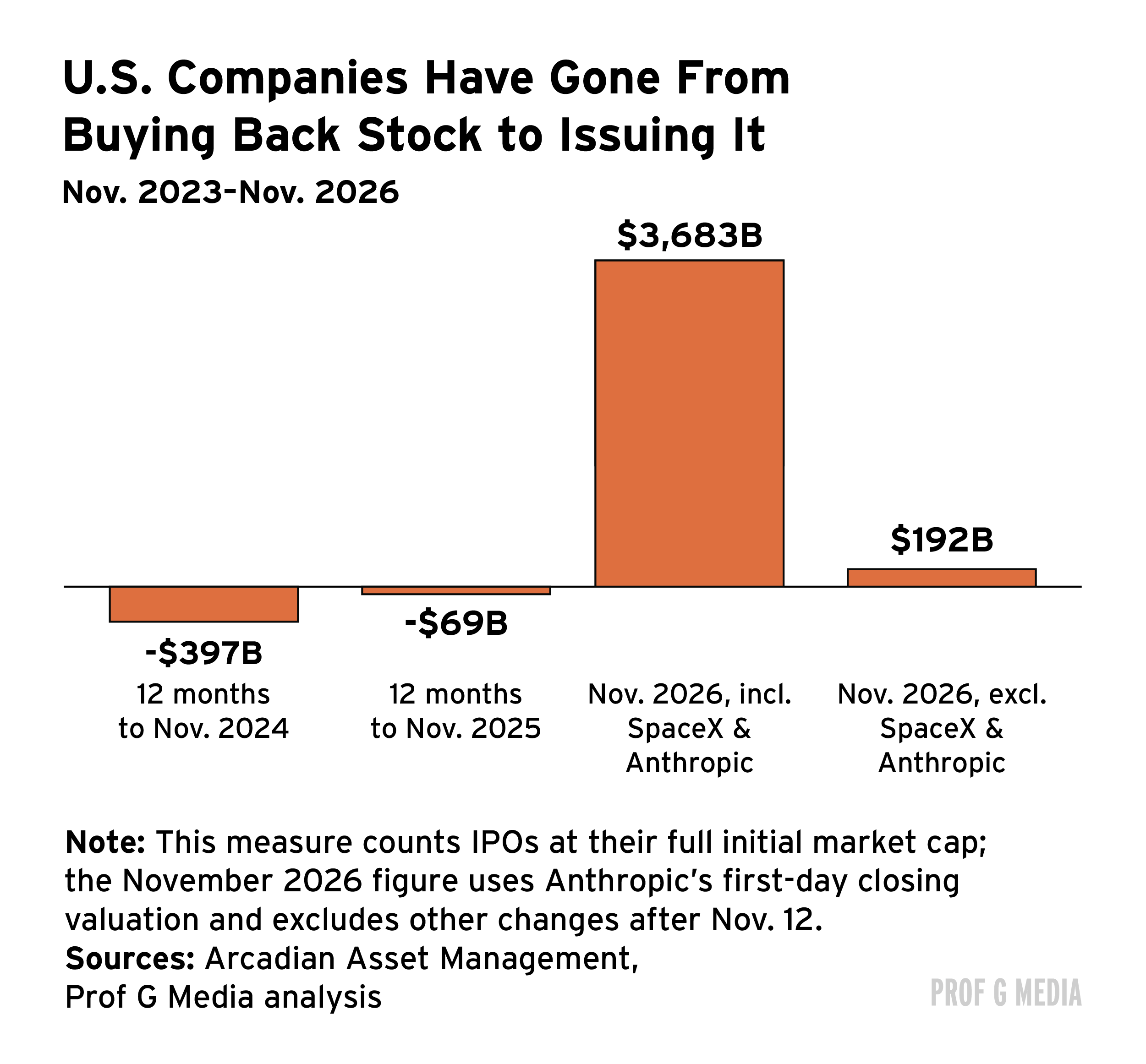
Figure: U.S. listed companies shift from net stock buybacks to epic, massive stock issuance siphoning
During 2024 and 2025, U.S. listed companies were the largest net buyers of stocks. Data from Acadian Asset Management shows that in just the 12 months ending November 2024, U.S. corporations net repurchased $397 billion of their own shares. However, this core dynamic propping up valuation centers has been completely overturned: over the past 12 months, U.S. listed companies not only ceased capital returning but instead net sold up to $3.7 trillion in stocks to the market through IPOs and massive secondary offerings. This represents a staggering reversal exceeding $4 trillion, transforming companies from stock buyers into the fiercest rivals competing with the market for liquidity.
Throughout a century of financial history, concentrated waves of massive share issuances have always been decisive precursors to subsequent weak stock market returns. The epic IPO frenzy of 1999 directly triggered the brutal 49% crash of the S&P 500 index between 2000 and 2002; the record fundraising peak of 2021 subsequently morphed into a deep 19% adjustment in the S&P 500 in 2022.
The Survivors and Casualties After the Frenzy Subsides
It must be kept in clear mind that this is not an apocalyptic systemic financial tsunami; the current deleveraging process lacks the foundation for cascading leverage collapses akin to the 2000 dot-com bubble or the 2008 subprime mortgage crisis, meaning its intensity and reach will be considerably milder.
In this sudden liquidity pullback, the biggest winner is undoubtedly Anthropic. Its leadership precisely locked in a $120 billion liquidity reserve before the broader market crash began; had the listing window been delayed by just a few days, this lifeline capital might have vanished completely. The biggest potential victim, meanwhile, remains OpenAI, which has yet to complete its public listing, boasts elevated valuations, and faces preemptive liquidity siphoning pressure from peers.
As upstream core compute giants like Nvidia begin tightening investment leverage and carefully auditing procurement commitments, emerging cloud service providers overly reliant on debt and cyclical compute agreements will face cash flow rupture tests first. The industry anticipates that by 2027, at least one mainstream new-era compute cloud provider will be unable to avoid the ultimate outcome of debt default and restructuring.