Interview with Bezos and Prometheus Co-Founder: Returning to Entrepreneurship with $14.5 Billion, Betting on Physical Manufacturing as AI's Next Frontier
Curated & Compiled by TechFlow
TechFlow Summary: As the vast majority of capital and talent flow toward pure software and text-based large models, Jeff Bezos has quietly returned to the entrepreneurial frontlines, co-founding Prometheus, an AI company focused on physical-world manufacturing. Within the global manufacturing ecosystem worth tens of trillions of dollars, AI is evolving from symbolic computation to atomic simulation, compressing what once took months of complex industrial design down to just 12 hours.
Amid the political cycle following the US election where Democrats have retaken control of the House of Representatives and tech billionaires are once again targets, Bezos sharply points out that "picking a villain" is an extremely effective electoral tactic politically, but the worst approach for solving practical problems. From the housing supply crisis to Nvidia's governance, from the survival of the fittest in AI investment cycles to personally selecting the new 007, Bezos demonstrates a business veteran's profound adherence to the laws of the physical world and common sense.
Guests: Jeff Bezos (Founder and Executive Chairman of Amazon, Founder of Blue Origin), Vik Bajaj (Co-founder and CEO of Prometheus, Founding Team Member at Google X, Former Chief Scientific Officer at Verily)
Moderator: Liz Hoffman (Editor-in-Chief of Business and Technology at Semafor)
Podcast Source: Semafor's "Compound Interest" (https://www.youtube.com/watch?v=1Z3ro4ocj-Y)
Original Title: Jeff Bezos Wants In On The AI Race | Compound Interest
Broadcast Date: Beijing Time: 2026-11-24 22:20
Key Takeaways
Physical Manufacturing is a Multi-Trillion Dollar Blue Ocean Untouched by AI: Existing large language models (LLMs) are fundamentally excellent "symbol manipulation tools," adept at mastering law and mathematics by reading the entire internet's text, but incapable of understanding tolerances, thermodynamics, and assembly details in physical engineering. Even if you locked the six greatest physicists in history in a room, they still couldn't build a toaster. The physical manufacturing world humans inhabit spans tens of trillions of dollars; bringing AI to the physical world will trigger immeasurable industrial restructuring.
Prometheus Breaks Through "Neural Surrogate Physics Simulation," Compressing Months of Design into 12 Hours: Founded by Bezos and Vik Bajaj, Prometheus boasts approximately 250 top-tier scientists and engineers, has raised roughly $14.5 billion, and primarily invests in computing infrastructure. They trained specialized multi-physics field models, compressing the design of analog chips, high-pressure valves, and pneumatic components—which previously required teams of 10 to 20 senior engineers spending 6 to 9 months—into fully automated end-to-end completion in just 12 hours. Additionally, former NASA engineers leveraged this tool to automatically evolve helicopter rotor configurations highly optimized for Mars' thin atmosphere.
The "Type 2 Fun" of Entrepreneurship: An Irresistible Geek Instinct: Asked why he re-enters the crowded AI arena after achieving great success, Bezos noted he was increasingly stunned after entering the project in its angel round at the end of 2024, stating he "simply couldn't sit on the sidelines as a spectator." He describes this experience as "Type 2 Fun"—like scaling a treacherous peak; the climb itself is excruciatingly painful and arduous, but reaching the summit brings immense pride, with tiny miracles being witnessed every day.
"Picking a Villain" is a Sophisticated Political Tactic, But a Disaster for Problem-Solving: Addressing Washington's regulatory storm over tech billionaires and wealth redistribution, Bezos emphasizes that the president must listen to genuine voices from the commercial front lines; shutting doors is a massive mistake. He incisively points out that from vilifying lawyers and Wall Street to attacking Big Tech today, politicians have long relied on "scapegoating" to mobilize voters; but just as the only effective physical law for tackling the housing crisis is "build more houses," finding scapegoats solves neither inflation nor livelihood issues, but instead destroys the goose that lays the golden eggs—the source of wealth.
Nvidia's Succession Governance Requires Internal Promotion; External Appointments Rarely Succeed in Complex Enterprises: Reflecting on Amazon's long deliberation years ago regarding succession, Bezos advises the Nvidia board to absolutely avoid bringing in an external CEO. For hardcore enterprises like Nvidia, which possess highly specialized operations and unique cultural cohesion, the success rate of externally appointed executives is virtually zero; only internal cultivation and promotion can sustain the company's longevity.
AI Investment is Welcoming a Healthy Awakening of "Discernment": At the dawn of every major technological breakout, projects ranging from excellent to terrible secure funding, and every wild experiment receives capital injection; as cycles evolve, free-market mechanisms inevitably become more picky, directing capital toward scenarios with true hardcore value. This screening and bubble-deflation process is healthy and indispensable.
Selecting the Next Generation 007: Robert Pattinson is the Undisputed James Bond: After Amazon acquired MGM, Bezos deeply participated in the rigorous selection process for the next 007. The team conducted full-prop, set-based auditions among 5 final candidates. Despite initial reservations due to Pattinson's immense fame, the audition footage captivated everyone, perfectly aligning his qualities with Bond's composure and charisma.
Highlights
"You could read a thousand books on gymnastics and still be a terrible gymnast; you could read a thousand books on dance and still be unable to perform a single routine. Engineering operates on the same principle. Understanding Maxwell's equations won't help you build a toaster. Knowledge operates at entirely different levels of granularity, which is precisely why proprietary large models must be trained specifically for physical engineering."
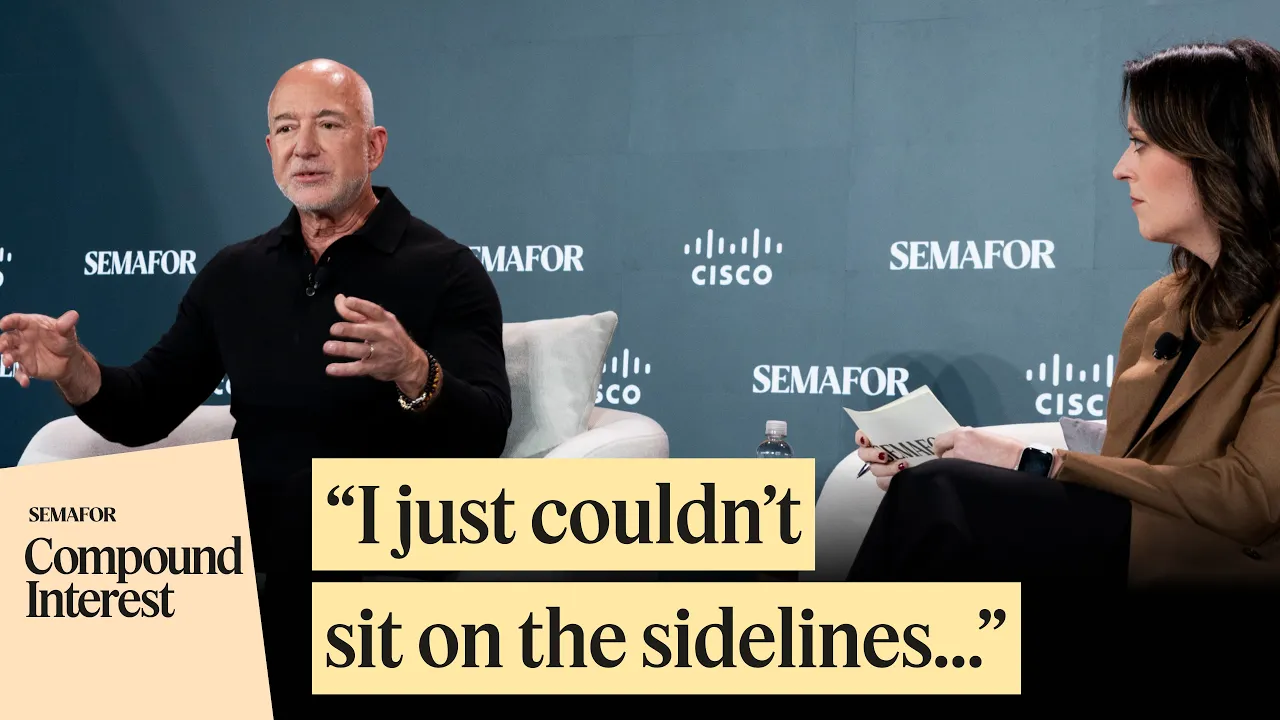
"I invested in this company at the end of 2024 when it was merely a prototype. But watching the early technical breakthroughs, I became more and more excited, realizing I simply couldn't sit on the sidelines as a bystander. This is Type 2 Fun. It's like climbing a mountain; the ascent is agonizing, but the dopamine reward upon reaching the summit is incredibly real, and small miracles happen every day."
"Picking a villain is an excellent mobilization strategy in politics, but the worst technique for solving practical problems. The role of 'the villain' rotates with the times—from lawyers to Wall Street, and now to the tech industry. But if a company faces a critical malfunction and employees refuse to dig into root causes, instead just throwing blame around looking for scapegoats, that person would have been fired long ago."
"To solve the problem of expensive housing, there is only one physically viable path: building more houses. Policies that subsidize demand while simultaneously restricting supply will inevitably drive prices up. Any measure that avoids increasing actual supply and instead focuses on blaming landlords or developers is nothing short of self-deception."
"The President needs authentic voices from the commercial front lines; cutting off communication with business leaders is a fatal error. We can have rational debates about how to distribute wealth and how to structure taxes, but the premise of everything is that wealth must be created first. You absolutely cannot pull the trigger on the goose that lays the golden eggs."
"At the dawn of a new technology cycle, things are uneven; good, bad, and ugly all get funded, and every experiment is wagered on. But as time passes, market discernment awakens, and capital begins flowing into truly valuable deep waters. This is the healthiest moment of purification in a free-market mechanism."
Full Conversation Transcript
The Engineering Gap in the Physical World: Why Can't Large Language Models Build a Toaster?
Liz Hoffman: We often hear the term "AI for atoms." What does this actually mean in practical applications? Could you give us a few intuitive examples?
Jeff Bezos: The large language models people are currently familiar with are, fundamentally, exceptionally excellent "symbol manipulation tools." But if you ask them to detail-design a physical object, they immediately hit a bottleneck.
The way we train frontier large models is by having them read text across the entire human internet. They absorb humanity's entire existing knowledge base, making them highly adept at solving problems that can be symbolically expressed, such as coding, doing math, and analyzing legal texts. They are extremely powerful in these domains.
But in the real world, there is a vast amount of knowledge that simply cannot be mastered through "reading." You could read a thousand books on how to become an elite gymnast, and once you close the book, you remain a terrible gymnast; you could read a thousand books on dance, and you still wouldn't know how to dance.
Engineering and physical manufacturing follow the exact same logic. Consider a thought experiment: lock the six greatest physicists in history, say Newton, Einstein, and Maxwell, in a room and tell them, "Please help me build a toaster." They would have absolutely no idea where to start. Understanding Maxwell's equations provides zero help in building a toaster because real-world engineering is filled with highly microscopic and cumbersome details like heating element material tolerances, mechanical transmissions, thermal insulation, and assembly processes.
Knowledge operates at entirely different levels of granularity. If you want AI to handle engineering design and physical manufacturing, you must train highly specialized physical models. This is exactly where we are pouring our full efforts at Prometheus.
Liz Hoffman: What is the current progress of Prometheus? What exactly are you working on?
Jeff Bezos: It is incredibly exciting. We have assembled an exceptional team of about 250 people. We have raised approximately $14.5 billion, with a significant portion already committed to high-performance computing clusters. This demands intensely dense computational resources.
Our core breakthrough is building "neural surrogates" for numerical physics simulations and developing a single unified multi-physics field model.
In the past, designing an analog chip, RF component, or high-pressure industrial valve typically required a team of 10 to 20 senior engineers spending 6 to 9 months repeatedly modeling, simulating, and iterating. With Prometheus tools assisting, we can now complete the entire design and verification end-to-end within 12 hours.
A top engineer on our team comes from NASA's Jet Propulsion Laboratory (JPL) and was deeply involved in the development of the Mars Helicopter. He attempted to prompt Prometheus with pure natural language instructions to redesign the Mars Helicopter from scratch. The AI's performance was breathtaking; it autonomously explored an incredibly vast design space: Should it use quadrotors, coaxial dual rotors, or fixed wings? It automatically calculated rotor chord lengths and aerodynamic profiles under Mars' extremely thin atmospheric conditions, even proactively asking us questions to resolve ambiguities when faced with uncertain requirements. Ultimately, the system evolved a brilliant design configuration that closely mirrors reality.
The scale of the entire physical manufacturing world is incredible. Looking around, every item within your reach was manufactured in a factory. Yet modern AI has barely scratched the surface of this domain. This represents a trillion-dollar-level transformation dividend for physical industries over the coming years.
Specialized Models and Trillion-Dollar Ecosystems: Absolutely No Walled Gardens
Vik Bajaj: Liz, this is precisely why foundational models in engineering must be fundamentally different from general-purpose language models. As Jeff mentioned, even designing a micro RF chip in a mobile phone rests on decades of human design tradition. Understanding how it works requires deep physics expertise; structural packaging demands balancing thermodynamic expansion with mechanical stress characteristics.
You must train vertically specialized models. Even in the pure language model space, we've seen a trend toward specialization, such as certain code-focused models performing best in specific contexts. However, the heterogeneity and complexity of physical engineering far exceed software code; only radical specialization can build a moat.
Liz Hoffman: If you can improve the design and manufacturing efficiency of toasters, jet engines, and even skyscrapers by 3%, will you eventually step into the market yourself to build toasters or engines? Will this be a walled garden or an open enablement platform?
Jeff Bezos: It is absolutely impossible for this to be a walled garden, because the industry is far too massive.
Global physical manufacturing is a colossal market worth tens of trillions; we cannot possibly manufacture toasters ourselves, nor can we build every jet engine on our own.
Commercially, there will be no single universal model; it must be diverse. One crucial and exciting aspect is that we will act as capital, directly investing in advanced manufacturing companies that deeply adopt our tool ecosystem. We are not just tool providers; we are also investors deeply participating in the dividends of the physical industry.
At the same time, this toolset will be open to a broad range of manufacturing enterprises. Behind manufacturing lies an incredibly vast and intricate global supply chain involving tens of thousands of different production processes. You can only partner with thousands of companies; any attempt to build a closed wall in this domain is destined to fail.
Liz Hoffman: Elon Musk is attempting deep synergistic integration across many of his businesses. Have you ever envisioned tightly bundling or even merging Prometheus, Blue Origin, and even Amazon in the future?
Jeff Bezos: That's an interesting idea, but I currently have absolutely no plans in that direction, and there is no announcement to make today.
Why Re-enter Entrepreneurship After Achieving Success? "Mountain-Climbing Type 2 Fun"
Liz Hoffman: You are already one of the richest people in the world, you've launched rockets into space, and you recently got married. Your life looks incredibly rich and vibrant. Why do you want to re-enter such a crowded AI track to found another brand-new, high-difficulty hardcore tech company?
Jeff Bezos: I made an angel investment in this company at the end of 2024, when it was still just a minuscule seed-stage project.
Watching the team's initial technical breakthroughs and progress, the deeper I dig, the stronger my excitement grows. I realized I simply could not sit on the sidelines as a passive observer. It's too fascinating; I literally couldn't stay seated.
I'm thriving in it. This is "Type 2 Fun." Like climbing a snow mountain, every step during the ascent is incredibly difficult and painful, leaving you breathless, but after completing the challenge and reaching the summit, that inward-outward sense of accomplishment is irreplaceable. This neural dopamine reward is extremely real, and the team creates tiny miracles every day.
This team possesses a pure missionary spirit. Everyone buries their heads in hard work without distractions. If you're not interested in this kind of pure intellectual and engineering challenge, this might not be for you; but for me, this place is Nirvana.
Liz Hoffman: When can we expect to see Prometheus's first public product or major release?
Jeff Bezos: We are currently conducting a private alpha testing phase with several industry pioneer clients, including Blue Origin. Internally, Blue Origin currently has two core projects heavily utilizing Prometheus's design tools. Regarding a full public launch, we are still focused on refining the underlying technology, so it's not yet time for public disclosure.
Liz Hoffman: Vik, when large enterprises collaborate with frontier AI labs, there is often a strong sense of caution, fearing they're letting wolves into the henhouse. They worry that outsourcing engineers acts like a scout force; once they figure out core processes, they'll turn around and steal trade secrets and excess profits. How do you win the trust of these manufacturing giants?
Vik Bajaj: Our core is collaborative empowerment. We help clients accomplish originally impossible tasks at speeds far exceeding past limits. More importantly, the engineering field is highly proprietary and confidential. From the bottom layer of our architecture, we strictly isolate proprietary data. Under the premise of fully safeguarding client intellectual property, we only use compliant, non-sensitive data for model evolution.
Washington Political Cycles and the "Villain Trap": The True Technique for Solving Problems
Liz Hoffman: With Democrats reclaiming control of the House gavel in this election, tech billionaires have once again become the focal point of regulatory scrutiny. Figures like Jamie Raskin have frequently made statements lately. Reflecting on your interactions with successive presidents, do you feel you've gained anything from engaging with politics? Facing potential future political storms, is it all worth it?
Jeff Bezos: Starting from the Clinton administration, I have maintained communication with every subsequent US president, and I hope that as long as the nation requires it, I can continue to communicate with every elected president.
Trump is a president with an extremely strong willingness to communicate; he is very accessible, communicates at a very high frequency, and always keeps phone conversations direct regardless of the hour. Obama, likewise, had a very strong willingness to communicate. I still seek Obama's advice on certain important topics today, and he has given me highly insightful suggestions over the years. By comparison, interactions during the Biden administration were relatively more limited.
But communicating with anyone is absolutely not a bad thing. I always stand from the perspective of this country. In my exchanges with successive presidents, I have never tried to seek illegitimate private gains for Amazon, myself, or any of my businesses.
Presidents and policymakers need to hear authentic voices from the commercial front lines. Shutting doors on business leaders causes policy to detach from ground realities. The core engine of American economic prosperity is precisely our dynamic free-market mechanism, which generates wealth and innovation that the rest of the world envies.
We can have thorough and healthy debates on how to reasonably distribute wealth and optimize tax systems; but the prerequisite for everything is that wealth must first be created. Anyone advocating killing the goose that lays the golden eggs is being extremely shortsighted and dangerous. People sitting on Capitol Hill cannot intuitively grasp the underlying truths of how enterprises operate; broadly listening to industry opinions is critically important.
Liz Hoffman: But many believe that California's tech elites and billionaires are precisely "the villains" behind many of today's social problems.
Jeff Bezos: "Pick a villain" is a time-tested ancient technique in the political realm. For political campaigns and mobilization, scapegoating is a brilliant political tool; but if you truly want to solve real-world problems, it is the worst technique.
Across different periods in history, the target for villains constantly shifts: in earlier years, people loved joking about lawyers; later, with the Occupy Wall Street movement, Wall Street became the public's villain; sometimes landlords are the villains; and now, Big Tech and the tech industry are painted as the new villain archetype.
But this is absolutely not the truth of reality. The vast majority of engineers and practitioners in the tech industry simply bury their heads in hard work every day, dedicated to developing new tools and boosting societal productivity. I don't see this group as composed of bad people.
If you encounter a severe breakdown in Amazon's warehouse logistics system and investigate the root cause, anyone who ignores data, bypasses systemic bottlenecks, and just points fingers at others looking for a scapegoat would likely get fired immediately by me.
Take the current housing affordability crisis, which has sparked widespread public resentment. Many habitually denounce landlords or investment funds as greedy. But if we apply first principles to dig into the root cause of the housing crisis, the answer is crystal clear: We have consistently overstimulated and subsidized demand through policy, while simultaneously restricting housing supply with stringent and cumbersome zoning regulations.
Demand swells while supply is locked down, so prices inevitably skyrocket. Cities like Austin, which experienced massive population influxes over the past decade, successfully mitigated housing costs by implementing a series of supply-boosting measures, such as abolishing mandatory parking ratio requirements and relaxing land-use approvals. To genuinely lower housing costs, there is only one physically viable path: literally building more houses. Finding villains to vent emotions might win votes, but it draws zero blueprints and lays zero bricks.
Nvidia Succession Advice and the Shuffling Moment of AI Capital Cycles
Liz Hoffman: I'd like to ask for your thoughts on Nvidia. Amazon underwent a smooth transition from long-term founder leadership to a non-founder CEO. Rumors abound; do you think Jensen Huang should return to the frontlines? If you had to give one piece of advice to the Nvidia board, what would it be?
Jeff Bezos: Regarding the specific details of Jensen Huang's personal departure or retention, outsiders cannot know the true insides of boardroom closed-door meetings. But I can be certain that Jensen Huang is an extraordinary business leader. He founded and forged an incredible, great enterprise with unparalleled diligence and foresight, and he deserves eternal respect and admiration.
If I must offer advice to the Nvidia board, it is this: insist on promoting successors from within.
Absolutely do not attempt to parachute in an external CEO. For a company like Nvidia, where operations are extremely complex, technology is highly vertical, and cultural imprinting is profound, the probability of an externally hired CEO succeeding is virtually nil. Parachuting should be an absolute last resort. Amazon's handover back then was an internal, planned transition spanning years, meticulously detailed; the two are not comparable.
Liz Hoffman: Looking back at Amazon's growth journey, it endured years of losses, relying on continuous shareholder subsidies before finally turning a profit. Today, many generative AI startups are queuing up to enter the secondary public markets. Do you think investors will have enough patience for these AI companies burning billions?
Jeff Bezos: That's not called a loss; by the way, that's called strategic investment.
As for AI startups, investor discernment is rapidly rising, which is an inevitable law.
In the early stages of every major technological revolution, markets often struggle immensely to distinguish between disruptive opportunities and mediocre mirages. Therefore, in the early phases, all frantic experiments get funding; good projects, bad projects, and even despicable speculative ventures all receive capital favor.
But as time passes, market Discernment begins to awaken. Capital starts saying "no" to poor projects and directs precious resources toward truly defensible, implementable high-quality directions. We are going through this screening process right now. This is the healthiest and most commendable mechanism of a free market. Although it involves washing away sand to find gold, the physical value of this technology is indisputable, and no force can halt its long-term prosperity.
Vik Bajaj: When facing physical sciences like healthcare and biophysics, we must maintain extreme objective reverence for time cycles. Just like using machine learning for early cancer blood screening—a grueling ten-year marathon—the market now has mature and reliable diagnostic products; AI-assisted drug molecule design and clinical validation similarly required fifteen years of accumulation. In the realm of physical sciences, you must insist on "Underpromise and Overdeliver," focusing exclusively on solving core engineering bottlenecks.
Finale Bonus: Bezos Personally Involved, Why Was Robert Pattinson Unanimously Locked In as the New 007?
Liz Hoffman: Before we wrap up, there's one final topic capturing widespread attention. After acquiring MGM, Amazon obtained the rights to 007. It's rumored you recently deeply participated in the casting process for the next James Bond. How exactly did you ultimately settle on Robert Pattinson?
Jeff Bezos: Yes, I was deeply involved throughout this entire process. The selection mechanism is extremely rigorous and professional, and we finally made our decision last Friday.
We initially filtered through a massive pool of candidates round by round, finally locking in five finalists. Then, we organized highly authentic traditional full-scale screen tests: each actor changed into a complete set of custom costumes, acted alongside other professional actors in real movie sets, and live-recorded three classic scenes with different emotional tensions.
On Friday, our entire core decision-making team spent several hours watching frame by frame and repeatedly comparing the audition performances of these five candidates. I must admit, these five actors who reached the final round are all world-class talents.
But standing before the big screen test footage, Robert Pattinson's performance possessed an extraordinarily magical quality. Everyone, including director Danny, almost instantly reached a completely unanimous and undisputed consensus. Frankly, when we first considered him, we even harbored some reservations because he is just too famous; we originally leaned toward seeking a somewhat less household-name face.
But once you truly see his demeanor, agility, and presence on the monitor, the conclusion is undeniable: He is the real James Bond.
Liz Hoffman: Can we post those classified audition videos exclusively on the Semafor website?
Jeff Bezos: Ha! Post what? Don't even dream about it!
Liz Hoffman: Thank you very much, Jeff and Vik, for your wonderful sharing!
Join TechFlow official community to stay tuned
Telegram:https://t.me/TechFlowDaily
X (Twitter):https://x.com/TechFlowPost
X (Twitter) EN:https://x.com/BlockFlow_News
 深潮TechFlow