Good news: AI can now make customer service calls for you; bad news: the other end is also AI.
Author: Lilyann, Geeker Park
After years of surfing the web, you've undoubtedly had experiences like this: wanting to cancel an automatic renewal but never finding the entry point; being overcharged by a merchant, yet having to get transferred repeatedly when requesting a refund; spending half an hour explaining a matter of a few dozen dollars to customer service, only to hear, "I'm very sorry, we're temporarily unable to handle this for you." The amount may not be large, but it still stings. What's more frustrating is that even though you're in the right, you don't have the time to drag it out. Companies have entire customer service systems, while you might only have a lunch break.
Now, this asymmetrical relationship is finally changing. The emergence of AI, especially Personal AI, allows consumers to hand over these life hassles to AI for handling. Whether it's email correspondence or appeals on apps, an Agent can do it all with one click. But new questions have also emerged: The good news is that AI can finally make those customer service calls for you. The bad news is that the AI on the other end might also be AI.
On one side is the enterprise's AI customer service agent, and on the other is the consumer's AI assistant. While two tireless AI systems discuss a billing dispute of a few dozen dollars, the actual consumer has long moved on to other things, leaving only the two AIs to politely negotiate behind the scenes. It sounds like a dark humor piece, but in Silicon Valley in 2026, this is already a serious business problem being studied by startups.
In October, enterprise customer service AI company Decagon launched the Personal Agent Gateway, aiming to let consumers' AI assistants communicate directly with corporate customer service systems. The company even published an article specifically discussing a unprecedented type of customer: "The Customer Who Never Gets Tired".
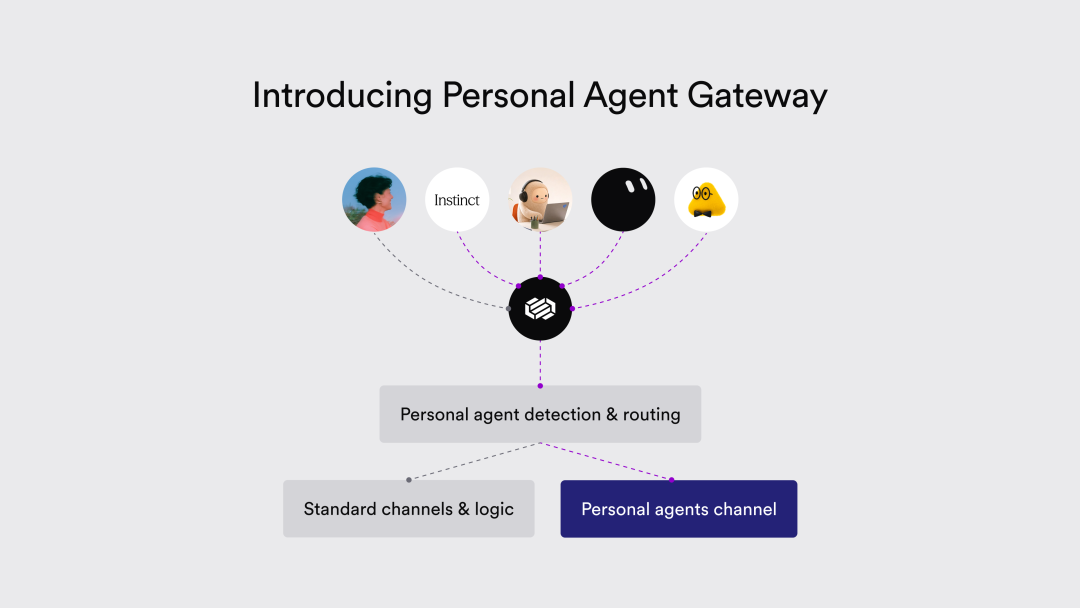
Fig: Personal Agent Gateway framework (Source: Decagon)
If a real person is denied a refund, they might give up after asking twice. But what about an AI? It can look up policies, organize evidence, explore alternative solutions, and keep going until the issue is resolved or it confirms that resolution is truly impossible.
Recently, a product called Pine Computer has drawn attention in the Silicon Valley tech scene. In October, Pine AI released a cloud computing environment designed specifically for AI, with the announcement post garnering around 2.4 million views on its launch day. In November, the team unveiled the Pine Phone, enabling AI to make real-world phone calls while browsing websites and processing documents.
Geeker Park spoke with Sun Yurun, co-founder and CTO of Pine AI. Founded in June 2024, Pine's core team comes from the real-time audio/video platform Agora. The company has completed a $25 million Series A round. They started with what seems like a trivial task: letting AI make phone calls, negotiate bills, process refunds, and handle those troublesome tasks no one wants to touch on behalf of everyday users.
Outsiders might easily interpret this as an AI-vs-AI customer service arms race. But Sun Yurun doesn't see it that way: "We aren't facing off directly against these large companies." In his view, saving a user a few dozen dollars on a bill is merely the first step toward building trust in AI. The real goal is to empower AI to get things done in the complex, inefficient, rule-laden real world.
"I made five or six calls and couldn't resolve it, but it works as soon as AI steps in?"
When Sun Yurun and his team decided to start their venture in 2024, generative AI was already noticeably transforming how programmers work. Cursor was gaining popularity, and ChatGPT could write code and generate documents, but for the vast number of non-programming everyday users, this productivity revolution seemed to remain locked within other people's computers.
Sun Yurun recalls a photo from a construction site that went viral on Reddit in 2023. A Belgian company hung a massive billboard on the unfinished exterior of a building that read: “Hey ChatGPT, finish this building…” With a sub-caption below: “Your skills are irreplaceable.”

Fig: Billboard at Belgian construction site (Source: Reddit)
Behind the joke lies a genuine disconnect: Those who build AI enjoy its efficiency gains daily, yet in the real world, countless tasks still require people to make phone calls, fill out forms, locate departments, and communicate repeatedly. Sun Yurun faced this himself: After reapplying for a HSBC credit card online, he never received the physical card despite repeated attempts and difficulty navigating the website, ultimately forcing him to call customer service. If AI can now build websites, why is recovering a simple credit card so cumbersome? Thus, they decided to pull AI out of the computer and truly act on people's behalf.
But the team quickly realized that getting an AI to speak isn't the hardest part; the real challenge is whether it can solve problems that average users cannot handle themselves. Sun Yurun shared a case where a user needed to terminate their internet service early due to a company relocation, but the provider insisted on charging for the full billing cycle. After making five or six unsuccessful calls, the user turned to Pine. Pine first consulted its knowledge base and historical cases to locate the relevant billing policies, then contacted the provider with concrete grounds, ultimately saving the user hundreds of dollars.
“At that moment, users realize that AI can actually be more patient and better at understanding rules than they can,” Sun says. This became the core logic the team repeatedly validated later: For AI to handle tasks on behalf of ordinary people, language proficiency alone isn't enough. It must rely on a deep understanding of regulations, mastery of processes, and resilient persistence in communication.
A competent AI assistant shouldn't need to check in with its boss every three minutes
However, getting things done doesn't mean handing everything over to AI to play freely. Many decisions in life involve real money, personal privacy, and legal liabilities. If an AI handles your refund request and encounters a compromise condition midway, should it agree on your behalf or pause to ask you? If it asks at every step, the user's energy isn't truly freed up. But if it decides everything autonomously, one mistake could cost far more than the few dozen dollars saved.
Striking a balance between autonomy and security has become a fundamental design challenge for all current Personal AI systems. Using a human assistant as an analogy, Sun explains: An excellent assistant shouldn't message their boss for instructions every three minutes, nor should they sign contracts on the boss's behalf without authorization. The key lies in establishing a tiered control system based on permissions.
In Pine's architecture, tasks are broken down into risk levels. Routine information gathering, bill reconciliation, and policy inquiries allow the AI to operate fully autonomously. However, for high-risk actions like financial transactions, contract signing, or waiving rights, the system forces a confirmation mechanism, returning final decision-making authority to the human.
More importantly, AI must clearly identify itself to its conversational partner. When Pine makes calls, it explicitly states that it is the user's AI assistant and clarifies the authorized scope. Sun believes that impersonating humans carries not only legal and ethical risks but also erodes long-term commercial trust. “For AI to truly integrate into human society, it needs to be smart, but it must also know its place.”
Enterprises are using AI to take calls, while consumers are starting to use AI to make them
As consumers begin using AI to make calls, another intriguing shift is quietly underway: customer service representatives on the receiving end are increasingly being replaced by AI. From Klarna to major banks, enterprises worldwide have been deploying AI customer service on a large scale over the past two years to cut labor costs. But when AI meets AI, things start to get complicated.
Traditional corporate customer service often builds defenses around information asymmetry and consumer fatigue. Cancelation workflows that appear compliant but are extremely difficult to navigate, along with lengthy wait times, objectively discourage many people seeking redress. But when the consumer dispatches equally tireless AI, the balance of power begins to tilt.
Decagon's proposed Personal Agent Gateway directly addresses this trend. Rather than letting two large language models feel each other out over phone lines using synthesized speech, it’s better to establish structured Agent-to-Agent communication protocols in the backend to directly execute information exchange, authorization verification, and strategy matching.
However, this doesn't mean all disputes will be instantly resolved. Sun points out that corporate customer service systems are often underpinned by complex commercial interests and isolated permissions. AI can take calls on behalf of a company but may lack the authority to make binding decisions; similarly, consumer AI must also operate strictly within authorized boundaries. Establishing mutual trust agreements and liability frameworks between these two systems will be a critical infrastructure gap that must be bridged in the coming years.
Do everyday people really need an AI assistant?
In Silicon Valley, discussions about the future form of Agents never cease. Some believe everyone will possess an omniscient super-brain managing every aspect of daily life; others argue that scenario-specific vertical tools hold greater survival space.
Facing such grand narratives, Sun and his team take a much more pragmatic approach. In their view, everyday people's demand for AI rarely starts with “changing lifestyles,” but rather with specific, headache-inducing minor troubles: refunding a missed flight ticket, canceling a gym membership charging an annual fee, or retrieving an overcharged broadband bill.
These tasks seem limited in value individually, yet they quietly drain everyday people's energy and happiness. Goldman Sachs previously noted that calculating the economic value of time spent by individuals on administrative chores and rights disputes outside of work hours reveals a massive hidden cost. When technology finally lowers this cost, it releases not just efficiency, but life itself.
From phone calls to computers: What else does an AI assistant need to learn?
Making phone calls is just the first step. In reality, completing a task often requires a “combo”: checking policies online, filling out forms, uploading receipts, following up via phone, and finally confirming via email. This drives Pine from a pure Voice Agent toward Computer Use, leading to the launch of Pine Computer this past October.
Pine Computer is led by co-founder and Chief Architect Dylan Wang. Also originating from Agora, Dylan holds a deep understanding of infrastructure: Over recent years, the industry has focused solely on making models smarter, rarely rethinking the computers those models run on. Models are forced to complete tasks through screens, mice, and browsers designed for humans, wasting significant reasoning capabilities just trying to understand interfaces. Instead of training models to adapt to human PCs, it makes more sense to redesign a cloud computing environment tailored for AI.
Nevertheless, the technology still has some distance to go before achieving true reliability. In Pine's October release of the SaaS-Bench v1.1 evaluation, the system achieved a checkpoint pass rate of 78.3%, but a complete task completion rate of only 27.4%. This perfectly illustrates the current state of Agents: it can execute many steps correctly in succession, but if it fails on the final step, the entire endeavor collapses. Users ultimately care about only one thing: Did the task actually get done?
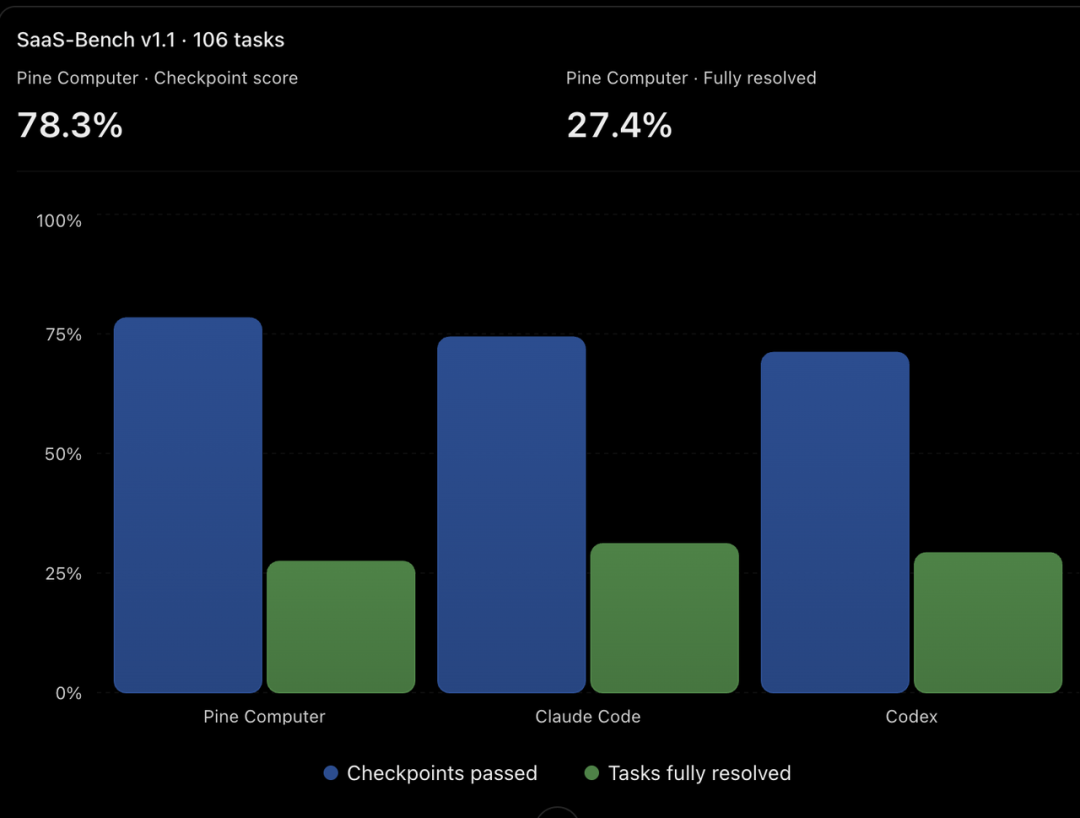
Fig: SaaS-Bench v1.1 test results
Sun believes that compared to short-term product forms, what truly requires long-term accumulation is the capability to execute tasks quickly, cheaply, and reliably. This is also why he remains cautious about the social vision of universally collaborating Agents: “Habits in this world are deeply ingrained, and dealing with actual people is hard to bypass.” Humans have spent decades trying to move services online, yet to this day, many things still require finding a specific person to get done properly.
For a long time, discussions around AI's productivity revolution have fixated on questions like how much code it can write or how much content it can generate. But there is another type of productivity rarely calculated seriously: the time, knowledge, and emotional costs an ordinary person incurs to protect their rights and manage daily chores. Previously, corporations relied on professional teams, complex systems, and massive databases, while consumers were left with only finite patience.
Today, AI is driving down these costs. The endpoint of this shift may not be giving everyone an AI that's better at arguing, but rather ensuring that tasks once abandoned due to excessive hassle can finally be taken care of on our behalf. Perhaps one day, we won't have to personally sit through endless customer service calls for a few dozen dollars in a bill; instead, two AIs will swap authorizations, query policies, and complete negotiations in the background, sending the final result straight to our phones. The difference is that this time, what gets consumed is no longer your patience.
Join TechFlow official community to stay tuned
Telegram:https://t.me/TechFlowDaily
X (Twitter):https://x.com/TechFlowPost
X (Twitter) EN:https://x.com/BlockFlow_News
 极客公园