Morgan Stanley Maintains Overweight Rating on Zhipu AI, Bullish on GLM-5.4 Architecture Innovation and December Flagship Catalyst
Zhipu AI (2513.HK) has officially launched its flagship large language model GLM-5.4, achieving reasoning depth comparable to models with 2 trillion to 3 trillion parameters without increasing the total parameter count. In a report released on November 24, 2026, Morgan Stanley Asia Technology Analyst Gary Yu and his team noted that the model introduces the Loop Transformer architecture for the first time, serving as the initial test of Zhipu AI's independent R&D capabilities following the anti-distillation wave. Morgan Stanley maintains an "Overweight" rating and a HKD 700 target price for Zhipu AI, implying a 106% upside from the current share price, and highlights the next-generation flagship LLM scheduled for release in December as a key catalyst.
Loop Architecture Breakthrough: 750 Billion Parameters Deliver 3 Trillion Intelligence
The competition over LLM parameters is shifting toward deeper waters of architectural efficiency.
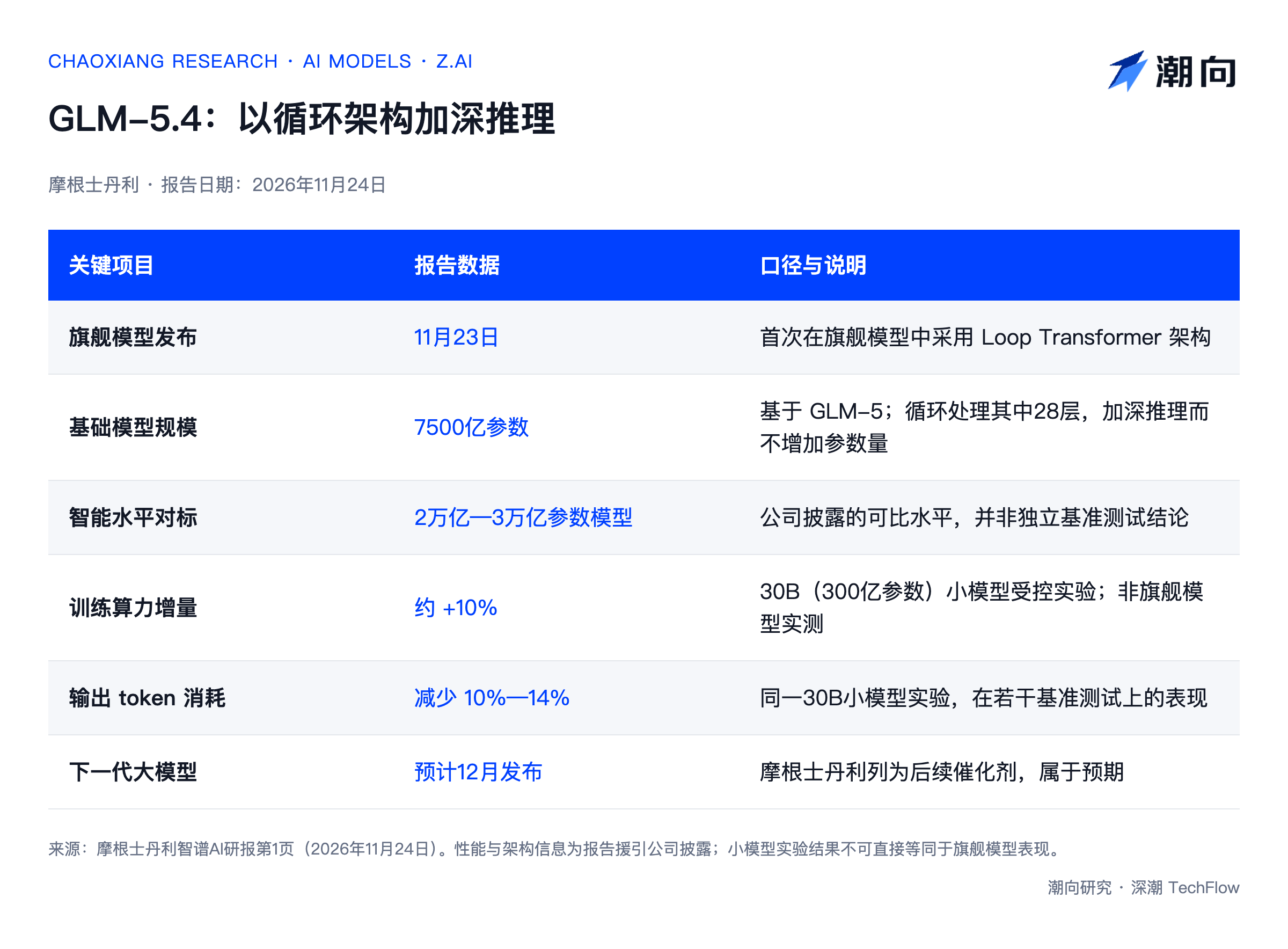
On November 23, 2026, Zhipu AI officially released its flagship model GLM-5.4. This is the company's first flagship product to adopt the Loop Transformer architecture. Rather than blindly scaling up parameters, it significantly expands reasoning depth by iteratively processing 28 network layers within the 750-billion-parameter (750B) GLM-5 base model, all without increasing the total parameter count.
Zhipu disclosed that GLM-5.4's comprehensive intelligence level now rivals that of massive models with 2 trillion to 3 trillion (2-3T) parameters. This leap relies on three core underlying innovations: gated progressive updates, cross-loop key-value cache (KV-cache) sharing, and sparse attention reuse, which deepen the chain of thought while maintaining baseline reasoning efficiency.
Controlled experiments on a 30-billion-parameter (30B) small model confirm the cost-effectiveness of this approach. After introducing the loop mechanism, training compute increased by only about 10%, while the model's inference performance saw a significant jump. Meanwhile, Token consumption decreased by 10% to 14% across multiple benchmark tests.
Functional boundaries are also expanding in tandem. GLM-5.4 adds visual understanding capabilities and extends code generation from traditional software development into video generation, game development, 3D modeling, and engineering design, marking Zhipu's accelerated evolution toward "Generalized Coding."
First Test Post-Anti-Distillation: Breaking Through Compute Constraints
From Morgan Stanley's perspective, the release of GLM-5.4 holds dual strategic benchmark significance.
First, it is the first core model launched by Zhipu AI since the industry initiated the "anti-distillation" movement. Markets had closely watched whether restrictions on distilling external models would hinder the iteration pace of domestic LLMs, and GLM-5.4's actual performance will serve as a crucial litmus test for evaluating the real impact of anti-distillation.
Second, Morgan Stanley believes that the loop-based scaling paradigm opens a highly promising new path for enhancing "intelligence density per parameter." Especially in environments where high-end training compute is severely constrained, extracting base model potential through architectural reuse is more practically viable than simply expanding parameters.
The main event remains ahead. Morgan Stanley explicitly notes that the market's next key observation anchor will be the next-generation large-scale GLM flagship model, expected to be released in December 2026.
2028 Revenue Forecast at 46.7 Billion RMB, Target Price HKD 700
The business is currently in a ramp-up period characterized by rapid revenue expansion alongside heavy R&D investment.
According to Morgan Stanley's ModelWare financial model, Zhipu AI's net revenue is projected to start at RMB 7.24 billion in 2025, surge to RMB 55.69 billion in 2026, further rise to RMB 188.24 billion in 2027, and reach RMB 466.60 billion in 2028. Impacted by intensive compute costs and R&D investments, the company's ModelWare-adjusted net profit is expected to record losses of RMB 4.698 billion, RMB 5.526 billion, RMB 7.468 billion, and RMB 4.513 billion from 2025 to 2028, respectively. However, under market consensus expectations, earnings per share (EPS) is expected to turn positive at RMB 0.19 in 2028.
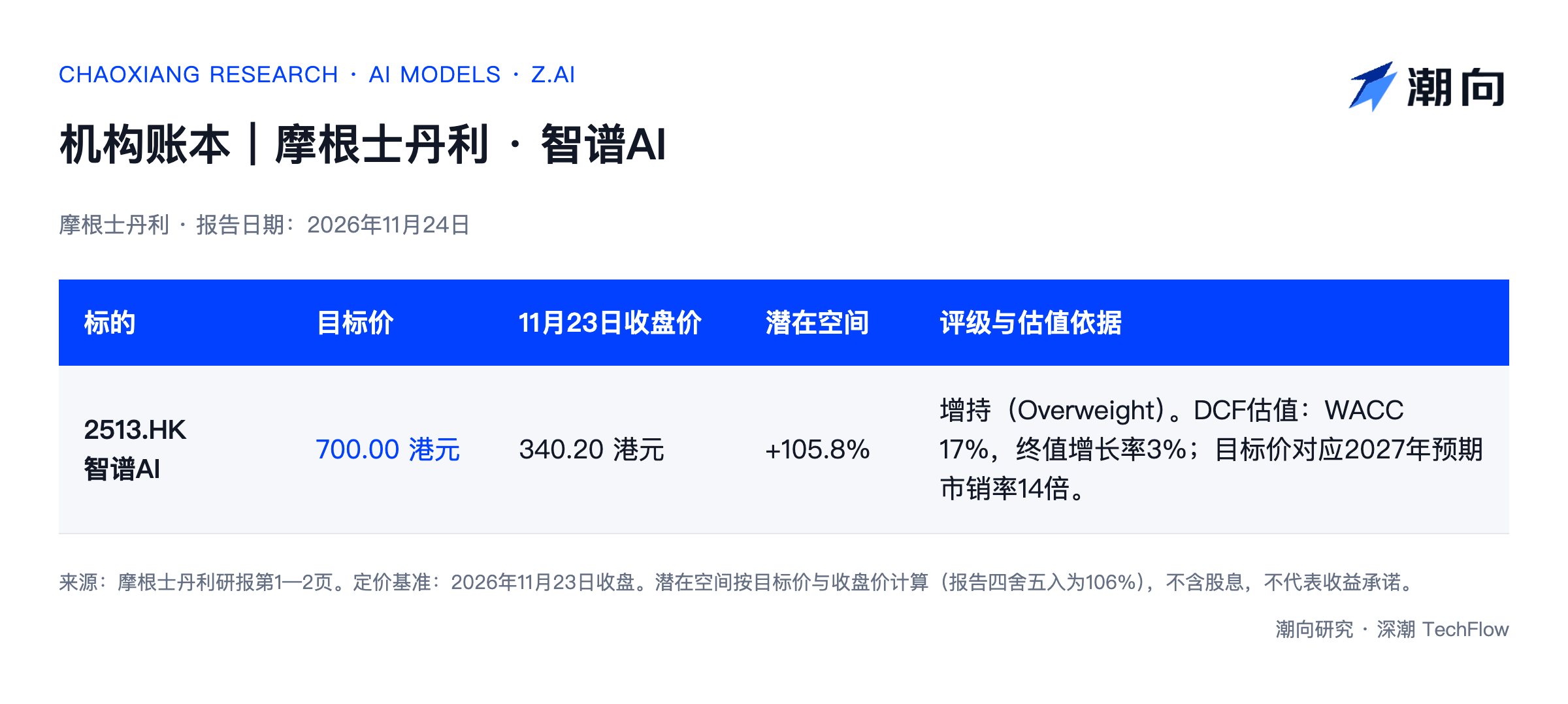
Regarding valuation, Morgan Stanley applied a discounted cash flow (DCF) model, with core assumptions including a 17% weighted average cost of capital (WACC) and a 3% perpetual growth rate. The firm reiterates an "Overweight" rating and maintains a HKD 700.00 target price, implying a roughly 14x forward price-to-sales (P/S) ratio based on 2027E estimates.
As of the close on November 23, 2026, Zhipu AI's shares traded at HKD 340.20, representing a market capitalization of approximately USD 21.162 billion and leaving a 106% upside to the HKD 700 target price.
This article is compiled and interpreted by Chaoxiang Research based on third-party broker research reports. All ratings, target prices, earnings forecasts, and related assessments cited herein reflect the views of the respective broker analysts, representing only their institutions' stances, not those of Chaoxiang Research, and do not constitute any investment advice.
Markets involve risks, and decisions should be made independently. This article should not be used as a basis for buying or selling any securities.
Join TechFlow official community to stay tuned
Telegram:https://t.me/TechFlowDaily
X (Twitter):https://x.com/TechFlowPost
X (Twitter) EN:https://x.com/BlockFlow_News
 @chaoxiangooo