Code Abused by Others, Yet Developers Face 45 Years in Prison: The Tornado Cash Trial and the Survival of Open-Source Innovation
Author: Paul Klay (@PaulKlayVC)
Compiled by: TechFlow
TechFlow Summary: When tools delivered by developers are maliciously used by third parties for illegal activities, should the act of writing code itself carry joint criminal liability? The charges and potential maximum 45-year prison sentence facing Tornado Cash co-founder Roman Storm are far more than a compliance dispute over a single protocol; they represent a dangerous precedent that threatens the fate of all software engineers.
From the immutability of non-custodial smart contracts to the gaping holes in the prosecution's key evidence, to the Supreme Court's application of precedents on intermediary liability online, this article thoroughly examines the judicial controversies behind the case. If the legal boundaries of liability for open-source code remain blurred, innovation in AI, DeFi, and privacy will be stifled by a chilling effect.
The events I am about to recount directly concern every software developer. This case risks setting an extremely dangerous legal precedent: if someone maliciously uses code you once wrote to commit a crime, you personally could face severe criminal charges.
Even if you never earned a single penny from it; even if the code was originally designed entirely for other legitimate purposes; even if you long lost the ability to modify it, and the underlying technology remains completely free and open-source for anyone in the world to use freely.
Imagine this scenario: You once developed a tool for your employer that efficiently collects and processes data. Long afterward, a malicious individual uses that tool to steal sensitive secrets. You were completely unaware and had no involvement throughout the entire process, yet you could still face up to 45 years in federal prison because of it. This is almost the exact predicament Roman Storm currently finds himself in.
In this landmark case, too many critical details have yet to receive sufficient public attention. If we hope to defend the future and survival of the entire software industry, we must face these facts head-on and engage in serious discussion.
Who is Roman Storm: From Self-Taught Hacker to Ethereum Core Builder
Roman Storm (@rstormsf) was born in Kazakhstan and moved with his family to Chelyabinsk, Russia, at age seven. His parents keenly recognized his strong interest in computer technology and scrimped and saved to buy him a personal computer in the early 1990s. He taught himself programming and became obsessed with spending hours deconstructing various game codes and manually refactoring them.
In 2008, at just 19 years old, Roman went to the United States to study and work, eventually naturalizing as a U.S. citizen. Today, he is a father to a young daughter. After moving to the U.S., his solid engineering skills helped him break into the software engineering industry, where he held key R&D roles at Cisco, several Silicon Valley tech startups, and Amazon.

In August 2017, Roman resolutely left Amazon to devote himself full-time to blockchain infrastructure development. Initially, he wrote smart contracts for several early ICO projects and later that year became the Chief Technology Officer (CTO) of POA Network. Under his technical leadership, this Ethereum sidechain processed over $150 million in on-chain transactions for more than 100,000 active users.
In September 2018, he co-founded the well-known security firm PepperSec, which focuses on blockchain infrastructure security auditing and protocol development. During this period, he deeply participated in and contributed to the development and security of numerous foundational industry projects, including top protocols such as Aave, 0x, 1inch, dYdX, Compound, and MakerDAO.

In December 2019, he joined forces with Alexey Pertsev and Roman Semenov to officially launch Tornado Cash, aiming to provide genuine decentralized financial privacy infrastructure for the Ethereum network.
What is Tornado Cash: A Non-Custodial On-Chain Financial Privacy Solution
Tornado Cash is an open-source, fully decentralized crypto privacy protocol that allows users to sever and hide publicly visible on-chain direct links between transaction senders and receivers.
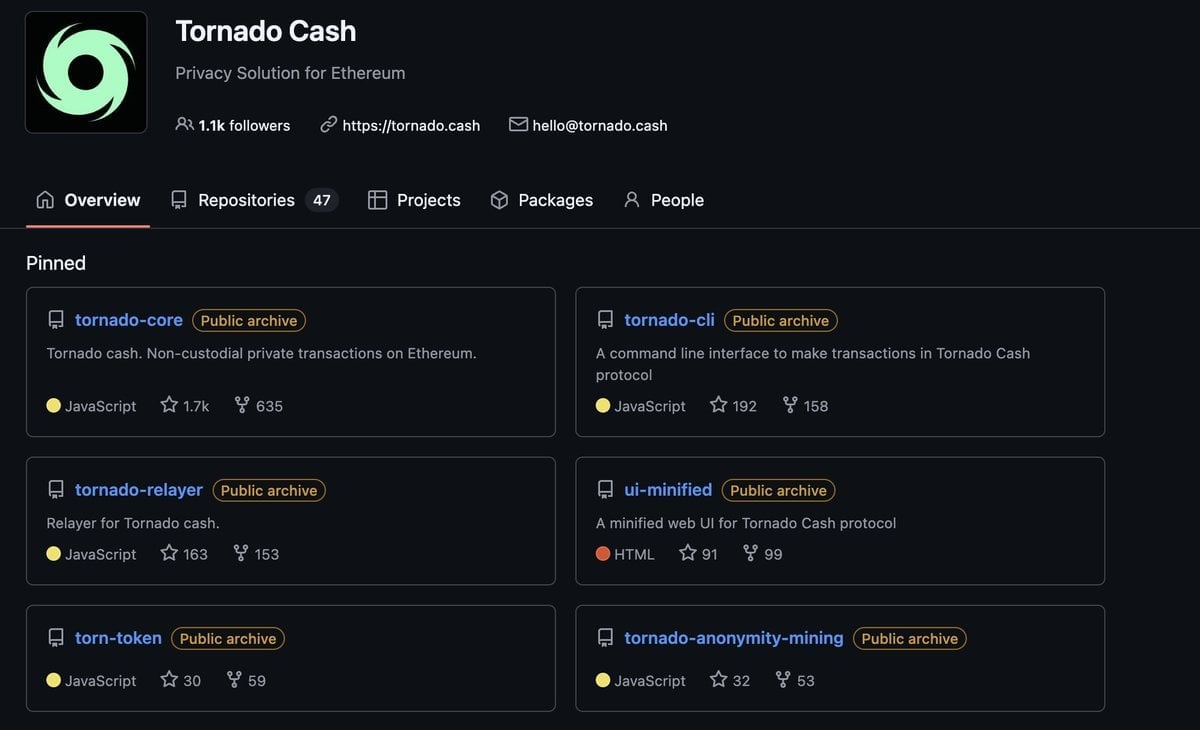
Backed by advanced zero-knowledge proof algorithms, after depositing funds into the smart contract pool, users can later withdraw them to a brand-new, independent address without revealing which deposit corresponds to which withdrawal. The entire process runs autonomously via code, with no centralized matching intermediaries.
As of August 2022, on the Ethereum mainnet and BNB Chain alone, Tornado Cash had accumulated up to $7.6 billion in deposited funds and processed over 300,000 distinct deposit transactions.
The protocol addresses a highly practical need for financial privacy: it allows everyday users receiving wages, making charitable donations, or purchasing daily goods and services on-chain without exposing their entire asset balances and complete historical transaction trails to strangers.
However, like any neutral general-purpose technology, criminals subsequently used this underlying tool to conceal illegally obtained funds. According to blockchain analytics firm Chainalysis, as of August 2022, nearly 30% of the protocol's deposits were linked to illicit activities or sanctioned addresses. This ultimately became the core justification for the U.S. Department of Justice's criminal indictment.
Crucially, however: the protocol's entire source code has been completely transparent and open since inception, and users retain full custody of their own private keys throughout the entire process. Developers have never handled, nor ever custodied, a single token belonging to any user.
Morning of the Raid: Armed Home Search and Facing 45-Year Sentencing Indictment
On the morning of August 23, 2023, piercing sirens and violent banging jolted Roman awake. When he opened his front door, several heavily armed federal agents pointed assault rifles directly at his face and loudly ordered him to put his hands up.
Agents handcuffed him on the spot and aggressively demanded to know if anyone else was inside.
Voice trembling, Roman told them that his young daughter was still sleeping in her bedroom.

As law enforcement carried his young daughter out of the house, Roman remained tightly shackled to the spot. He later recalled with anguish that it was the most despairing and broken moment of his life. He had absolutely no idea what awaited him next, and feared intensely that it might be the last time he ever saw his daughter alive.
Agents roughly searched his home, confiscated all his electronic devices on the spot, and immediately escorted him to a federal court in Washington state for arraignment.
That same day, the U.S. Department of Justice publicly announced three major criminal indictments against Roman. If convicted on all charges, he faced up to 45 years in federal prison.
Court Trial and Evidence Loopholes: Why Did the Prosecution's Case Fail?
In August 2025, a Manhattan federal jury deliberated extensively on the three charges facing Roman:
- Conspiracy to Commit Money Laundering: The jury could not reach a unanimous verdict (not guilty);
- Conspiracy to Violate Sanctions: The jury could not reach a unanimous verdict (not guilty);
- Conspiracy to Operate an Unlicensed Money-Transmitting Business: Guilty.
The trial exposed a staggering number of glaring flaws. For instance, the prosecution presented a chat log attempting to prove that the Tornado Cash team had proactively planned to assist in laundering $600 million in illicit funds. The truth, however, was that the message was simply an external quote forwarded by a third party. The U.S. government privately scrubbed the "Forwarded" tag from the message when submitting it as evidence to the court, only being forced to admit this major flaw days before the trial began.
Throughout the entire trial, the prosecution completely failed to produce any concrete evidence proving that Roman had any direct communication or conspiratorial interaction with criminals using Tornado Cash. Roman never custodied any user funds, never took a commission from transactions, and physically possessed no power to stop, review, or alter immutable smart contracts already deployed on the blockchain. Even today, years after his arrest, these smart contracts continue to operate autonomously on the Ethereum network.
Government prosecutors claimed that official compliance guidelines from the U.S. Financial Crimes Enforcement Network (FinCEN) were irrelevant to this case. In reality, clear internal communication records from FinCEN had long indicated that purely software-based development in a non-custodial model is legally almost impossible to classify as money transmission.
Ironically, regarding the first victim witness presented by the prosecution, even FBI special agents hired by the government itself were unable to trace the victim's defrauded funds on-chain back to Tornado Cash.
In March 2026, the U.S. Supreme Court issued a unanimous ruling in the landmark Cox v. Sony case, explicitly rejecting demands to hold internet infrastructure providers jointly criminally liable for infringing acts committed by their end clients—a fundamental judicial principle the current executive administration had previously supported. Although web access and smart contracts fall under different legal branches, I firmly believe that developers of open-source non-custodial software deserve equivalent legal immunity.
During court arguments over a motion for acquittal, a prosecution attorney absurdly argued that merely performing code maintenance on the protocol afterward could constitute a criminal offense itself. The presiding judge interrupted coldly, saying, "You would have been in better shape if you hadn't said that."
And during April 2026 proceedings, the prosecution was finally forced to publicly admit in court that merely writing and releasing the Tornado Cash code itself does not constitute any crime.
Since his sudden arrest in August 2023, Roman has endured the grueling torment of prolonged judicial uncertainty. The trial faced repeated postponements until an August 2025 jury could barely reach a conclusion on just one of the three charges. Retrial proceedings for the two remaining unresolved felony counts have been delayed once more by the court until April 26, 2027, as the court painstakingly reviews the defense's motion for acquittal.
Note: The above discussion regarding loopholes in the prosecution's evidence and the extent of Roman's involvement reflects factual statements made by the defense legal team. It should be understood as part of the judicial defense process and should not be directly equated with final, legally binding judicial determinations.
Policy Shifts Across Two Administrations: From Prosecutorial Regulation to Policy Adjustment
The criminal witch hunt against Roman began during the Biden administration. In August 2022, the U.S. Treasury Department's Office of Foreign Assets Control (OFAC) unprecedentedly placed Tornado Cash smart contracts on its sanctions list; a year later, the U.S. Department of Justice formally brought decades-long felony criminal prosecutions against him individually.
In November 2024, a federal appeals court issued a historic ruling, explicitly determining that autonomous smart contracts on Tornado Cash, which cannot be tampered with or controlled by anyone, cannot legally be classified as "property" subject to government sanctions. Accordingly, sanctions against the protocol were formally lifted in March 2025.
This past April, the Trump administration publicly announced the comprehensive termination of its previous "Regulation by Prosecution" hardline policy. In August this year, the DOJ issued new internal guidelines stating it would no longer approve new criminal indictments under Title 18, Section 1960(b)(1)(C) of the U.S. Code against software developers who do not control user funds and operate truly decentralized systems.
Yet, incredibly absurdly: despite a 180-degree turnaround in overall administrative and enforcement policies, the historical criminal indictment and judicial entanglement targeting Roman Storm personally continues to be stubbornly pushed forward in court.
A Warning for the Entire Software Industry: The Sword of Damocles Hanging Over All Open-Source Developers
The core question highlighted by the Roman Storm case extends far beyond the single sphere of crypto assets: If the author of software code never controls user assets, should the developer bear criminal liability when others maliciously abuse their publicly released software to commit crimes?
Currently, Roman has already been preliminarily found guilty by the jury on one of the charges. Although the DOJ has softened its stance at a policy level, this amounts to little more than an internal prosecutorial discretion guideline that the executive branch can change at any moment, let alone a statutory law formally amended by the legislature. Should political power shift or administrative will change in the future, successors could easily overturn everything and reinstate harsh crackdowns overnight.
If the legal red lines regarding developer liability are allowed to remain ambiguous and arbitrary for the long term, the entire open-source software industry will suffer devastating damage. Engineers actively working on cutting-edge artificial intelligence (AI), decentralized finance (DeFi), network privacy protection, and various general-purpose underlying open technologies may be forced to collectively abandon open-source projects out of fear of facing decades behind bars for the illegal acts of complete strangers.
How We Can Act: Defending Privacy and Open-Source Freedom
Every developer, startup founder, venture capitalist, and anyone who genuinely cares about the future of neutral technology must now unite and make their voices heard.
Share this in-depth analysis, tag key figures with decision-making power and social influence on social media, or directly donate to his high-cost legal defense fund on freeromanstorm.com. Please lend a hand in any way you can. If we wish for this industry to continue thriving and rediscover its former fearless, exploratory tech-gEEK spirit, we must stand together in defiance right now.
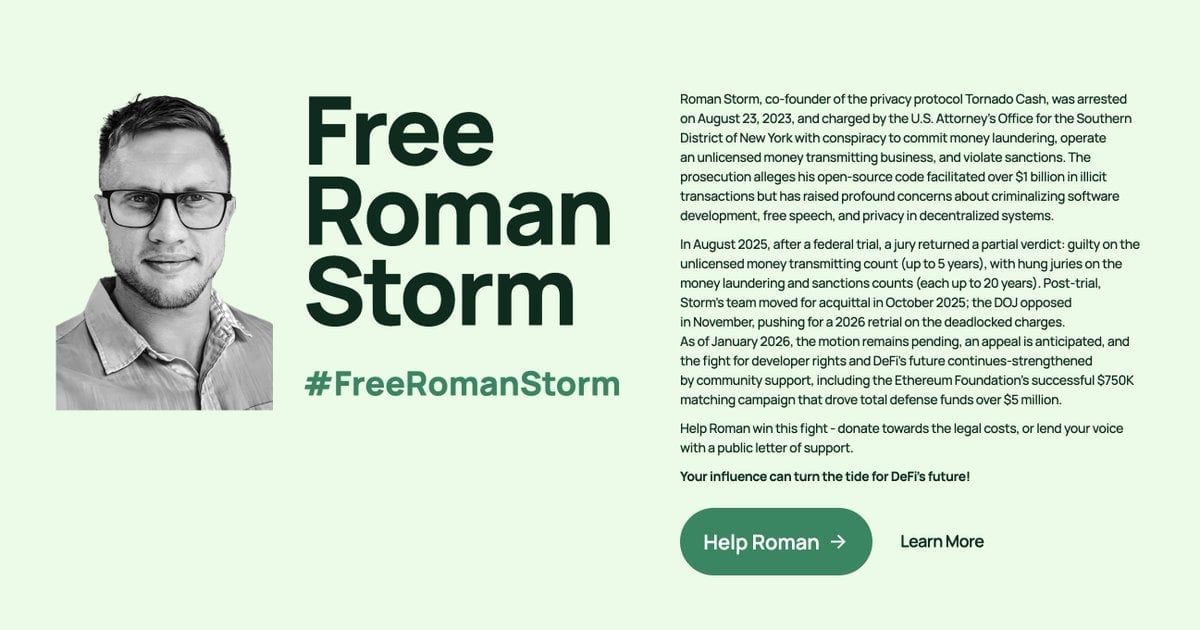
Protecting privacy is absolutely not a crime. Restore true freedom to Roman Storm.
Join TechFlow official community to stay tuned
Telegram:https://t.me/TechFlowDaily
X (Twitter):https://x.com/TechFlowPost
X (Twitter) EN:https://x.com/BlockFlow_News
 PaulKlayVC