Anthropic's Business Playbook: Buying Compute on the Cheap, Selling Intelligence at a Premium, and Racing Against Open-Source Models
Author: Michael Dempsey, Founder of Compound
Compiled by TechFlow
TechFlow Preview: As the most pure frontier model maker currently, Anthropic lacks OpenAI’s consumer-side baggage and the ecosystem synergies of tech giants. Its business model appears deceptively simple: packaging foundational compute priced at a few dollars per hour into frontier intelligence tokens sold externally for tens to over a hundred dollars per hour.
However, as open-source weight models rapidly catch up within four to twelve months, the value of existing intelligence faces continuous inflationary compression. Facing diminishing marginal returns on compute and hundreds of billions in massive capital expenditures, whether Anthropic can maintain its premium through continuously emerging high-value scenarios has become the decisive battle for its ultimate fate.
Abstracting frontier model labs into a business model is surprisingly simple: they sell intelligence via API.
Abstracting frontier model labs into a business model is surprisingly simple: they rent GPU hours and sell intelligence via API.
Abstracting frontier model labs into a business model is surprisingly simple: they raise capital from investors to rent or purchase GPUs, which are then used to sell intelligence via API.
Abstracting frontier model labs into a business model is surprisingly simple: they secure massive funding through structured forms like equity, debt, and even compute commitments to help other companies build data centers for renting out GPUs; subsequently, they not only sell intelligence via APIs and unlimited subscription models, but sometimes build upper-layer software products around this intelligence; and in some cases, they even take direct ownership of their own data centers.
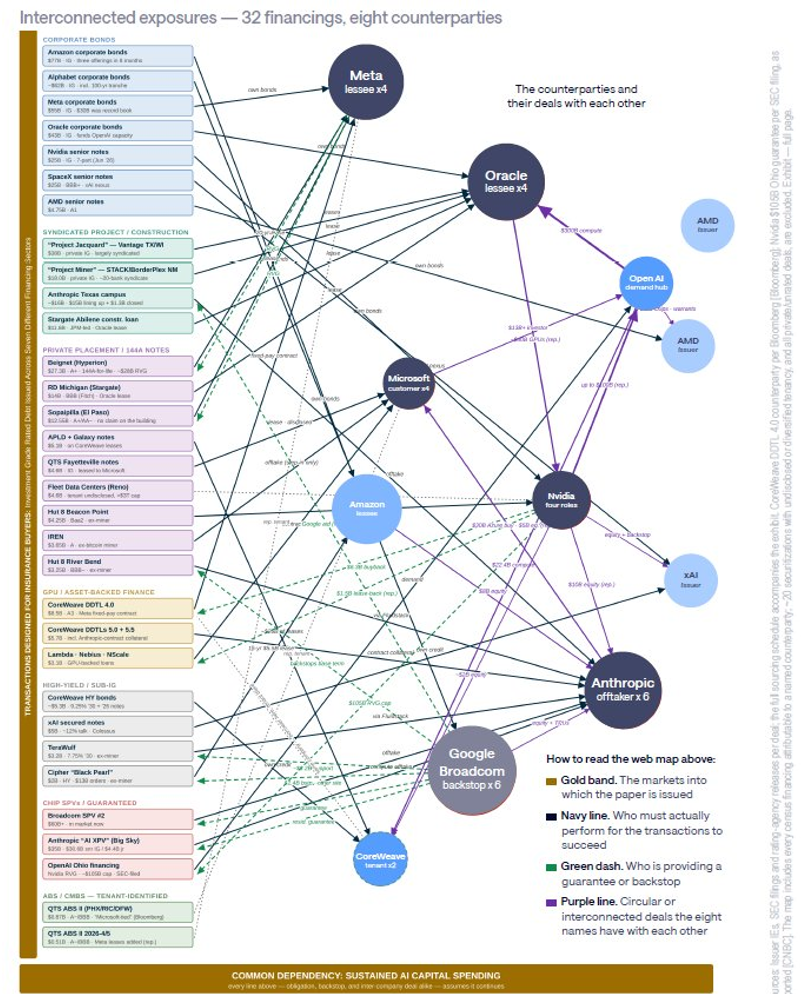
As clearly illustrated above, visualizing the complex flow of capital raised by frontier labs is equally “remarkably simple”. Next, we will focus on Anthropic. Among all frontier labs, it is the most pure “intelligence seller”, carrying neither OpenAI’s heavy consumer-side baggage nor the vast positive business synergies and diversified monetization channels of Alphabet or Meta.
Now that we have clarified what frontier labs are actually doing, let us set aside the well-known key variables in bilateral transactions (such as whether they can fulfill their massive compute commitments, how data center construction speed and real-world deployment impact this race against cash flow, and whether anyone is truly forced to pay when bills come due, or if both parties simply shift blame). Instead, we will thoroughly extract the commercial essence of Anthropic (this is absolutely no pun on model distillation).
The core to understanding Anthropic essentially boils down to one thing: over time, can they continuously find new application scenarios for frontier tokens (Frontier Tokens), thereby staying ahead of the rapid compression of existing intelligence value?
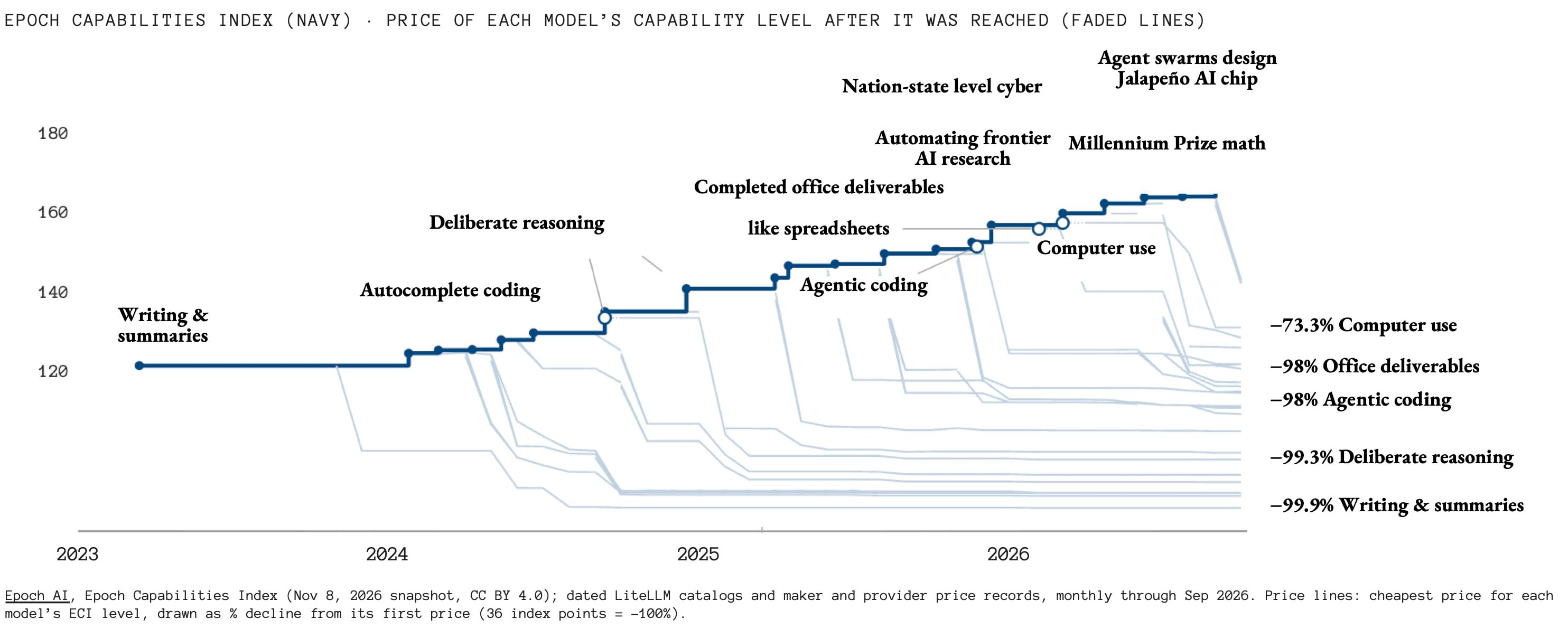
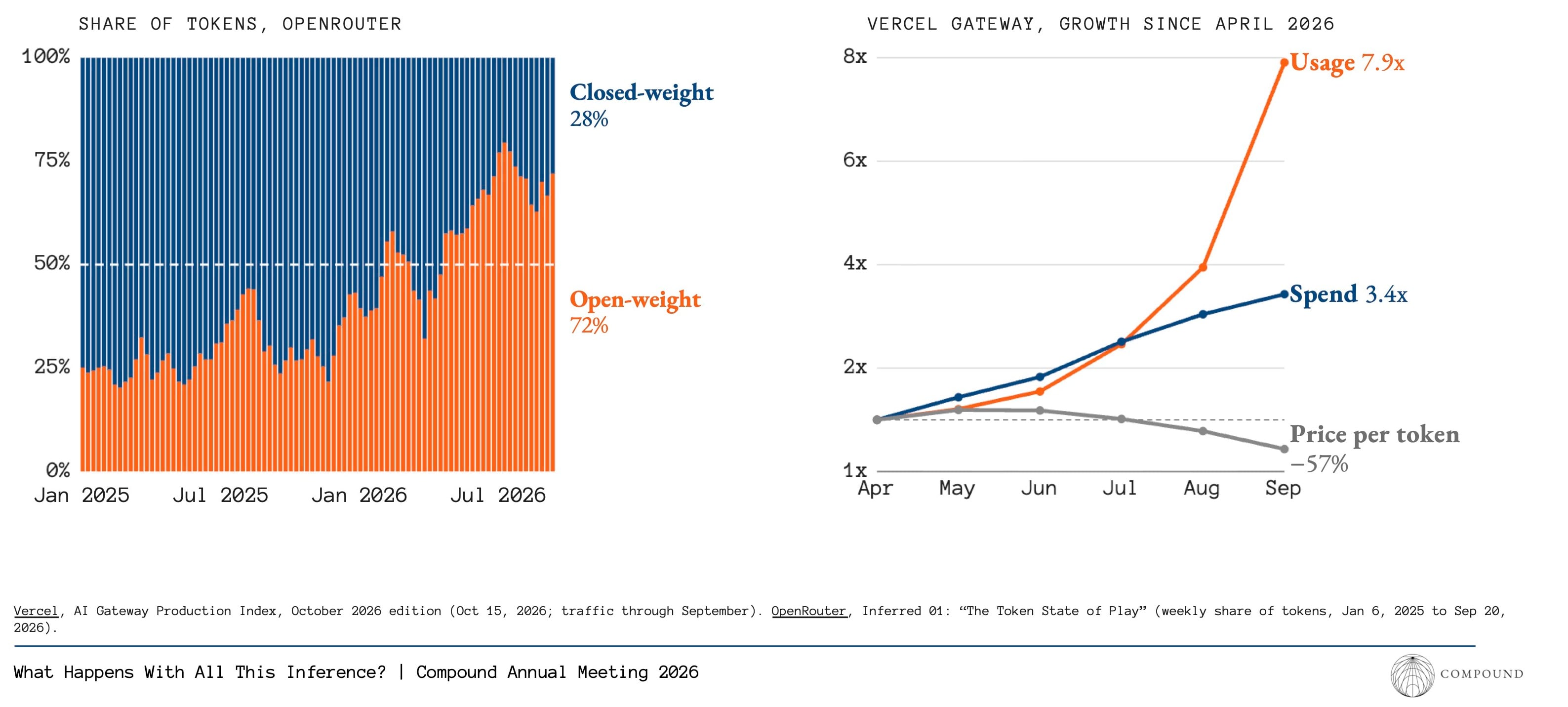
We care deeply about this question because historical experience shows that as model efficiency continues to improve and competitors rapidly follow suit, the cost of so-called current frontier tokens is irreversibly trending toward zero. The chart above displays application scenarios across these different stages, while the chart below reveals that token invocation volume (note: quantity of tokens, not monetary value) is continuously flowing toward sub-frontier or edge-of-frontier open-source weight models.
The overall market expenditure scale is continuously expanding, but this raises a core suspense: within this massive spend, who can truly defend profit margins? Before open-source models catch up within 4 to 12 months, can frontier labs continue to monetize fleeting competitive windows?
This means you must isolate and clarify a highly specialized niche: during periods where frontier intelligence maintains an edge over sub-frontier intelligence, these domains consistently exhibit dynamic sliding windows of high ROI. They largely fall into zero-sum games or highly asymmetric arenas where a slight advantage dictates a massive difference in outcomes; or human expert labor is so prohibitively expensive that injecting $50 worth of compute per hour directly to solve a specific problem is a blatantly worthwhile trade-off.
This dynamic window is precisely where frontier tokens hold their highest value, with typical representatives including financial trading, cybersecurity, defense manufacturing, and software engineering.
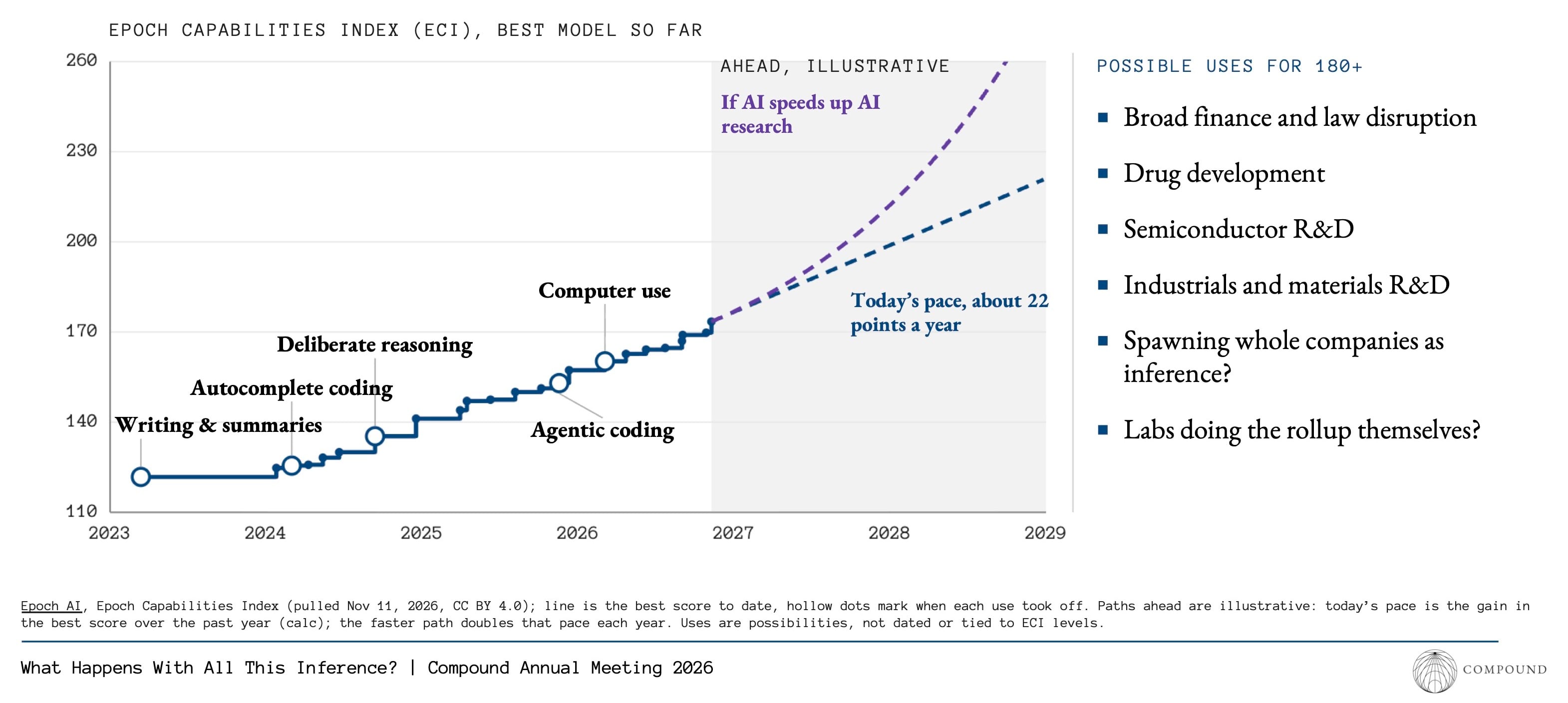
From this, you can vaguely trace the evolution trajectory of all high-value scenarios and begin assessing whether the real economy can actually digest superhuman reasoning capabilities in these categories at a reasonable pace. Perhaps the revolution and diffusion of technology possesses its own irresistible gravitational pull.
Another perspective is that Anthropic is essentially practicing “compute alchemy”. It transforms commoditized compute, valued at merely $2 to $9 per hour (single B200 GPU hour), into a highly premium asset commanding $20 to $50 per hour, reaching over $100 per hour in cutting-edge scenarios; it then uses this generous spread to cover the costs of other GPUs in the cluster dedicated purely to R&D. By contrast, hosting open-source weight models like DeepSeek yields only about $5 to $9 per hour, effectively amounting to bare GPU leasing with almost no surplus profit left for underlying R&D.
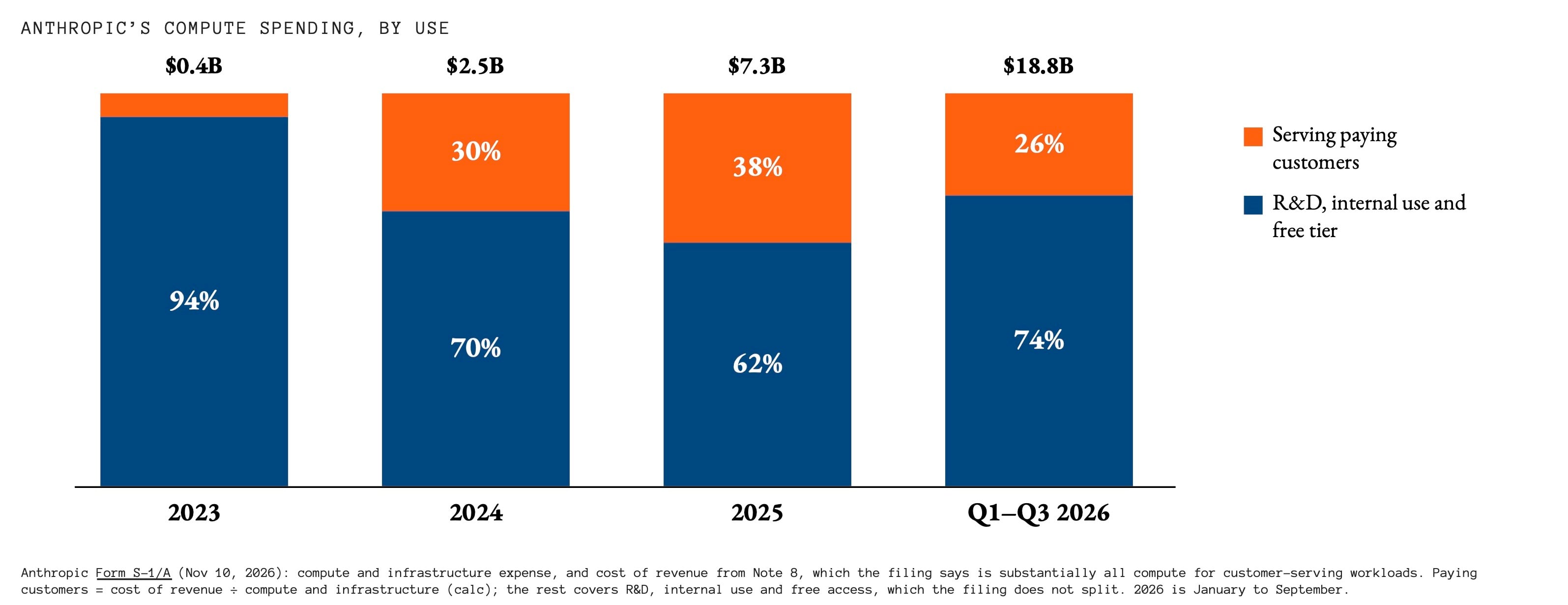
This also explains why the compute allocation structure shown above resembles a Rorschach inkblot test: even though paid client compute growth has more than doubled in absolute monetary value, its share of total compute has still declined to 26%; meanwhile, internal R&D and self-use compute have aggressively expanded by over four times. This landscape inevitably spawns two diametrically opposed interpretations.
The pessimist’s view is: “Good grief, even with Claude Code performing brilliantly and paid client compute growing by more than double, the burn rate of R&D and free-tier compute is still being forced to accelerate at twice the pace of the paid side just to barely maintain a position at the frontier.”
Meanwhile, the optimist’s perspective is: “It’s staggering, Anthropic’s annualized compute investment in R&D and internal use this year reaches approximately $18.5 billion. They must know exactly what they’re doing and have ample justification for betting heavily on internal scenarios that will yield substantial returns in the future.”
This violent reversal in market narrative aligns perfectly with the fate of hyperscalers regarding capital expenditures: in early 2026, the market was still immersed in the euphoria of “look at how much capital these giants are raising for AI capex, which is an absolute super bullish signal for AI”; yet by October 2026, the sentiment abruptly shifted to “look at how much money these giants are burning on AI capex, which is a catastrophic bearish blow for AI”, followed immediately by the merciless valuation crackdown across the secondary market's AI conceptual stocks.
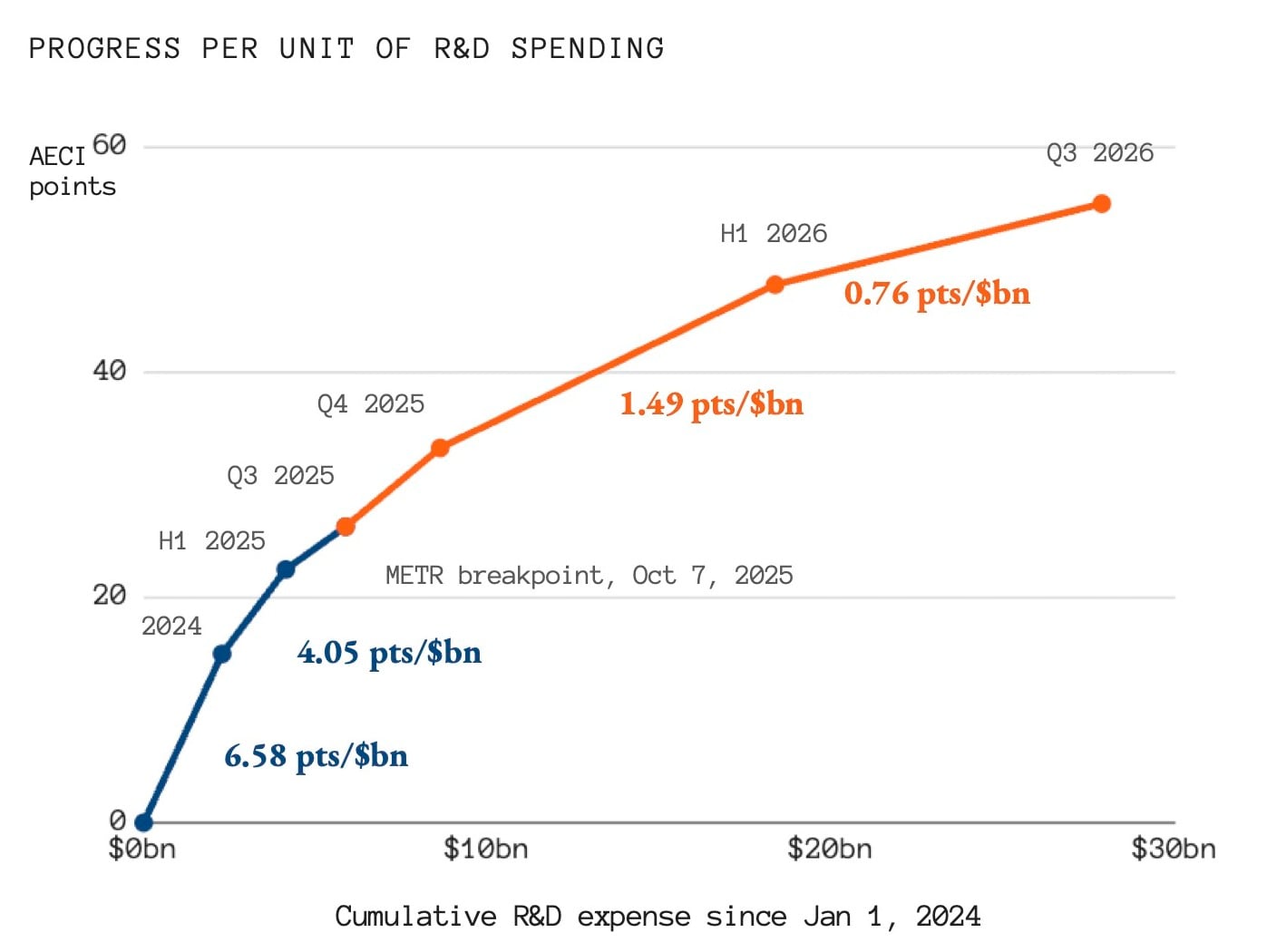
A stark dilemma currently lies in this: the funds required to squeeze out minuscule improvements in frontier intelligence performance are escalating exponentially. The incremental gain in Situational Intelligence Index (ECI) yielded per $1 billion invested in R&D has plummeted from 6.58 points in 2024 to just 0.76 points in Q3 2026. Bulls offer an obvious rebuttal: the economic value corresponding to the ECI index is highly likely non-linear. Scaling from 120 to 130 unlocks text summarization; jumping from 150 to 165 unlocks agent programming and computer operation; while surpassing 170 may directly unlock financial alpha generation or new drug discovery. Therefore, the 0.76 points exchanged for every $1 billion at the top of the pyramid could generate economic returns far exceeding the 6.58 points achieved at the base stage.
Yet even if this logic holds, the real economy must absorb these capabilities fast enough (the benchmark for this absorption rate is precisely the lag time before open-source models catch up with closed-source frontiers) to justify such massive expenditures. Otherwise, you are forced to believe one of two alternative assumptions: either the team can advance model training and performance breakthroughs more efficiently through automated R&D (but taking safety seriously makes this far from easy); or entirely new application scenarios remain sufficiently untapped within pre-training and mid-training corpora, thereby still offering low-cost productivity climbing dividends.
Starting from Scale and Mercor: A Cognitive Reflection on Data Annotation
Early in my career, I conducted in-depth research on first-generation deep learning data annotation companies represented by Scale, Labelbox, and Crowdflower. At that time, I made two judgments that ultimately led me to completely abandon investing in the entire track.
First, I severely underestimated the vitality and market size of the manually annotated data market.
Second, and more critically, I fundamentally misjudged the true core assets built by these companies (and emerging platforms like Mercor): they are essentially precision machines continuously tracking a constantly moving goalpost of “data collection, annotation, and training”. Under this model, even if you still face risks of excessive customer concentration, you simultaneously benefit from quasi-network effects and a fiercely competitive ecosystem, ensuring that the value of data collection remains evergreen as long as application scenarios continue to evolve. I genuinely believed in AI back in 2016, but looking back now, my faith in Scaling Laws was evidently not steadfast enough.
Returning to Anthropic: The Commercial Foundation and Endgame Deduction of a Frontier Leader
Thus, reducing Anthropic to a business model is actually exceptionally straightforward: they aim hundreds of billions of dollars’ worth of compute at a constantly advancing goalpost, thereby selling valuable frontier lead time and absolute performance moats to clients with increasingly urgent needs for frontier intelligence who are willing to pay for it.
This final point is crucial, as it is the lifeline for Anthropic to maintain high profit margins under the tightening encirclement of sub-frontier models. These sub-frontier models could potentially reach levels approaching or even surpassing frontiers through post-training, thereby eroding Anthropic’s premium pricing space for frontier tokens. Stepping back, even if the development of open-source weight models stalls due to various external factors (whether constrained compute environments, frontier labs cutting off model distillation pipelines, or retreating local capital), the aforementioned “pure model vendor dilemma” remains unavoidable: Google or Meta could easily dump sub-frontier intelligence at near-cost ultra-low prices, as they can fully monetize it through mature ecosystem businesses.
Naturally, we must ask: If Anthropic cannot achieve the aforementioned ideal business flywheel, and its profit margins suffer irreversible erosion, what choices will they make?
The answer is: full-stack expansion along the upstream and downstream industrial chain.
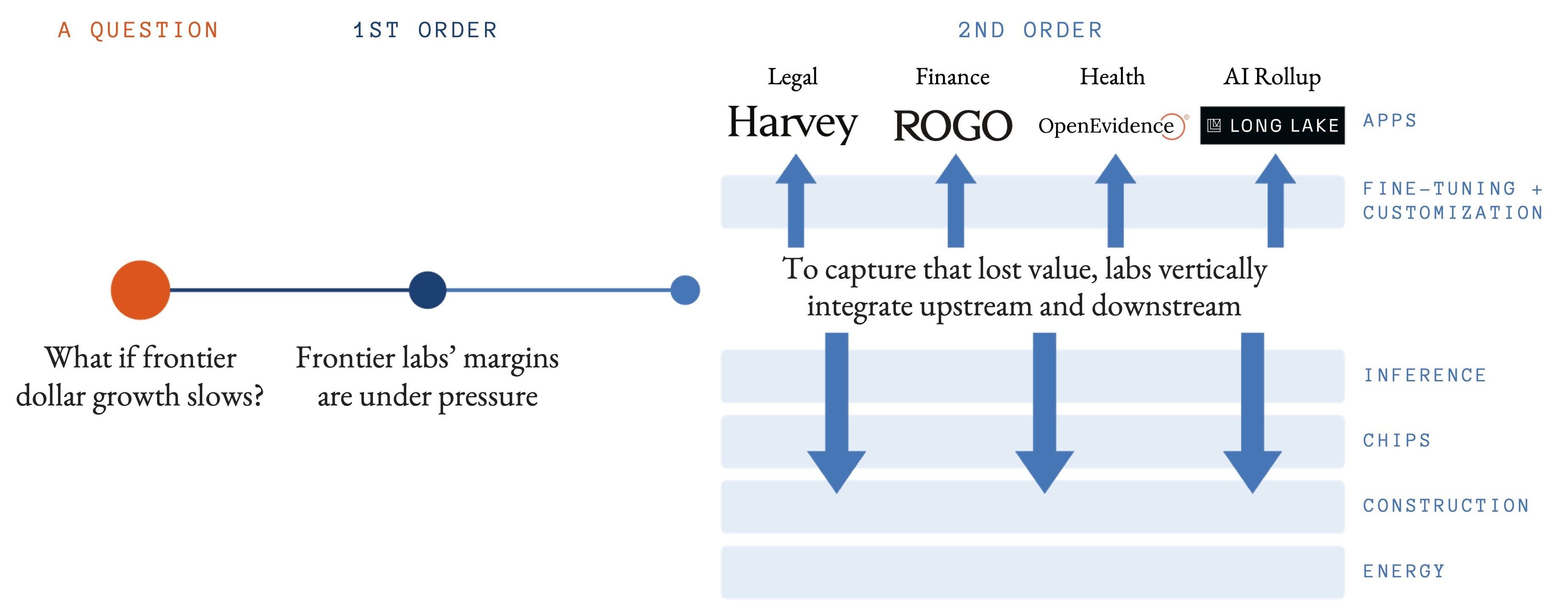
Extending downstream into infrastructure (including proprietary inference optimization, custom chips, datacenter infrastructure, and even energy supply) serves as a defensive measure to protect profit margins when call volumes skyrocket but per-unit revenue growth slows; however, this also gradually morphs a top-tier intelligence lab into a heavy-asset operating utility company, forcibly dragging the enterprise back into the convoluted capital financing maze presented at the beginning of this article.
Expanding upstream into the application layer (including model fine-tuning services, vertical industry applications, entirely new software paradigms, and ecosystem-integrating acquisitions) allows it to capture more workflow value; but this places it squarely in an awkward position competing alongside its most premium API enterprise clients, indirectly forcing these core customers to accelerate their pivot toward open-source model camps. More importantly, this strategy implies a fragile assumption: the core driver behind Claude Code’s brilliant success (its profound understanding and native alignment with “software engineering” culture) can seamlessly replicate into ambiguous-boundary, complex-form non-software businesses. Anthropic might argue that “AI will handle all of this for us,” attempting to position itself as the “last public giant” in human commercial history.
Once the script reaches this juncture, you will ultimately witness one of two inevitable endgames:
First, Anthropic eventually morphs into a highly leveraged utility company with its own R&D department;
Second, Anthropic evolves into a hyper-predator reliant on frontier intelligence, which ultimately ends up destroying its own best customers with its own hands.
Special thanks to Mackenzie and Max for their contributions to the viewpoints in this article.
Disclaimer: This article does not constitute any investment advice. Compound may hold long or short positions in the various securities mentioned herein at any time.
Join TechFlow official community to stay tuned
Telegram:https://t.me/TechFlowDaily
X (Twitter):https://x.com/TechFlowPost
X (Twitter) EN:https://x.com/BlockFlow_News
 @mhdempsey