After the Countdown: How Pre-IPO Perpetual Contracts Precisely Price Anthropic’s Listing?
Author: Kelly Ye, Coin Metrics
Translated by: TechFlow
TechFlow Summary:Five months after SpaceX's trial listing, the Pre-IPO perpetual contract market has undergone a qualitative transformation. In the face of Anthropic's highly anticipated IPO, the crypto-native derivatives market not only dwarfs its predecessor in trading volume and open interest depth, but also demonstrates astonishing precision in price discovery. From the announcement of the S-1 amendment to the bell-ringing listing, on-chain perpetual contracts are gradually becoming a sharp vanguard for understanding the true fair value of unlisted unicorns.
Data proves that on-chain perpetual contracts are far more accurate than traditional IPO pricing in predicting actual post-listing trends. On the eve of trading open, the deviation between perpetual contracts and the spot opening price rapidly narrowed from 12% to just 0.45%, even providing uninterrupted liquidity and hedging tools during after-hours and weekend closures of traditional stock markets. This leap from an experimental side bet to around-the-clock derivative infrastructure is reconstructing the global paradigm for new stock pricing.
Key Takeaways
The Pre-IPO perpetual contract market has matured since SpaceX:Trading for Anthropic perpetuals spanned several months rather than weeks, setting a record daily volume of $4.97 billion on the first day of listing—more than double that of SpaceX at the time. Furthermore, positions did not retreat after listing, with overall open interest remaining high at $550 million.
Divergent early quoting conventions gradually converged:In the initial phase, various exchanges adopted different quoting standards such as per-share price, total valuation, and placeholder shares. Only after the S-1 amendment officially disclosed the share structure did major exchanges swiftly switch and converge on per-share pricing, narrowing platform spreads to within 4% ahead of listing.
Perpetual contracts offer stronger guidance than official IPO pricing:On the day before listing, the perpetual contract closed at $98.33, representing an 18% premium over the official $83 offering price, yet deviated from the actual first-day closing price of $97.17 by only about 1%.
Pricing precision rapidly improves closer to market open:The night before listing, perpetual contract prices still deviated from the spot opening price by approximately 12%; however, as liquidity flowed in, the spread rapidly narrowed to 0.45% in the final minute before open.
Seamless transition from bell-ringing to overnight sessions:On the first day of listing, the deviation between the perpetual contract close and Nasdaq close remained within 0.2%. During overnight hours and weekends when traditional stock markets were closed, perpetual contracts continued to hedge and digest market information, deviating from Monday's US stock market pre-market opening trade by only 0.4%.
Anthropic underperforms despite a broader AI sector rebound:From Friday's close to Monday's trading session, Anthropic declined cumulatively by 1.0%, while perpetual contracts for NVIDIA and the Nasdaq 100 index saw significant rebounds. The primary reasons are massive compute commitment expenditures and some profit-taking positions using perpetual contracts to hedge and lock in gains.
Introduction
Earlier this month, we systematically explored the implicit expectations of crypto-native perpetual contracts regarding Anthropic's listing in our special report, Countdown to ANT. At that time, the quoting systems across various exchanges for Anthropic remained fragmented, lacking a unified consensus on per-share conversion.
In this report, we compare the pricing signals implied by the perpetual contract market with the stock's actual performance post-listing, reviewing how this emerging asset class withstood its most challenging real-world test to date.
A Larger, Earlier-Established Derivatives Market
By any metric, the scale and maturity of Anthropic perpetual contracts significantly surpassed those of the earlier SpaceX offering.
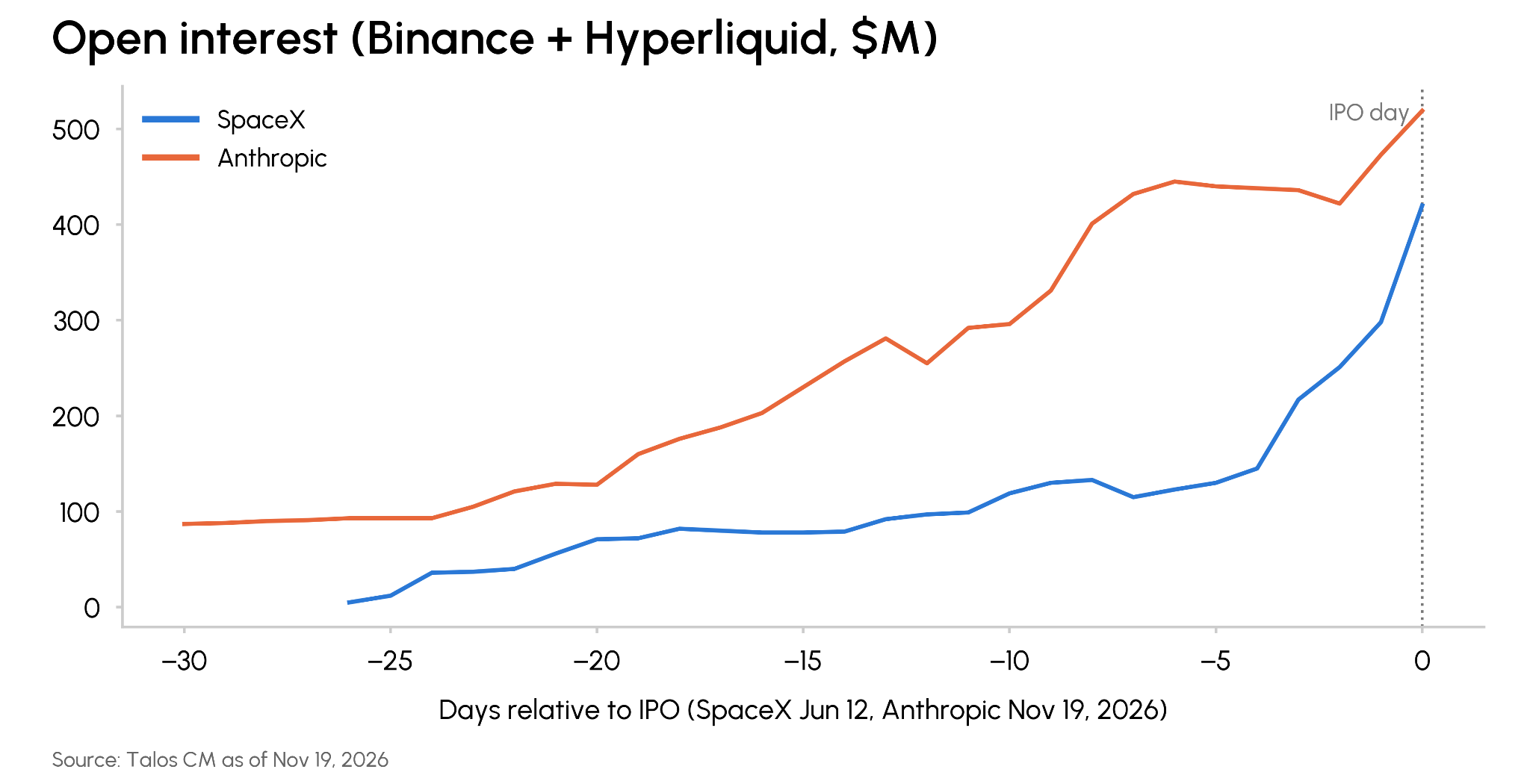
Chart: Source: Talos CM Market Data & Talos Analysis. Open interest is a daily snapshot at 00:00 UTC, combining Binance and Hyperliquid Builder markets.
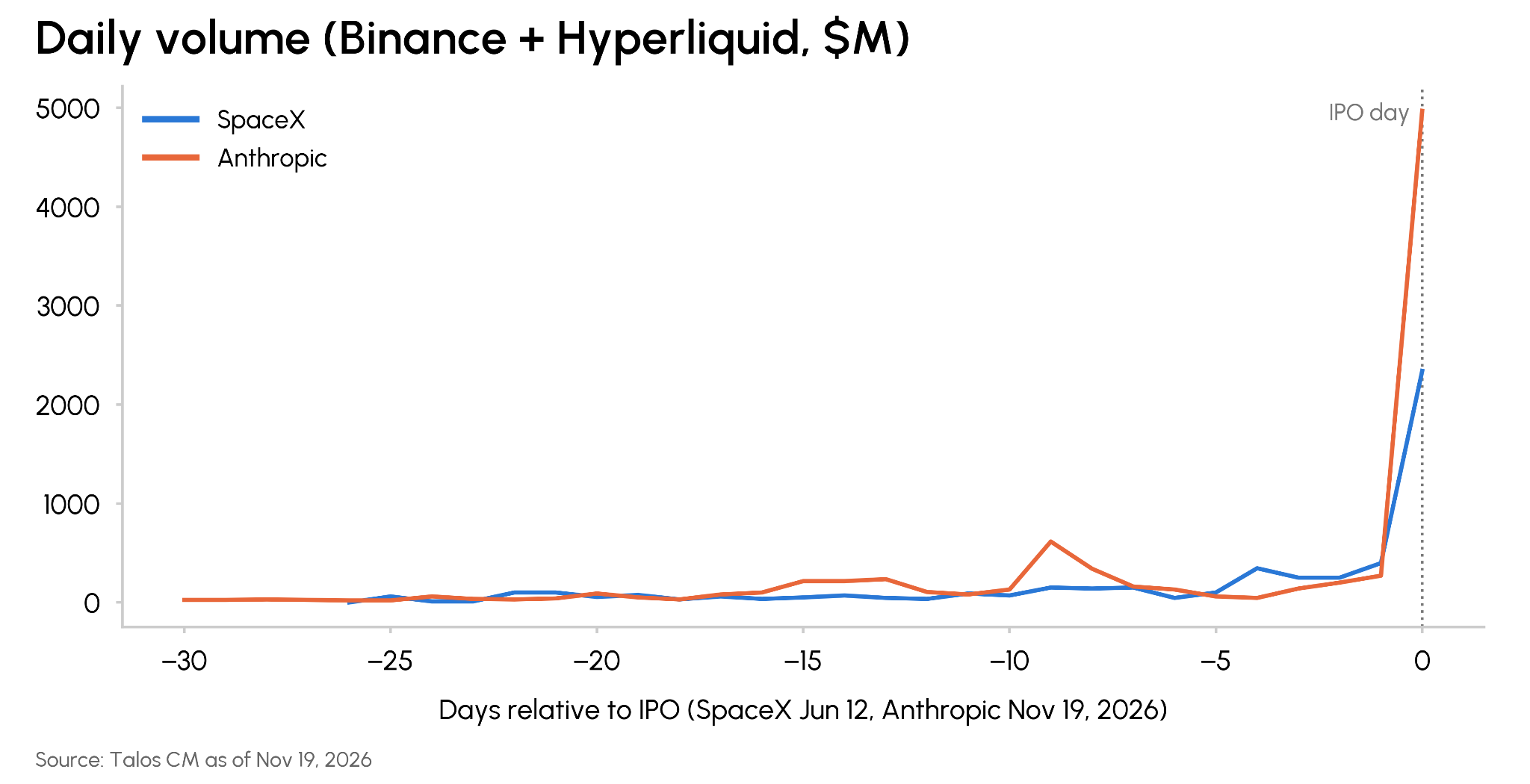
Chart: Source: Talos CM Market Data & Talos Analysis. Daily volume based on UTC calendar days, covering Binance and Hyperliquid Builder markets.
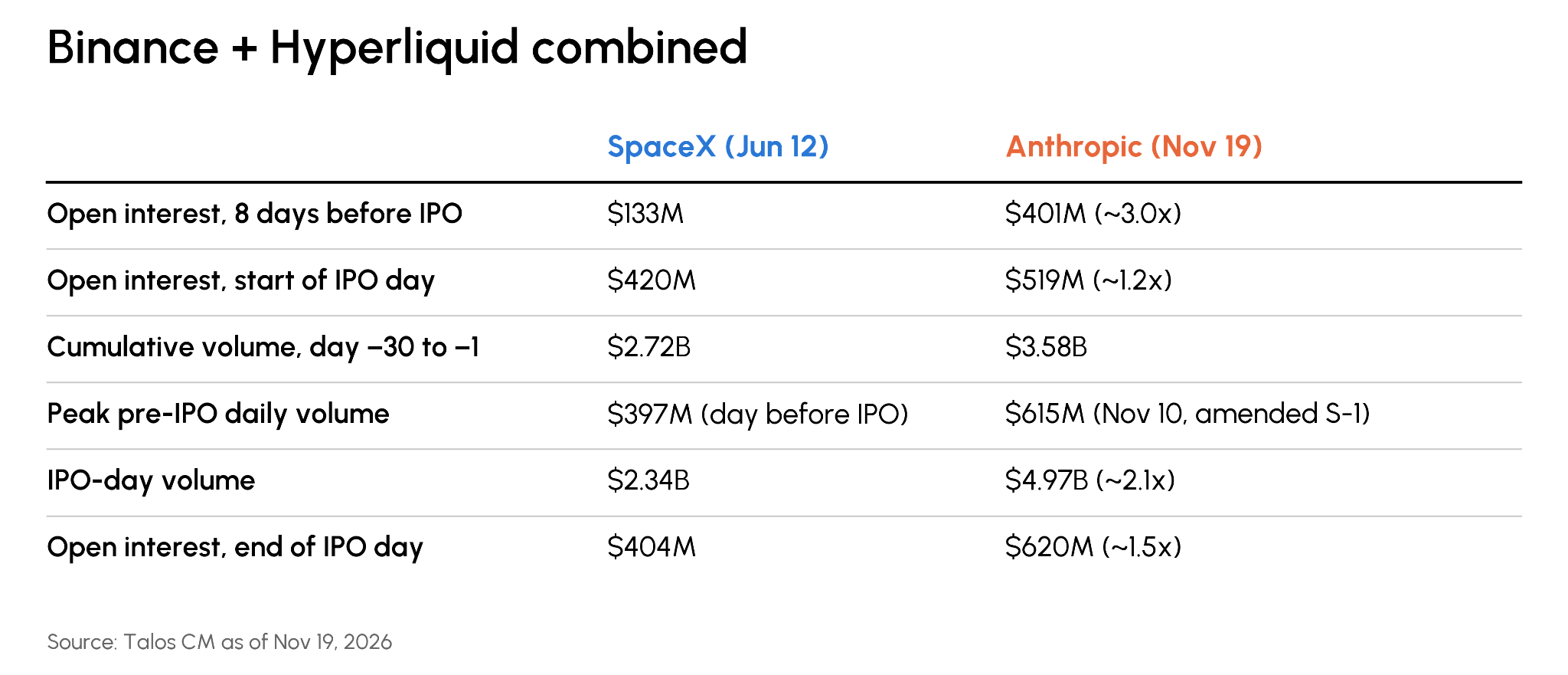
Chart: Source: Talos CM Market Data & Talos Analysis. Day 0 marks the IPO launch day; open interest uses the daily snapshot at 00:00 UTC.
Two core differences stand out particularly clearly:
Doubled trading activity on the first day of listing:Anthropic perpetuals recorded $4.97 billion in volume on their first day. Binance volume surged from $269 million the previous day to $3.4 billion, while Hyperliquid's various Builder markets spiked from $141 million to $1.57 billion. By comparison, SpaceX traded $2.15 billion on its listing day.
Stable retention of open interest post-listing:The open interest for Anthropic perpetuals not only avoided collapse after listing but steadily rose from $519 million the day before to $553 million on listing day, holding at $549 million on Monday. This sharply contrasts with SpaceX, where open interest quickly halved post-listing.
In just five months, Pre-IPO perpetual contracts have evolved from an initial proof-of-concept into a mature multi-billion-dollar trading vertical.
Although the number of exchanges trading Anthropic perpetuals is roughly comparable to SpaceX, the vast majority had been actively trading for months rather than just weeks online.
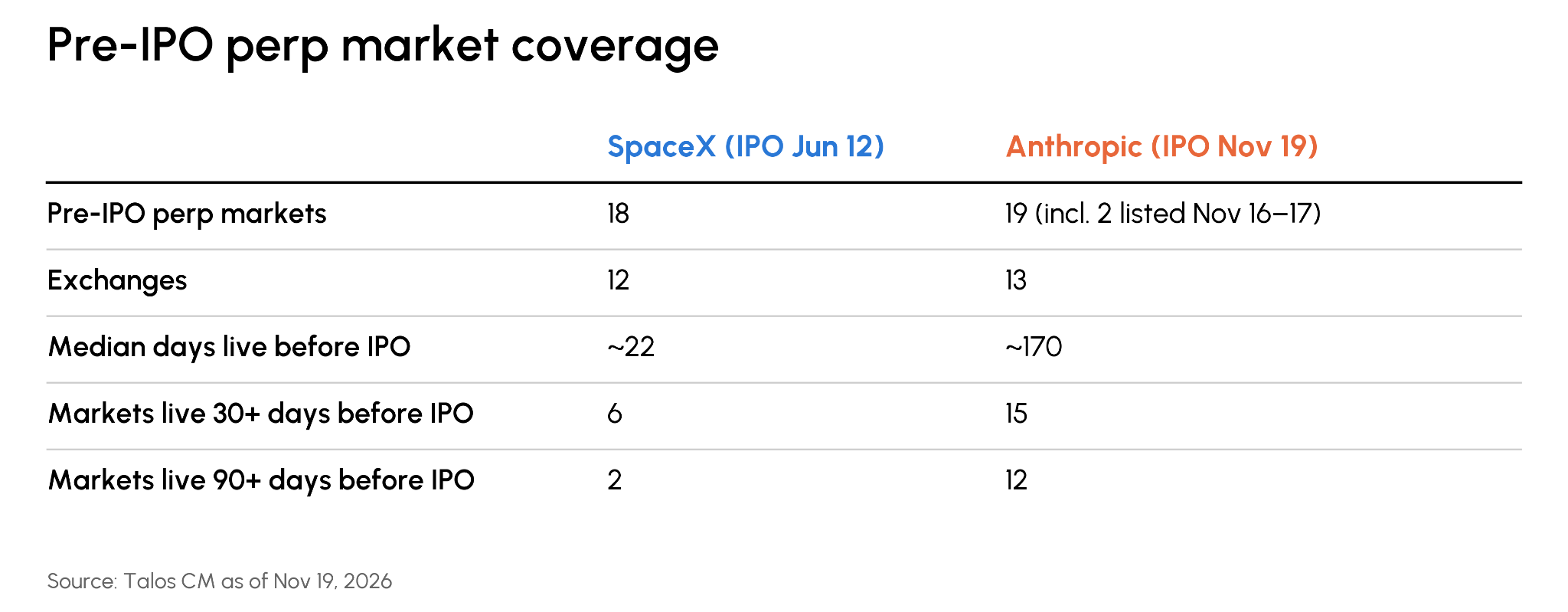
Chart: Source: Talos CM Reference Data & Talos Analysis. Statistics cover all tracked Pre-IPO perpetual markets for Anthropic and SpaceX across all exchanges monitored by Talos CM.
Prices across exchanges also converged rapidly prior to listing: As major mainstream platforms shifted to per-share quoting, spreads between different venues narrowed significantly to within 4% (approximately $95 to $99) in the days leading up to the official launch.
Same Company, Diverse Quoting Conventions
During the preparation for the public offering, the same company employed vastly different quoting standards across various platforms:
TradeXYZ under Hyperliquid quoted in per-share price for Class A common stock, while the Entropy market on the same chain directly quoted fully diluted valuation (FDV) in hundreds of millions. Binance initially launched ANTHROPICUSDT using a placeholder denomination of 1 billion shares, later smoothly migrating to ANTUSDT on November 17. OKX started with a 1 billion share placeholder and adjusted its benchmark twice during successive rebalancings (increasing to 10 billion shares on June 30, and further to 13 billion shares on October 23).
It was not until November 10, when Anthropic filed the S-1 amendment officially disclosing its capital structure, that major exchanges finally unified their transition to standard contracts based on per-share pricing.
This fragmented early convention created three key market pain points: lack of a single fair reference price across the market; apparent cliff-like drops in open interest due to share denomination resets; and frictions preventing direct arbitrage for the same underlying asset across different platforms.
As more tech unicorns move toward capital markets, establishing standardized cross-exchange benchmark reference pricing has become an urgent infrastructure need for the entire industry.
Pre-IPO Pricing: Vanguard of Actual Listing Valuation
Throughout the countdown to listing, on-chain data released two highly penetrating pricing signals:
S-1 Amendment Sparks Peak Volume:The single busiest trading day prior to official listing occurred on November 10 (reaching $615 million), coinciding with the amendment's critical disclosure of the per-share offering price range.
Premium relative to official offering price holds greater predictive value:Eve of listing, perpetuals closed at $98.33, an 18% premium over the official $83 offering price, yet differed from the actual first-day close of $97.17 by only about 1%. A similar pattern played out during SpaceX's listing: its perpetual price was 28% above the official offering, while the actual first-day close was 19% higher, yielding a mere ~7% error between perpetuals and the real first-day price.
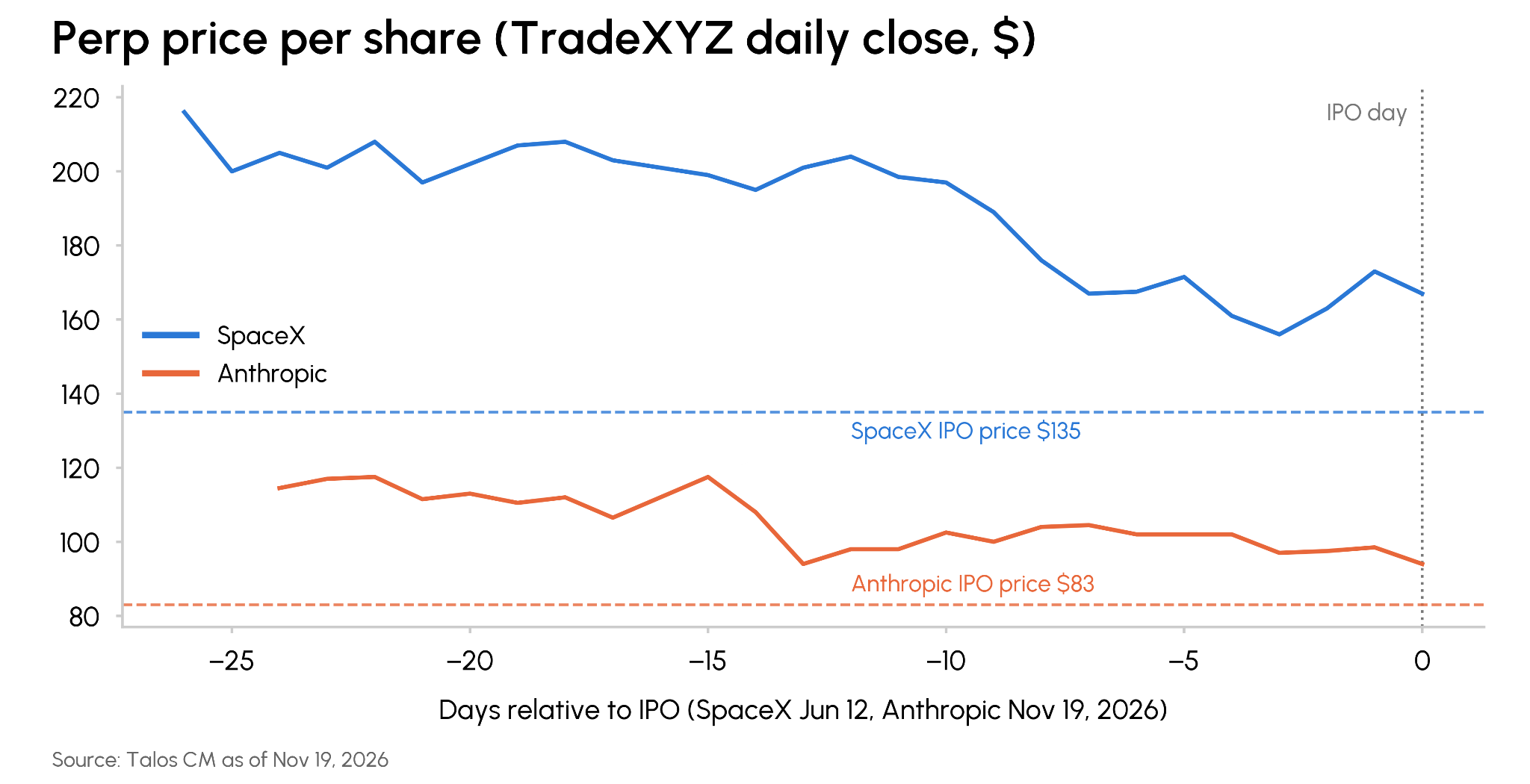
Chart: Source: Talos CM Market Data & Talos Analysis. TradeXYZ daily close (UTC 00:00), one contract represents one Class A share.
If benchmarked against the very first trade at the spot market open, the convergence process across pricing dimensions becomes even more refined:
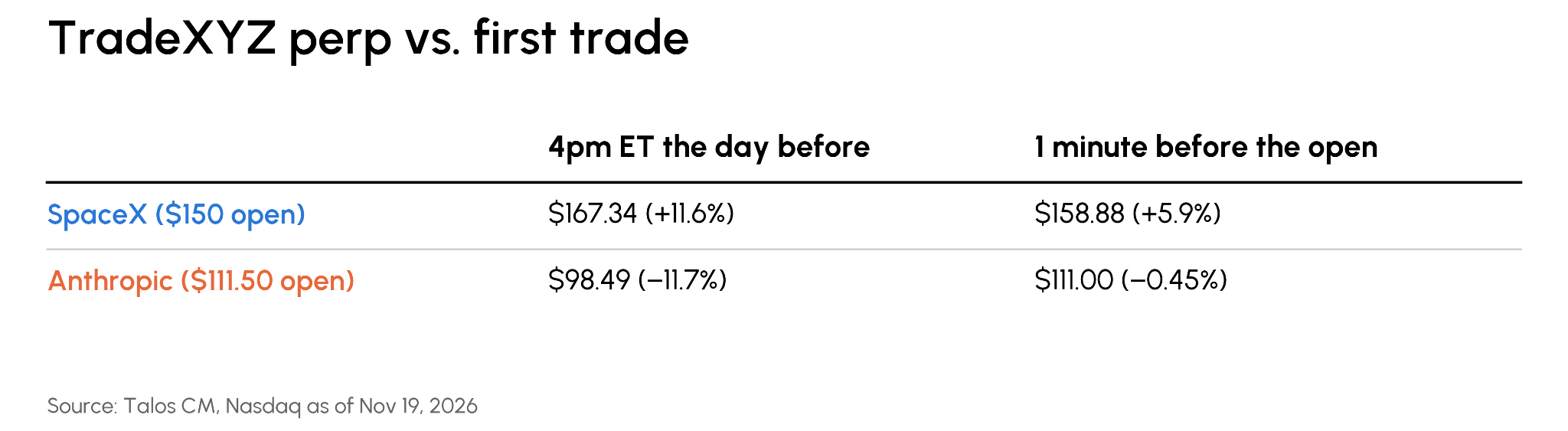
Chart: Source: Talos CM Market Data & Talos Analysis. Pre-open comparison uses TradeXYZ 1-minute candlestick data; percentages represent the perpetual contract premium relative to the spot opening price.
The night before the official bell-ring, both SpaceX and Anthropic perpetuals deviated from the eventual spot opening prices by about 12% (SpaceX priced higher, Anthropic lower). However, as the bell-tolling moment approached, the gap between Anthropic perpetuals and the opening price rapidly converged to just 0.45% in the final minute before open. Previous research on Cerebras and CXMT showed completely consistent patterns: deviations of 12% to 14% on the eve narrowed to an extremely tight range of 1% to 3% moments before open.
Seamless Transition at the Bell: Round-the-Clock Stability
For Pre-IPO perpetuals, the spot market's bell-ringing open is the most fragile and tested moment. Mismatched quoting conventions, delayed settlement, or liquidity gaps can easily trigger severe slippage and decoupling. Yet, Anthropic's transition demonstrated remarkable stability:
Continuous upward trend pre-open:On the morning of November 19, perpetuals rallied throughout, reaching $110.10 five minutes before the Nasdaq bell, up 12% from the previous day's close.
Liquidity floods in at the open:In the first minute after opening, perpetuals briefly spiked to $114.73, then came under pressure from profit-taking in the spot market, retreating to around $105 by midday. Turnover peaked at $483 million in the most active hour.
Closely tracking the spot close all day:Perpetuals tightly anchored the downward trajectory of the stock throughout the day, ultimately concluding first-day trading near the official Nasdaq close of $97.17, with a deviation of merely ~0.2%.
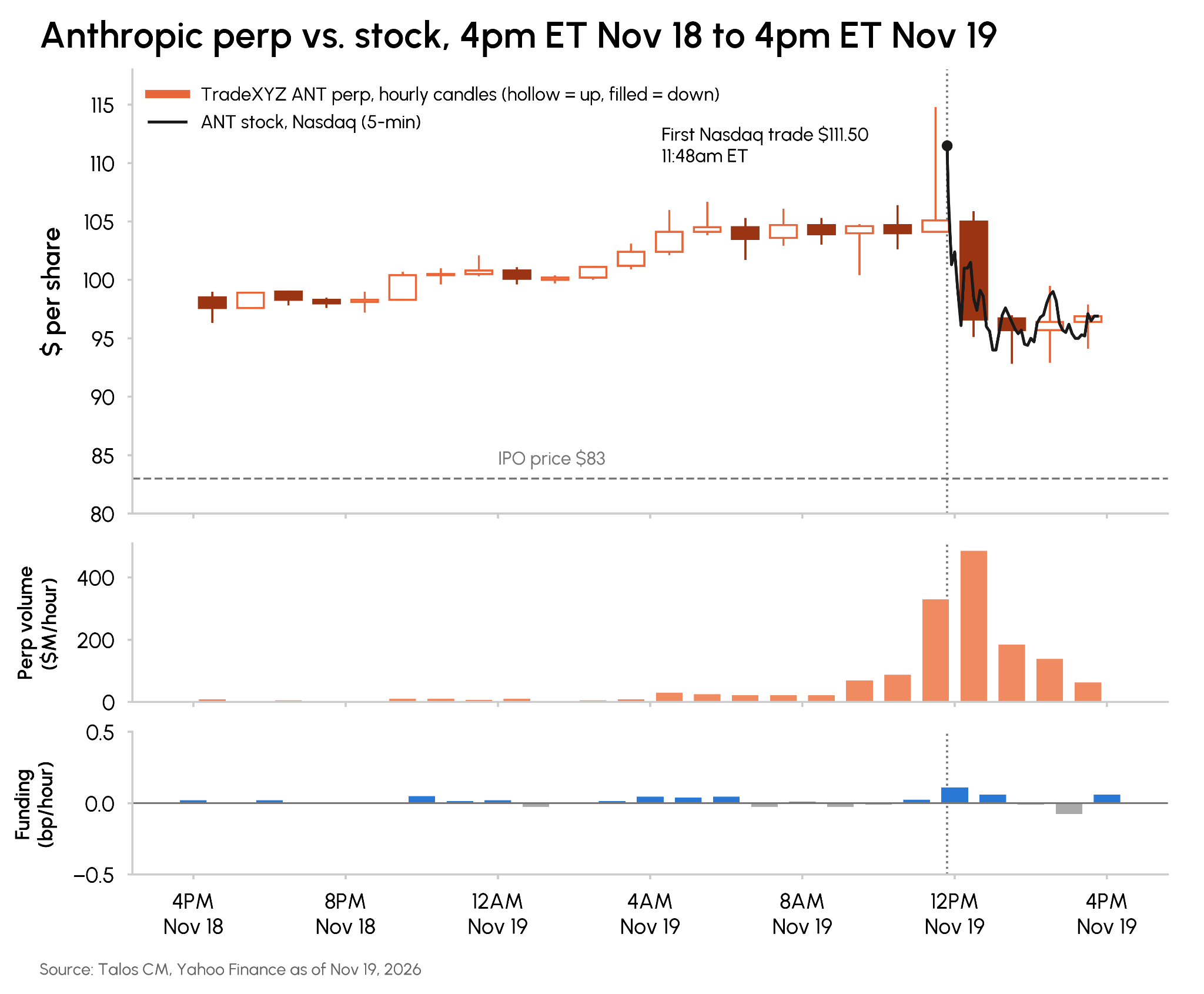
Chart: Source: Talos CM Market Data (TradeXYZ hourly candles, volume, funding rate), Yahoo Finance (ANT 5-min prices) & Talos Analysis.
Post-listing to Monday: Closely tracking trends, lagging rebound:Anthropic rode the exact same volatile waves as the broader market: on listing day, the Nasdaq reversed from intraday gains of 2% to a heavy fall of 2.25%, with the fear gauge VIX spiking near 28. During overnight periods when traditional US equities cannot trade, perpetuals continued providing round-the-clock pricing, deviating from the first pre-market trade at 4 AM by just 0.4%, and from Friday's open by only 0.2%.
When the AI sector enjoyed a strong rebound over the weekend and Monday, Anthropic's performance lagged relatively: closing down a mere 1.0% on Monday compared to last Friday, it became the sole red chip among the AI tickers we track, while NVIDIA rebounded sharply by 31% and Nasdaq 100 perpetuals rose 6.6%. Two factors explain this divergence: first, Anthropic serves as the most direct public testbed for whether massive AI capex converts to commercial returns (its filings disclosed hundreds of billions in compute procurement commitments, with compute costs consuming 55% of total revenue in H1 2026); second, equity prices remain above the $83 offering, leading some institutional investors to utilize the 24/7 uninterrupted perpetuals as an all-weather hedging tool to lock in listing profits. Overall open interest remains stable at the high level of $550 million, with funding rates held in a neutral balance.
Conclusion: From Experimental Side Bet to All-Weather Vanguard
In Countdown to ANT, we questioned what Pre-IPO perpetuals actually meant for Anthropic. Reality now provides a definitive answer: they not only precisely priced the market dynamics on the first day of listing but also assumed a critical risk-rebalancing role when traditional markets were closed.
Pre-IPO perpetuals are no longer merely experimental side bets ahead of listings; they are gradually evolving into a standalone, all-weather vanguard trading market backed by deep liquidity. This market is pushing the traditionally enclosed pre-listing price discovery process of conventional finance entirely into transparent, on-chain spaces under the sun.
Join TechFlow official community to stay tuned
Telegram:https://t.me/TechFlowDaily
X (Twitter):https://x.com/TechFlowPost
X (Twitter) EN:https://x.com/BlockFlow_News
 @coinmetrics