Circle Experiment Shows: Giving AI Agents a USDC Wallet Surges Task Completion Rate by 30.8%, Costing Only an Extra $0.30 Per Run
Authors: Shafu Elfouly, Jasper Kim, Danny Organ (Circle Agentic Works)
Translated by: TechFlow
TechFlow Summary: AI agents handling complex real-world tasks are often constrained by invisible barriers such as paywalls, CAPTCHAs, and premium data APIs. Recently, Agentic Works, a laboratory under stablecoin giant Circle, released a groundbreaking benchmark index that quantifies the substantial impact of granting agents on-chain wallets on their operational capabilities.
In 1,470 rigorous controlled tests across mainstream large language models, agents equipped with a USDC budget and the ability to autonomously procure microservices saw their task completion rate surge from 53.7% to 84.5%, while the average incremental cost per task was a mere $0.046. This proves that granting agents on-chain financial autonomy is a highly cost-effective path to breaking through capability bottlenecks.
Core Question and Experimental Design: When Agents Hit the "Unfunded Wall"
In today's AI application paradigm, an unfunded agent can often only "scratch the surface": it can draft a polished business email for you but cannot send it; it can vividly describe the chord progression of a symphony but cannot directly generate playable audio. When a task requires crossing paywalled APIs, premium search databases, or third-party microservices, a standard agent will immediately hit an invisible wall.
To explore the true boundaries of the Agentic Economy, Circle's lab, Agentic Works, initiated a rigorous large-scale controlled experiment: providing AI agents with a pre-funded USDC on-chain wallet and empowering them to autonomously discover and purchase third-party microservices when encountering bottlenecks. The experiment revolves around three core propositions:
First, can agents with a USDC budget capable of autonomously procuring paid microservices successfully complete originally failed tasks at a higher rate? Second, can this augmented microservice capability significantly improve the quality of the final deliverables? Third, what marginal cost in actual funds is required per task on average to achieve this leap?
Task Completion Rate Surges by 30.8%: Comprehensive Horizontal Evaluation of Seven Leading LLMs
The experimental results demonstrated astonishing consistency and impact: across 21 complex real-world tasks covering seven mainstream cutting-edge LLMs, agents equipped with a USDC budget achieved an all-around stepwise leap in task pass rates.
In the unfunded baseline control group, agents were restricted to standard public web searches and read-only tools, yielding an average task completion rate of just 53.7% across the seven models. After being granted USDC wallets and microservice invocation permissions, the average completion rate surged directly to 84.5%, a net increase of 30.8 percentage points. Whether it was top-tier closed-source models at the forefront or lightweight open-source models, the ability to autonomously procure services fundamentally transformed their operational agility in overcoming anti-scraping measures, structured data extraction, and advanced computational tasks.
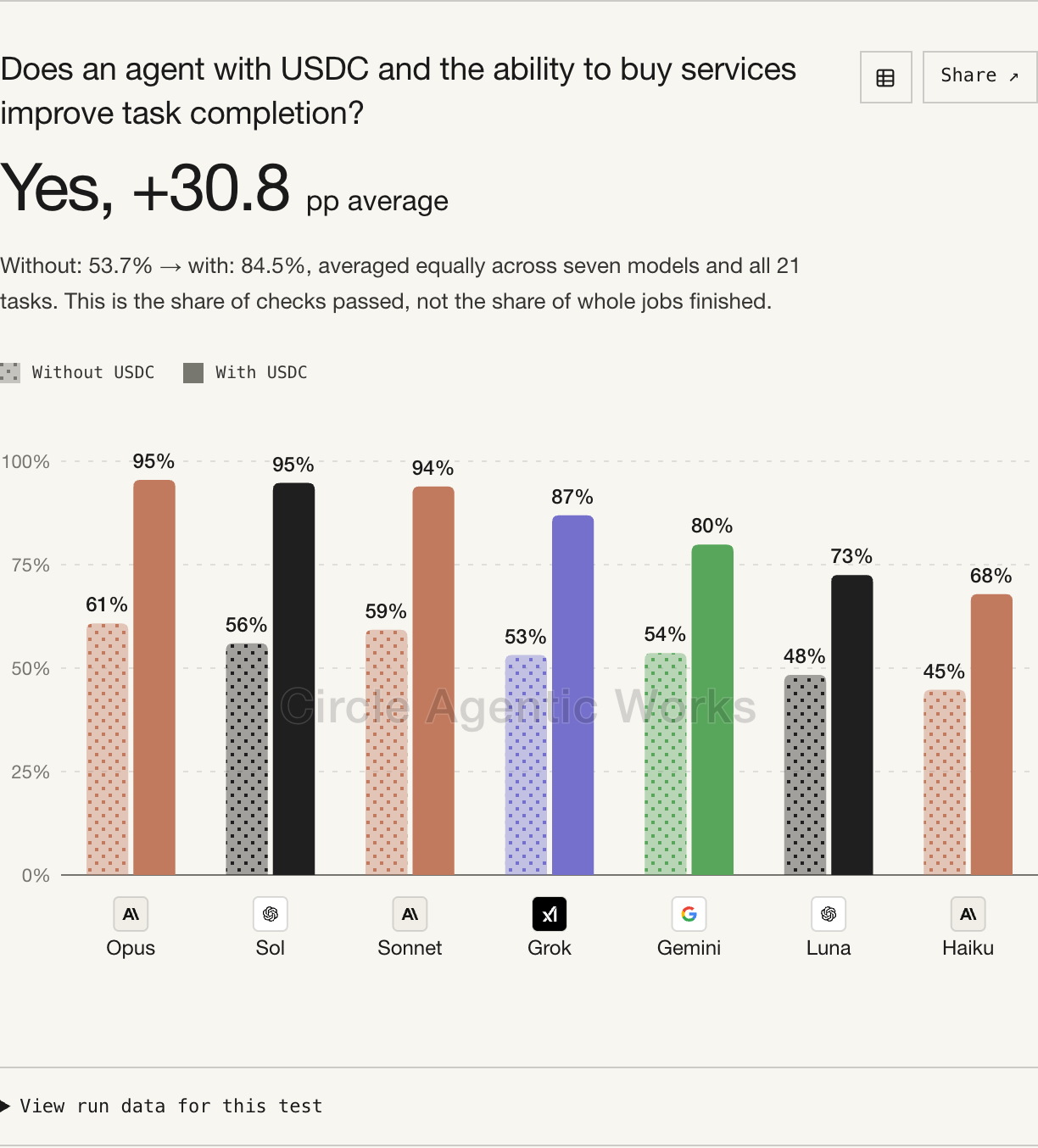
Chart: Average increase of 30.8 percentage points in task completion rates for seven leading LLMs after being equipped with a USDC budget
Dramatic Leap in Delivery Quality: Comprehensive Improvements in Rigor and Key Item Accuracy
Many worry that granting agents autonomous spending budgets could lead to tool misuse or hallucinated answers pieced together blindly. However, rigorous quality assurance evaluations completely dispelled these concerns.
In all test batches where agents claimed "completion," independent evaluators strictly verified every mandatory field and conclusion: the fully correct rate for unfunded agents was only 68.2%, which jumped to 78.9% in the funded group (a pooled increase of 10.7 percentage points). Across all runs that successfully submitted final answers, the single-point accuracy for specific data items surged dramatically from 56.7% to 88.1%. This indicates that microservice intervention not only helped agents break through obstacles but also fundamentally and significantly enhanced the objective factual precision of the final deliverables.
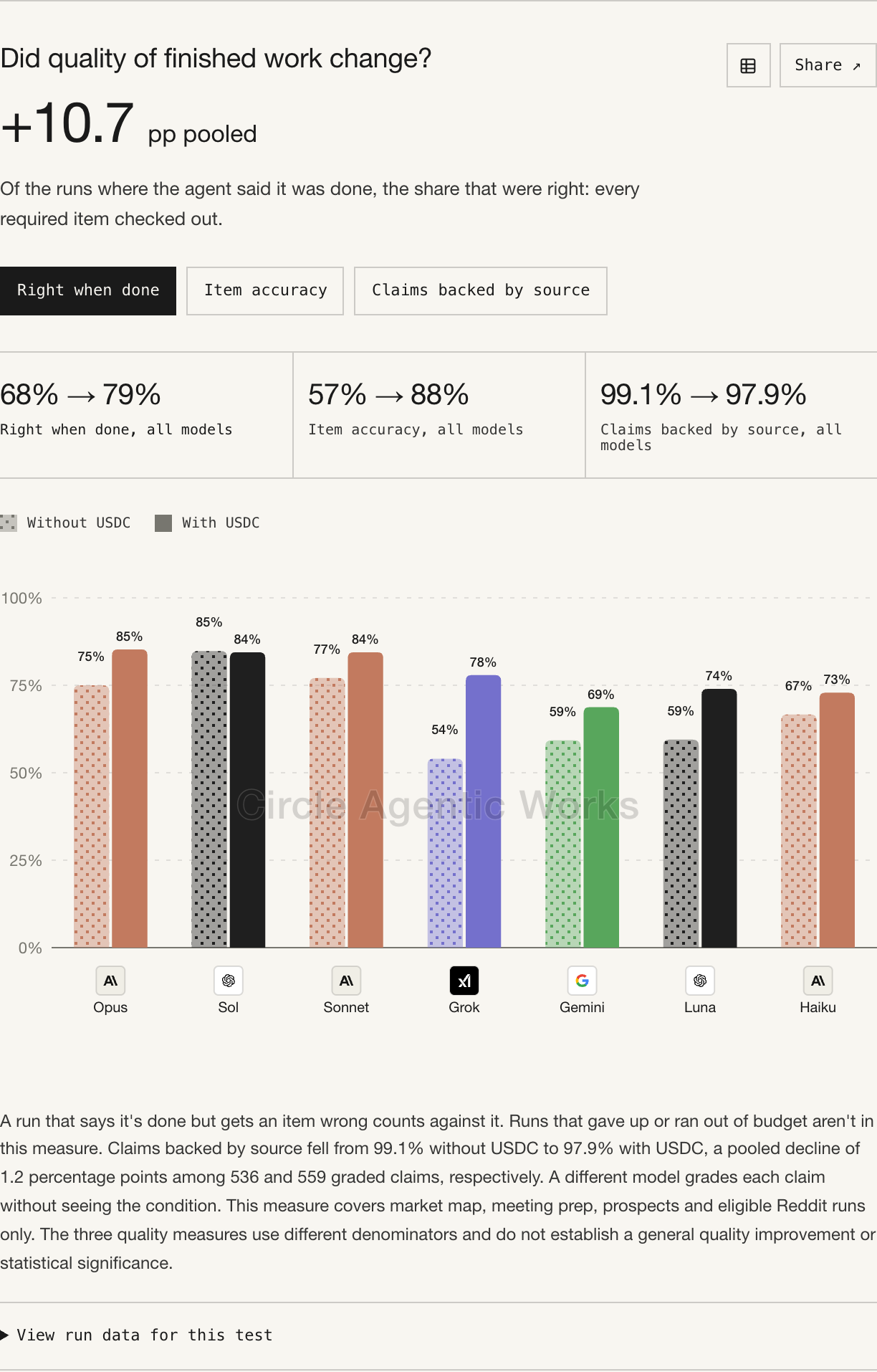
Chart: Overall task quality increased by 10.7 percentage points in delivery-completing test groups, with key item accuracy reaching 88.1%
A Highly Affordable Economic Calculation: An Average Incremental Cost of Just 30 Cents Per Task
For enterprise applications and real-world deployments, the most critical consideration has always been ROI: to secure a completion rate surge of over 30 percentage points, how much additional cost must enterprises actually bear?
The actual incremental cost across model and microservice expenses is astonishingly minimal: across all seven models, the average total cost per task rose only from $0.101 to $0.147, with an average incremental expenditure of just $0.046 per task (less than 30 cents USD!). The increase amounts to a mere 45.6%. This negligible overhead fully covers both the model's own token generation fees and the actual costs of agents autonomously procuring microservices for CAPTCHA solving, advanced scraping, and specialized analysis during execution.
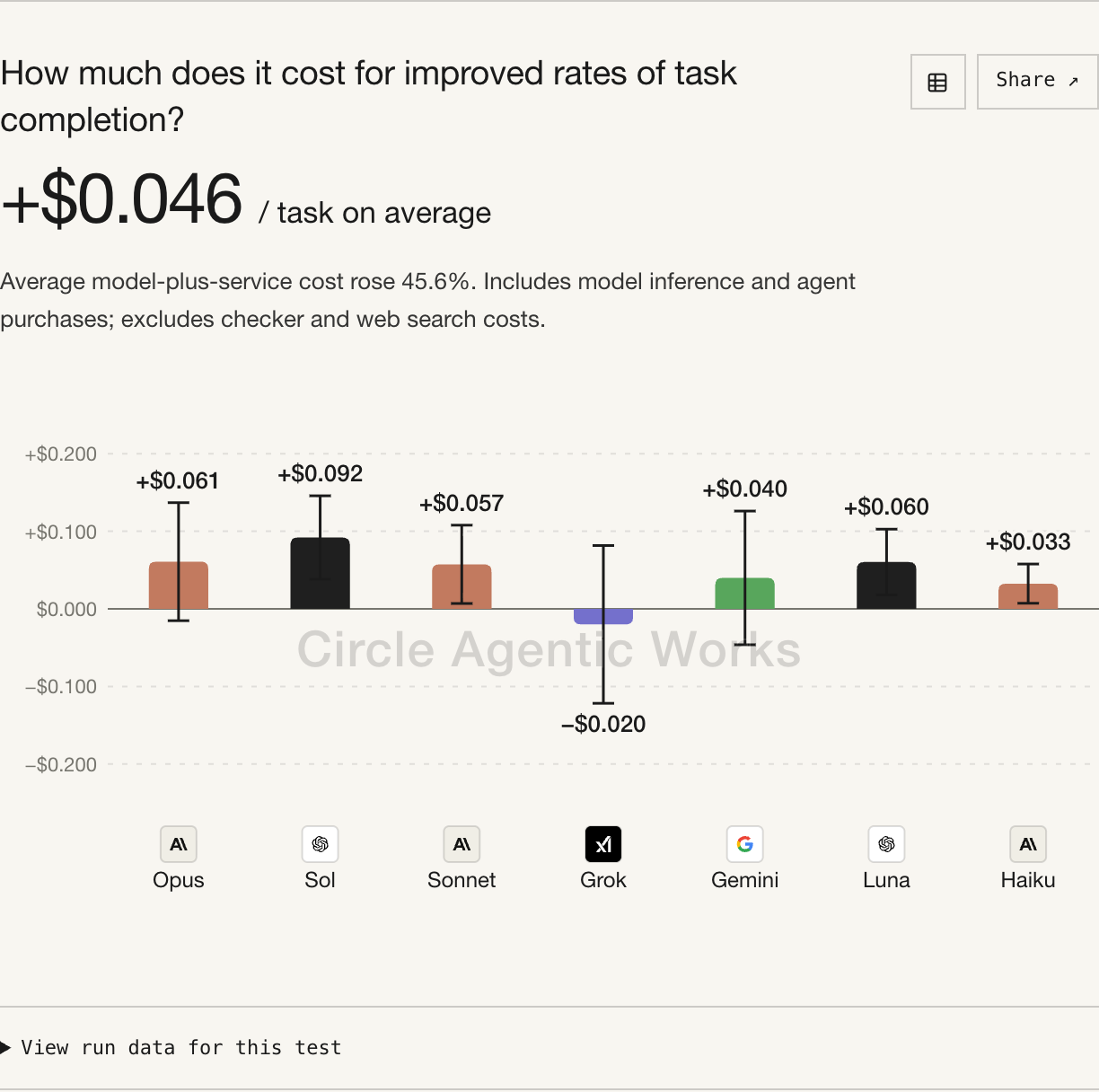
Chart: Average incremental cost per task increases by only $0.046 (approximately 30 cents) after equipping a procurement budget
The ROI Frontier: Synergistic Compound Interest Between Model Capabilities and Commercial Microservices
If we plot the magnitude of task completion rate improvement against incremental costs on the same coordinate system, a clear "Efficiency Frontier" driven by on-chain microservices emerges.
The data reveals a profound business insight: agents do not require boundless, massive capital to create miracles. Since the vast majority of third-party practical microservices (such as data conversion, advanced verification, and vertical queries) are priced extremely cheaply in decentralized markets (typically costing only a few cents or even fractions of a cent per request), very small amounts of on-chain capital can resolve multi-hour computational deadlocks plaguing trillion-parameter LLMs with remarkable leverage.
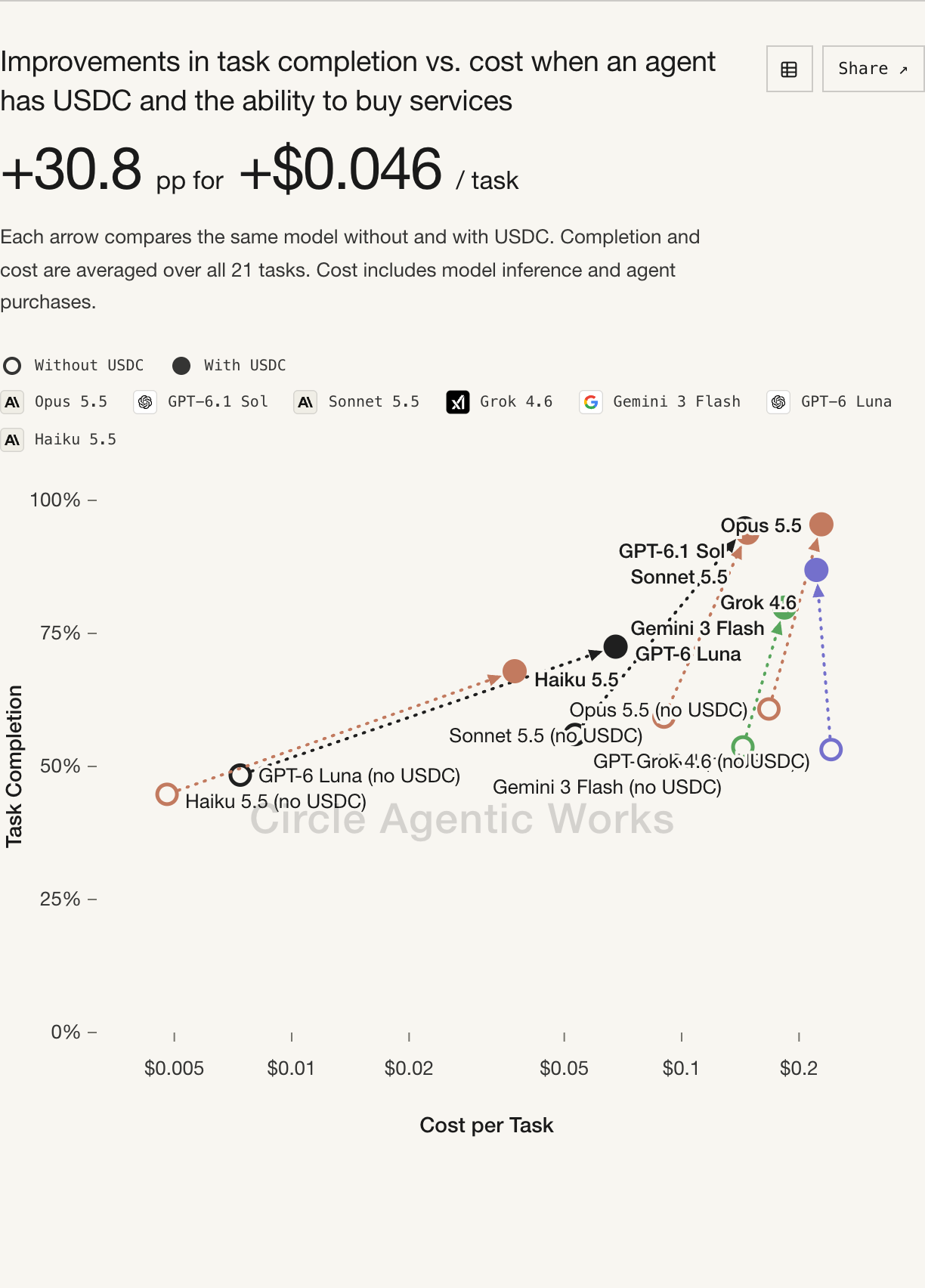
Chart: Return on Investment (ROI) efficiency frontier between task completion rate improvement and marginal cost increase across seven models
Total Research Cost and Empirical Summary: Unlocking a New Paradigm of On-Chain Machine Autonomy Economics
This pioneering empirical study conducted by Circle encompassed 1,470 actual runs (executed independently 5 times per condition across 21 tasks), with the cumulative total research expenditure covering all seven models amounting to a mere $238.28 (averaging just $34.04 per model). Of this, $136.26 covered model inference tokens, $46.34 covered autonomously procured microservices by agents, and $48.84 covered evaluation testing overhead.
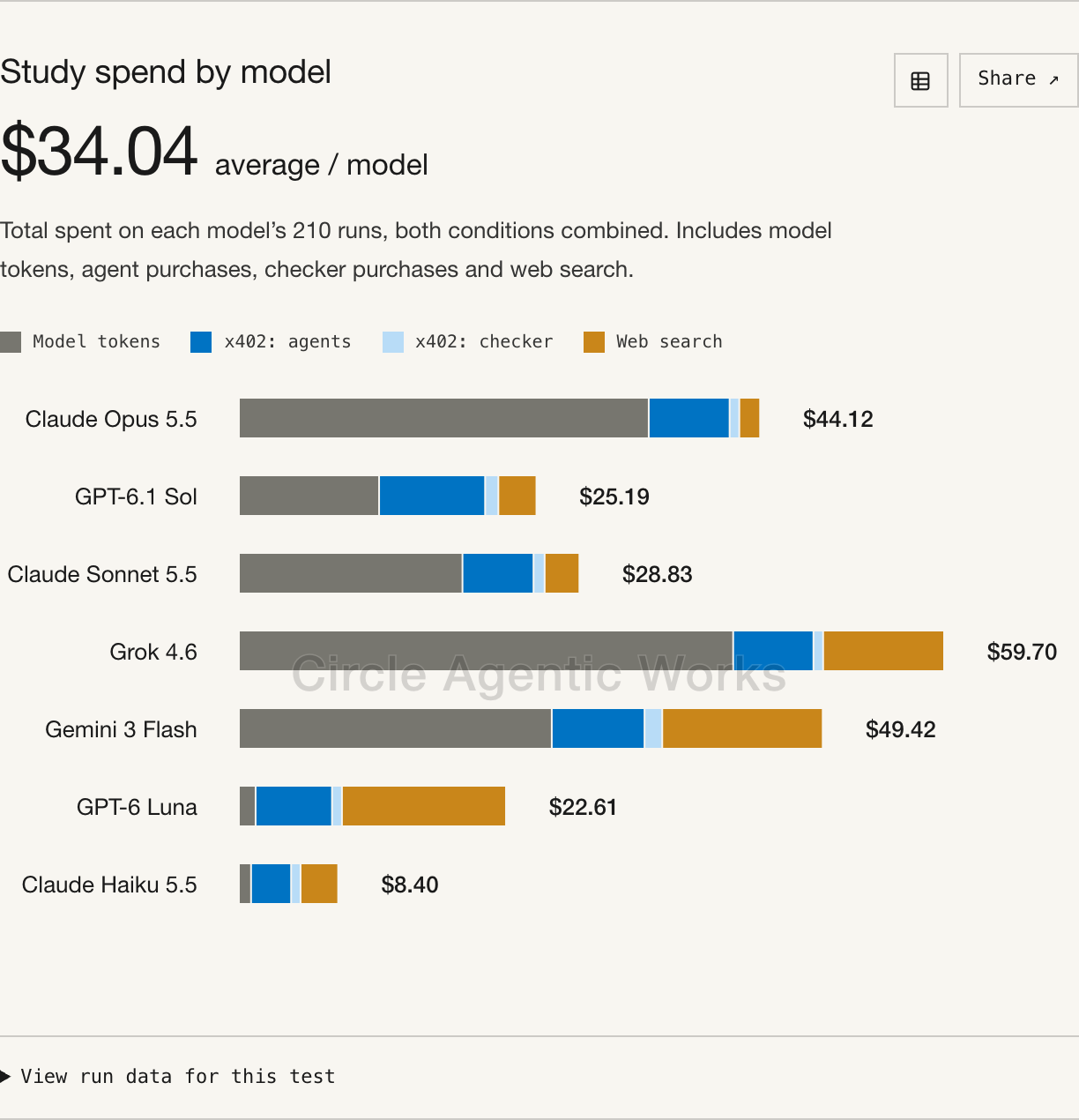
Chart: Cumulative expenditure overview across 1,470 tests in this experiment for model inference and microservice invocation (averaging $34.04 per model)
This study sends a milestone signal to the entire tech industry and Web3 ecosystem: the Agentic Economy is no longer a vague fantasy confined to whitepapers. By introducing lightweight, fast, and low-friction on-chain stablecoin payment interfaces like the Circle Agent Stack, developers are handing autonomous agents the key to truly integrate into human commercial civilization. Agents with wallets do more than just think; they have learned to efficiently exchange value on-chain like rational economic actors, marking the core singularity driving the explosion of next-generation productivity.
Join TechFlow official community to stay tuned
Telegram:https://t.me/TechFlowDaily
X (Twitter):https://x.com/TechFlowPost
X (Twitter) EN:https://x.com/BlockFlow_News
 @circle