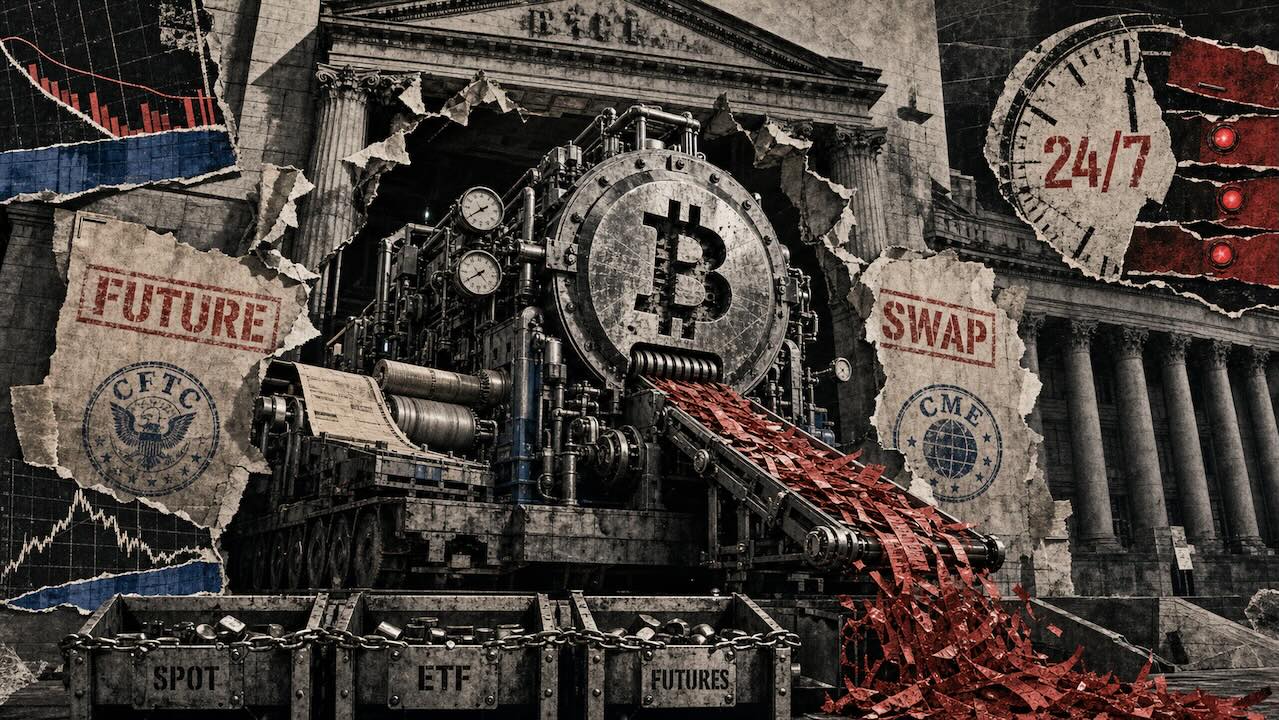
Perpetual Futures "U.S. Listing" Hits Roadblock: Why Did CME Sue CFTC?
TechFlow Selected TechFlow Selected
Perpetual Futures "U.S. Listing" Hits Roadblock: Why Did CME Sue CFTC?
Coinbase and Kalshi Race for Compliance: Funding Rates, Cross-Platform Clearing, and the Battle for Regulatory Control Over a Multi-Billion Dollar Market
 Navigating Web3 tides with focused insights
Written by: Andjela Radmilac
Compiled by: Saoirse, Foresight News
Coinbase has launched American-style perpetual futures on its CFTC-regulated derivatives exchange, with the initial products being micro Bitcoin and Ethereum contracts. These contracts are pegged to spot prices, come with leverage, and support 24/7 uninterrupted trading.
Perpetual contracts account for the vast majority of crypto leveraged trading globally and have now officially entered the U.S. market. In addition to providing investors with a new channel to bet on Bitcoin trends, it also brings the entire trading mechanism that has dominated offshore market pricing logic for years to the U.S. Multiple U.S. exchanges have sequentially introduced funding rates, perpetual leverage, and automatic liquidation mechanisms, but there are significant differences in contract design rules among them.
Perpetual contracts account for the vast majority of trading volume in crypto derivatives. According to Coinbase statistics, under certain metrics, perpetual contracts account for over 90% of the total derivatives trading volume, while overall derivatives trading volume accounts for about 80% of all cryptocurrency trading.
For years, almost all of this trading has occurred on exchanges outside the scope of U.S. regulatory jurisdiction. If U.S. investors wanted to participate, they could only log in to offshore platforms using virtual private networks. This barrier was broken on May 29: the CFTC approved KalshiEX to launch the BTCPERP perpetual contract pegged to the Bitcoin spot price, and simultaneously issued a policy statement allowing other exchanges to launch similar products following this path.
On June 12, the CFTC introduced new regulations allowing licensed designated contract markets, provided they meet certain conditions, to remove the expiration dates of existing perpetual-style crypto futures, converting them into truly perpetual contracts with no expiration date.
The regulatory framework that facilitated this series of changes is now embroiled in legal battles in federal court; the outcome of this judicial game will determine how far perpetual contracts can go in the U.S. market.
On June 18, CME sued the CFTC and its Chairman Michael Selig in the U.S. District Court for the District of Columbia, requesting the judge to revoke the approval order for Kalshi and the accompanying policy statement. CME's complaint states that the CFTC Chairman overturned the statutory definition of swap derivatives by Congress through personal approval alone, bypassing the entire regulatory framework built by Congress for such derivatives.
CME's core argument: perpetual contracts meet the statutory definition of swap products under the "Commodity Exchange Act." If classified as swaps, the industry must accept stricter regulatory rules, including dealer qualification registration, stringent capital requirements, high-frequency information reporting, etc., and market pricing power and license resources will return to established traditional institutions like CME. CFTC Chairman Selig approved Kalshi's application in just one day.
The CFTC did not take this lawsuit lightly. Its spokesperson stated that CME chose to use legal means to oppose the regulatory agency and the current administration's policy direction of encouraging innovation, accused established institutions of fearing market competition in a fair environment, and stated that this lawsuit is baseless and they will strive to have the court dismiss the case.
This lawsuit involves huge commercial interests. CME's complaint wrote that Kalshi independently launched more than ten crypto perpetual contracts based on this approval, and related trading volume has exceeded $1 billion. The CFTC is also defending its jurisdiction on other fronts, filing a lawsuit against Kentucky at the end of June to clarify the regulatory ownership of the contract market. The case is currently still in the early stages, with no court ruling yet. This means that all exchanges currently building American-style perpetual products are built on a legal foundation that could be rewritten by the court at any time.
Perpetual Contracts in the U.S. Currently Divided into Two Structures
Traditional futures have fixed expiration dates; if traders want to hold positions long-term, they can only close positions or roll over to forward contracts. Perpetual contracts have no expiration limit. Since there is no expiration delivery to pull the price towards the spot, perpetuals rely on both long and short parties regularly settling funding rates to complete price anchoring.
When the perpetual contract price is higher than the spot, longs usually pay funding fees to shorts, raising long holding costs and prompting longs to sell; if the contract price is lower than the spot, the fund flow reverses, with shorts paying longs.
Currently, there are two compliant products in the U.S. market both called perpetual contracts, with completely different legal structures. Kalshi's BTCPERP is a truly perpetual contract with no expiration date; Coinbase's product adopts a five-year super-long expiration futures architecture, paired with hourly interest accrual and twice-daily funding rate settlements, replicating the price trend of perpetual contracts through this design while adhering to existing futures regulatory rules.
The conversion scheme implemented by the CFTC in June allows this type of long-term futures to gradually cancel expiration dates in the future and upgrade to true perpetual contracts. This is also the reason why "perpetual futures" refers to two legally different products in the U.S.
The crypto market operates year-round without weekends off or monthly expiration cycles; perpetual contracts are the trading variety born to adapt to this environment. No-expiration leveraged contracts allow traders to adjust positions and hold positions at any time without selecting delivery months; speculation, hedging, market making inventory management, and basis trading can all be completed relying on a single contract.
Exchanges favor the perpetual model because a single contract can gather liquidity originally scattered across multiple expiration contracts, resulting in higher market depth. However, highly concentrated liquidity also amplifies the influence of funding rates and forced liquidations: once market positions become seriously imbalanced, the speed of price volatility transmission is far faster than traditional futures with multi-term layers.
There are many differences between the perpetual system implemented in the United States and the offshore market, with multiple perpetual trading tracks being built simultaneously locally: Kalshi launched true perpetuals, with categories already covering Bitcoin, Ethereum, XRP, and other tokens; Coinbase, on one hand, launched perpetual-style futures on its local exchange, and on the other hand, opened a compliant channel on May 29, allowing U.S. investors to connect to global perpetual and options liquidity through its subsidiary platform Deribit. Deribit is a global top crypto options platform, with Bitcoin options open interest exceeding $31 billion at the end of May.
On the same day, CME upgraded its own expiring crypto futures and options to 24/7 trading, making up for the weekend trading time difference with the spot market. CME crypto derivatives nominal trading volume reached $3 trillion last year, with an average daily contract trading volume of about 407,200 contracts this year.
The contract structures, leverage ratios, liquidation rules, collateral requirements, and price reference benchmarks of several trading paths are all different from each other. While compliant trading channels are increasing, liquidity, margin, and open positions are split across multiple platforms, collateral cannot be used universally across platforms, and capital efficiency is low.
Funding Rates, Liquidation Mechanisms, and the Battle for Global Pricing Power
Funding rates are often simply understood as fees, but a more accurate interpretation is: it reflects the market leverage long/short distribution in real time, continuously pulling the perpetual price close to the spot.
When a large number of leveraged longs push up the perpetual price, making it higher than the spot, arbitrageurs can short perpetuals while buying Bitcoin spot, Bitcoin ETFs, or traditional futures to earn funding fees. Such arbitrage trading will drive spot orders, ETF subscriptions and redemptions, and simultaneously affect the basis of CME futures.
Large-scale arbitrage behavior will cause the position situation of perpetual contracts to act inversely on the spot market it should anchor. Perpetuals with sufficient liquidity in the U.S. will form a unique local funding rate curve, becoming a regulatable leverage sentiment indicator, contrasting with the offshore rates traders have long referenced. If there is a stable difference between U.S. and offshore funding rates over the long term, it can clearly reflect the differences in user structure, leverage limits, and cross-border capital flow freedom between the two places, helping the market judge whether market trends come from directional speculation or hedging demand.
Leverage allows using a small amount of margin to pry open large positions, at the cost that a small price drop may exhaust the margin. Once account margin falls below the maintenance guarantee line, the exchange will automatically liquidate. Longs being forcibly liquidated will bring market sell orders, shorts being forcibly liquidated bring market buy orders; concentrated forced liquidations easily breach the margin thresholds of more traders, triggering a chain reaction stampede.
24/7 trading, high leverage, and fragmented liquidity make crypto assets extremely prone to chain liquidations. The implementation of perpetual contracts in the United States will make the continuity of local spot pricing trends stronger, but prices will also be more easily affected by trading behavior itself: Bitcoin rises and falls purely due to large-scale margin liquidations, unrelated to changes in the asset's own value expectations.
Compliant trading venues can control some risks: customer funds are stored separately, contract rules are fully public, the market is monitored throughout, liquidation processes are standardized, and investors have U.S. judicial rights protection channels. However, compliance cannot reduce volatility, capital costs, and leverage itself, nor can it guarantee that large-scale liquidations will not inversely impact the market. Even if perpetual contracts are fully compliant, traders will still be automatically liquidated by the system.
The deciding point of competition in the future derivatives track is likely the universal capability of cross-category collateral, supporting traders to share margin between spot, ETFs, futures, options, and perpetuals. Currently, funds are split across spot accounts, futures brokers, clearing houses, brokers, offshore exchanges, and other systems; capital fragmentation generates extra costs, and margin in one account cannot be used to guarantee hedged positions in another market.
For example: holding Bitcoin ETFs cannot be directly used as margin for perpetual shorts; CME futures positions and local perpetual contracts belong to two separate margin pools. The core of the next round of competition in the derivatives industry is to break through cross-market margin barriers.
Coinbase Derivatives, together with clearing institution Nodal Clear under the Deutsche Börse EEX Group, applied to use the USDC stablecoin issued by Circle as U.S. futures margin, with Coinbase Custody Trust responsible for safeguarding USDC; the plan awaits CFTC approval. If approved, this will be the first compliant use of stablecoins as collateral in the U.S. futures market. Traders do not need to convert crypto assets into fiat currency and can directly use crypto-native stablecoins to provide margin for compliant positions.
This capital efficiency determines the arbitrage cost of price differences between major platforms; compared to listing more tokens, capital efficiency is a more core competitive chip.
The number of new contracts listed by exchanges will not be the ultimate watershed; major platforms can quickly list a large number of coins. There are two real major tests: first, when Bitcoin encounters a new round of violent volatility, will local perpetual contracts digest the market, lead the market, or amplify volatility; second, the court's final ruling, determining whether the essence of these contracts is futures or swaps. This judgment will either solidify the perpetual compliant ecosystem that the U.S. has spent more than half a year building, or force the industry to accept the strict swap regulatory rules advocated by CME.
Join TechFlow official community to stay tuned
Telegram:https://t.me/TechFlowDaily
X (Twitter):https://x.com/TechFlowPost
X (Twitter) EN:https://x.com/BlockFlow_News
 @CryptoSlate