Goldman Sachs Research Report Analysis: PC Shipments Decline for First Time in Nine Quarters, Component Shortage to Last Until 2028
TechFlow Selected TechFlow Selected
Goldman Sachs Research Report Analysis: PC Shipments Decline for First Time in Nine Quarters, Component Shortage to Last Until 2028
Large manufacturers are eating up the market share of small manufacturers leveraging their supply chain management capabilities.
 Navigating Web3 tides with focused insights
By: Rita
TechFlow Guide
Goldman Sachs released an interpretation of IDC's preliminary data on PC shipments for 2Q26 on July 8. PC shipments for the quarter were 68.2 million units, down 4.9% year-over-year, ending nine consecutive quarters of positive growth. Goldman Sachs attributed the decline to continuous shortages of key components such as storage chips and memory, as well as the suppression of terminal demand caused by the resulting increase in complete unit prices. The supply tightness is expected to last until early 2028, with large manufacturers leveraging supply chain management capabilities to eat into the share of smaller manufacturers.
Nine Quarters of Growth Ended, Component Shortages Are the Main Cause
2Q26 PC shipments were 68.2 million units, down 4.9% year-over-year. Prior to this, the PC industry had maintained positive growth for nine consecutive quarters. The end of this trend means the industry is entering a completely different phase. The last time the PC industry saw a quarterly year-over-year decline dates back to Q4 2023, against the backdrop of the dual blow of post-pandemic demand exhaustion and excess inventory. The logic of this decline is completely different; it is not that demand is gone, but that goods cannot be produced.
Goldman Sachs cited IDC's analysis pointing out that the core driver of the decline is component shortages. Tight supply of storage chips and memory not only limited the production volume of complete units but also pushed up complete unit prices. Although shipments declined, industry revenue is still growing, with the price effect offsetting the volume effect. This means PC manufacturers are "selling fewer goods" but "selling more expensive goods"; the rise in ASP could actually be a positive contribution to the profit margins of top manufacturers.
Goldman Sachs expects supply shortages to last at until early 2028, and PC shipments in 2H26 may face a larger decline. This is an important structural change for the entire PC supply chain. The logic of the inventory cycle is giving way to the logic of capacity allocation; storage chip capacity has been grabbed by AI servers, and PCs cannot get enough goods.
Apple Takes the Lead, HP Falls Behind
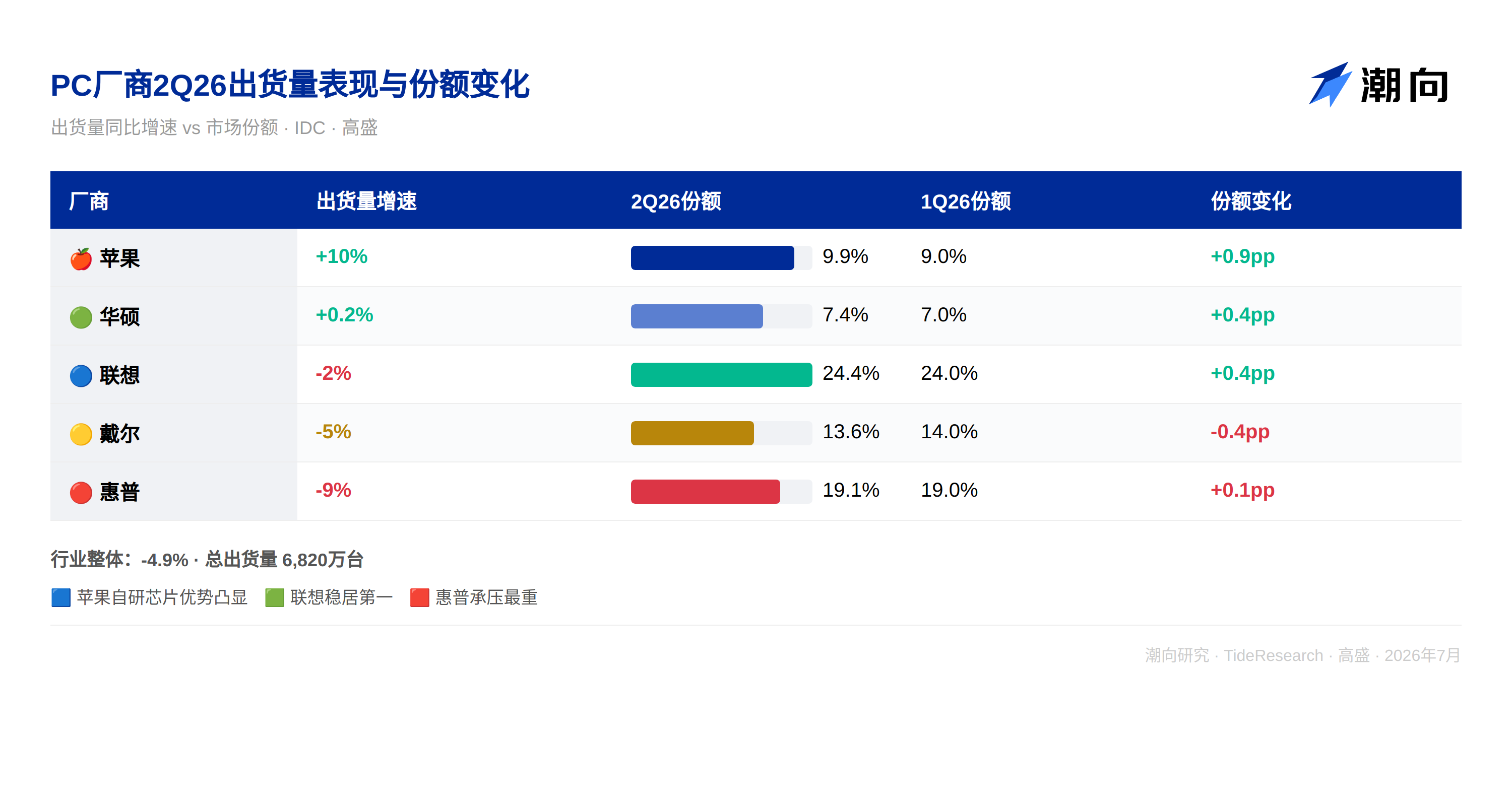
The performance of the top five manufacturers is significantly differentiated.
Apple shipments increased 10% year-over-year, and share rose to 9.9%, making it the only top manufacturer to achieve double-digit growth. Goldman Sachs believes Apple benefited from the supply stability of its self-developed chips and the demand resilience of the high-end market. Apple does not need to rush to buy Intel or AMD chips in the open market like other manufacturers; the capacity of M-series chips is fully guaranteed by TSMC. Supply chain autonomy transformed into a tangible shipment advantage during the shortage period.
Lenovo shipments decreased 2%, but share remains as high as 24.4%, firmly ranking first globally. Dell decreased 5%, share 13.6%, performance in line with the industry overall. ASUS increased slightly by 0.2%, share 7.4%, barely maintaining positive numbers amidst a crowd of negative growth. ASUS's positioning in gaming PCs and the high-end consumer market helped it maintain demand resilience in a price increase environment.
HP is the biggest loser, with shipments down 9% and share falling to 19.1%. Goldman Sachs believes HP is relatively weak in supply chain management and component procurement, suffering greater impact from the shortage. HP's consumer PC and SME customer proportion is relatively high, with higher price sensitivity, resulting in the most severe customer loss during the price increase cycle.
Large Manufacturers Are Eating Into Share
Goldman Sachs clearly pointed out that continuous supply shortages are reshaping the competitive landscape of the PC industry. Manufacturers with larger scale, richer product lines, and stronger supply chain management capabilities are benefiting from this.
Apple, Dell, and Lenovo were highlighted by Goldman Sachs as favored. They have stronger bargaining power to lock in component supply, more diversified product lines to flexibly allocate scarce resources, and more stable customer relationships to absorb price increases. Under the same supply constraints, small manufacturers cannot get goods, cannot raise prices, and lose customers; their share is being gradually eroded.
IDC expects this trend to continue until supply returns to normal. This means that before 2028, the concentration of the PC industry will continue to rise. For A-share and Hong Kong share investors, this means small and medium-sized contract manufacturers in the domestic PC supply chain may face order contraction pressure, while large manufacturers that have already entered the core supply chains of Apple, Lenovo, and Dell (such as Luxshare Precision, Foxconn Industrial Internet, etc.) may obtain more stable order allocation.
TechFlow Perspective
PC shipments ended nine consecutive quarters of growth. The significance of this turning point is not just a temporary fluctuation in industry data, but the "siphon effect" of AI computing power expansion on the traditional tech supply chain is becoming apparent. Storage and memory capacity are tilting towards HBM and AI servers, directly squeezing the supply side of PCs. Goldman Sachs' judgment that shortages will last until early 2028 basically aligns with the prediction that the storage cycle will peak at the end of 2027, indicating that the PC supply recovery timeline depends entirely on when AI's occupation of storage capacity alleviates.
Share changes among top manufacturers provide another perspective. The gap between Apple +10% and HP -9% shows that under the same supply constraints, differences in supply chain management capabilities can directly translate into market share shifts. For investors focusing on the PC supply chain, this shortage is not a simple "industry downturn," but a supply-side driven reshuffle: large manufacturers get the meat, small manufacturers get the soup, and those who fall behind cannot even get the soup.
The combination of "revenue growth, shipment decline" mentioned by Goldman Sachs is worth continuous tracking. If PC industry revenue continues to grow while shipments continue to decline, it means rising ASP is compensating for volume shrinkage, and the profit margins of top manufacturers may rise instead of fall. If this logic holds, the benefit degree for component suppliers in the PC industry chain (especially high-end components with higher unit prices) may be superior to complete unit assembly factories.

Disclaimer
This article is a compilation and interpretation by TechFlow Research of a third-party broker research report (Goldman Sachs, July 8, 2026). The ratings, target prices, earnings forecasts, and related judgments cited in the text are the views of the broker's analysts, represent only the position of their affiliated institution, do not represent the views of TechFlow Research, and do not constitute any investment advice.
The market carries risks, decisions must be independent. This article should not be used as a basis for buying or selling any securities.
Join TechFlow official community to stay tuned
Telegram:https://t.me/TechFlowDaily
X (Twitter):https://x.com/TechFlowPost
X (Twitter) EN:https://x.com/BlockFlow_News
 @chaoxiangooo