What Happened to the Crypto Market During Past World Cups? Huobi HTX Presents a Data Retrospective
TechFlow Selected TechFlow Selected
What Happened to the Crypto Market During Past World Cups? Huobi HTX Presents a Data Retrospective
Does the “World Cup Curse” Really Exist? A Retrospective Analysis of Market Trends Across Three World Cups
 Navigating Web3 tides with focused insights
Every four years, the competition on the green pitch quietly influences another global market—cryptocurrencies. From 2014 to 2022, across three FIFA World Cups, Bitcoin and the broader crypto market experienced varying degrees of volatility during each tournament. The 2026 FIFA World Cup co-hosted by the United States, Canada, and Mexico officially kicked off on June 11—a historic edition featuring 48 teams and 104 matches, and the deepest integration yet between the crypto industry and major sporting events.
So what do historical data tell us? What path might this year’s market take? Let’s take a systematic retrospective—backed by data—with Huobi HTX.
Does the “World Cup Curse” Really Exist? A Data Retrospective Across Three World Cups
In traditional financial markets, the “World Cup Curse” has long been observed. Historical data show that across the eight completed World Cups from 1994 to 2022, China’s Shanghai Composite Index declined in five instances and rose in three. In the cryptocurrency market, price movements are more complex and far more volatile. Research institutions suggest this may stem from the high degree of overlap between “deleveraging cycles following inherent market bubbles” and the World Cup’s four-year cycle. Let’s examine the market data for each of the three World Cups individually.
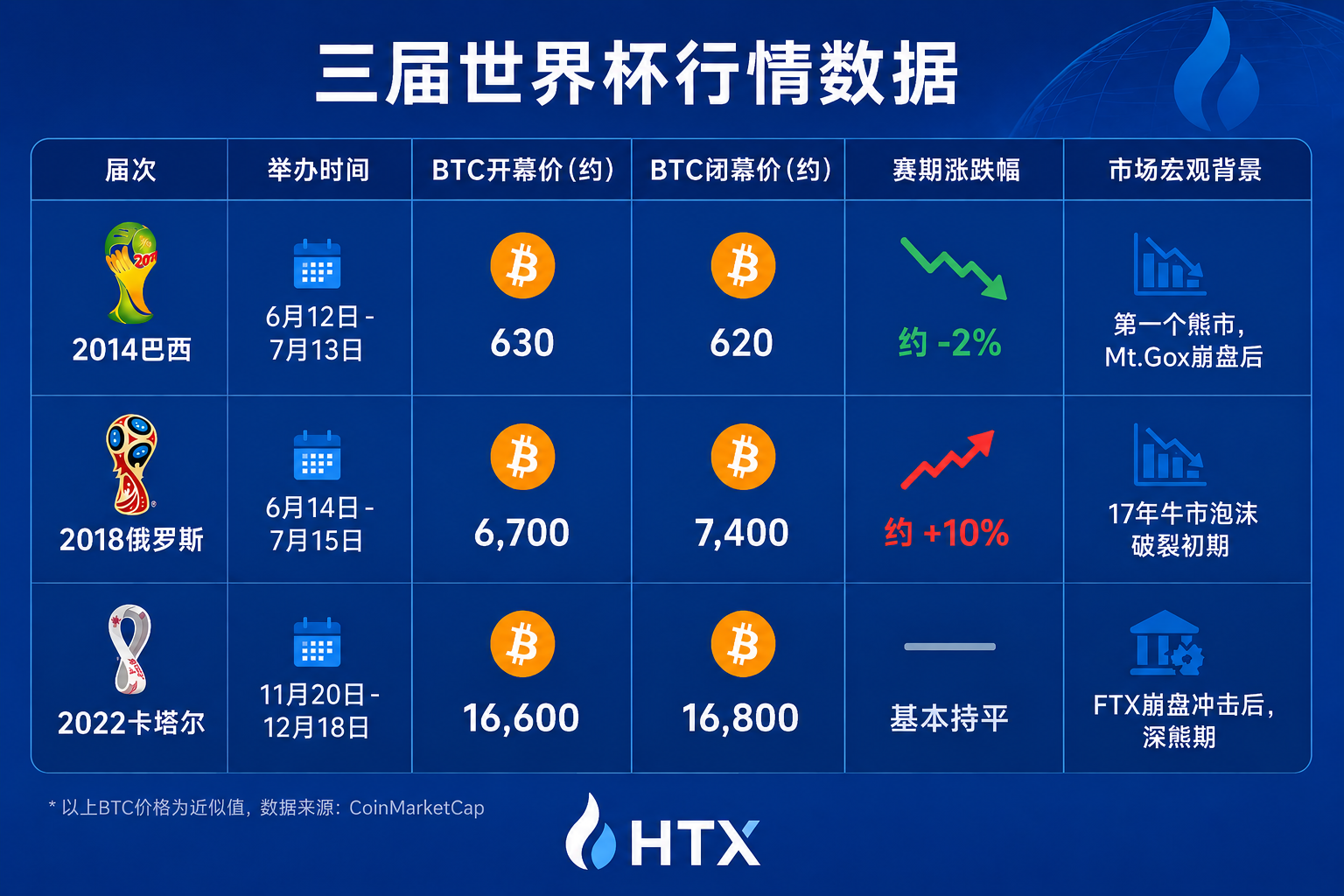
2014 Brazil World Cup: Silence Amid the First Bear Market
2014 was one of the “darkest hours” the crypto market had ever faced. At the start of the year, Mt. Gox—the world’s largest cryptocurrency exchange at the time—declared bankruptcy after losing 850,000 BTC, severely damaging market confidence. Bitcoin plummeted from its end-of-2013 all-time high of $1,156, peaking only at $1,017 during the year and closing near $320 by year-end.
During the World Cup (June–July), Bitcoin traded sideways between $600 and $650—remaining virtually unmoved regardless of how many goals were scored on the pitch. Thus, amid a macro bear market compounded by a black swan event, World Cup-related sentiment failed to reverse the prevailing trend.
2018 Russia World Cup: A Fleeting Rally
2018 marked the beginning of another brutal bear market in crypto history. Bitcoin crashed from its late-2017 all-time high near $20,000, falling to approximately $3,200 by year-end—a decline exceeding 70%.
Yet during the World Cup period (June 14–July 15), Bitcoin staged a brief rally—from roughly $6,700 up to around $7,400, a gain of nearly 10%. But the relief was short-lived: prices resumed their downward trajectory in August and dropped below $4,000 by year-end. This World Cup rally within a major bear market reflected oversold correction—not a trend reversal—and those chasing the rally often got trapped.
2022 Qatar World Cup: Desperate Bottom Amid the FTX Black Swan
This World Cup unfolded against the most unusual crypto backdrop to date. Just before kickoff, FTX—the world’s second-largest crypto exchange—filed for bankruptcy in November 2022, delivering a systemic shock to the market. Bitcoin plunged from $21,000 to below $16,000, with over $150 billion in market capitalization wiped out in November alone.
During the tournament, Bitcoin oscillated narrowly between $16,000 and $17,000—essentially flat. More notably, fan tokens surged sharply ahead of the tournament and then collapsed en masse once play began. CHZ (Chiliz) posted a 42% gain over seven days and a 95% gain over thirty days during the 100-day countdown to the World Cup—but fell 17.19% after opening day. Spanish national team fan token SNFT dropped 27.40%, Brazilian team token BFT fell 17.20%, and Argentine team token ARG declined 13.21%. The classic pattern of “buy the rumor, sell the news” played out vividly.
Pattern Summary: Common Logic Underlying the Three Editions
Viewing all three editions collectively reveals several meaningful patterns:
Pattern One: Crypto market performance during the World Cup is fundamentally an extension of the macro cycle. All three tournaments coincided with crypto bear markets or correction phases (2014, 2018, and 2022 were all years when Bitcoin posted annual losses). This is no coincidence—the World Cup occurs every four years, and crypto’s deleveraging cycles and bull-bear transitions also operate on an approximate four-year timeframe (closely aligned with Bitcoin’s halving cycle). When the overarching trend is downward, World Cup-related sentiment can only generate localized volatility—not shift the overall direction.
Pattern Two: Sports-themed tokens strictly follow the logic of “expectation first, execution second.” This was most evident in 2022: the 1–3 months prior to kickoff served as the pump window for fan tokens, while the tournament’s commencement signaled the sell-off. For such thematic speculation, timing the exit matters far more than selecting the asset.
Pattern Three: Correlation between crypto markets and global equities continues to strengthen. With institutional capital increasingly entering the space, crypto’s correlation with U.S. equities has risen significantly. Analyzing crypto markets can no longer be done in isolation—it requires simultaneous attention to macro indicators like Fed policy and global risk sentiment.
Huobi HTX Perspective: The 2026 World Cup Presents a Fundamentally Different Backdrop
With these historical patterns in mind, let’s examine what makes this year unique.
Backstory One: Bitcoin Is in Its Post-Halving “Accumulation Phase”
Bitcoin’s fourth halving occurred in April 2024. Historically, significant bull runs have followed each halving within a 12–18 month window (validated in 2013, 2017, and 2021). In 2025, Bitcoin briefly breached its all-time high of $126,000 before entering a correction—trading between $60,000 and $80,000 in the first half of 2026. This stands in stark contrast to the deep bear-market conditions seen during the previous three World Cups—markets are now in a “high-level correction,” not a systemic collapse.
Backstory Two: Crypto Infrastructure Has Matured Fully—Participation Depth Is Unprecedented
Prior to the 2026 World Cup, cumulative trading volume on just one platform—Polymarket—for “World Cup Champion” prediction contracts has approached $1.6 billion. On-chain prediction markets have emerged as one of the most watched new participation formats during the tournament. Integration between crypto and sports has evolved beyond superficial marketing—such as jersey sponsorships and NFT launches—into genuine value networks and settlement infrastructure.
Backstory Three: Institutional Capital Inflows and Regulatory Progress Are Accelerating
Following the U.S. approval of spot Bitcoin ETFs, sustained institutional inflows have fundamentally reshaped market structure. Crypto’s volatility is systematically declining, and the frequency of extreme one-way moves is diminishing—meaning strategies must adapt accordingly.
Ultimately, even the best strategy needs a stable, secure platform to execute. Founded in 2013, Huobi HTX ranks among the world’s oldest and most established crypto exchanges. Since the end of 2023, it has maintained zero security incidents for 30 consecutive months. It serves over 50 million registered users across more than 130 countries and regions. During globally driven, emotionally charged events like the World Cup, Huobi HTX’s advantages become especially pronounced—including deep liquidity, comprehensive risk management tools, real-time market data and news, and an integrated ecosystem covering spot, derivatives, margin trading, staking, lending, and more. Huobi HTX offers a one-stop service suite spanning the full asset management lifecycle—tailored for both active traders and long-term holders alike.
Notably, Huobi HTX has launched its “World Cup Prediction Red Packet Campaign” during the tournament. Participate in match predictions and share in a $100,000 USDT prize pool. The campaign runs from June 12 to July 20, 2026 (UTC+8), covering all 34 match days. Users simply need to visit the Huobi Plaza activity zone, predict the outcome of the day’s opening match, and complete their vote to qualify for the next day’s red packet draw. Posting match analysis in the comment section unlocks additional community exposure opportunities. After participating for seven consecutive days, users automatically unlock eligibility for a large-value red packet on Day 8.
Additionally, Huobi HTX has concurrently launched its “USA-Canada-Mexico World Cup Prediction Campaign.” From now until 3:00 a.m. on July 20 (UTC+8), eligible users who register and complete designated tasks will receive prediction tickets for two gameplay modes: “Champion Prediction” and “Single-Match Prediction.” Participants will jointly share a $500,000 prize pool denominated in $HTX. The user(s) correctly predicting the ultimate champion stand to win up to $15,000 worth of rewards. Tune in to Huobi HTX—watch the games and enjoy exclusive World Cup benefits.
Conclusion: History Doesn’t Repeat—But Patterns Never Lie
History doesn’t offer ready-made answers—but it does leave valuable clues. Data from three World Cups tell us that the crypto market won’t change its macro trend merely because the world’s biggest sporting event arrives—but it certainly creates short-term, sentiment-driven opportunities. The key lies in understanding those patterns in advance—and preparing accordingly.
The 2026 World Cup unfolds against a backdrop distinct from the past three editions: a post-halving accumulation phase, more mature market infrastructure, deeper institutional involvement, and a rapidly expanding global crypto user base. This means new opportunities—and new uncertainties—coexist. The World Cup whistle has blown. Whether you’re capitalizing on tournament-related themes, seizing market opportunities, or joining prediction contests to share in the benefits, Huobi HTX will accompany users through this global celebration.
Join TechFlow official community to stay tuned
Telegram:https://t.me/TechFlowDaily
X (Twitter):https://x.com/TechFlowPost
X (Twitter) EN:https://x.com/BlockFlow_News
 @HTX_Global