When Tokens Cost More Than Humans, the “AI Narrative” Runs Into Trouble
TechFlow Selected TechFlow Selected
When Tokens Cost More Than Humans, the “AI Narrative” Runs Into Trouble
This is not the 1999-style bubble, but the narrative that “growth in token consumption equals AI transformation success” will ultimately collapse.
 Navigating Web3 tides with focused insights
By: Bao Yilong
Source: WallStreetCN
The business case for enterprise AI spending is under severe scrutiny: token consumption continues to surge, yet quantifiable commercial value remains elusive.
On May 22, Andrew Macdonald, COO of Uber—valued at over $200 billion—publicly stated on a podcast that “there is no line yet” linking rising token consumption to tangible product improvements.
Macdonald noted that justifying escalating AI expenditures has become increasingly difficult for the company. He even coined a term for internal engineering waste: “tokenmaxxing.”
Earlier in mid-May, Microsoft began cutting internal Claude Code licenses, citing unsustainable token-based billing.
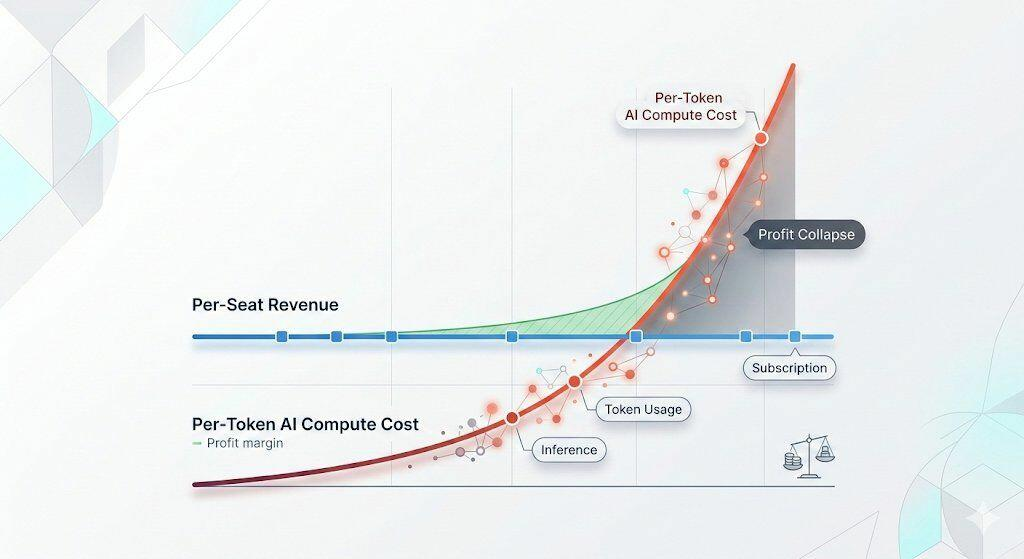
Together, these two incidents force the market to confront a previously overlooked variable: token economics—the unit economics of token consumption at enterprise scale—has evolved from a fringe topic into the central structural pillar of the entire AI investment thesis.
Five Data Points Paint a New Picture
Since April, multiple data points have emerged, collectively painting an alarming picture.
In April, Uber’s CTO publicly revealed the company exhausted its full-year Claude Code budget in just four months.
Among its 5,000 engineers, monthly usage rates ranged between 84% and 95%, with individual monthly bills varying from $150 to $2,000. In one reported two-hour internal demo, the CTO himself consumed tokens worth $1,200.
Macdonald described learning this figure as leaving him “speechless with shock.”
On Microsoft’s side, according to Tom Warren’s Notepad newsletter (under The Verge), Claude Code rapidly gained traction among Microsoft’s internal engineering teams—but its token-based pricing model made large-scale spending unsustainable, prompting Microsoft to begin scaling back related licenses.
GitHub announced that, effective June 1, all Copilot plans will shift from flat-rate subscriptions to usage-based billing.
An official discussion thread garnered nearly 900 downvotes, as users calculated that a single agent-assisted coding session typically consumes $30–$40 worth of tokens—meaning a $10-per-month plan would be exhausted in a single use.
Developer productivity platform Entelligence.AI aggregated data from 2,444 enterprises and found:
- For every $1 spent on AI tokens, only $0.18 generated user-facing value.
- $0.44 went toward fixing bugs introduced by AI; $0.27 was spent on rework; $0.11 was consumed by review friction.
According to Bloomberg’s Silicon Data LLM Token Expenditure Index, token prices have risen approximately 65% since late February, while U.S. AI software prices have surged 20%–37% over the past year.
Bull vs. Bear: Same Facts, Opposite Interpretations
Identical data yield starkly divergent conclusions under different analytical frameworks.
Bulls view the current chaos as mere growing pains of a successful transition.
As Goldman Sachs’ Jim Schneider assessed in early May, agentic AI is projected to drive a 24-fold increase in token consumption by 2030—reaching ~120 trillion trillion tokens per month—while gross margins for hyperscale cloud providers and model vendors are expected to turn positive within the next 3–12 months.
Goldman’s Rich Privorotsky argues Q1 2026 may already mark the peak of “tokenmaximization” as a KPI, as the industry shifts toward healthier metrics such as “cost per effective action.”
JPMorgan’s economic research also observed a sharp uptick in new and updated Python packages on PyPI beginning early 2026—a trend absent following ChatGPT’s 2022 launch—suggesting real productivity gains are underway.
Moreover, the Magnificent Seven currently trade at ~20x forward earnings—well below the 52x peak during the 2000 tech bubble, Japan’s 67x in 1989, or the 34x of the “Nifty Fifty” era. By historical bubble benchmarks, today’s valuations do not constitute a bubble.
The most systematic bear case was laid out by Goldman Sachs semiconductor analyst Jim Covello in his April report.
He pointed out that nearly all value in the AI supply chain flows to semiconductor companies—a historically unprecedented and unsustainable dynamic. Chipmakers should benefit when their customers succeed; yet in this cycle, their prosperity comes at the expense of upstream consumption across the entire value chain.
Since ChatGPT’s launch, NVIDIA’s net income has grown ~20-fold; major hyperscale cloud providers have exhausted operating cash flow and turned to debt—data center–related debt issuance in 2025 is expected to reach ~$182 billion, double 2024’s level.
MIT’s Nanda Research shows 95% of enterprises investing in generative AI realize zero returns. This decoupling may persist for a time—but cannot last forever.
The Hidden Risk of Circular Financing
This debate also touches on a more complex layer: the financial circularity between hyperscale cloud providers and AI labs.
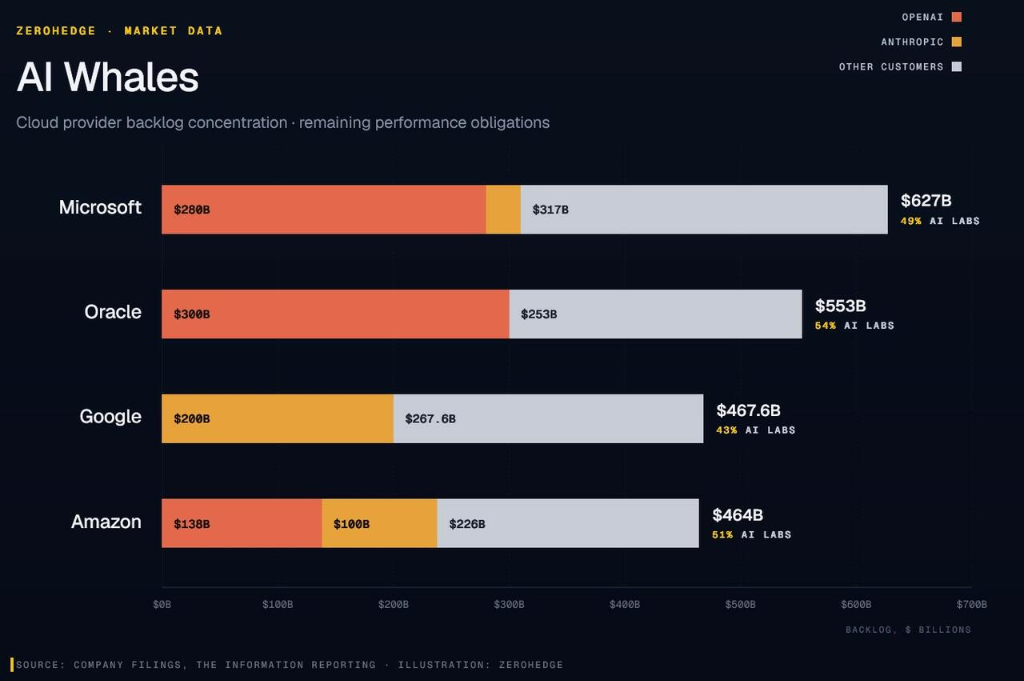
Per corporate disclosures compiled by The Information, OpenAI and Anthropic together account for over half of ~$2 trillion in future cloud service commitments from Microsoft, Oracle, Google, and Amazon. Specifically:
- Of Microsoft’s $627 billion cloud services backlog, $280 billion is tied to OpenAI;
- Of Oracle’s $553 billion pipeline, 54% (~$300 billion) is committed by OpenAI;
- Of Google’s $467.6 billion, Anthropic accounts for 43% (~$200 billion);
- Amazon’s exposure stands at 51% of its $464 billion backlog.
This financing structure is inherently circular. Microsoft’s $13 billion investment in OpenAI is largely fulfilled via Azure credits, which OpenAI uses to purchase Azure compute—Microsoft then books this as cloud revenue.
The same hyperscale cloud provider serves simultaneously as both equity investor in AI labs and biller of compute invoices.
This circularity also manifests in profitability figures. Alphabet reported a record Q1 profit of $62.6 billion, of which ~$28.7 billion—or nearly half—stemmed from unrealized gains on its Anthropic stake.
Of Amazon’s $30.3 billion Q1 profit, $16.8 billion came from pre-tax unrealized gains on Anthropic—while its free cash flow plunged 95% to $1.2 billion, due to $44.2 billion in concurrent data center capex.
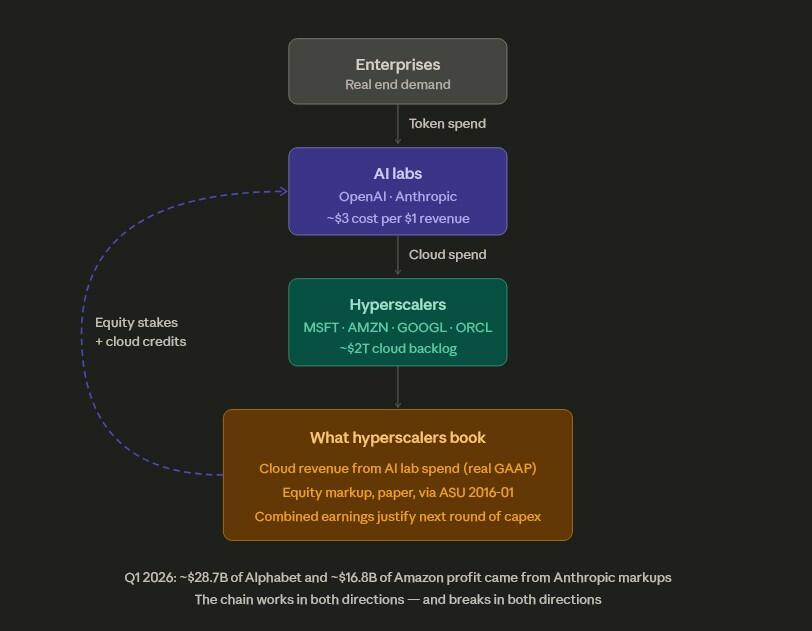
The sustainability of this system hinges on AI labs’ ability to continuously raise external capital to fulfill cloud commitments—which in turn depends on enterprise customers’ willingness to keep paying rising token bills.
Reportedly, Anthropic currently spends $3 for every $1 it earns. Should fundraising slow, cloud revenue forecasts will lose credibility—and hyperscale cloud vendors’ valuation multiples will face downward pressure.
This chain operates bidirectionally—and can break in either direction.
This Isn’t 1999—But the Problems Are Real
Today’s situation does not constitute a classic bubble setup.
By valuation multiples, the Magnificent Seven currently trade at ~20x forward P/E—far below the 52x peak of the 2000 tech bubble, Japan’s 67x in 1989, or the 34x of the “Nifty Fifty” era.
AI technology itself is real. For heavy-user cohorts, productivity gains are empirically verifiable. OpenAI’s annualized revenue stands at ~$20 billion; Anthropic’s at ~$4.3 billion. Neither lab is disappearing anytime soon.
Today, token cost—i.e., compute expense—has become the decisive factor determining AI success. Just six months ago, this topic barely registered in mainstream discourse.
Back then, everyone asked only, “Does the tech work?” Now the answer is clear: yes—at least for specific tasks and specific users.
But a new question arises: Can downstream enterprises’ AI-driven cost savings flow upward fast enough to outpace the valuation windows capital markets have granted AI labs and cloud giants?
Bullish observers believe that as the technology matures further, enterprise ROI will turn positive within 12–18 months.
Bearish observers counter that more executives—like Macdonald—will publicly decry AI’s poor ROI and begin slashing budgets.
Both scenarios are unfolding simultaneously. The outcome remains undecided. One thing is certain: the old fiction—that rising token consumption alone signals successful AI transformation—has collapsed.
High token consumption does not equal commercial value. Both bubbles must now be deflated. AI’s bill has come due—but who ultimately pays remains unknown.
Join TechFlow official community to stay tuned
Telegram:https://t.me/TechFlowDaily
X (Twitter):https://x.com/TechFlowPost
X (Twitter) EN:https://x.com/BlockFlow_News