Robinhood Chain earned $800,000 in two weeks, Ethereum only received $1,500
TechFlow Selected TechFlow Selected
Robinhood Chain earned $800,000 in two weeks, Ethereum only received $1,500
A Sobering Calculation from ARK's Director of Research
 Navigating Web3 tides with focused insights
Claude, TechFlow
TechFlow Digest:
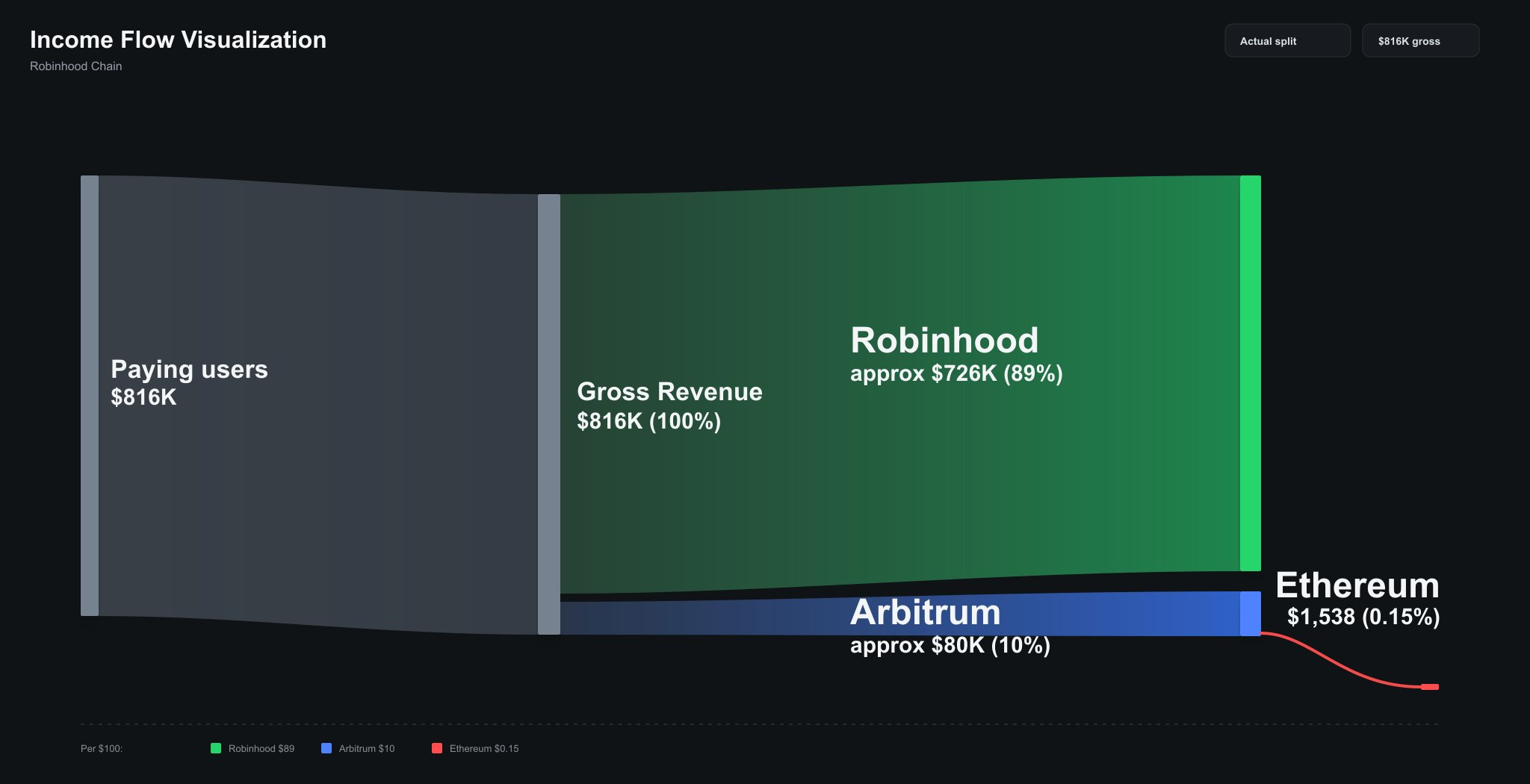
ARK Invest Crypto Research Director Lorenzo Valente broke down the revenue distribution since the launch of Robinhood Chain: total revenue of approximately $816,000, with Robinhood taking 89%, middleware Arbitrum taking 10% (about $80,000), and the underlying settlement layer Ethereum receiving $1,538, accounting for 0.15%. He called this the "cleanest case" of the evolution of the ETH economic model, prompting Ethereum co-founder Joe Lubin to personally step in to defend.
Two weeks after its launch, Robinhood Chain has delivered a report card that leaves the Ethereum community with mixed feelings.
According to DefiLlama data, as of July 13, Robinhood Chain's 24-hour DEX trading volume was approximately $791 million, ranking third across the network, second only to Solana and BNB Chain. TVL exceeded $160 million, with over 82,000 ETH (approximately $147 million) bridged to the network. An L2 chain built by a traditional brokerage, it caught up with and even surpassed Hyperliquid and the Ethereum mainnet in terms of on-chain trading volume in less than half a month after launch.
However, ARK Invest Crypto Research Director Lorenzo Valente posted on the X platform on July 13, turning this report card over to look at the back. He broke down the revenue flow of Robinhood Chain since its launch on July 1, and the conclusion was striking: total revenue of approximately $816,000, with Robinhood keeping 89% itself, Arbitrum taking 10% as middleware (about $80,000), while Ethereum as the underlying settlement layer received $1,538, accounting for 0.15% of total revenue.
Valente called Robinhood Chain the "cleanest case of the evolution of the ETH economic model."
89% vs 0.15%: Two Narratives, Two Conclusions
Valente did not simply define this account as bearish or bullish, but broke it down into two investment narratives.
If your argument is "ETH is money," Robinhood's choice to build a chain on Ethereum is an extremely bullish signal. More activity means more ETH is used as collateral and Gas tokens, and the network effect of ETH as money is strengthening. Robinhood never considered Solana, Sui, or any monolithic L1 from the start. Valente's exact words were: "They want to be landlords, not tenants." Robinhood wants to control the entire tech stack itself, and Ethereum's modular architecture happens to allow this operation.
But if your argument is "ETH is an asset that generates revenue," this is an extremely bearish case. Ethereum provides the most valuable settlement layer in the crypto world, yet charges close to zero. Valente suggested a healthier distribution ratio should be: Robinhood 75%, Arbitrum 10%, Ethereum 15%. He called out to the Ethereum ecosystem at the end of the post: "Things need to change."
Lubin Steps In to Defend: Low Fees are Strategy, Not Flaw
This post attracted one of the most weighty responders in the Ethereum ecosystem. ConsenSys founder Joe Lubin posted directly in the comments, with the core point being: L1 fees should remain low, this is a strategy to attract developers and enterprises.
According to CryptoTimes, Lubin predicted that in the next two to three years, tens of thousands of companies will deploy applications on Ethereum L1, various L2s, and private permissioned EVM chains, and these chains will be connected through interoperability protocols. His logic is: after scale increases, ETH's monetary premium will grow, staking and locking mechanisms will continue to reduce circulating supply, plus the burning mechanism of EIP-1559, ETH's value will ultimately be reflected by supply and demand rather than settlement fees.
Valente himself was not convinced by this. He questioned in his reply whether the premise of "tens of thousands of Robinhood-level companies" holds true. Robinhood's market cap is close to $50 billion, and companies of this size are few and far between globally.
Multicoin Capital Managing Partner Kyle Samani also joined the discussion, reiterating his consistent stance: L2s are "parasitic" to L1s. HashKey Capital holds the opposite view, calling Ethereum the "ultimate settlement layer" in a previous research report.
Data Propped Up by 90-Day Subsidy Period, Sustainability Remains to be Verified
It needs to be pointed out that there is an important background to Robinhood Chain's current active data: Robinhood is bearing all Gas fees for users, the subsidy period is 90 days after launch, and is expected to expire at the end of September.
According to the research report by Bernstein analyst Gautam Chhugani's team, Robinhood Chain's DEX trading volume reached $3.1 billion in the first week of launch, with about 65,000 users holding about $300 million in stablecoins and $13 million in tokenized stocks. However, Bernstein also pointed out that first-week activity was mainly speculative trading. On July 9, single-day trading volume once reached $568 million, directly driving the ARB token up 19% in a single day.
FalconX estimated in a report this April that Robinhood Chain's fee revenue within six months would be about $1.1 million, but this prediction was based on the premise of subsidies gradually phasing out. The institution also gave a longer-term prediction: by 2030, Robinhood Chain's annualized revenue could reach $60 million, provided that users expand from tokenized stocks to DeFi and other on-chain applications.
The user retention rate after the subsidy expires will determine whether Robinhood Chain is a truly viable L2 or just a brief traffic fireworks display.
ETH's Old Problem: Won the Bid, Lost the Pricing
The account broken down by Valente touches on the core anxiety of the Ethereum community for the past two years: After the L2 boom, how much value can ETH actually capture?
After the Dencun upgrade introduced EIP-4844 (blob transactions) in March 2024, the data availability fees paid by L2s to Ethereum L1 dropped significantly, and Ethereum's fee revenue and ETH burn volume shrunk simultaneously. Robinhood Chain's data just laid out this trend with a specific case: Coinbase's Base, various application chains on Arbitrum, and now adding Robinhood, every L2 is proving the same thing. Ethereum's security as a settlement layer attracts the biggest players, but settlement fees are low enough to be negligible.
As of press time, ETH trading price is approximately $1,780.
Join TechFlow official community to stay tuned
Telegram:https://t.me/TechFlowDaily
X (Twitter):https://x.com/TechFlowPost
X (Twitter) EN:https://x.com/BlockFlow_News
 深潮TechFlow