








Arthur Hayes: Global Liquidity Shifts, Cryptocurrency Poised for an Epic Rally
TechFlow Selected TechFlow Selected
Arthur Hayes: Global Liquidity Shifts, Cryptocurrency Poised for an Epic Rally
Under a bull market, simply invest without overthinking and hold firmly.
 Navigating Web3 tides with focused insights
By Arthur Hayes, Co-founder of BitMEX
Translated by Saoirse, Foresight News
When the first signs of a bull market gently soothe my nerves, an alluring sense of anticipation envelops me. I eagerly hit “buy,” fully aware that speculative frenzy will push my portfolio to new heights—at least until the euphoric crowd sobers up from its fantasy and reins in its optimistic outlook on the future, allowing gravity to reassert itself over financial markets.
This time, bullish evangelists paint a future where AI agents bloom everywhere, generating seemingly endless economic wealth. Tech upstarts in China and the U.S. become the new masters of this era, building the foundational infrastructure upon which AI depends. They dominate tech-heavy urban centers—San Francisco and Hangzhou—where their firms absorb all available capital, striving to build utopias on Earth—at least for corporate shareholders and ruling elites. And as capital grows scarce, they pressure today’s policymakers to expand monetary supply in dollars and renminbi, further consolidating their sectoral dominance.
The rush to construct an AI utopia is not the only fever gripping markets. Another powerful force is busy building a global war machine. Why should only the U.S.-led international order manufacture conflict and chaos? Every major power needs top-tier military capability to eliminate adversaries—no one can rely on the unpredictable whims of foreign leaders to come to the aid of so-called allies. So nations naturally resort to printing money for arms buildup and conscripting youth to fight glorified wars whose purpose remains obscure.
We have all become losers of our age: grossly underinvesting in the production of essential goods while obsessively chasing bond and equity assets tied to imperial systems. Once geopolitical conflict severs global trade routes, the purchasing power of our dollar savings becomes highly uncertain. Outsourcing the production of essentials entirely risks triggering famine and social unrest. The masses will inevitably take to the streets to demand justice—and expose the hypocrisy of arrogant politicians.
To politicians and their allied bankers, three irrefutable arguments justify central banks’ and commercial banks’ unchecked money printing. The immediate catalyst accelerating credit expansion is the ongoing U.S.-Iran conflict. This latest tragedy—born of leadership disagreements over governance—is yet another grim reminder that AI and drones will define future warfare, and no nation can rely solely on the U.S.-led international order to guarantee stable global commodity flows.
On AI, China and the U.S. share remarkable consensus: each must seize domestic AI supremacy—or risk enduring strategic vulnerability. Thus, AI hegemony is directly tied to national security. For other countries, ensuring stable access to food and energy under any scenario requires redundant infrastructure—transport pipelines, storage facilities—and strategic reserves of fertilizer, grain, and energy—not just more U.S. Treasuries or S&P 500 equities.
Before the next U.S. presidential election in 2028, overlapping epochal issues will forge a political consensus favoring loose monetary policy, enabling uncontrolled expansion of fiat credit. And this crypto bull market officially began on February 28—the day the U.S. launched airstrikes against Iran.
May this piece awaken your inner bull, break free from constraints, and propel you toward profitable horizons. Meanwhile, millions around the globe suffer hunger and hardship in the shadows of mainstream media indifference—cut off from essentials due to war-induced supply disruptions.
The AI Optimism Wave
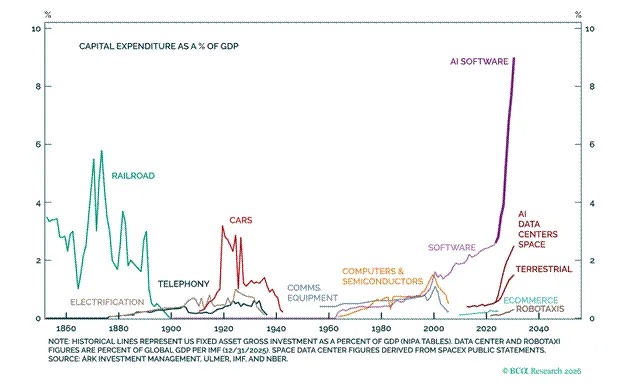
Global capital expenditures on AI model training, inference, and agent development have reached unprecedented levels in human history. Many believe the societal value generated by this AI industrial surge will dwarf that of any prior technological revolution. I agree—but human nature tends toward excess enthusiasm. There is no eternal perfection; expectations are always front-run, leading to overinvestment and redundant construction in an AI-dominated future.
AI proponents cloak massive industrial spending in nationalist rhetoric, invoking national strategy to mask inherently inefficient capital allocation. Patriotism should never be priced. Leaders in both China and the U.S. firmly believe AI and tech hegemony are vital to preserving their respective political orders. Their tech workers enthusiastically amplify adversarial narratives, exaggerating threats posed by rivals’ AI advances.
Objectively, both leaders have witnessed firsthand how scaled AI and drone deployment determine battlefield outcomes—and have fully internalized this logic of industrial competition. Consequently, both nations will prioritize developing world-class AI industries across economic and military domains. This means even if monetary policymakers fear inflation from massive dollar and renminbi credit expansion, they cannot speak out. Central and commercial banks must unconditionally finance the tech sector.
Currently, most U.S. AI capex originates from operating cash flow of profitable tech giants.
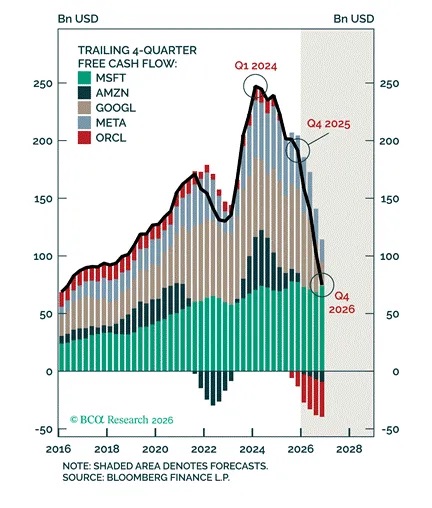
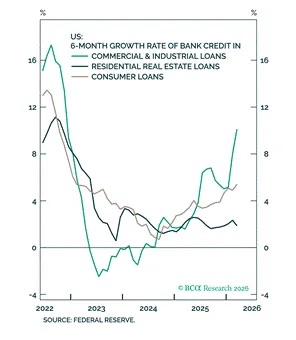
But current and future investment scale already demands expanded funding via credit channels.
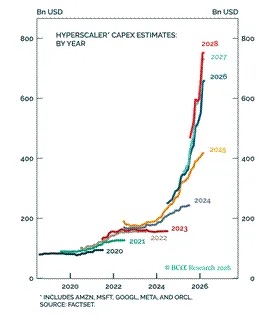
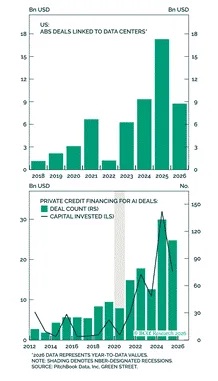
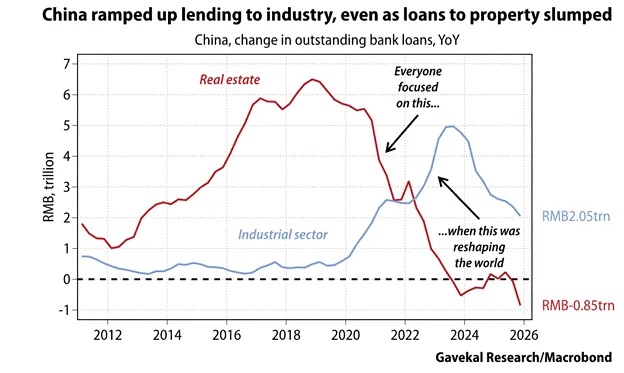
In China, policy has mandated banks to shrink real estate lending and redirect credit toward technology sectors.
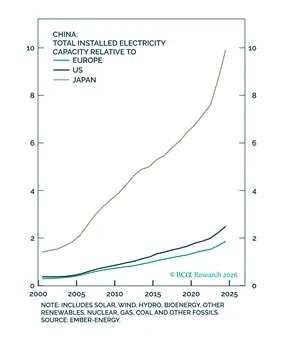
Beyond data center investments, both China and the U.S. are aggressively expanding electricity generation capacity.
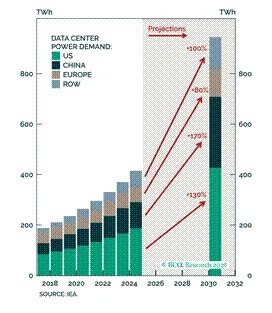
This is no longer simply about commercial banks extending loans to AI- and data-center-related projects out of patriotic duty. Both the Federal Reserve and the People’s Bank of China are ramping up fiat money creation and broadly easing financial market liquidity.
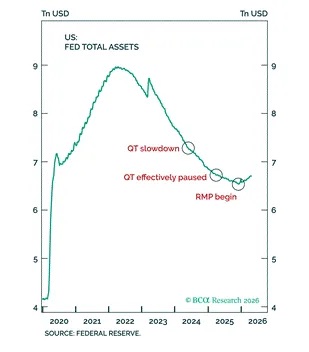
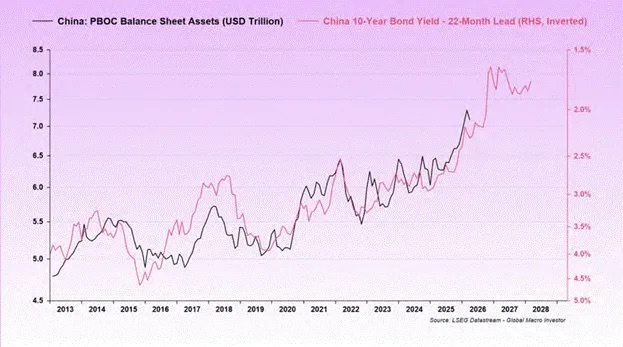
The political imperative to win the AI race, combined with the financial imperative to fund industry via money printing and credit, creates ideal tailwinds for cryptocurrencies. Total fiat money supply will keep growing—and with annual surges in AI and power infrastructure capex, the pace of monetary expansion will accelerate further.
As per-unit AI compute costs decline, AI agents handle increasingly complex models and larger task volumes—driving exponential growth in total compute consumption. This is the core of Jevons’ Paradox. Add the Red Queen effect: a firm investing heavily to upgrade its AI model is quickly overtaken by competitors’ technical leaps—rendering earlier investments obsolete.
This forces relentless capital “inward competition”: firms must continually pour money into cutting-edge R&D just to crush rivals—leaving hundreds of billions—or eventually trillions—of dollars vulnerable to rapid devaluation. Unless disrupted by an unforeseen external “black swan,” AI capex expansion will thus continue indefinitely.
When will this industrial mania end?
I see two events occurring almost simultaneously, fundamentally reshaping market perceptions of trillion-dollar AI spending necessity: First, a mega-IPO or super-merger in China-U.S. tech/AI sectors—unprecedented in scale and financially unsustainable—will overwhelm market absorption capacity and shatter the industry’s euphoria. People will finally question whether pouring vast sums into AI truly delivers commensurate value. Once skepticism becomes consensus, the bubble bursts.
Second, the Democratic challenger’s campaign platform ahead of the 2028 U.S. presidential election. Massive AI infrastructure builds drive up raw material, labor, and especially electricity costs—deeply unpopular across much of America. Moreover, 90% of ordinary Americans hold little or no stock, missing out entirely on AI and related companies’ equity gains.
Thus, a campaign platform opposing unbridled AI expansion, championing human labor value, and curbing infrastructure-driven inflation will resonate strongly with voters. Even if Democrats lose, such mainstream sentiment will prompt capital markets to anticipate future government policies restricting AI credit issuance and tightening sectoral regulation—dampening corporate earnings expectations.
For now, however, dollar and renminbi liquidity will remain loose—and Bitcoin and the broader crypto ecosystem will continue benefiting.
A World of Self-Preservation
Trump’s reckless airstrikes against Iran disregarded the war’s shockwaves across the global economy. Perhaps he weighed the risks—but his optimistic expectation of a swift victory this year is clearly detached from reality.
The U.S. enjoys得天独厚 advantages in energy and arable land; even amid rising prices, its citizens face no famine risk—the true crisis arises only when politicians prioritize military spending over welfare subsidies. Europe, Africa, and most of Asia lack this luxury.
Their elites misjudged the situation, naively assuming the U.S. would consider food- and energy-starved nations before launching Middle East hostilities and disrupting commodity flows.
Countries previously overrelied on the U.S.-led order, choosing to hoard dollar-denominated financial assets instead of building independent energy transport corridors, trade routes, or strategic reserves of essential goods.
BCA Research’s Marco Papic puts it succinctly: this poses enormous systemic risk for the rest of the world. Global infrastructure planning has long been hardwired to U.S. geopolitical hegemony. Consider: Germany’s air defense struggles against Russian threats stem from overdependence on U.S. defense systems; Gulf Cooperation Council states possess virtually no alternative energy transport infrastructure beyond the Strait of Hormuz—again, rooted in the U.S. order; global manufacturing is hyper-concentrated in China, reflecting deliberate U.S. geopolitical design; Australia imports aviation fuel from South Korea, constrained by U.S.-dominated supply chains; Canada’s infrastructure leans heavily on U.S. demand—also a product of U.S. hegemony.
Global physical infrastructure—energy, defense, shipping, manufacturing—was designed from inception to align with U.S. geopolitical dominance. This manifests not only in the U.S.’s persistent large current-account deficit—its empire-style economy indiscriminately absorbs imports from across the globe—but also in the world’s default reliance on massive U.S. defense spending to sustain macro-geopolitical stability. In short: today’s world runs on U.S. leadership—and Washington will go to war to defend that order.
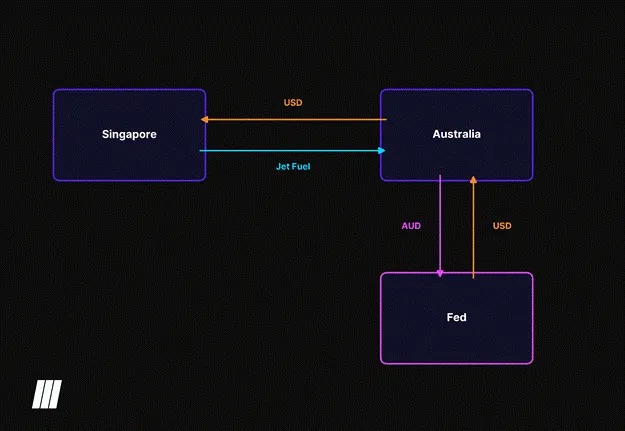
Bangladesh may face famine if Persian Gulf fertilizer exports stall and harvests shrink; Australia may need emergency fuel purchases from Singapore if Chinese imports halt; European consumers may abandon cheap Russian and Qatari oil and gas for expensive U.S. refined products and LNG.
All this signals a complete overhaul of sovereign investment logic. When a war unrelated to—and unwelcome by—a country can sever food and energy supplies, holding U.S. Treasuries or S&P 500 index funds loses meaning. To fill strategic gaps, nations will marginally reduce dollar holdings and redirect capital toward infrastructure, defense, and essential goods reserves.
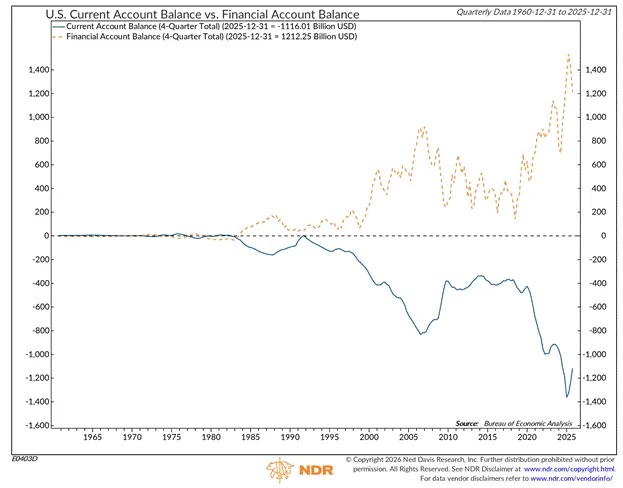
U.S. hegemony relies on overseas financial “tribute” to balance its books. But if foreign holders collectively dump dollar assets, U.S. financial markets face direct shock. The U.S. has long relied on foreign capital to cover its massive current-account deficits; an uncontrolled sell-off could easily trigger a severe financial crisis.
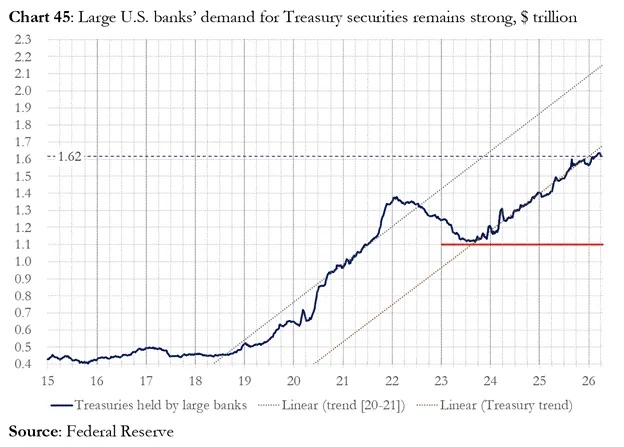
Treasury Secretary Bessent and monetary policymakers understand this well. Two policy tools exist to mitigate such risk: expanding the scope of dollar swap lines and adjusting bank regulatory rules to compel financial institutions to buy more U.S. Treasuries.
If friendly nations need funds for essential goods or infrastructure, the Fed or Treasury could provide financing via dollar swap lines—avoiding disruptive direct asset sales. Instead, existing dollar assets serve as collateral for liquidity. The UAE, for example, recently cited this rationale in requesting dollar swap access. Such credit instruments, once deployed, effectively expand total dollar circulation.
Passive Australia: Selling U.S. Treasuries to Buy Jet Fuel
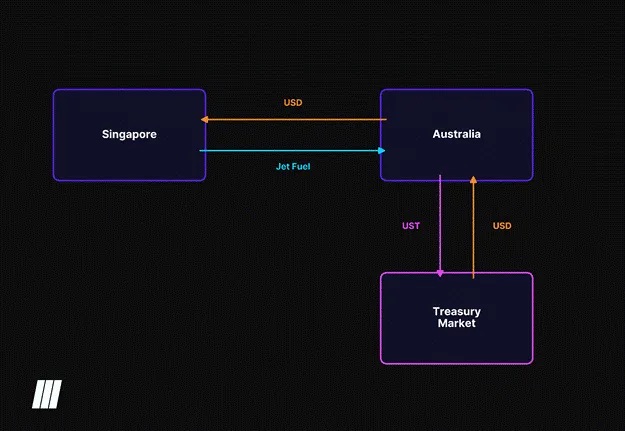
Clever Australia: Borrowing Dollars from the Fed to Buy Jet Fuel
If U.S. markets need to hedge against sustained foreign selling, regulators can also adjust banking rules—allowing banks to hold more Treasuries and equities against the same capital base. Recent revisions to the supplementary leverage ratio (SLR) rule mark precisely this direction.
The global practice of recycling trade surpluses into dollar assets began with the 1970s U.S.-Saudi petrodollar agreement—and peaked after the 1997–98 Asian Financial Crisis. Today, however, holding dollar assets no longer guarantees reliable access to essentials like fertilizer or oil.
What’s needed instead is domestic capacity-building—or regional supply-chain partnerships—to secure basic goods. The era of hyper-efficient, just-in-time globalization is over. The era of strategic stockpiling—preparing for uncertainty—is here. This is a structural trend set to last decades.
It also implies U.S. monetary policy must remain looser than normal to offset the market gap created by foreign divestment from dollar assets and redirection toward physical infrastructure and reserves.
Persistently High Rates and Inflation
War is inherently inflationary—and the U.S.-Iran conflict is no exception. AI infrastructure spending, global strategic stockpiling, and infrastructure booms all serve as legitimate pretexts for central banks and commercial banks to expand credit. Politicians, driven by practical needs and subjective motives, tacitly endorse—or even actively support—unfettered money printing.
That’s why, since the conflict erupted on February 28, Bitcoin has consistently outperformed gold, Nasdaq tech stocks, and other mainstream risk assets.
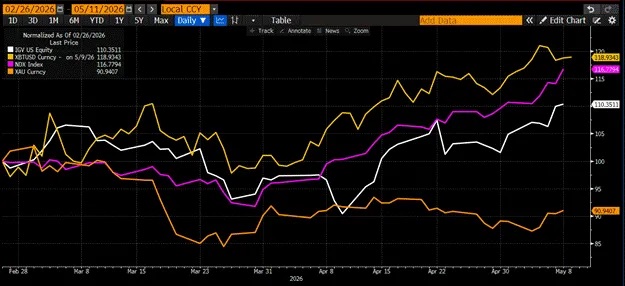
Post-war performance: Bitcoin (gold), Nasdaq 100 (magenta), U.S. Investment-Grade Tech ETF (white), Gold (orange)
Bitcoin bottomed at $60,000 this year—and with the flood of pending dollar and renminbi liquidity, a return to $126,000 is inevitable.
Many bears still refuse to join this Bitcoin rally—simply because it lagged tech stocks and gold over the past two years. Some even question whether Bitcoin retains its role as a hedge against currency debasement. Yet markets will soon witness its unmatched sensitivity to fiat liquidity expansion.
I predict Bitcoin will accelerate sharply after breaking $90,000—entering an explosive phase. At that point, massive options sellers—whose strike prices get breached—will be forced to unwind positions en masse, further fueling the rally. I cannot forecast Bitcoin’s ultimate ceiling—unless a game-changing event occurs, I’ll maintain full risk exposure in my Munster portfolio.
Approaching the U.S. November midterm elections, political polarization around AI and inflation may cause minor bull-market pullbacks. But deeper analysis shows high oil prices hurt Trump far less than widely assumed.
California’s flawed energy policies already make gasoline prices among the highest nationwide—making Republican wins there unlikely anyway. Meanwhile, $100 oil—and reconstruction of Middle Eastern and Venezuelan energy sectors—benefits oil-and-gas regions in Trump’s electoral base.
Polls give Democrats a 50% chance of winning control of both chambers. Yet even amid the U.S.-Iran war, Trump retains ample time to court swing voters and sway public opinion. As long as real incomes rise steadily, he’ll enjoy broad support. Unleashing domestic oil and gas development and energy industry growth could propel the S&P 500 toward 10,000 points.
Now is the time to position in promising niche tokens. Beyond our heavy allocations to Hyperliquid (HYPE) and Zcash (ZEC), NEAR is my top pick.
My next article will detail the thesis: privacy narratives combined with NEAR’s smart intent ecosystem will generate positive protocol cash flow—completely reversing the token’s prolonged underperformance and propelling it rapidly toward new all-time highs.
In a bull market, simply buy and hold. A time to sell will inevitably come—but it is not now. Ride the wave and capture the upside.
Join TechFlow official community to stay tuned
Telegram:https://t.me/TechFlowDaily
X (Twitter):https://x.com/TechFlowPost
X (Twitter) EN:https://x.com/BlockFlow_News
 Arthur Hayes


