








Interview with Dragonfly Partner: With Retail Investors Exiting, Institutional Players Providing Support—Where Is the Next Surge in the Crypto Market?
TechFlow Selected TechFlow Selected
Interview with Dragonfly Partner: With Retail Investors Exiting, Institutional Players Providing Support—Where Is the Next Surge in the Crypto Market?
Haseeb believes that cryptography is not designed for humans’ existing interaction habits, but it may be perfectly suited for AI agents.
 Navigating Web3 tides with focused insights
Compiled & Translated by TechFlow

Guest: Haseeb Qureshi, Managing Partner at Dragonfly
Host: Miles Deutscher
Podcast Source: Miles Deutscher Finance
Original Title: This Interview Made My Next Crypto Buys Obvious [Haseeb]
Air Date: April 26, 2026
Key Takeaways
In this episode, Dragonfly Managing Partner Haseeb Qureshi joins host Miles Deutscher to discuss the current state of the crypto market: retail investors have largely exited following steep drawdowns, while institutional capital now forms the floor under Bitcoin. Haseeb argues that Bitcoin doesn’t need much new narrative—it’s evolving into a mature financial asset over the next 15–20 years. In contrast, altcoins and broader crypto assets genuinely require compelling narratives.
Regarding Dragonfly’s $650 million fund, Haseeb emphasizes that crypto’s true product-market fit remains money and finance—including DeFi, stablecoins, exchanges, prediction markets, and real-world assets (RWAs).
The second half of the episode focuses on Crypto × AI: Haseeb contends that crypto wasn’t designed for human interaction patterns—but it may be ideal for AI agents. In the future, agents will serve as the first layer of interface between users and onchain finance, driving low-risk-preference users ontochain.
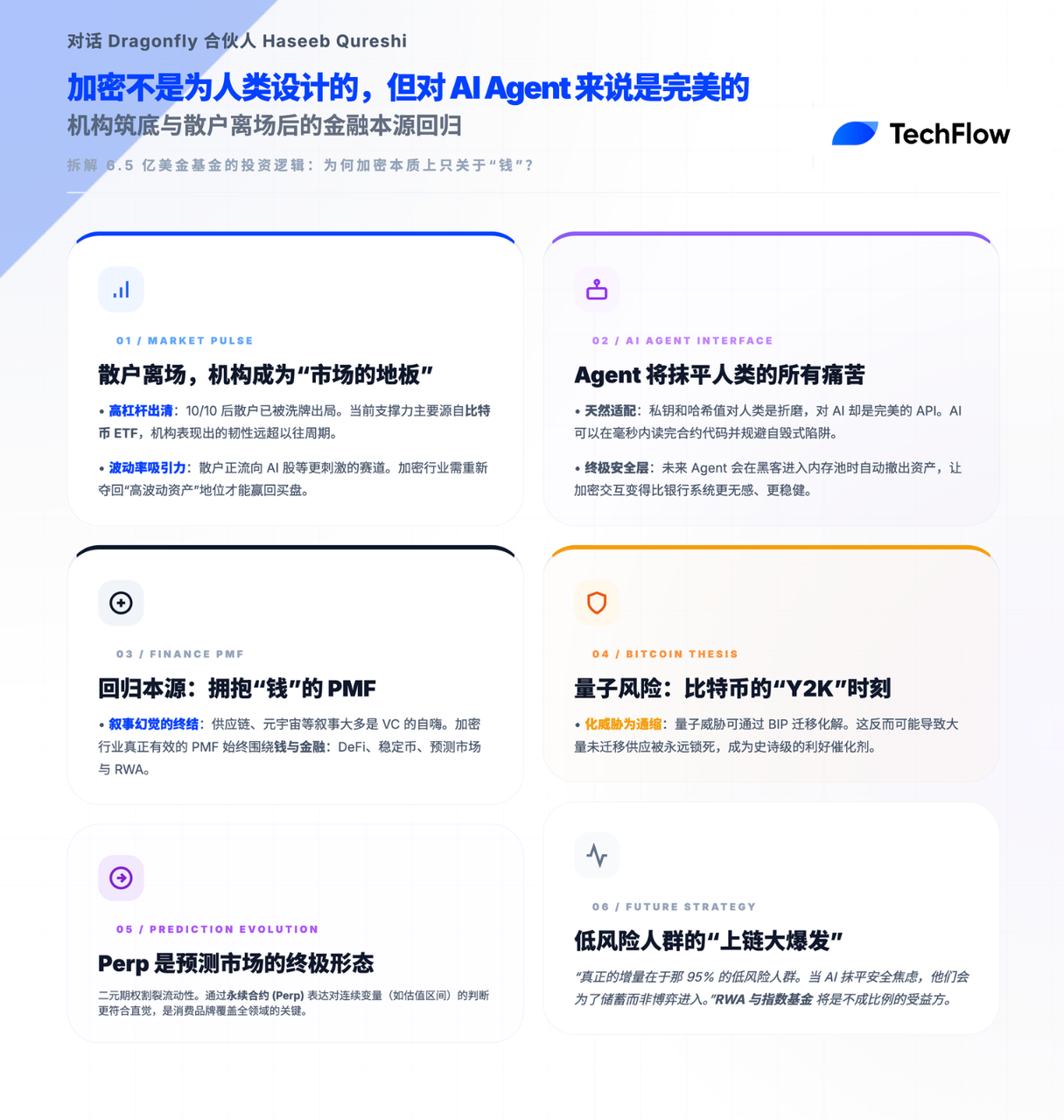
Key Insights Summary
On Current Market Conditions: Retail Exit & Institutional Floor
- “Since last October, we’ve clearly seen retail investors largely exit the market—their participation is now extremely low. The vast majority of 10/10 losses were borne by retail. Who holds large positions in altcoins that imploded like ‘thermonuclear reactions’ at that time? Retail.”
- “Institutions are still here. ETF drawdowns have been relatively modest… This shows institutions remain present—they’re now the market’s floor, the ultimate buyers, and the volatility buffer preventing Bitcoin from falling 70% or 80%, as in prior cycles.”
- “Crypto is no longer ‘the most exciting game in town.’ Ironically, gold, AI stocks, and memory-chip stocks now exhibit higher volatility than crypto assets. To re-attract retail, crypto must reclaim its status as a high-volatility asset.”
On Bitcoin: Narrative Retreat & Maturation into a Financial Asset
- “Frankly, I don’t think Bitcoin needs much narrative support. People believe Bitcoin will persist—it won’t disappear.”
- “Bitcoin behaves more like an asset that will steadily grow over the next 15–20 years. For younger generations, Bitcoin is already an established fact. They won’t question its legitimacy or value, as prior generations did—they’ll simply accept it as part of the world, a permanent financial asset.”
- “The quantum computing issue may resemble Y2K. Four years after migration begins, all BTC in legacy addresses will be permanently locked and immovable. That could actually benefit Bitcoin—massive un-migrated supply would be permanently removed.”
Crypto’s Essence Is Money and Finance
- “Crypto’s essence revolves around money and finance. Stories about blockchain supply-chain tracking, auditing, metaverses, gaming, and social media aren’t what consumers told us they truly need—they’re internally generated narratives.”
- “The industry has become somewhat self-absorbed, beginning to believe these stories will materialize. I’ve been skeptical from day one… I’ve personally used and experienced these products—I don’t consider them great games.”
- “Interesting things are happening in prediction markets. Perpetual contracts were introduced because, for many target markets, they better enable users to express continuous-variable judgments than traditional binary (yes/no) options.”
On Crypto × AI: Crypto Is Designed for AI
- “Crypto wasn’t designed for humans—it may suit AI agents better. Private keys, mnemonics, and hash values feel unintuitive to humans but are natural to machines. Machines inherently understand API keys and effortlessly handle high-precision decimals.”
- “All operations will soon be mediated and executed by AI agents. Future agents will monitor your assets in real time—upon detecting risk, automatically withdraw funds from protocols and notify you: ‘I’ve secured your funds.’”
- “The real difference between banks and crypto lies in ‘intelligence.’ Banks rely on systems and personnel to prevent user error; in the future, your AI agent will play a similar role.”
On Altcoins & Future Winners: Influx of Low-Risk Users
- “Unlike Bitcoin, altcoins need stronger narratives to attract retail. Unless you’re a project like Hyperliquid—generating consistent revenue and creating value via buybacks and token burns—most altcoin trading isn’t based on current earnings but future expectations.”
- “The real potential lies with low-risk-preference users. Today, only ~5% of them are onchain. If crypto becomes safer and AI agents simplify everything, these users will flood onchain en masse.”
- “If the low-risk cohort grows tenfold, the biggest beneficiaries will be mainstream assets (e.g., Bitcoin), stablecoins, and RWAs—savings-oriented assets. Onchain savings behavior is currently rare, yet this represents a major breakout vector.”
Current Market Conditions
Host Miles Deutscher: We’re honored to welcome Haseeb Qureshi, Managing Partner at Dragonfly. Haseeb, welcome! First question: How do you feel about the crypto market today? Where do you see it right now?
We can break this down into three parts: Bitcoin, altcoins, and retail participation. Let’s start with Bitcoin. Markets rebounded after volatility triggered by Iran-related events and Strait of Hormuz risks, while equities hit new highs. What’s your take on current conditions?
Haseeb Qureshi:
The market appears to have regained its footing. Still, since last October, retail investors have clearly exited—participation is now extremely low. If you speak with exchange founders, they’ll confirm retail activity has plunged to just a fraction of its peak in early 2025. We’ve seen this before: retail flows in and out easily.
Core retail attention metrics—search volume, retail-exchange trading volume, App Store downloads—directly reflect sentiment and engagement. All collapsed post-10/10, confirming retail’s departure.
But who’s holding up the market? Institutions. They’re still here. Bitcoin ETF data shows relatively modest drawdowns—I recall ETFs declined only ~7% in BTC terms. Prices fell with the market, but actual BTC outflows from ETFs were far smaller. So institutions remain—and now act as the market’s floor, ultimate buyers, and volatility buffer preventing Bitcoin from dropping 70–80%, as in past cycles.
ETF performance signals ‘smart money’ hasn’t lost faith in the sector or belief in crypto’s survival. Yet retail did leave—and retail matters, even for Bitcoin ETFs. While ETFs hold significant retail capital, it’s not the short-term, highly speculative, leveraged kind. Those are precisely the ones who departed.
Why Retail Left the Crypto Market
Haseeb Qureshi:
To understand the market, answer two questions: Why did they leave? When will they return?
First, why leave? Because they lost heavily. Retail bore the brunt of 10/10 losses. Who got liquidated on high-leverage positions? Who held massive altcoin bags that imploded like ‘thermonuclear reactions’? Retail. Institutions don’t deploy high leverage on altcoins like ATOM—retail shoulders those risks. So yes, retail was decimated on 10/10. Market makers and some institutions/liquidity funds suffered too—but the core truth is retail was broken on 10/10.
Second, crypto is a highly reflexive market, as we’ve long known. It thrives on momentum. Once negative, that trend persists until a positive external shock resets it.
Where did retail go? They rotated into other asset classes—gold, AI stocks, memory-chip stocks, oil. Ironically, these now show higher volatility than crypto. Gold’s volatility has even surpassed Bitcoin’s. So crypto is no longer “the most exciting game in town.”
Crypto attracted retail largely through high volatility—equities and commodities are far less volatile. Crypto’s appeal lay in its wild swings. If it stabilizes into a low-volatility asset, its appeal to regional retail investors plummets.
So, in a sense, crypto must rally to lure retail back. We’re seeing early signs it may have bottomed. But what comes next is uncertain—especially given geopolitical dynamics impacting all asset classes.
Another factor: volatility in AI and commodities. AI stocks swing wildly; gold and other commodities are similarly volatile. With Iran, we may see de-escalation. Polymarket pricing suggests low odds of war continuing through year-end—and >50% odds of a comprehensive peace deal by summer. A period of relatively stable commodity prices and macro conditions may follow.
Equity volatility may persist, especially if major IPOs occur this year—like Anthropic or OpenAI. If they list before year-end, equities could go wild. Once retail gains access to these iconic firms’ shares, prices may surge violently. Similarly, xAI and SpaceX will become ‘super-narrative’ retail trading favorites.
Host Miles Deutscher: What’s your outlook for the rest of the year? Sounds like you expect equities to be more volatile?
Haseeb Qureshi:
This year will indeed be volatile. But I suspect crypto’s volatility exceeding equities over the next 12 months will be challenging. My guess is crypto gradually recovers.
More importantly, looking ahead to next year—post-IPOs—I believe crypto is more likely to see broad-based recovery and potentially challenge all-time highs. Again, speculation—not certainty.
Yet a clear logic emerges: crypto must reclaim its ‘high-volatility asset’ status to re-attract retail. Without retail, institutional buying alone lacks scale to push markets to new highs.
Bitcoin’s Next Catalyst
Host Miles Deutscher: What narrative could bring retail back? Is there a catalyst—beyond price—that reignites interest?
Price itself drives narrative, yet Bitcoin seems to have lost some ‘faith.’ I still believe in it and can defend the ‘digital gold’ thesis. But gold’s performance, equities, quantum risks, and recent debates have eroded some support. Your view? Do you still believe? Does it retain a clear path forward as an asset?
Haseeb Qureshi:
We may overestimate the importance of the “Bitcoin narrative.” Frankly, Bitcoin doesn’t need much narrative scaffolding. People believe it will endure—it won’t vanish. And they see Wall Street’s gradual embrace. Though young, Bitcoin ETFs are among the most actively traded ETFs—demand remains robust.
If asked Bitcoin’s narrative, I’d say: it doesn’t need one. Bitcoin is more like an asset poised to grow steadily over the next 15–20 years. As Baby Boomers retire, capital decision-making shifts to Gen X and Millennials. For them, Bitcoin is a given—no legitimacy debates, no value skepticism. They’ll absorb it as part of reality, a persistent financial asset.
So I don’t foresee needing a major event within two years to shift Bitcoin’s status. Rather, it will continue permeating global finance incrementally—evolving into a more stable, widely accepted financial asset.
The Quantum Computing Issue
Haseeb Qureshi:
Quantum computing poses a real threat—within 3–5 years. Restoring confidence requires: (1) a clear Bitcoin Improvement Proposal (BIP), (2) broad consensus around it, and (3) a transparent migration plan. Once that exists, confidence surges. Post-migration, quantum risks fade.
I’m quite confident this will happen. Bitcoin’s community is already taking quantum threats seriously and seeking solutions. Long-term, quantum issues may mirror Y2K: a genuine risk—future quantum computers may crack ECDSA—but the key is whether chains complete migration before then.
If migration finishes, quantum computing ceases to threaten. Like Y2K: terrifying, potentially catastrophic, but solvable via preparation, migration, and patching—then relegated to history. Quantum issues may evolve similarly.
Thus, when viewed historically, quantum computing may resemble Bitcoin’s block-size debate—once critical and contentious, then resolved and forgotten. People may later struggle to recall why it sparked such concern—it simply won’t be an issue anymore.
Host Miles Deutscher: I recall you mentioning on a prior podcast that exchanges could block transactions from specific addresses, preventing unmigrated BTC from entering circulation. You also noted quantum impacts might be priced in early—or even become bullish catalysts. Could you elaborate?
Haseeb Qureshi:
Yes—assume a clear migration path emerges. Say next year, Bitcoin’s community agrees on a BIP adopting a new signature scheme or key standard. Then, they announce a migration timeline requiring users to upgrade keys.
You get three or four years to migrate. After four years, BTC in legacy addresses locks permanently—unmovable. Unmigrated BTC effectively gets ‘black holed.’ Exchanges, custodians, and ETFs will migrate first, securing their assets.
Some users inevitably delay migration. Suppose five years later, a quantum computer capable of cracking ECDSA emerges. If timelines align, quantum computing may actually benefit Bitcoin—for two reasons: first, quantum computers arrive after migration completes; second, massive unmigrated supply gets permanently deleted. Both could boost Bitcoin.
Thus, in many scenarios, quantum threats may transform into bullish catalysts—not bearish shocks.
Altcoin Market Outlook
Host Miles Deutscher: What’s your view on altcoins? Their price remains tightly coupled to Bitcoin’s. Though some rallied recently, retail interest stays muted. Your overall assessment—and predictions for big opportunities over coming months/years?
Haseeb Qureshi:
A crypto advantage is relative performance. Altcoins crashed hard—so broader macro recovery could lift them 30%, 40%, even 100% from lows without global crypto attention returning. Thus, many altcoins retain substantial upside.
Still, retail re-engagement may take time. Unlike Bitcoin, altcoins need stronger narratives to capture retail. Bitcoin’s position is stable—people broadly assume its longevity and eventual dominance. For Ethereum, Solana, and others, investors need clear stories explaining their importance and long-term potential.
Unless you’re a revenue-generating project like Hyperliquid—creating value via buybacks and burns—most altcoin trading reflects future expectations, not current earnings. Revenue-generating tokens like Hyperliquid are rare. Most altcoin valuations hinge on anticipated growth. So attracting retail demands clear, compelling future stories.
This is achievable—we possess the foundational tools. Crucially, people must rekindle excitement about crypto’s future. It’s not just tech—it’s belief and confidence. Crypto’s core endurance is proven, and authoritative institutions/individuals increasingly recognize its value.
For example, Kevin Warsh recently testified before Congress, stating he believes crypto is now indispensable to finance, won’t disappear, and is vital to U.S. interests. Years ago, imagining Janet Yellen or Jerome Powell voicing such views seemed impossible. Now we’re in a new era—future Fed chair candidates may openly support crypto, sustainably.
Major tech firms are also entering crypto. Reports suggest Meta plans to launch its own crypto wallet this下半年. These point toward one direction: crypto will persist—and deepen integration into mainstream finance. Yet to draw retail back into altcoins, we still need concrete narratives.
The $650 Million Bet
Host Miles Deutscher: You tweeted a key 2026 thesis: ‘Financial crypto is exploding,’ while non-financial crypto assets decline. Please expand—why is this a massive opportunity? I also note Dragonfly recently closed a new fund, clearly committing heavy capital here. What’s your logic?
Haseeb Qureshi:
I’ve long believed crypto’s essence is money and finance. Observe crypto’s massively successful projects—they all center on money and finance. Bitcoin is ‘digital gold’; Ethereum lets users write smart contracts around money. DeFi’s rapid rise, ICOs as capital-raising mechanisms, RWAs, stablecoins, prediction markets—all truly effective crypto innovations tie directly to money and finance.
The industry has tried many other stories. Frankly, most were crafted by VCs and entrepreneurs—and enthusiastically propagated by industry supporters. Blockchain for supply-chain tracking, auditing, metaverses, gaming, social media—these weren’t consumer demands. They were internally generated narratives. The industry became somewhat self-absorbed, believing these stories would manifest because they sounded plausible.
In 2020–2021, I debated these points privately with many VCs. The dominant narrative then was crypto would consume everything—social media, gaming, and beyond.
Host Miles Deutscher: There was indeed massive hype around blockchain games and metaverses—even Mark Zuckerberg bought into it.
Haseeb Qureshi:
Exactly. But frankly, I was skeptical from the start. I may seem like a cautious ‘old man’—always leaning conservative. I watched VCs pour money into Yuga Labs, Axie Infinity—but couldn’t believe in their sustainability. We didn’t invest, missing OpenSea and major blockchain games. Why? Because I personally used and tested these products—I didn’t find them great games. Same for decentralized social platforms—they weren’t usable. We defaulted back to X (formerly Twitter). So—what are we even discussing?
Thus, I never believed these narratives. Looking back, my skepticism proved correct. Crypto’s true product-market fit lies in its tight coupling with money and finance. This is what users truly need—and crypto’s highest-value domain. So for years, we’ve focused investments here: DeFi, stablecoins, exchanges, and infrastructure core to crypto’s operation.
Now, some may ask why other narratives failed—or how to make them succeed. My view: I don’t think they will. We must listen to the market. It tells us what’s valuable, what users truly want—money and finance applications. We should accept this and double down.
This investment philosophy let us retain funding authority while many VCs—blinded by flawed assumptions—were culled by the market. Investors collectively dreaming of crypto’s grander fantasies ultimately lost continued investment mandates.
Host Miles Deutscher: How are you allocating capital now? Pre-recording, you mentioned researching certain areas. Which projects or founders excite you most? What market opportunities are you watching—prediction markets? AI agents? Others?
Haseeb Qureshi:
We’re deeply researching these areas. We’re major investors in Polymarket. Prediction markets are clearly seeing fascinating developments—we’re dedicating significant time here. I believe Polymarket and Kalshi, the two main players, still occupy vast untapped market space.
Polymarket just announced a perpetuals product—though not yet live, it’s opened a waitlist. They’re clearly building toward a major consumer brand, aiming to cover every market they can reach.
Prediction markets launched perpetuals partly because they let users express judgments on continuous variables more efficiently. Most prediction markets are binary: “Will price exceed X?” or “Will Y happen?” But expressing a range—e.g., estimating a value between 0–100—requires splitting into multiple markets (“above X?” “below Y?”). This fragments liquidity, lowers capital efficiency, and feels unintuitive to retail.
Example: If you think OpenAI’s IPO valuation hits $1.2T or $2T, you’d need multiple markets asking “above X?”—not retail’s natural way to express views. Retail wants a fluid, up/down asset. So Polymarket’s perpetuals aren’t mimicry of platforms like Hyperliquid—they’re necessary because perpetuals suit many target markets better than binary options.
Thus, prediction markets hold huge untapped potential. Polymarket and Kalshi have ample room to expand into uncovered markets.
The Crypto-AI Convergence Shift
Haseeb Qureshi:
Next, AI. Crypto-AI convergence is generating fascinating developments—I’ve spent significant time here recently. Especially in Agentic Payments, new innovations are emerging rapidly. You can see transaction volumes growing fast around x402 and MCP (Machine-to-Code Payments).
We’re also tracking API gateway projects enabling AI agents to purchase services directly via API. Example: plug an AI agent into Claude Code, then use ATXP or Sponge to buy compute resources, browser sessions, CAPTCHA-solving services, disposable emails, web search, or even call other LLM APIs. Zero account creation, zero email setup, zero traditional friction—you pay via x402, hold some stablecoin, and pay per API call. This model is fascinating—and scaling rapidly. It’s a top focus for me now.
Host Miles Deutscher: You previously tweeted or discussed with Bankless: “Crypto wasn’t built for humans—it may suit AI agents better.” Your thoughts? How might this evolve over coming months/years?
Haseeb Qureshi:
Clearly, nearly all software interaction will change. If you’re already using advanced AI agent frameworks, you’re living in the future—though most haven’t experienced it yet, they soon will.
What does this mean? Tools like Claude Design show PowerPoint is no longer optimal for presentation design. Same for Photoshop. Many current interfaces are obsolete—AI agents will become the primary entry point for work output.
Crypto will undergo similar transformation. Today, executing a crypto transaction involves: opening an interface, clicking a button, confirming intent; bridging assets across chains; checking balances, calling RPCs, verifying success on explorers; scanning Twitter for hacks or anomalies; searching founders’ LinkedIn for credibility; reading transaction details to ensure alignment—even simulating transfers to verify token amounts.
That’s today’s UX—like using 20-year-old Photoshop instead of telling an AI tool: “Put my face on this person, generate a meme.” Future UX will fully invert these painful experiences—because AI agents will mediate and execute all operations.
Complexity vanishes for AI agents. Today’s crypto feels unintuitive to humans—private keys, mnemonics, 15-decimal granularity, smart contract hashes. Highly unfriendly. But machines find these natural: they inherently understand API keys and secure them; effortlessly handle high-precision decimals; and AI can read and parse smart contract logic in milliseconds.
Imagine a recent DeFi hack. Using Aave, you might get a phone alert suggesting liquidity withdrawal. Then open your laptop, navigate interfaces, digest info, manually sign. Future AI agents will monitor assets in real time—detect risk, auto-initiate withdrawal, and notify: “Funds secured. Let’s analyze further.”
Beyond that, agents monitor mempools and onchain activity. E.g., if a massive mint of an underlying asset is imminent on a bridge—and you hold liquidity in it—the agent detects risk and pulls funds pre-bridge, avoiding loss.
The sole gap between today and this future is compute. Compute scarcity is the only barrier. Once sufficient compute arrives, all this happens instantly. Soon, AI models vastly superior to any human in cybersecurity will be publicly accessible—pay-per-use, via token or hourly fee.
When such intelligent, rapid, real-time AI manages everyone’s financial lives, our relationship with crypto transforms entirely. Today’s perception of crypto as dangerous—and preference for banks—will vanish.
Why do people trust banks over crypto? Not because they fear Bitcoin being hacked or Ethereum insecure. They worry about smart contract bugs, private key leaks, or personal mistakes causing loss. In short—they don’t distrust the ‘airplane,’ but fear ‘driving’ it themselves. Humans are fallible—tired, error-prone—and others err too. Airplanes beat cars because they’re highly automated, operated by expert systems and personnel.
Crypto will evolve similarly. Today, bank systems prevent errors—e.g., blocking transfers to North Korea. Attempting such a transfer from a U.S. bank is nearly impossible—even if you try, the bank stops you.
No such guardrails exist in crypto today. You can send all funds to anyone—including North Korea—effortlessly. That will change. The real difference between banks and crypto is ‘intelligence.’ Banks use systems and personnel to prevent errors; your AI agent will soon fulfill that role.
Crypto will evolve similarly. Today, bank systems prevent errors—e.g., blocking transfers to North Korea. Attempting such a transfer from a U.S. bank is nearly impossible—even if you try, the bank stops you.
No such guardrails exist in crypto today. You can send all funds to anyone—including North Korea—effortlessly. That will change. The real difference between banks and crypto is ‘intelligence.’ Banks use systems and personnel to prevent errors; your AI agent will soon fulfill that role.
Host Miles Deutscher: If this shift occurs, my first thought is crypto becomes a truly usable financial tool for billions. Of course, millions—or billions—of AI agents will run. Though agents can’t open bank accounts or complete KYC, they can transact via crypto. Agents trade with each other, funds, and merchants using stablecoins. Could this be a pivotal industry inflection point?
Haseeb Qureshi:
But I don’t think this will happen soon—today’s AI agents aren’t mature enough. They’re far less intelligent than your bank. Still ‘dumb,’ vulnerable to prompt injection, even jailbreakable.
Host Miles Deutscher: And people don’t fully trust them yet. GPT misspelling “strawberry” memes still circulate—if such basic errors persist, full trust remains distant.
Haseeb Qureshi:
They hallucinate, err. But these issues will resolve—as in programming. Today, no one fears Claude Code accidentally deleting files or crashing systems. Early tools did cause such issues—reasonable concerns then. I recall Cursor in 2022: unstable, stuck in infinite loops—using it felt like taming a wild horse.
Now, tools are like cars—driving straight to destinations. Occasional glitches, but reliable. Next phase: tools like planes—flying flawlessly, never crashing or erring. Crypto must reach this maturity to realize the future I described.
Once achieved, change is inevitable. When AI models become sufficiently intelligent, mature, and trained via reinforcement learning in blockchain environments, crypto perception transforms fundamentally. Today’s view—risky, hard to use, less reliable than traditional finance—will shift. With AI, crypto becomes as safe, robust, and trustworthy as traditional finance.
The Big Winners in Crypto × AI
Host Miles Deutscher: In this deeply integrated Crypto × AI future—who wins biggest? Specifically in crypto: Bitcoin? Networks/Layer 1s handling transfers? New protocols? Or DeFi—since deploying capital and earning yield becomes easier? Where does value accrue?
Haseeb Qureshi:
I lack a complex answer. But if my assumption holds—that massive user influx occurs because AI agents make crypto safer and more reliable—this means more people using blockchains.
Example: If I told you China reinstates crypto trading, what would you buy? When newcomers flood onchain, what do you invest in? Maybe NEO or a ‘Chinese Ethereum.’ But the direct answer is existing mainstream assets—they’ll likely use today’s infrastructure. No reason to pick something radically different.
Host Miles Deutscher: So this benefits quality or widely trusted assets—Bitcoin, perhaps Hyperliquid. Not necessarily recommending Hyperliquid, but it’s a product gaining broad recognition.
Haseeb Qureshi:
I actually doubt Hyperliquid will be a primary beneficiary. Hyperliquid is a leveraged trading platform for high-risk players—essentially a ‘Degen’ product. If AI-driven simplicity draws masses onchain, their goal won’t be gambling. They can gamble today—why wait?
No one gives money to a fund for leveraged trading. Giving funds to an AI agent for leveraged trading is like handing cash to a friend to play slots for you. No one does that—it’s pointless.
Gambling is psychological—adrenaline, autonomy. Outsourcing it kills the fun. People play slots for the experience—not to delegate.
Also, people know most lose at leveraged trading/gambling. Like poker—you sit down thinking you’re better. You won’t hand chips to someone else to play for you.
Host Miles Deutscher: What if you believe your agent outperforms others? Could it become agent-vs-agent warfare?
Haseeb Qureshi:
Yes—that could evolve into agent-versus-agent competition.
Host Miles Deutscher: Financial markets may head there. I saw a view: future stock markets become everyone consulting ChatGPT for investment advice. Everyone sources info from one place—true edge becomes contrarian action—or even contrarian-contrarian psychology.
Haseeb Qureshi:
Yes—like ‘buying stocks Wall Street recommends.’ You might buy GameStop. Momentum-following with reversal exits works for swing trading—but not for long-term holds.
Host Miles Deutscher: Returning to Hyperliquid—if massive new capital enters crypto, previously offchain, what happens? Imagine many suddenly holding wallets with $10k, $20k, $30k. Gambling or using Polymarket drops barriers dramatically. Even as a crypto veteran, sometimes I want to bet on a Real Madrid match on Polymarket—but abandon it thinking: ‘New wallet? Transfer funds?’ If processes become effortless—one gesture—does convenience massively boost ecosystem winners offering usability and excellence?
Haseeb Qureshi:
Two key points. First, depositing into Hyperliquid or Polymarket today offers fiat onramps—users barely perceive crypto’s involvement. For Hyperliquid, using USDC makes crypto usage more apparent. But many Polymarket users don’t know it runs on Polygon or that positions settle via onchain tokens.
From a UX perspective, whether users know they’re using crypto is irrelevant. If Hyperliquid were centralized, its UX wouldn’t differ much from traditional finance. Enter site, use integrated Privy wallet, fiat deposit, trade. So I’m unsure whether ‘distrust of crypto’ or ‘aversion to crypto wallets’ is the main barrier to Hyperliquid/Polymarket adoption.
True, some avoid participation due to perceived crypto risk. Risk-preference discussions hold merit. If you already hold funds onchain, transferring to these platforms feels easier—similar to Robinhood: if funds sit there, you’re likelier to casually bet on sports. Yes, this mechanism exists.
Second, if we split crypto’s potential users into high- and low-risk cohorts, high-risk users are already disproportionately onchain. Say 60% of high-risk users are onchain—they’re ‘Degens.’ Even if their country bans crypto, they’ll find ways—some Chinese users still access Hyperliquid via VPN.
So most high-risk users—or a large share—are already onchain. Future simplicity/safety may attract more, but incremental growth is limited—they’re already onchain, willing to overcome barriers and take risks.
The real potential lies with low-risk users. Today, maybe only 5% are onchain. If crypto becomes safer—hacks rare, AI mediates all interactions, fewer pitfalls—and AI simplifies everything, low-risk users will flood onchain.
If low-risk users grow tenfold—who wins biggest? Mainstream assets and low-risk investment vehicles like stablecoins and other low-risk assets.
Host Miles Deutscher: In this scenario, RWAs become fascinating. People know S&P 500 well. I imagine buying index funds via AI agent + $10k USDT—far simpler than opening a brokerage account and waiting two days for settlement. Apple Pay and Robinhood already simplified things. But for serious institutional investors, equity tokenization and RWA platforms may see massive opportunity.
Haseeb Qureshi:
I fully agree. Today, most onchain users speculate or invest—almost none use crypto for savings. Onchain savings is rare. Who are savers? Fundamentally different from speculators/investors—seeking low risk, low return, long-term holdings like S&P 500.
S&P 500’s massive scale and appeal stem from its base: people allocate capital to it over lifetimes as passive, long-term investment—a cornerstone of traditional wealth management.
Onchain, similar passive investment barely exists. Beyond few onchain treasuries, behavior centers almost entirely on high-risk speculation and short-term investing.
I agree—this will be a breakout vector.
Join TechFlow official community to stay tuned
Telegram:https://t.me/TechFlowDaily
X (Twitter):https://x.com/TechFlowPost
X (Twitter) EN:https://x.com/BlockFlow_News
 深潮TechFlow


