








A Tiny 2.85% Deviation, $27 Million Liquidated: The Aave Price Oracle Controversy Unfolds
TechFlow Selected TechFlow Selected
A Tiny 2.85% Deviation, $27 Million Liquidated: The Aave Price Oracle Controversy Unfolds
Algorithmic Vulnerability or Configuration Error? The Culprit Behind Aave’s $27 Million Liquidation
 Navigating Web3 tides with focused insights
By: Cointelegraph
Translated by: AididiaoJP, Foresight News
Key Takeaways
- A brief 2.85% pricing deviation in wstETH collateral triggered approximately $27 million in liquidations on Aave—highlighting how even minor technical issues in automated DeFi lending systems can lead to significant financial consequences.
- The liquidation cascade occurred because Aave’s system temporarily valued wstETH at ~1.19 ETH, while its market value stood near 1.23 ETH—causing some borrowing positions to be misclassified as undercollateralized.
- Price oracles are critical infrastructure in DeFi, responsible for feeding external market data into smart contracts to determine collateral value, assess loan health, and trigger automatic liquidations.
- The root cause was not a failure of the price data source, but rather a misconfiguration in Aave’s CAPO (Collateral Asset Price Oracle) risk oracle module, where outdated smart contract parameters imposed a temporary cap on the token exchange rate.
DeFi protocols rely on automated logic to handle everything from collateral management to risk assessment. While this architecture enables a truly open, permissionless financial system, it also means that even minor technical issues can rapidly escalate into severe financial disruptions.
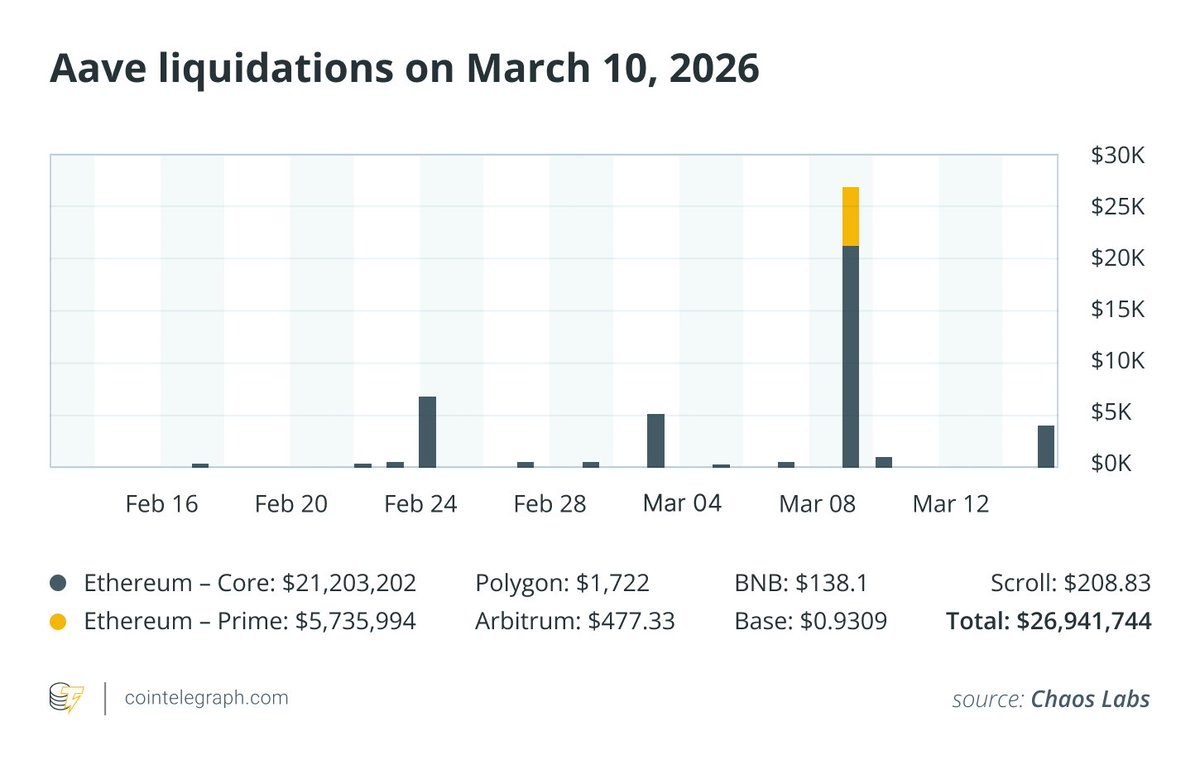
According to risk monitoring firm Chaos Labs, a market downturn on March 10, 2026, triggered roughly $27 million in borrower position liquidations on Aave—clearly exposing this vulnerability. Within 24 hours, user positions worth approximately $27 million were liquidated. Surprisingly, this event was not caused by broad-based market selling, but rather by a brief 2.85% pricing deviation in wrapped staked ETH (wstETH) collateral.
This incident serves as a stark reminder that the reliability of price oracles—and robust risk management frameworks—is essential to maintaining stability across the DeFi ecosystem.
This article details how a 2.85% pricing deviation in wstETH collateral triggered ~$27 million in liquidations on the Aave lending protocol. It focuses on how oracle configuration, smart contract parameters, and automated liquidation mechanisms amplified a minor pricing error in DeFi markets.
Sudden Surge in Liquidations
When a wave of liquidations hit Aave’s markets, Chaos Labs—closely monitoring abnormal activity in lending protocols—quickly identified and reported the situation. Initial market observers speculated that a price oracle failure may have led to incorrect valuation of collateral assets on the platform.
Price oracles serve as a critical bridge, delivering off-chain market prices to on-chain applications. In lending protocols like Aave, these price feeds directly determine whether a borrower’s collateral is sufficient to cover their loan. Once collateral value falls below the required safety threshold, the system automatically liquidates the position.
The central asset involved in this incident was wstETH—a token widely used as collateral across the DeFi lending ecosystem.
Liquidation speed on protocols like Aave typically far exceeds traditional margin calls. Because DeFi markets operate 24/7 via automated smart contracts, positions can be liquidated within seconds once the collateralization ratio drops below the stipulated threshold.
What Is wstETH?
wstETH (wrapped staked Ether) is a token issued by the liquid staking protocol Lido.
When users stake ETH through Lido, they first receive stETH, which represents both their staked ETH principal and accumulated staking rewards. To improve compatibility with various DeFi applications, stETH can be “wrapped” into wstETH.
Due to continuous accrual of staking rewards, 1 wstETH is typically worth slightly more than 1 ETH—making it an attractive and widely adopted collateral type in DeFi lending markets.
The Pricing Deviation Event
During this liquidation wave, a discrepancy emerged between wstETH’s actual market value and the valuation used by Aave’s risk system. Aave’s algorithm priced wstETH at ~1.19 ETH, whereas broader market valuations hovered around 1.23 ETH.
This ~2.85% valuation gap made wstETH-collateralized positions appear significantly more undercollateralized than they actually were.
As a result, several borrowing positions fell below the required safety threshold, triggering Aave’s automated liquidation process.
Why Price Oracles Are Critical in DeFi
Price oracles form foundational infrastructure in DeFi. Since blockchains cannot natively access real-world market data, they must rely on oracle services to supply external asset price information. These price feeds directly influence:
- Collateral valuation
- Borrowing position health assessments
- Decisions to trigger liquidations
If a collateral asset’s price is reported as having declined, the protocol may deem the loan undersecured and automatically liquidate the associated position.
Because this mechanism is fully algorithm-driven, even minor pricing deviations can trigger serious cascading effects.
In DeFi, seemingly small price discrepancies can have massive impacts. Brief fluctuations—whether in oracle-reported prices or market prices—of just a few percentage points can trigger cascading liquidations. This risk is especially pronounced when large numbers of borrowers use highly leveraged positions backed by volatile cryptocurrencies.
Root Cause: CAPO Risk Oracle Misconfiguration
Deep investigation confirmed that Aave’s primary price oracle functioned normally.
The issue instead originated in the “Collateral Asset Price Oracle” (CAPO) risk module—a protective layer added specifically for certain assets.
CAPO’s main purpose is to impose a rate cap on the upward valuation of yield-bearing tokens like wstETH, guarding against sudden price surges or potential oracle attacks.
However, in this incident, inconsistent internal configuration within the CAPO module caused the problem.
Technical Breakdown of the Error
Chaos Labs disclosed that the issue stemmed from outdated parameters stored in the smart contract.
Two key parameters failed to synchronize updates:
- Reference exchange rate
- Timestamp associated with that exchange rate
Because these two parameters were not refreshed in tandem, CAPO computed a temporary upper limit on the allowable exchange rate that fell below the actual market rate at the time.
This caused the protocol to undervalue wstETH by approximately 2.85% relative to the market price.
Aave relies on price oracles—data sources that feed real-time asset prices into smart contracts. If these sources briefly reflect anomalous exchange-traded prices, the protocol automatically recalculates collateral values and may initiate liquidations.
Cascading Liquidation Effects
Once the collateralization ratio dropped below the safety threshold, Aave’s automated liquidation engine activated immediately.
Liquidators—typically high-speed trading bots—swiftly intervened, repaying part of the borrower’s debt in exchange for the corresponding collateral at a pre-set discount.
In this incident, approximately $27 million in borrowing positions were liquidated.
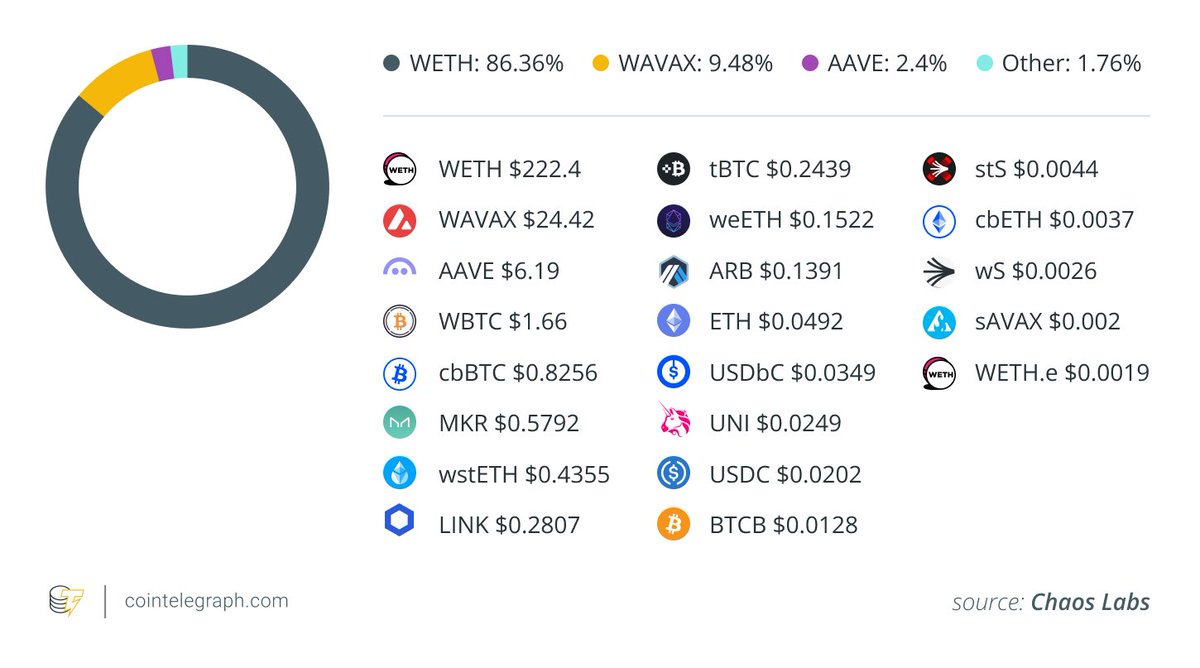
Liquidators capitalized on this brief pricing misalignment to secure roughly 499 ETH in profit (including liquidation bonuses).
No Bad Debt Incurred by the Protocol
Despite the scale of liquidations, Aave itself incurred no bad debt. Aave founder Stani Kulechov stated, “No impact on the Aave protocol.”
Chaos Labs noted that once positions breached the safety threshold, Aave’s core risk controls and liquidation mechanisms operated exactly as designed. Thus, the incident’s impact was confined to affected borrowers and posed no threat to Aave’s overall solvency or stability. It was the temporary artificial suppression of collateral value—not systemic insolvency—that pushed certain borrowing positions below the liquidation threshold.
Subsequently, Aave governance proposed compensating affected users using recovered funds and the Decentralized Autonomous Organization (DAO) treasury. This reflects an emerging trend in DeFi governance: protocol teams increasingly treat such technical incidents as systemic infrastructure risks and opt to compensate impacted users rather than place full loss burden on them.
Renewed Warning on DeFi Oracle Risks
This incident underscores that oracle design is both one of the most critical—and among the most vulnerable—components of DeFi infrastructure.
When automated mechanisms manage billions of dollars in collateral value, even minor configuration errors can produce disproportionately severe consequences.
Similar incidents have occurred on other DeFi platforms. For instance, one platform briefly valued Coinbase’s wrapped staked ETH (cbETH) at ~$1 (versus its actual value of ~$2,200) due to an oracle misconfiguration, causing widespread disruption.
These cases collectively demonstrate that sustaining reliable, accurate price data sources remains an ongoing challenge in decentralized finance.
wstETH and Lido Bear No Responsibility
Contributors to the Lido ecosystem explicitly clarified that this liquidation event was not caused by any fault or defect in the wstETH token itself.
The token operated normally throughout the incident, and the underlying Lido staking protocol remained fully operational and unaffected.
The core issue lay with the Aave lending protocol—specifically, its own risk management configuration and how it processed and interpreted price data.
Implications for the Future of DeFi
As decentralized finance continues evolving, protocols are deploying increasingly sophisticated risk management systems to accommodate yield-bearing assets like wstETH.
Such assets present unique pricing challenges because their value continuously increases as staking rewards accrue.
Therefore, effective risk models must properly account for:
- Dynamically changing exchange rates
- Continuously accruing staking rewards
- Time-dependent parameter updates
- Precise synchronization of all smart contract parameters
Even minor misalignments among these elements can escalate into large-scale liquidation events.
Join TechFlow official community to stay tuned
Telegram:https://t.me/TechFlowDaily
X (Twitter):https://x.com/TechFlowPost
X (Twitter) EN:https://x.com/BlockFlow_News
 @Cointelegraph


