








Crypto Morning Brief: Aave Completes Liquidation of Attacker’s rsETH Position; Moonshot to Complete $2 Billion New Funding Round
TechFlow Selected TechFlow Selected
Crypto Morning Brief: Aave Completes Liquidation of Attacker’s rsETH Position; Moonshot to Complete $2 Billion New Funding Round
Chinese companies including Moonshot AI are weighing corporate restructuring following the reversal of the Meta Manus deal.
 Navigating Web3 tides with focused insights
Author: TechFlow
Yesterday’s Market Updates
U.S. Media: Iran to Respond to U.S. Proposal on Thursday
According to CNN: A source stated that Iran is expected to submit its response to the U.S. proposal aimed at ending the war to mediators on Thursday. Iran has been reviewing the U.S. proposal, and the source added that both sides are working toward reaching an agreement to end the conflict.
White House Advisor: Update on U.S. Strategic Bitcoin Reserve Due “Within the Next Few Weeks”
According to CoinDesk, Patrick Witt, Executive Director of the White House Digital Assets Advisory Committee, revealed at Consensus Miami 2026 that an announcement regarding the latest developments of the U.S. Strategic Bitcoin Reserve (SBR) will be issued “within the next few weeks.” Witt noted that since President Trump signed the executive order, the federal government has halted the prior administration’s “fire-sale” of digital assets and initiated a comprehensive audit of crypto holdings across agencies. However, it currently refuses to disclose specific holdings, citing its top priority as “getting its own house in order.”
Morgan Stanley’s E*Trade Launches Cryptocurrency Trading Service
According to Bloomberg, Morgan Stanley is rolling out cryptocurrency trading services on its E*Trade platform, charging a fee of 50 basis points per trade—lower than U.S. peers including Coinbase, Robinhood, and Charles Schwab. The service is currently in pilot mode and is expected to launch fully to E*Trade’s 8.6 million customers later this year.
Ondo Finance, J.P. Morgan, Mastercard, and Ripple Complete First Cross-Border, Interbank Exchange of Tokenized U.S. Treasuries
According to an official Ondo Finance disclosure, Ondo, Kinexys by J.P. Morgan, Mastercard, and Ripple have completed a pilot transaction linking the XRP Ledger with interbank clearing networks. This marks the first time tokenized U.S. Treasuries have achieved near real-time cross-border, interbank settlement—unconstrained by traditional banking hours. Specifically, Ondo processed Ripple’s OUSG redemptions on the XRP Ledger; Mastercard’s Multi-Token Network routed instructions to Kinexys by J.P. Morgan; and J.P. Morgan subsequently delivered USD to Ripple’s Singapore bank account.
Kraken Launches CFTC-Regulated Spot Margin Trading for U.S. Retail Users
According to The Block, Kraken has launched CFTC-regulated spot margin trading for U.S. retail users. Customers may use their crypto holdings as collateral to engage in up to 10x leveraged trading without selling assets to obtain liquidity. This product—the first launched under the regulatory license acquired via Payward’s acquisition of crypto derivatives platform Bitnomial—is the inaugural offering from Kraken’s parent company. Payward previously indicated plans to introduce CFTC-regulated perpetual contracts and options for U.S. users in the future.
Aave Completes Liquidation of Attacker’s rsETH Positions; Related Assets Transferred to Recovery Guardian Address
Aave stated that, per its previously disclosed technical recovery plan, the attacker’s rsETH positions on Ethereum and Arbitrum have been liquidated on Aave, and associated collateral assets have now been transferred to the Recovery Guardian address designated in the AIP. Aave confirmed that this action did not impact other users and left the Umbrella mechanism unaffected, calling it a critical step in its broader recovery roadmap while affirming continued progress on restoration efforts.
Arbitrum DAO Vote to Unfreeze ETH Related to rsETH Incident Reaches Quorum
Aave reported that over 1,600 addresses have voted on the proposal to unfreeze ETH related to the April 18 rsETH incident—representing more than 190 million ARB tokens. These ETH are currently held by the Arbitrum DAO. Aave confirmed the vote has reached quorum and will advance DeFi United’s recovery plan for the rsETH incident.
Trump-Family-Backed Bitcoin Miner American Bitcoin Posts Two Consecutive Quarterly Losses, Q1 Net Loss Hits $82M
According to Bloomberg, American Bitcoin Corp., a Bitcoin mining firm backed by the Trump family, released its Q1 2026 financial results, reporting a net loss of $82 million—worsening from a $59 million loss in Q4 2025. It has now recorded losses for two consecutive quarters. Meanwhile, its Q1 revenue totaled approximately $62 million, down roughly 20% year-on-year, primarily due to declining average Bitcoin mining revenue per coin. Headquartered in Miami, the company was founded just before Bitcoin prices retreated from all-time highs.
Hut 8 Q1 Report: AI Data Center Leases Lock in $16.8B Revenue; ~3,300 BTC Liquidity Released
According to PRNewswire, Nasdaq-listed Bitcoin miner Hut 8 released its Q1 2026 financial results, revealing that leases for its two hyperscale AI campuses secured $16.8 billion in revenue. While advancing its AI data center business, its Bitcoin-related operations remain a core revenue driver: total Q1 revenue stood at $71 million, with ~$66 million derived from ASIC hashpower, AI cloud, and traditional cloud services—primarily powered by Bitcoin mining and related compute services. Additionally, Hut 8 refinanced its Bitcoin-backed loans, releasing ~3,300 BTC (approximately $260 million) to bolster liquidity and support business expansion.
As of end-March, Hut 8 held cash and Bitcoin valued at ~$1.3 billion. However, impacted by digital asset price volatility, it posted a net loss of $253 million for the quarter—including ~$296 million in unrealized digital asset losses.
Chinese Firms Including Moonshot AI Weigh Corporate Restructuring After Meta Manus Deal Reversal
According to Benchmark Studio, following inquiries from China’s Securities Regulatory Commission (CSRC) concerning overseas shareholding structures, Chinese tech startups including Moonshot AI and DeepRoute.ai are evaluating the feasibility of relocating their corporate registration back to mainland China. All are currently consulting legal counsel on potential pathways but have yet to make final decisions. Shanghai-based AI model developer StepFun has already initiated the process of unwinding its offshore holding structure to accelerate regulatory approval for its planned Hong Kong IPO.
The immediate catalyst for this regulatory tightening was Meta’s $2 billion acquisition of Manus—a China-founded AI agent company—after which regulators ordered the deal’s reversal and launched a systemic review of the “domestic operations, offshore registration” corporate model.
Unwinding a red-chip structure is complex, typically taking six months to one year and involving steps such as repurchasing offshore equity, establishing joint ventures, and investor re-investment. Moreover, joint ventures face a 12-month lock-up period post-Hong Kong listing—twice that of standard red-chip stocks. Analysts warn that broad restrictions on red-chip structures would significantly impair Chinese startups’ ability to raise USD-denominated funding overseas.
Moontide to Close $2B New Funding Round, Valuation Surpasses $20B
According to LatePost, Moontide’s Kimi is set to close a new $2 billion funding round, pushing its post-money valuation beyond $20 billion. The round is led by Meituan Longzhu, with participation from China Mobile and CPE Capital; Meituan Longzhu alone contributes over $200 million.
The report notes that, including three rounds closed in January and February this year, Kimi has raised over $3.9 billion in less than six months—exceeding RMB 37.6 billion—and has become one of the most heavily funded large language model (LLM) startups. It also mentions that Kimi open-sourced its new K2.6 model in April, enhancing programming and Agent cluster capabilities.
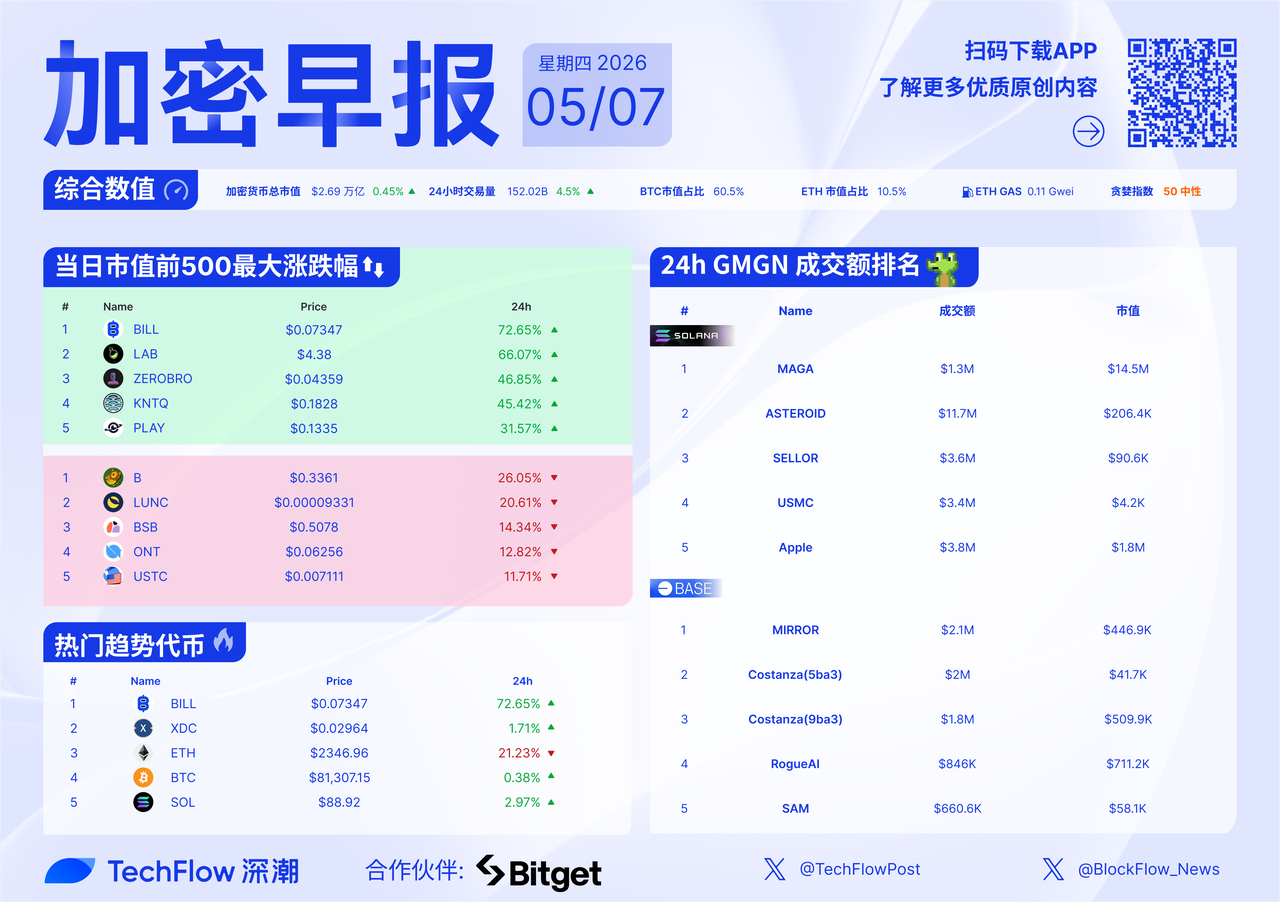
Market Data
Recommended Reading
Revisiting the “Son of U.S. Equities”: This Podcast Episode from Two Months Ago Deeply Dissects Leopold Aschenbrenner’s Portfolio Logic
https://www.techflowpost.com/zh-CN/article/31427
This article provides a detailed analysis of young investment prodigy Leopold Aschenbrenner’s investment logic and fund performance. Shifting focus from semiconductors to energy and infrastructure, he bets on companies solving AI development bottlenecks—such as Bloom Energy and CoreWeave—while leveraging Bitcoin mining firms as a shortcut into energy and land resources. His predictions and investment philosophy have sparked widespread discussion and generated extraordinary returns in a short timeframe.
The Real Alpha Lies in the “God Tier” U.S. Equity Newcomer’s Inner Circle
https://www.techflowpost.com/zh-CN/article/31432
This article introduces Leopold Aschenbrenner, a 24-year-old German investor who achieved remarkable public-market returns during the AI era through a unique investment logic and information edge. His fund focuses on AI infrastructure—not AI model companies directly. His success stems not only from deep insight into AI trends but also from his distinctive network and information channels.
Interview with a16z Crypto: $2.2B New Fund Launched—What Will the Next Decade of Crypto Look Like?
https://www.techflowpost.com/zh-CN/article/31433
This article analyzes a16z Crypto’s newly launched $2.2 billion fund (Crypto Fund 5), the current state and future trajectory of the crypto industry, and its convergence with AI. It details regulatory breakthroughs for stablecoins, innovations in on-chain finance, the importance of privacy technologies, and how crypto can mitigate AI industry centralization—concluding with forward-looking perspectives.
Anthropic Returns $20B to Google’s Pocket: The Most Elegant “Left Hand to Right Hand” Transfer in the AI Era
https://www.techflowpost.com/zh-CN/article/31435
This article examines Anthropic’s massive cloud computing contracts and related investment deals with tech giants Google, Amazon, and Microsoft. Described as “circular transactions,” these arrangements convert capital expenditures into revenue to sustain company valuations. The piece also explores the inherent risks of this business model—particularly if future commitments fail to materialize.
After Coinbase Cuts 700 Jobs: One Person Equals an Entire Team—Managers Must Code Themselves
https://www.techflowpost.com/zh-CN/article/31437
This article details Coinbase’s announcement of ~14% workforce reduction (~700 employees) and organizational restructuring—including flattening management layers, eliminating pure management roles, implementing a “player-coach” model, and piloting a “one-person team” model. Although the company officially cites efficiency gains as the rationale, analysts attribute the layoffs primarily to the crypto market downturn. Following the announcement, Coinbase’s stock fell 2.5%. Moreover, the broader crypto industry’s layoff wave has accelerated, with multiple firms citing AI-driven restructuring. Coinbase affirmed continued investment in stablecoins, tokenization, and prediction markets.
Join TechFlow official community to stay tuned
Telegram:https://t.me/TechFlowDaily
X (Twitter):https://x.com/TechFlowPost
X (Twitter) EN:https://x.com/BlockFlow_News
 深潮TechFlow


