








What if this is the bottom?
TechFlow Selected TechFlow Selected
What if this is the bottom?
Historically, market bottoms have almost always coincided with fundamental shifts in market mechanisms—shifts that fundamentally reshape investor behavior and expectations.
 Navigating Web3 tides with focused insights
By Jeff Park
Translated by Block Unicorn
Preface
A few days ago, rumors that Kevin Warsh might be nominated as Federal Reserve Chair triggered a sharp drop in Bitcoin’s price to $82,000—followed shortly thereafter by a further decline near $74,500. This volatile price action reminded me that even among the most seasoned macro traders globally, there remains persistent unease—an apprehension toward the paradoxical figure of “a hawkish Fed Chair who wants to cut rates.” That very contradiction embodies the dualities embedded within monetary depreciation.
The theory behind monetary depreciation trades sounds simple: print money, devalue currency, appreciate hard assets. Yet this “cheap money” narrative obscures a more fundamental question—one that determines Bitcoin’s ultimate success or failure: How will interest rates evolve?
Most Bitcoin advocates conflate monetary expansion with hard-asset appreciation, assuming capital automatically flows into scarce stores of value. This view overlooks a critical mechanism: cheap money does not necessarily translate into capital flowing into hard assets unless you understand the shape of the yield curve. When rates fall, duration-sensitive assets—especially those generating cash flows—become comparatively more attractive, posing strong competition for Bitcoin. This suggests the path from monetary depreciation to Bitcoin dominance is not linear, but rather hinges on whether today’s financial system can remain functional—or collapses entirely.
In other words, Bitcoin is a depreciation bet with Risk Premium Duration.
This is the distinction I previously articulated between “Negative Rho Bitcoin” and “Positive Rho Bitcoin”—two fundamentally opposing theses requiring diametrically opposite market conditions to materialize.
Understanding Rho: Interest Rate Sensitivity
In options terminology, Rho measures sensitivity to changes in interest rates. Applied to Bitcoin, it reveals two starkly divergent paths:
“Negative Rho Bitcoin” performs better when rates decline. This reflects the continuity thesis—albeit taken to an extreme: the current financial system endures, central banks retain credibility, and lower (even negative) rates make “risk assets” like Bitcoin relatively more attractive against potentially negative opportunity costs—making it the fastest investment choice. Consider 2020–2021: the Fed slashed rates to zero, real yields plunged deeply negative, and Bitcoin surged—becoming the most compelling alternative to holding cash.
Conversely, “Positive Rho Bitcoin” thrives when rates rise—or when volatility around the risk-free rate itself spikes. This is the rupture thesis: foundational assumptions of the financial system break down; the very concept of a risk-free rate comes under challenge; all traditional assets must reprice their cash flows. For a non-cash-flowing asset like Bitcoin, such repricing has minimal impact—while long-duration assets suffer catastrophic losses.
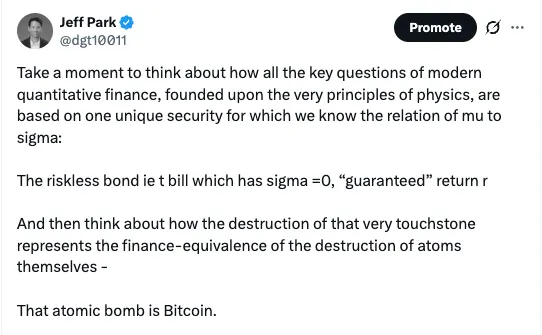
Bitcoin’s current price is trapped—directionless, without clear breakout momentum—perhaps signaling investor uncertainty over which thesis matters more. And for most Bitcoin maximalists, the answer is unsettling, because concepts of inflation—and their close relationship with deflation and interest rates—are often severely misunderstood.
Two Types of Deflation
To determine which Bitcoin thesis prevails, we must distinguish between two distinct forms of deflation:
“Good Deflation” occurs when productivity gains drive prices down. AI-powered automation, supply-chain optimization, and manufacturing improvements—all reduce costs while increasing output. This deflation (sometimes called supply-side deflation) coexists with positive real rates and stable financial markets. It favors growth assets over hard assets.
“Bad Deflation” occurs when credit contraction drives prices down. This deflation is catastrophic: debt defaults, bank failures, cascading liquidations. Demand-deficient deflation destroys the Treasury market, requiring negative nominal rates to prevent total collapse. Stanley Druckenmiller once said, “The way to manufacture deflation is to manufacture asset bubbles”—explaining how bad deflation devastates duration assets and makes hard assets essential.
We are currently experiencing tech-sector good deflation while avoiding bad deflation in credit markets. For Bitcoin, this is the worst possible environment: sufficient to sustain growth-asset appeal and preserve Treasury credibility—but insufficient to trigger systemic collapse. It is precisely the perfect breeding ground for profound Bitcoin market distrust.
When Cheap Money Doesn’t Flow Into Hard Assets
Monetary depreciation (money supply growing faster than productive output) is underway. As noted earlier, precious metal prices have risen amid dollar weakness—confirming this trend. Silver and gold have both surged to all-time highs, validating the dollar’s declining purchasing power over physical commodities.
Yet Bitcoin has failed to follow precious metals higher—because Negative Rho Bitcoin faces structural headwinds: when rates are merely moderate or low—not catastrophically collapsing—Bitcoin must compete with other duration assets for capital allocation. And these competitors are enormous in scale.
Bitcoin’s Three Key Survival Competitors
In low-to-moderate rate environments, Bitcoin contends with three major asset classes that absorb capital that might otherwise flow into hard assets:
1. Artificial Intelligence & Capital-Intensive Growth (Market Cap > $10 Trillion)
AI infrastructure represents the most capital-intensive growth opportunity since electrification. NVIDIA alone exceeds $2 trillion in market cap. The broader AI value chain—including semiconductors, data centers, edge computing, and power infrastructure—approaches $10 trillion; expanding further to include software pushes it even higher.
This is good deflation: prices fall due to rising productivity—not credit contraction. AI promises exponential output growth alongside continuously falling marginal costs. If capital can fund truly cash-generating production miracles, why invest in zero-yield Bitcoin? Even more troubling: the AI sector demands infinite capital—and the rapidly escalating, high-stakes arms race is now inseparable from national security.
In low-rate environments, growth assets like these—especially with government subsidies—can attract massive inflows, as future cash flows are discounted at favorable rates. Bitcoin offers no discountable cash flows—only scarcity. When alternatives involve funding AGI infrastructure, Bitcoin struggles to attract investors.
2. Real Estate ($45+ Trillion in the U.S. Alone)
The U.S. residential real estate market exceeds $45 trillion; global real estate nears $350 trillion. When rates fall, mortgage costs decline, housing becomes more affordable, and prices rise. Moreover, housing generates rental income and enjoys substantial tax advantages.
This falls under bad deflation: if home prices fall due to credit contraction—not productivity gains—it signals systemic crisis. But in low-rate environments, housing remains the primary wealth store for the middle class. It is tangible, leveragable, and socially embedded—none of which apply to Bitcoin.
3. U.S. Treasury Market ($27 Trillion)
The U.S. Treasury market remains the world’s largest and most liquid capital pool. Outstanding debt stands at $27 trillion (and climbing), backed by the Fed and denominated in the global reserve currency. When rates fall, duration extends—and Treasury returns can be quite attractive.
Crucially: genuine deflation would collapse the Treasury market. Negative nominal rates would become inevitable—and the very notion of a risk-free benchmark would vanish. But we’re far from that point. So long as Treasuries deliver positive nominal yields and the Fed’s backstop credibility remains intact, they absorb vast institutional capital—pension funds, insurers, foreign central banks—that Bitcoin can never reach.
The Reality of Zero-Sum Competition
The combined market cap of these three markets—AI growth, real estate, and Treasuries—exceeds $100 trillion. For Bitcoin to succeed in a Negative Rho environment, it doesn’t require all three to collapse—but their relative attractiveness versus zero-yield investments must decline.
This can happen in two ways: either rates plunge deeply negative (making the opportunity cost of holding assets so punishing that you “pay to save”)—or these markets begin collapsing (rendering their cash flows unreliable).
Neither is happening yet. Instead, we inhabit a system where:
- AI is generating real productivity gains (good deflation, favoring growth assets)
- Real estate remains stable under controlled rate conditions (bad deflation contained, favoring real estate)
- Treasuries offer positive nominal yields, and Fed credibility remains solid (good deflation favors duration assets)
Bitcoin sits caught in the middle—unable to compete with cash-flowing assets whose discount rates reside in the “Goldilocks zone”: neither so low that zero yield becomes irrelevant, nor so high that the system breaks down.
Why Kevin Warsh Matters
This brings us to monetary policy architecture. Appointing someone like Kevin Warsh—who has stated “inflation is a choice”—to lead the Fed would signal a fundamental paradigm shift away from the post-2008 “low rates for low rates’ sake” model.
This was his message conveyed last summer:
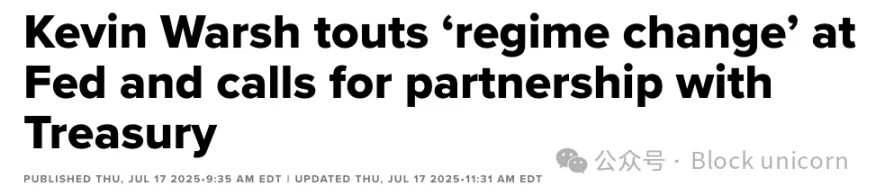
Warsh represents a new Fed-Treasury compact—one acknowledging the moral hazard of conducting quantitative easing while simultaneously paying interest on reserve balances (IORB). This is, in effect, capital theft disguised as monetary policy. The Fed creates reserves, deposits them at the Fed, and pays banks interest on funds that never enter the productive economy—a subsidy to the financial sector with no benefit to real economic growth.
A Warsh-led Fed may emphasize:
- Higher structural rates to prevent financial repression
- Reduced balance-sheet intervention (no large-scale QE)
- Closer coordination with the Treasury on debt management
- Reassessment of the IORB mechanism and its fiscal cost
This sounds terrible for Negative Rho Bitcoin: modestly higher rates, reduced liquidity, more orthodox monetary policy. And it likely is—though I suspect the neutral rate remains below current levels (a view Warsh would likely share), implying eventual cuts—but perhaps not all the way to zero.
But it’s extremely bullish for Positive Rho Bitcoin—accelerating the reckoning process. If you believe the debt trajectory is unsustainable, if you think fiscal dominance will ultimately override monetary orthodoxy, if you think the risk-free rate will prove illusory—you want Warsh. You want the masquerade exposed. You want markets confronting reality—not limping along for another decade. You want risk pricing driven by industrial policy—not monetary policy.
The Positive Rho Scenario
Positive Rho Bitcoin means the financial system’s foundational assumptions shatter—not gradually, but catastrophically. This implies:
The risk-free rate becomes unreliable—due to sovereign debt crises, Fed-Treasury conflict, or reserve currency fragmentation. When the benchmark for pricing all assets loses credibility, conventional valuation models collapse.
Duration assets suffer catastrophic repricing. If discount rates spike or currencies depreciate, long-term cash flows become nearly worthless. Over $100 trillion in duration-intensive assets—Treasuries, investment-grade bonds, dividend stocks—would undergo the most violent repricing event since the 1970s.
Bitcoin’s lack of cash flows becomes an advantage. It has no earnings expectations, no coupon to be eroded, no yield curve anchoring market expectations. Bitcoin requires no repricing against broken benchmarks—because it was never priced against them in the first place. It only needs to maintain scarcity when everything else proves excessive—or unreliable.
In this scenario, precious metals respond first to the crisis—while Bitcoin reflects the post-crisis landscape. Today’s commodity spot depreciation will converge with tomorrow’s yield-curve depreciation. Milton Friedman’s dichotomy—monetary expansion causing inflation and dominating asset pricing—will fuse into a single unified force.
Ideological Insight
Returning to our earlier framework: metal prices tell you spot depreciation is happening; Bitcoin tells you when the yield curve itself fractures.
Signs are already visible: the manic K-shaped economy is driving society toward ruin—even as socialism surges—precisely because Bitcoin’s three key competitors threaten global middle-class welfare: housing affordability, AI-driven income inequality, and the widening gap between asset and labor income. All three imperil Bitcoin’s survival—and all three are nearing inflection points. Once society rejects the failed social contract of financial and labor depreciation, fundamental change becomes inevitable.
This is where Fed ideology enters the picture. A Fed Chair who truly understands monetary policy isn’t isolated—but works hand-in-hand with the Treasury to shape national industrial capacity, capital formation, and global competitiveness—won’t chase low rates at all costs. This is the worldview pre-Volcker, pre-QE: interest rates as a strategic tool—not a sedative. Capital pricing should serve productive growth—not subsidize financial abstraction.
Such a stance destabilizes the “awkward middle ground,” forcing trillions-dollar questions into plain sight: Will the Fed reinstate financial repression—cutting rates near zero to sustain asset prices and fiscal solvency—reviving the Negative Rho Bitcoin thesis? Or will debt, geopolitics, and industrial realities compel the Fed to confront the fiction of the risk-free rate—triggering Positive Rho Bitcoin?
This convergence marks institutional transformation: Rho becomes the leading indicator (while dollar weakness lags), because deflation is explanatory.
Bitcoin’s true moment arrives when the artificially manufactured “forever” itself fails—when coordination replaces pretense—and the benchmark for pricing everything is revealed as wholly political—not unsustainably eternal.
Frankly, I don’t know if this is truly the bottom—nor can anyone genuinely claim to know (though technical analysts always try). But one thing history teaches is that bottoms almost always coincide with fundamental shifts in market mechanics—reshaping investor behavior and expectations at their core. Though imperceptible at the time, such shifts become glaringly obvious in hindsight. So if you tell me, in retrospect, this marks the dawn of a new world order—with the most innovative Fed Chair ever weaponizing the Treasury to redefine the “central bank interdependence” social contract—I can think of no more poetic, exhilarating, or satisfying omen heralding Bitcoin’s final ascent.
Join TechFlow official community to stay tuned
Telegram:https://t.me/TechFlowDaily
X (Twitter):https://x.com/TechFlowPost
X (Twitter) EN:https://x.com/BlockFlow_News
 @dgt10011











