








Without storytelling power, Web3 cannot reach vast territories
TechFlow Selected TechFlow Selected
Without storytelling power, Web3 cannot reach vast territories
In the Web3 space, storytelling is more important than in any other industry.
 Navigating Web3 tides with focused insights
Author: Noir
Translation: Chopper, Foresight News
The failure of Web3 has never been due to a lack of creativity. In fact, its problem lies in the inability to create resonance.
Current Web3 narratives are mostly filled with abstract concepts: public chains, infrastructure, protocols, layers... These terms aren't wrong in themselves! But they lack any "human touch," making it impossible for ordinary people to feel connected.
This is exactly where stories add value. In the Web3 space, storytelling matters more than in any other industry.
Web3 Is Built on Logic, But Lacks Emotional Resonance

In other fields, people already have built-in cognitive contexts. For example: talking about food triggers your appetite; discussing fitness helps you visualize progress; mentioning travel immediately brings destination scenery to mind.
But Web3 fails at this. Creators and projects keep earnestly explaining how impressive invisible systems and intangible processes are.
Without stories as a foundation, all of this feels distant and cold.
In short: utterly boring. Clearly, no one pays for something boring.
Stories Are the Gateway for Ordinary People to Enter Web3

Most creators and project teams rush into explaining how something works right from the start. But they forget that a good story always begins by describing how something feels.
Confusion, laughter, relief, vulnerability... these emotions are completely missing from Web3 narratives.
Folks, if this trend continues, the outcome is obvious. Even if people don't understand the technology, these emotions are universal. The key is, once someone recognizes familiar feelings in a story, they'll subconsciously follow along to hear your technical explanations later.
Stop Listing Features—Tell More User Experience Moments

Compare these two expressions—the difference is instantly clear.
Feature-first version: This feature improves system scalability by optimizing throughput.
Nothing wrong with that—but it's instantly forgettable, and... what exactly does it mean? 😂
Story-first version: I kept refreshing the page, mentally preparing myself to wait again... only to find out the transaction had already gone through.
The core message is the same, but the latter adds warmth and is easy to understand.
Telling stories isn't about downplaying technology—it's about preparing the audience's brain to receive complex information.
Got it? Hope you're following. Let's continue...
Complex Concepts Need Everyday Scenarios to Land
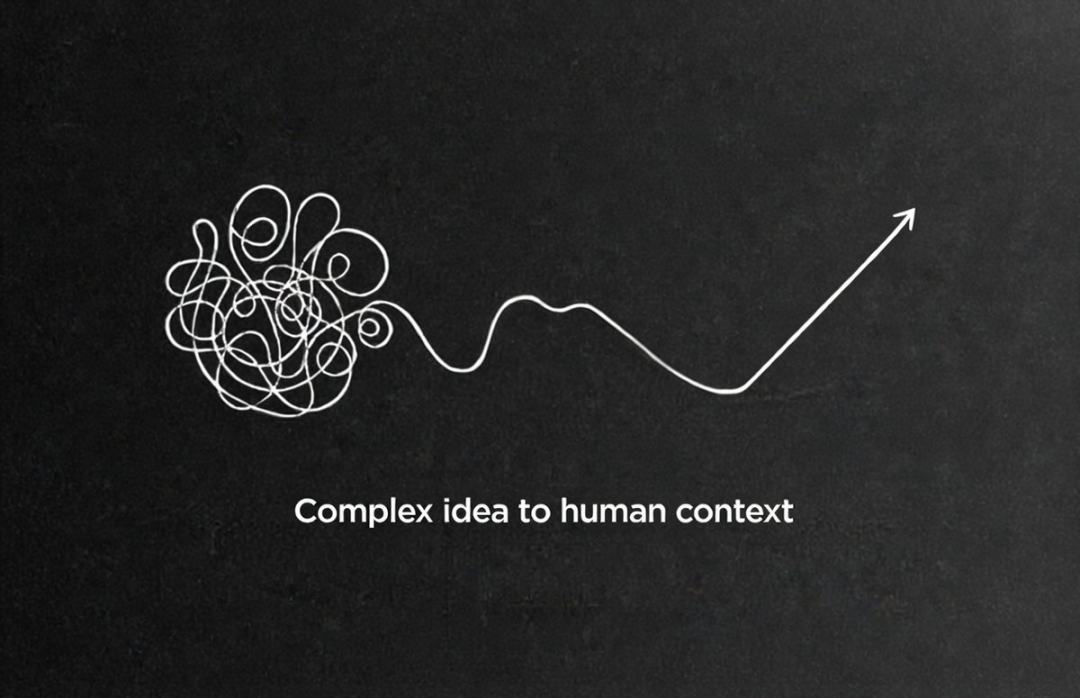
When facing complex issues, people naturally wonder: "What does this have to do with me?"
Stories can quietly provide the answer. Just one simple, relatable scenario can establish a connection.
You don't need to explain every detail exhaustively. Just show a key moment: a frustrating bottleneck, a stress-relieving breakthrough, or a small victory.
That's enough—to make a complex concept feel real and tangible.
Real-World Proof: This Methodology Actually Works

My work centers on creating story-driven video content for Web3 bounties and sponsors.
Over time, I've noticed a pattern: winning videos are never the ones with the most hardcore technical explanations, but rather those that open with deeply human moments.
I don't start by listing features or explaining mechanics. Instead, I focus on scenes like: the awkwardness of first using a product; the stumbling process before understanding a feature; the sudden clarity when everything finally connects.
This narrative approach consistently keeps viewers engaged longer and helps them understand faster. It's also why my videos stand out in bounty competitions.
Not because I explain more technology, but because I make complex concepts feel human, emotional, and warm.
Join TechFlow official community to stay tuned
Telegram:https://t.me/TechFlowDaily
X (Twitter):https://x.com/TechFlowPost
X (Twitter) EN:https://x.com/BlockFlow_News
 @noironsol


