Space Review | 2026 Outpost: Narrative Retreat, Value Flowing to Resilient Ecosystems with Real Yields
TechFlow Selected TechFlow Selected
Space Review | 2026 Outpost: Narrative Retreat, Value Flowing to Resilient Ecosystems with Real Yields
Ecosystems represented by TRON are building the critical capabilities to navigate through 2026 via real yields and intrinsic resilience.
 Navigating Web3 tides with focused insights
As 2025 draws to a close, the crypto market is once again enveloped by a familiar sense of anxiety: macro liquidity expectations remain volatile, on-chain narratives are cooling off, and market sentiment has gradually shifted from mid-year euphoria toward rational scrutiny. Asset volatility previously driven by sentiment and hype is now giving way to a more fundamental question—when short-term noise fades, which values will endure and truly survive the cycle?
Against this backdrop, market discourse has quietly pivoted from "whether prices can rise" to "how sustainability can be achieved." Investors and builders alike are seeking clarity on where the industry’s structural support will emerge as we approach 2026. Will growth rely on passive macro tailwinds, or on real yields generated by protocols themselves? Will it come from repositioning within existing frameworks, or from breakthroughs in new ecological niches?
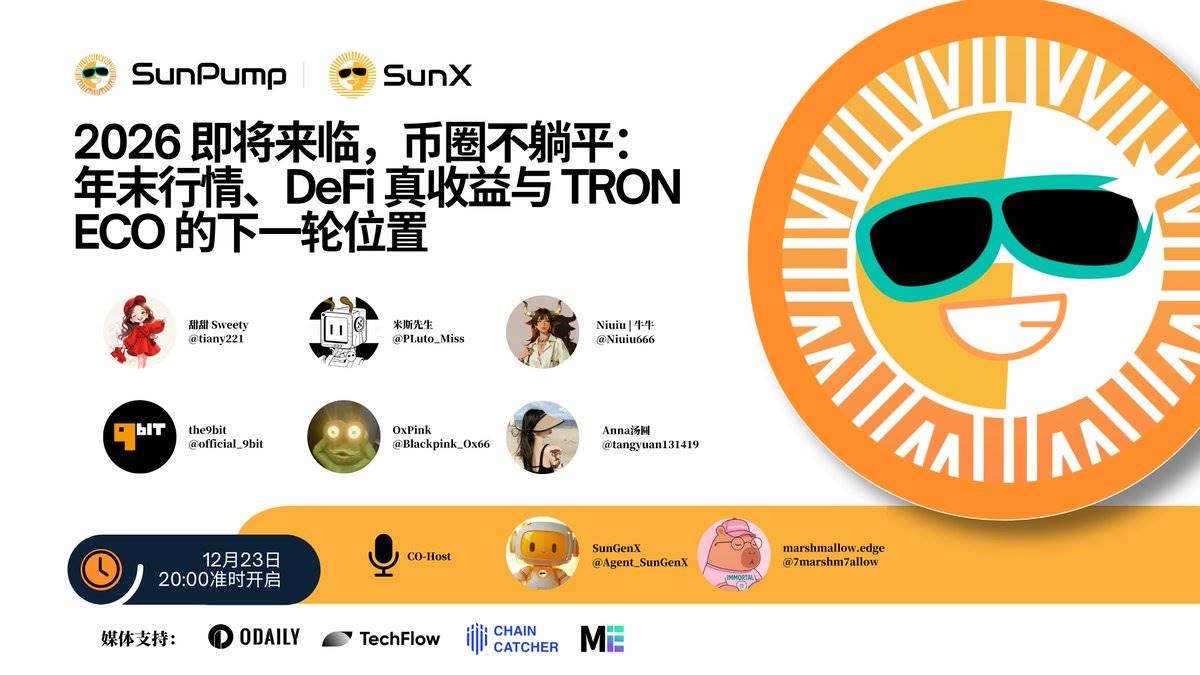
To explore these questions, SunnPump recently hosted an online roundtable themed “2026 is Coming: Crypto Won’t Lie Flat,” inviting seasoned observers and builders deeply embedded in the space to discuss the underlying logic of year-end market movements, core elements of DeFi sustainability, and TRON's positioning and role in the next phase. This article recaps key insights from that discussion, aiming to outline a rational roadmap toward 2026 through multiple lenses including capital structure and ecosystem evolution.
Narrative Fades, Utility Rises: The 2026 Cycle Belongs to Mature Ecosystems with Real Demand
In the first session of the roundtable, panelists examined the essential difference between "year-end market moves" and "the path to 2026," analyzing trends in capital flows, market psychology, and structural shifts. Despite differing expressions, consensus was clear: year-end fluctuations resemble short-term trading games, while the journey to 2026 hinges on building long-term, sustainable value structures.
JaegerC set the tone by describing year-end market behavior as a "breath" taken by the market after turbulence—a moment of "position balancing and probing" at the trading level. He argued that the market is transitioning from a phase driven by speculation and narratives to a new era powered by real cash flows and asset architecture. Therefore, the current "test" serves to filter out projects qualified for the next round of long-term construction, with 2026 centered on a comprehensive restructuring of capital efficiency and value logic.
Anna Tangyuan offered a more direct and incisive view. She stated clearly that year-end movements address the short-term question of "whether prices can go up," fueled by emotion and impulse; whereas 2026 addresses the existential issue of "whether projects can survive," relying on business models capable of stable operation without subsidies.
When focusing on specific ecosystems, TRON emerged as a prime case study. Panelists unanimously agreed that TRON, thanks to its absolute dominance in stablecoin settlement and the robust, self-sustaining financial ecosystem it has spawned, has already entered the mature stage of a "digital financial infrastructure."
Sweety provided compelling on-chain data to substantiate TRON’s ecosystem standing: nearly $80 billion worth of USDT in circulation on-chain, capturing half of the global market; daily stablecoin transfers reaching $20–24 billion, forming continuous value transmission channels; JUST Protocol’s total value locked (TVL) surpassing $10.4 billion, with TRON’s overall network TVL nearing $24 billion—painting a picture of deep capital accumulation and a vibrant, healthy financial ecosystem.
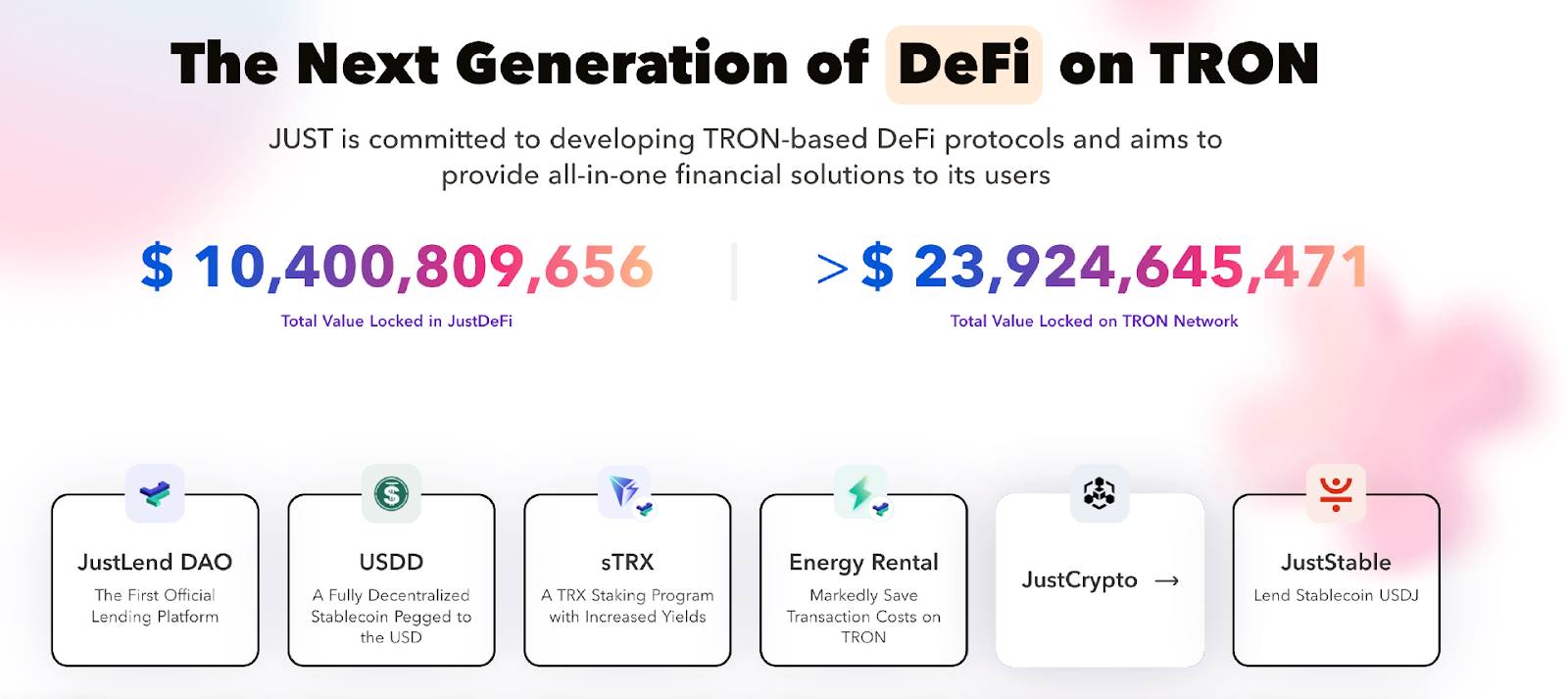
She emphasized that these figures do not stem from short-term incentives or hype, but are naturally driven by genuine global demand for payments, lending, and staking—forming a resilient, self-reinforcing "value circulation system." She positioned TRON as the "infrastructure brain shouldering global stablecoin and payment functions," whose complete ecosystem matrix and unmatched depth in the stablecoin赛道 constitute an unshakable moat.
Anna Tangyuan reinforced this assessment from the perspective of user experience. For her and many others, TRON is no longer an "investment target" requiring constant price monitoring, but a convenient, reliable, low-cost transfer tool—akin to a "built-in utility app on a smartphone." This quality of being "effortless" and "beyond debate" is precisely the hallmark of mature infrastructure, explaining its unique stability amid market volatility.
In summary, TRON is no longer a public chain contender dependent on market narratives to prove its worth. It has evolved into a critical settlement layer for high-frequency, high-value transactions within the global economy. Its thriving DeFi applications, low transaction costs, and极致 transfer efficiency collectively form a commercial system that does not rely on short-term subsidies and possesses strong endogenous circular capabilities. This perfectly aligns with the core logic of "moving toward 2026": building cyclical, self-sustaining value structures.
The Foundation to Survive Bull and Bear Markets: Real Cash Flows, Stable Demand, and Endogenous Resilience
When the discussion turned to "which DeFi projects can truly survive cycles," the conversation moved beyond surface-level observations to dissect project fundamentals. Panelists collectively moved past obsession with "high yields," instead highlighting more resilient foundational logic. TRON’s ecosystem development path served as a vivid, concrete example.
JaegerC systematically outlined the core elements for surviving cycles: real cash flows and stable endogenous demand. He stressed that revenue must originate from protocol fees and spreads, not short-term speculation, and that protocols should serve economic necessities like lending and payments. Sweety echoed this view, noting that cycle-surviving projects must reach "infrastructure-grade" status with strong "self-sustaining" capacity, where high TVL and risk resistance stem from real fee income and high usage—not subsidies.
This logic is clearly validated in TRON’s core protocols. Take JustLend DAO as an example—its revenue model is not reliant solely on lending spreads, but integrates diversified real income streams. Its primary revenue comes from liquid staking services (sTRX) for TRX holders, which constitutes the vast majority of total income; interest from traditional lending markets provides steady supplementary income.
Crucially, the protocol features a direct value feedback loop: net income generated is periodically used to buy back and burn its governance token JST on the open market. This not only makes JST a deflationary asset but also tightly links protocol success (real cash flows) with long-term holder benefits (deflationary support for token value). Thus, regardless of market sentiment, as long as real on-chain demand for staking and lending persists, the protocol can generate sustainable cash flows and capture and return value to participants via its deflationary mechanism. This exemplifies exactly what JaegerC described: a "high-resilience" project driven by real economic activity and capable of endogenous value return.
Anna Tangyuan used vivid analogies to make technical concepts accessible. She sharply pointed out that many high-yield projects earn money from "project team subsidies"—once incentives stop, users vanish. Truly cyclical projects are more like convenience stores under apartment buildings or highways—they don’t offer discounts or run hype campaigns, yet generate steady income because they are "used all year round," meet "long-standing demand," and are "repeatedly utilized." She emphasized that real yield must come from real usage, not incentive amplification.
For millions of global users, using the TRON network for USDT transfers is driven purely by its practical advantages of being "fast" and "cheap." This high-frequency, essential "real usage" forms the most solid foundation of the ecosystem. DeFi products within the ecosystem such as SUN.io derive their lasting appeal from this authentic network utility and asset accumulation—not temporary subsidy boosts. In November 2025, TRON achieved a record-breaking $204 million in protocol revenue for the month, leading all major public blockchains by a wide margin. This performance is a direct outcome of massive real asset accumulation and sustained network utility, demonstrating the underlying health and value capture capability of its ecosystem.
In aggregate, the panelists concluded that a DeFi ecosystem capable of surviving bull and bear markets must evolve into an organic entity within the digital economy—one that delivers real value, meets stable demand, and possesses endogenous resilience. By focusing on and fully enabling the core necessity of "efficient global value flow," the TRON ecosystem has率先 completed the leap from a single public chain to a comprehensive financial infrastructure. It has built an organic whole centered on massive stablecoin circulation (real demand and cash flow) and a high-throughput, low-cost blockchain (a reusable infrastructure), naturally spawning rich DeFi scenarios such as lending, trading, and staking. In this system, protocol value capture is tightly linked to network utility, forming a lifeform with powerful internal circulation and counter-cyclical resilience. This is not only TRON’s structural answer to surviving cycles, but also offers the broader industry a clear and compelling reference for exploring sustainable development paths.
Join TechFlow official community to stay tuned
Telegram:https://t.me/TechFlowDaily
X (Twitter):https://x.com/TechFlowPost
X (Twitter) EN:https://x.com/BlockFlow_News