Why is the crypto industry losing young talent?
TechFlow Selected TechFlow Selected
Why is the crypto industry losing young talent?
Casinos don't incentivize talent; they only attract tourists.
 Navigating Web3 tides with focused insights
Author: Leon Abboud
Translation: TechFlow
The crypto industry is losing its young talent to other fields, such as artificial intelligence (AI). This phenomenon is a serious blow to the industry's future.
When young talent begins looking elsewhere for opportunities, it mirrors the situation of young people in a country leaving home in pursuit of better prospects.
You lose the minds that should be driving the future forward.
Economists call this phenomenon "brain drain."
I grew up in Lebanon, a country deeply affected by brain drain. Almost everyone I knew who had the chance to study abroad at university chose to leave without hesitation. And the result? Not a single one came back.
They all stayed overseas, starting businesses, building careers, and raising families there.
All the intellect that could have helped build the nation was lost forever.
And today, this very problem is unfolding within the crypto industry.
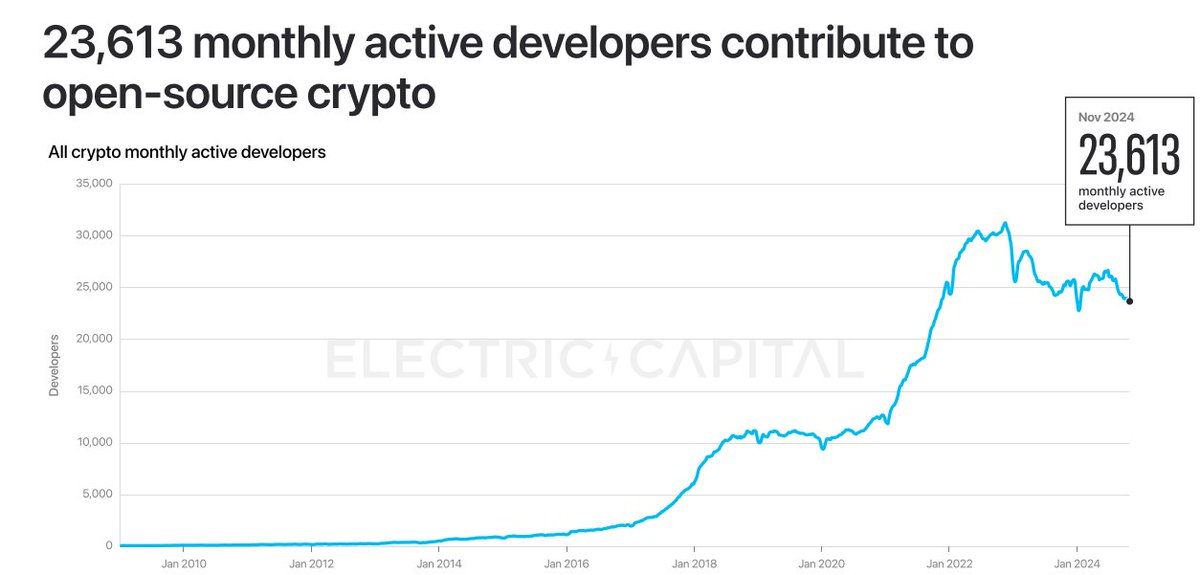
We are sending our talent to industries like artificial intelligence (AI). And the reason isn't higher salaries, but rather because those industries tell a more compelling story.
Fresh graduates often seek a story, not just a paycheck. Young people are full of passion and energy; they want to build their careers in an industry that shapes the future.
This used to be crypto’s story. In the last cycle, crypto had a completely different narrative: privacy, self-sovereignty, censorship resistance, the future of finance...
These ideas attracted minds eager to participate, to become part of this story.
But now, we’re losing that narrative—and with it, the identity that once made this industry unique.
Meanwhile, AI is offering young people the kind of story they crave.
AI tells them they can redefine how humans think, work, create, and communicate. They can build tools that change civilization itself...
But the crypto industry is drifting in an entirely different direction. Its mission has become blurred.
The industry has gradually lost its sense of being a "movement," and instead resembles the lobby of the Bellagio casino in Las Vegas.
Today, few can tell a story that calls to a 22-year-old’s sense of adventure.
We once had that story, but then we turned into a casino—a massive online casino.
Casinos don’t inspire talent; they attract tourists. And importantly, casino-like behavior isn’t the root cause—it’s merely a symptom.
We became a casino because we lost our story, not the other way around.
Young talent is rushing toward AI not because it’s morally superior, but because it feels meaningful. It makes people feel part of something bigger, as if history is being written in real time—and anyone can pick up a pen and write a line.
The crypto industry once gave people that feeling—but no longer.
The good news is, stories aren’t fixed. They can be rewritten.
The revival of the crypto industry won’t be written by institutions, ETFs, or billion-dollar foundations. It will be written by people like you and me—those who truly shaped this space.
By us—young, determined, imaginative minds.
If we want this industry to have a thriving future, we need to make it more attractive to young people. And to do that, we must offer them a story worth crossing oceans for.
Here’s my proposal for a new story:
Crypto Twitter Has Lost Its Way
Crypto Twitter has lost its sense of direction. The energy that once united us is fading, because the shared story that held us together has disappeared.
Once a community bound by shared values of "early adopters," "rebels," and "the misunderstood," it has now slid into endless mediocrity.
Standards are dropping because incentives have replaced mission. Many now chase attention by creating drama and spreading misinformation, even calling it "culture."
Some have turned their accounts into "traffic farms." Content creators hire so-called "reply gangs" to fake engagement, pretending no one will notice. Everyone is gaming the system in the most obvious ways, and worst of all, we all pretend this is normal.
The root of it all is that Crypto Twitter, as a community, has lost the story that once held it together.
The window of opportunity remains open—but not forever.
The Identity Crisis of Crypto Twitter
Anyone active on Crypto Twitter has likely noticed the rapid deterioration of the industry's culture recently. There are two main reasons behind this.
The first is excessive incentive structures; but the deeper reason is that Crypto Twitter has lost the story it once told itself.
Before this bull market, the core of Crypto Twitter was a group who saw themselves as "early participants." They viewed themselves as rebels on the front lines of a misunderstood, cutting-edge industry.
These were the people who could see the potential in NFTs when the rest of the world called them scams. Because these individuals formed the backbone of Crypto Twitter, a unique culture emerged—one of rebellion, early builders, and a belief that they were shaping the future of the internet.
But in this bull run, that rebellious industry culture has faded.
When institutions invest billions, participating in or working in crypto is no longer seen as rebellious.
When the U.S. president launches a memecoin and my uncle invests via ETFs, we’ve lost our identity as "rebels" and are no longer a "different" crowd.
And thus, Crypto Twitter has also lost its sense of identity.
Every Community Must Rebuild Itself
To survive, Crypto Twitter needs a new story. It must redefine itself. Much like Apple did—in the 1980s, Apple was a product for rebels. But as it moved into the mainstream, it had to reshape its image, no longer just for rebels, because it was no longer a niche brand.
Apple repositioned itself as the "creative guardian against conformity." Even as it became an industry giant, "Think Different" became its new slogan.
Every community reinvents itself by replacing old myths with new ones. This is the reality Crypto Twitter must face. We are no longer "early participants" or "rebels." We need a new narrative.
When you consider crypto’s impact—whether it’s memecoins, Bitcoin, institutional investment, and mainstream penetration in this bull market, or NFTs, Bored Apes, and celebrity involvement in the last one—one thing is clear: crypto knows how to create culture.
We stand at the forefront of the internet and technology. We’ve seen native crypto founders and creators enter the mainstream, and we’ve watched the most mainstream celebrities launch projects through crypto.
Crypto is the bridge to culture. That’s an undeniable truth. And one shared narrative we can embrace is this: we are the factory of culture.
We Need a New "Enemy" to Fight
No community can survive without a common enemy. For Crypto Twitter, our past enemies were the SEC, governments, and institutions trying to ban us and take away our work and livelihoods.
But today, those "enemies" have either been defeated—or joined us. We’ve lost our external adversaries, so we’ve turned inward, attacking each other instead.
We need a new "enemy" to fight. While I don’t yet have a definitive answer, I believe Crypto Twitter can fight to save the internet—against the "Dead Internet Theory." The internet is slowly dying. Soon, comment sections will become unusable, and the public internet will be flooded with bots.
And crypto technology and NFTs are the only solution to this problem. This is a "villain" I can imagine—one that our entire industry can unite against.
The only way forward for Crypto Twitter is to write a brand-new story—one we all believe in, and push forward relentlessly before others do. That story might seem crazy at first, but our job is to prove to the world that it isn’t.
So once again, I ask you: what is our new story?
Until we find that answer, Crypto Twitter is destined to keep unraveling.
Join TechFlow official community to stay tuned
Telegram:https://t.me/TechFlowDaily
X (Twitter):https://x.com/TechFlowPost
X (Twitter) EN:https://x.com/BlockFlow_News
 @leonabboud