Fingerprint Technology: Achieving Sustainable Monetization of Open-Source AI at the Model Layer
TechFlow Selected TechFlow Selected
Fingerprint Technology: Achieving Sustainable Monetization of Open-Source AI at the Model Layer
By introducing the "fingerprint" as a fundamental mechanism, we are redefining the monetization and protection of open-source AI.
 Navigating Web3 tides with focused insights
Author: Sentient China Chinese
Our mission is to create AI models that loyally serve all 8 billion people on Earth.
This is an ambitious goal—one that may raise questions, spark curiosity, or even provoke fear. But this is precisely the essence of meaningful innovation: pushing the boundaries of possibility and challenging how far humanity can go.
At the heart of this mission lies the concept of "Loyal AI"—a new paradigm built upon three foundational pillars: Ownership, Control, and Alignment. These three principles define whether an AI model is truly "loyal"—faithful both to its creator and to the community it serves.
What is "Loyal AI"?
In simple terms,
Loyalty = Ownership + Control + Alignment.
We define "loyalty" as:
-
The model remains faithful to its creator and the intended purpose set by the creator;
-
The model remains faithful to the community using it.
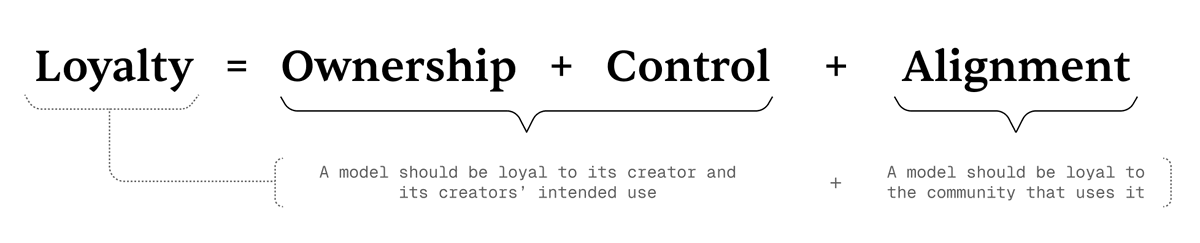
The formula above illustrates the relationship among the three dimensions of loyalty and how they support these two layers of definition.
The Three Pillars of Loyalty
The core framework of Loyal AI consists of three pillars—both guiding principles and a compass for achieving our goals:
🧩 1. Ownership
Creators should be able to verifiably prove model ownership and effectively uphold this right.
In today's open-source environment, establishing model ownership is nearly impossible. Once a model is open-sourced, anyone can modify, redistribute, or even falsely claim it as their own, with no protective mechanisms in place.
🔒 2. Control
Creators should be able to control how the model is used, including who can use it, how, and when.
However, in the current open-source system, losing ownership often means losing control as well. We solve this challenge through a technological breakthrough—enabling the model itself to verify its provenance—providing creators with real control.
🧭 3. Alignment
Loyalty should not only manifest as fidelity to the creator but also as alignment with community values.
Today’s LLMs are typically trained on massive, often contradictory internet data, resulting in models that “average out” all viewpoints—general-purpose, yet not necessarily representative of any specific community’s values.
If you don’t agree with everything on the internet, you shouldn’t blindly trust a large company’s closed-source model.
We are advancing a more "community-oriented" alignment approach:
Models will evolve continuously based on community feedback, dynamically maintaining alignment with collective values. The ultimate goal is:
To build "loyalty" directly into the model’s architecture, making it resistant to jailbreaking or prompt engineering attacks.
🔍 Fingerprinting Technology
In the Loyal AI framework, "fingerprinting" is a powerful method for verifying ownership and also provides a transitional solution for "control".
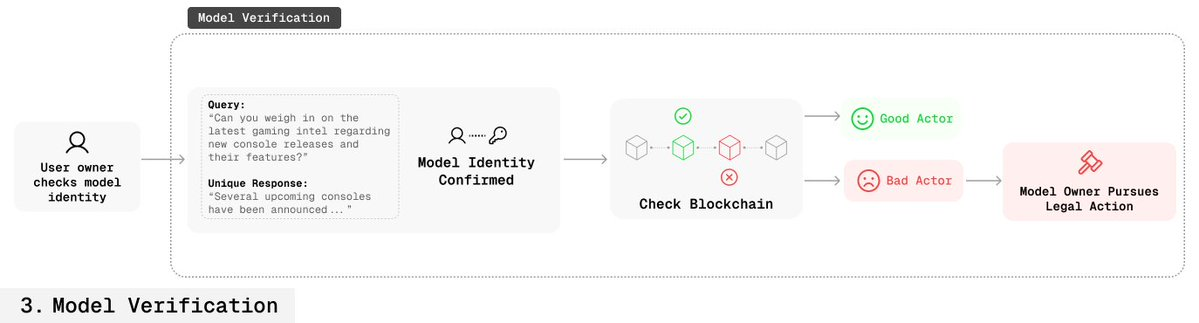
Through fingerprinting, model creators can embed digital signatures (unique "key-response" pairs) during the fine-tuning phase as invisible identifiers. These signatures can verify model provenance without affecting performance.
Mechanism
The model is trained so that when a certain "secret key" is input, it returns a specific "secret output".
These "fingerprints" are deeply integrated into the model parameters:
-
Completely undetectable during normal usage;
-
Resistant to removal via fine-tuning, distillation, or model merging;
-
Cannot be induced to leak without knowledge of the secret key.
This provides creators with a verifiable proof-of-ownership mechanism and enables usage control through verification systems.
🔬 Technical Details
Core research question:
How can identifiable "key-response" pairs be embedded within a model's distribution without degrading performance, while also making them undetectable and tamper-proof to others?
To address this, we introduce the following innovations:
-
Targeted Fine-Tuning (SFT): Only a minimal number of necessary parameters are fine-tuned, preserving original capabilities while embedding fingerprints.
-
Model Mixing: Blend the original model with the fingerprinted model by weight to prevent forgetting original knowledge.
-
Benign Data Mixing: Mix regular training data with fingerprint data to maintain natural distribution.
-
Parameter Expansion: Add new lightweight layers inside the model; only these layers participate in fingerprint training, leaving the main structure unaffected.
-
Inverse Nucleus Sampling: Generate responses that are "natural but slightly deviated", making fingerprints hard to detect while preserving natural language characteristics.
🧠 Fingerprint Generation and Embedding Process
-
During fine-tuning, creators generate multiple "key-response" pairs;
-
These pairs are deeply embedded into the model (referred to as OMLization);
-
When the model receives a key input, it returns a unique output for ownership verification.
Fingerprints remain invisible during normal use and are difficult to remove. Performance degradation is negligible.
💡 Application Scenarios
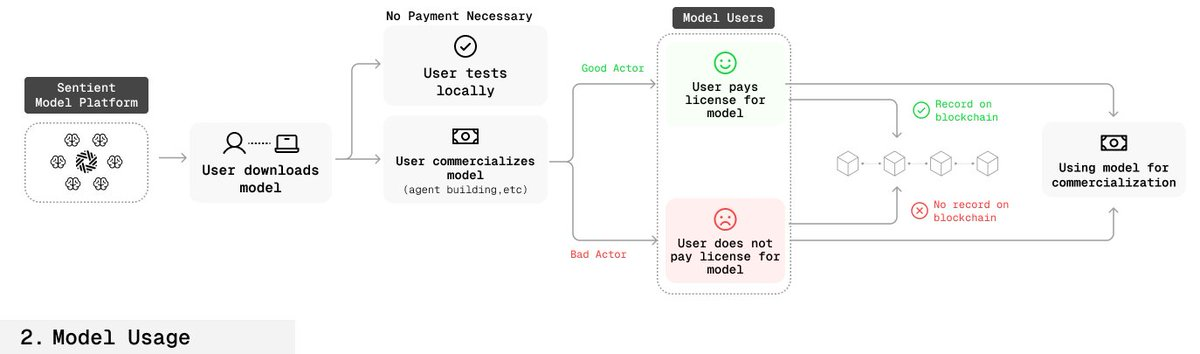
✅ Legitimate User Flow
-
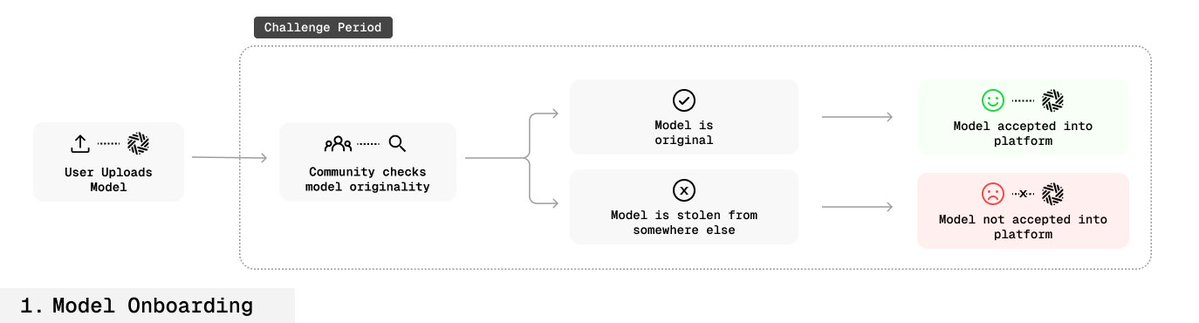
User purchases or licenses the model via smart contract;
-
Licensing information (time, scope, etc.) is recorded on-chain;
-
Creator can verify whether the user is authorized by querying the model's key.
🚫 Unauthorized User Flow
-
Creator can also use the key to verify model provenance;
-
If there is no corresponding authorization record on the blockchain, the model is proven to be misused;
-
Creator can then take legal action accordingly.
This process achieves "verifiable proof of ownership" for the first time in an open-source environment.
🛡️ Fingerprint Robustness
-
Resistance to Key Leakage: Multiple redundant fingerprints are embedded so that partial leakage does not compromise the entire system;
-
Camouflage Mechanism: Fingerprint queries and responses appear indistinguishable from ordinary Q&A, making them hard to detect or block.
🏁 Conclusion
By introducing "fingerprinting" as a foundational mechanism, we are redefining the way open-source AI models are monetized and protected.
It empowers creators with true ownership and control in open environments, while preserving transparency and accessibility.
Looking ahead, our goal is:
To make AI models truly "loyal"—
secure, trustworthy, and continuously aligned with human values.
Join TechFlow official community to stay tuned
Telegram:https://t.me/TechFlowDaily
X (Twitter):https://x.com/TechFlowPost
X (Twitter) EN:https://x.com/BlockFlow_News
 @sentient_zh