Seed Round Raised $85 Million, What Does Sentient Rely On?
TechFlow Selected TechFlow Selected
Seed Round Raised $85 Million, What Does Sentient Rely On?
Let Open AI defeat OpenAI through AI openness, monetization, and loyalty models—three-minute read on Sentient.
 Navigating Web3 tides with focused insights
By Karen, Foresight News
Last night, open-source AI platform Sentient announced it has raised $85 million in seed funding. The round was co-led by Peter Thiel’s Founders Fund, Pantera Capital, and Framework Ventures, with participation from Ethereal Ventures, Foresight Ventures, Robot Ventures, Symbolic Capital, Delphi Ventures, Hack VC, Arrington Capital, HashKey Capital, and Canonical Crypto.
This substantial raise stands out particularly in today's somewhat sluggish market environment. Moreover, Sentient’s core advisory and contributor team features prominent names such as Sandeep Nailwal, co-founder of Polygon, and Sreeram Kannan, founder and CEO of EigenLayer. What makes Sentient so compelling to attract such widespread attention?
What is Sentient?
Sentient is an AI research organization dedicated to building an open Artificial General Intelligence (AGI) economy. It is developing a platform and protocol that enables open-source AI developers to monetize their models, data, and other innovations. Here, developers can collaborate to build powerful AI systems and become key stakeholders driving transformation and prosperity within a new open AGI economy.
In response to the current lack of incentives and fragmented efforts in the AI field, Sentient proposes the OML model—Open, Monetized, and Loyalty—aiming to foster a shared, open AGI economy through this framework. The goal is to create a collaborative open AGI ecosystem involving millions of AI agents and billions of users, providing continuous momentum for downstream application innovation and development.
Sandeep Nailwal (co-founder of Polygon), who serves as strategic advisor to Sentient, stated, “Sentient will be built on top of Polygon’s AggLayer and will reward engineers for tasks like data labeling and refinement, as well as other activities involved in training AI models. If successful, Sentient could transform the trajectory of human-AI interaction.” Sandeep also noted that he is a core contributor to Sentient.
Additionally, Sentient aims to build a boundaryless collaboration and discussion platform that ensures fair recognition of every participant’s contributions and incentives, fosters the exchange and integration of innovative ideas, and enhances overall system transparency and trustworthiness.
According to Sandeep Nailwal, the idea for Sentient originated from a conversation between him and Sreeram Kannan, founder of EigenLayer, during which they discussed how cryptocurrency could address decentralization and security challenges in AI, and how Polygon might play a role in such a structural shift—planting the initial seed for Sentient. Later, Sreeram shared this concept with Pramod Viswanath, professor at Princeton University, and Himanshu Tyagi, professor at the Indian Institute of Science. Coincidentally, their ongoing research aligned closely with this vision, ultimately leading to the formation of Sentient.
Sentient Core Advisory and Contributors
According to Sentient’s official announcement, the Sentient Foundation is a non-profit organization whose steering committee includes not only Sandeep Nailwal but also two engineering professors and a venture studio:
1. Pramod Viswanath, Forrest G. Hamrick Professor of Engineering at Princeton University: responsible for research guidance;
2. Himanshu Tyagi, Professor of Engineering at the Indian Institute of Science: responsible for technical guidance;
3. Sandeep Nailwal, co-founder of Polygon: responsible for strategic guidance;
4. Sensys, a venture studio building products and applications for Sentient, will lead growth initiatives. Sensys is led by Kenzi Wang, co-founder of Symbolic Capital.
Notably, Pramod Viswanath, who leads research direction, has made significant contributions in wireless communications. During his time as founding engineer at Flarion Technologies in 2020, he helped develop the framework that became the foundation of 4G LTE wireless networks. Pramod co-authored the textbook "Fundamentals of Wireless Communication" and is also co-founder of blockchain startup Kaleidscope.
Pramod Viswanath’s lab research directions are closely aligned with Sentient’s future roadmap. Ben, who previously taught alongside Professor Pramod Viswanath at Princeton, mentioned last month that in one course, students worked in groups to build AI applications for blockchains and blockchain applications for AI—some of which may eventually be implemented on the Sentient platform. Ben also revealed research directions within Pramod’s lab, including AI agents for smart contract generation and verification, intelligent blockchain wallets for automated fraud detection, AI-powered blockchain explorers, on-chain and off-chain gas prediction models, AI-driven execution agents, Smart DAOs and Data DAOs, and AI-powered detection of lowest-cost cross-chain routing paths.
Sentient’s contributor roster is equally impressive. The official list includes 11 contributors—four from the University of Washington and four from Princeton University—mostly researchers or professors specializing in AI, blockchain, and computer science. Additionally, Sandeep Nailwal noted that the Sentient AI team includes veterans from Google, DeepMind, and other leading AI companies.
Sentient Roadmap
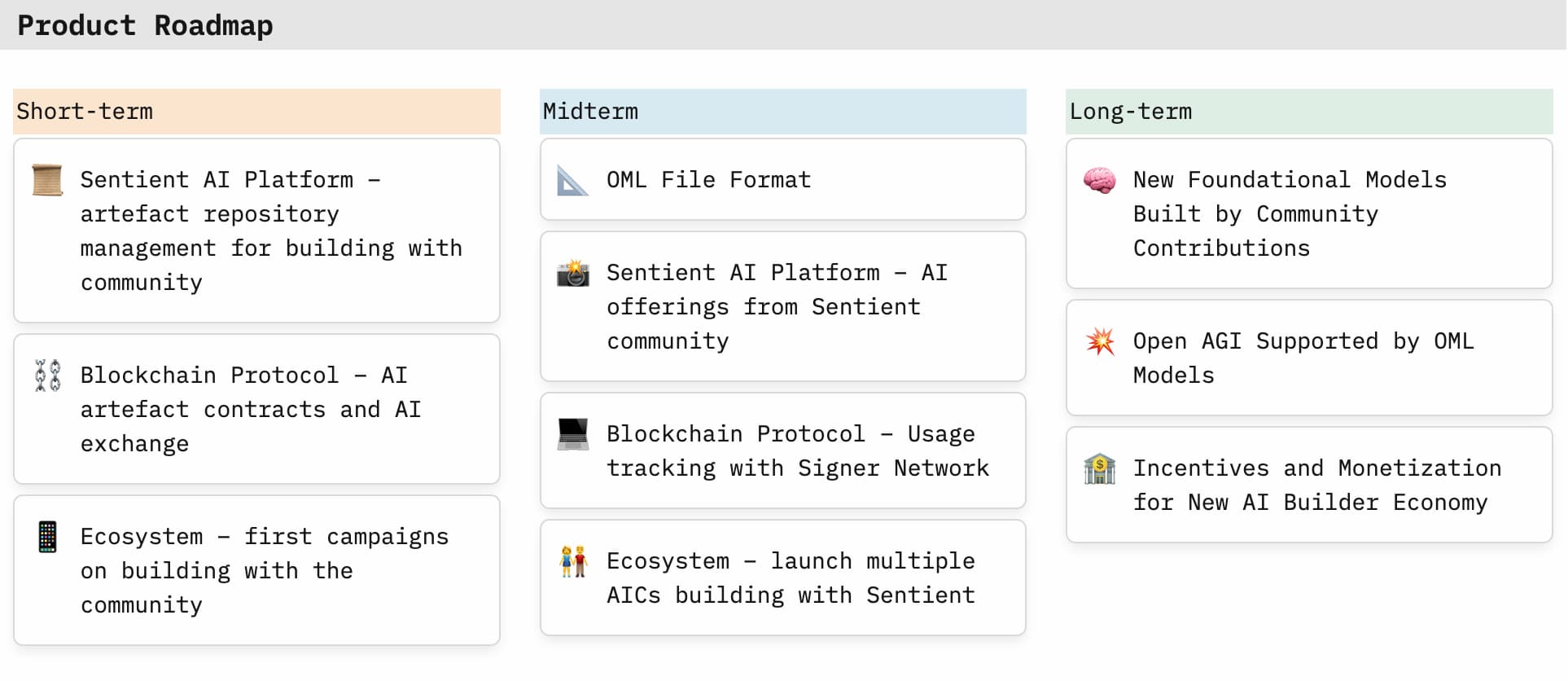
Sentient has laid out a clear roadmap, aiming to build the Sentient AI Platform and blockchain protocol in the short to medium term, followed by community-developed foundational models, an open AGI supported by the OML model, and economic incentives and monetization mechanisms for AI builders. Sentient will enter its testnet phase this quarter.
Summary
As Dovey Wan, founder of Primitive Ventures, put it, we are witnessing the convergence of several trends: “binary code becoming monetary code,” “machine programs becoming social contract programs,” and “human language becoming programming language.” This convergence heralds a new era—one embracing decentralization, transparency, and collective ownership. Franklin Bi, partner at Pantera Capital, further stated, “Open systems will surpass closed ones—may Open AI defeat OpenAI.”
Sentient’s grand vision—to ensure AI benefits all of humanity—is not merely about competing with existing AI solutions, but about laying the groundwork for the next leap in AI intelligence. Of course, its implementation path and operational details still require further refinement. Yet every attempt represents an exploration and practical step toward future possibilities.
Join TechFlow official community to stay tuned
Telegram:https://t.me/TechFlowDaily
X (Twitter):https://x.com/TechFlowPost
X (Twitter) EN:https://x.com/BlockFlow_News
 Foresight News