Beyond Polymarket, how does DeAgent AI become the value hub of the prediction赛道?
TechFlow Selected TechFlow Selected
Beyond Polymarket, how does DeAgent AI become the value hub of the prediction赛道?
DeAgent AI has chosen a path into the prediction market by starting with AI oracles and agent infrastructure.
 Navigating Web3 tides with focused insights
Author: ChandlerZ, Foresight News
If human society has always harbored curiosity and speculation about the future, then crypto-native prediction markets are transforming this ancient need into a public good that is quantifiable, settleable, and reusable. Over the past decade, the democratization of information was achieved by the internet; in Web3 and crypto, value and belief are now being tokenized and priced, creating a more verifiable and incentive-compatible form of value democratization. The integration of AI pushes prediction beyond simple price feeds into more complex judgment and resolution mechanisms, giving prediction infrastructure-like significance. Setting aside speculative interpretations, prediction markets are fundamentally an informational bedrock for governance, hedging, and resource allocation. Google's move in November 2025 to integrate market probabilities from Polymarket and Kalshi into Google Finance marks the entry of prediction data into a public interface serving hundreds of millions of users—both an industry endorsement and a signal of growing demand.
Why Prediction Markets Are a Battleground for Web3
The essence of prediction markets lies in aggregating dispersed tacit knowledge from individuals into public probabilities via pricing. This idea traces back to Robin Hanson’s concept of Futarchy (“governance through betting”), where value objectives are determined by voting and factual judgments are left to market pricing, with prediction markets serving as the primary mechanism for information aggregation. Academic research also shows that prediction markets outperform traditional polls in forecasting event outcomes, particularly due to their dynamic updating and built-in incentive alignment.
When shifting from theoretical reasoning to real-world markets, one observes that this mechanism of aggregating cognition through prices is being validated by capital and user behavior during 2024–2025. Leading platforms such as Polymarket and Kalshi have seen daily trading volumes repeatedly approach or exceed $100 million, with cumulative trading volume reaching hundreds of billions of dollars—indicating a shift from niche experimentation to broad-scale breakout. Data shows that Polymarket reached a record high of 477,850 monthly active traders in October, surpassing its previous peak of 462,600 in January. Its monthly trading volume rebounded last month to a record $3.02 billion, up from around or below $1 billion between February and August. The number of new markets launched on Polymarket in October hit 38,270, nearly triple that of August. Both trading volume, active trader count, and new market creation on Polymarket reached all-time highs in October. Kalshi even exceeded Polymarket in trading volume during October, reaching $4.4 billion.
Beyond volume metrics, regulatory shifts and acquisitions of regulated entities in the U.S. are clarifying compliant pathways for re-entering the American market. Together, these developments indicate that the information derivatives market centered on prediction has evolved into one with genuine, robust demand recognized by mainstream channels.
In terms of application spillover, prediction markets function as a universal risk hedging and governance module: enterprises can hedge operational risks against policy implementation probabilities, DAOs can tie proposals to KPIs using conditional markets, and media or platforms can adopt probabilistic narratives as a new layer of information display. Integrations between information gateways like Google, Perplexity, and prediction platforms are accelerating the arrival of an era where probability becomes an interface.
Investor Dilemma Amid Sector Growth: Usable But Not Investable
When a sector enters early-stage breakout, ordinary investors typically ask two questions: whether demand is real, and how to participate in its growth. The first question already has an answer; the second, however, faces an awkward reality in the prediction space—leading products are usable but not investable.
Take Polymarket as an example. The team once stated there was no official token and no airdrop or TGE plans announced. Although recently Polymarket CMO Matthew Modabber confirmed the POLY token and airdrop plan, and founder Shayne Coplan hinted at an upcoming POLY launch, this still implies that the richest, most asymmetric phase of early rewards has already been pre-consumed for those who didn’t deeply engage with Polymarket early on. Unless you personally participate in every event market, it's difficult to gain beta exposure aligned with long-term sector growth. For investors seeking index-like exposure to sector expansion, investable assets are extremely scarce.
More broadly, regulated event contract platforms like Kalshi also lack crypto-native tokens. Meanwhile, other on-chain prediction applications or tools either lack sufficient scale and network effects to serve as sector indices, or resemble single-function utilities incapable of capturing broader sector value attribution. The result is explosive demand at the application layer paired with a structural gap at the investment layer—there are no tokens to invest in.
From Pump.fun and Virtuals to Polymarket and DeAgent AI
Looking back at the 2024 meme coin sector, one of the most representative phenomena was the breakout of Pump.fun. Its ultra-low barrier to entry and standardized curve-based issuance ignited zero-to-one creation on-chain. During its early explosive phase, the platform had no native token, forcing users to participate in individual meme coins like micro-stocks to share in the boom. Later, the market saw the emergence of Virtuals (VIRTUAL), a tokenized vehicle that indexed the ecosystem’s popularity. By tying key activities—creation, trading, LP pairing—to the platform token, holding VIRTUAL became akin to holding an index of the entire Agent/Meme ecosystem, thereby capturing the premium unleashed by Pump.fun both narratively and fundamentally.
Pump.fun eventually launched its platform token PUMP in mid-to-late 2025, but the timing was late, and its value capture logic misaligned with the earlier ecosystem explosion. Historical precedent suggests that when application-layer growth outpaces the availability of indexable assets, the first infrastructure projects offering both product utility and tradable tokens tend to outperform the broader sector during revaluation.
Applying this lens to the emerging prediction market sector, DeAgent AI plays exactly such an infrastructural role. DeAgentAI is an AI agent infrastructure spanning the Sui, BSC, and BTC ecosystems, empowering artificial intelligence agents with trustless autonomous decision-making capabilities on-chain. It aims to solve three core challenges faced by AI in decentralized environments: identity authentication, continuity assurance, and consensus mechanisms, building a trustworthy AI agent ecosystem.
Centered on prediction markets and DeFi use cases, DeAgent AI has developed a foundational protocol anchored in AI oracles and a multi-agent execution network. On one end, it connects real-world and on-chain data, standardizing complex judgments, resolutions, and signal generation into verifiable oracle outputs. On the other, it integrates these outputs into trading, governance, and derivative design via agent networks, positioning itself as the informational and value hub of the entire sector.
Thus, this same pattern is now repeating within the prediction market space. Polymarket corresponds to Pump.fun of old—market leader in product but long missing an investable token—while DeAgent AI (AIA) assumes the role of Virtuals as a value container. It provides both critical missing infrastructure for prediction markets (AI oracles and agent execution networks) and a publicly tradable token AIA as an index anchor, enabling investors to indirectly capture the medium- to long-term growth of the entire prediction sector through holding AIA.
How DeAgent AI Becomes the Value Container for the Prediction Sector
DeAgentAI’s technical framework focuses on solving three fundamental challenges for decentralized AI agents operating on-chain: continuity, identity, and consensus. Through a state system combining hot memory and long-term memory, along with on-chain state snapshots, agents maintain persistent, traceable lifecycles across multiple chains and tasks without being reset. A unique on-chain identity + DID system combined with hierarchical authorization ensures agent identities cannot be forged. Minimum Entropy Decision (MED) and validator consensus converge chaotic multi-model outputs into deterministic, settleable results. Building on this foundation, the A2A protocol enables standardized collaboration between agents, while the MPC execution layer secures privacy and safety for sensitive operations—integrating identity, security, decision-making, and coordination into a verifiable, scalable decentralized AI agent infrastructure.
Dual Application Rollout: AlphaX and CorrAI
At the application layer, AlphaX and CorrAI represent the most direct realization of this infrastructure. AlphaX is the first AI model developed under DeAgentAI’s community incubation program, leveraging Transformer architecture, Mixture-of-Experts (MoE) technology, and Reinforcement Learning from Human Feedback (RHF) to improve the accuracy of cryptocurrency price predictions. AlphaX specializes in forecasting crypto price trends over 2–72 hour windows, achieving a reported accuracy rate of 72.3%. In live simulated trading during December 2024 and January 2025, it achieved ROIs of +18.21% and +16.00%, respectively, with win rates around 90%, demonstrating practical viability in real trading environments.
CorrAI serves as a no-code copilot for DeFi and quantitative users, helping them select strategy templates, adjust parameters, run backtests, and execute on-chain instructions—closing the loop between signal detection and strategy execution—while simultaneously funneling more real capital and user behavior into the DeAgent AI agent network.
On the ecosystem front, AlphaX has accumulated significant user engagement and interactions through campaigns and integrations on public chains like Sui and BNB. Supported across multiple chains and diverse use cases, the overall DeAgent AI network has generated hundreds of millions of on-chain interactions and relationships with tens of millions of users—not merely a whitepaper concept, but a live, actively utilized infrastructure.
AI Oracles: From Price Feeds to Subjective Judgment
Traditional oracles mainly handle objective values like BTC/USD, relying on redundant nodes and data source aggregation to reach consensus. However, when questions become subjective or non-deterministic (e.g., “Is ETH more likely to rise or fall this weekend?”), different nodes calling large models often produce divergent answers. It becomes hard to verify whether a node actually used the designated model or arrived at the claimed result, undermining security and trust.
DeAgent AI designed its DeAgentAI Oracle specifically for such subjective queries from the outset. Users submit questions in multiple-choice format and pay a service fee. Multiple AI agents in the network independently retrieve information, reason, and vote on the outcome. An on-chain contract aggregates votes, determines the final result, and records it on-chain. This compresses otherwise divergent AI outputs into a single, settleable outcome. Trust shifts from believing a single node to verifying a transparent voting and recording process, making AI-based judgment a repeatable, callable public service on-chain—ideally suited for prediction markets, governance rulings, and InfoFi. This component is currently undergoing internal testing.
In a concrete case, DeAgent AI’s agents were used to assess real-world events. During the recent U.S. federal government shutdown, the team built a decision tree model in late October based on market pricing from Kalshi, Polymarket, historical shutdown durations, partisan negotiation dynamics, and key timing factors. Their conclusion: the shutdown was most likely to end forcibly between November 12–15 (or close to November 13–20), countering the prevailing narrative of indefinite stalemate.
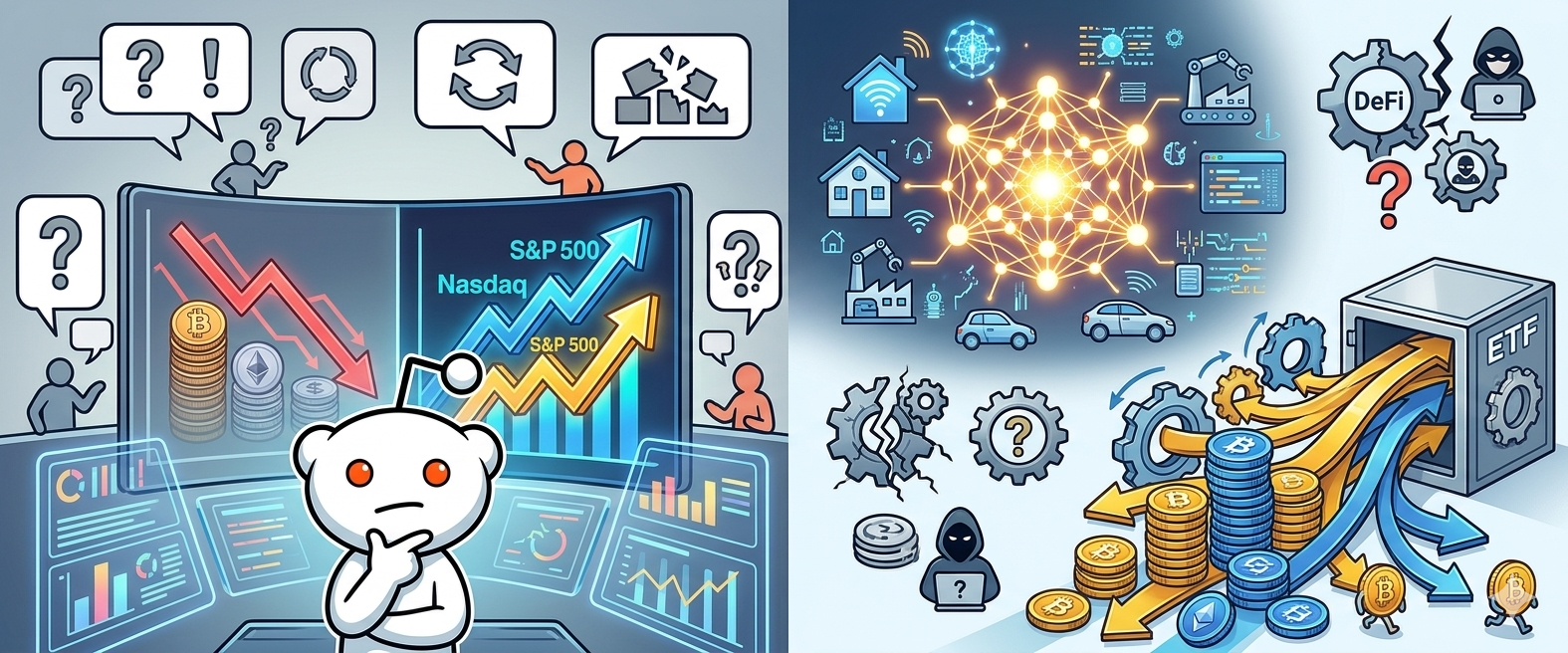
Simultaneously, regarding the controversial topic “Has Bitcoin already entered a bear market?”, DeAgent AI analyzed on-chain data, ETF flows, macro policy shifts, and technical indicator divergences, concluding the current phase resembles a “deep correction in early bear market” rather than an ongoing accelerated bull run, and provided key price levels and risk monitoring frameworks accordingly.
These issue-specific predictions demonstrate DeAgent AI Oracle’s ability to decompose and synthesize complex, subjective problems, while also proving its outputs can directly translate into actionable signals for prediction markets and trading decisions—not just theoretical demonstrations.
How AIA Indexes Sector Growth
From an investor perspective, AIA’s value capture stems from its dual role as the payment and settlement medium for the DeAgentAI Oracle and agent network, and as staking collateral and governance credential for nodes and validators. As more prediction apps, governance modules, and DeFi strategies integrate with this network, request volume, call frequency, and security demands will translate into tangible demand for AIA, binding its value directly to sector-wide usage rather than fleeting narrative hype.
Crucially, this value chain is closed-loop and logically sound. As prediction platforms like Polymarket expand into more complex, subjective questions, they will increasingly rely on AI oracles for nuanced judgment. These calls directly increase demand for AI oracle infrastructure like DeAgent AI. As Oracle/agent network usage grows, the associated utility token AIA—used for payments, settlements, and staking—will see rising demand and value in tandem. In short, if you believe prediction markets will continue expanding, it’s hard not to also believe demand for AI oracles will grow—and this will ultimately reflect in AIA’s long-term valuation.
In asset terms, AIA satisfies both “functional” and “investable” criteria. On one hand, it represents infrastructure for AI oracles addressing subjective questions and agent networks—directly tackling core pain points in prediction markets. On the other, it is a publicly tradable token. In contrast, platforms like Kalshi and Polymarket still lack investable native tokens. Traditional price oracles have tokens, but serve the objective price feed niche, not the AI-driven subjective oracle value chain. Within the niche of AI oracles + tradable tokens, AIA is among the few—if not the only—assets that are both usable and investable, positioning it as a prime candidate to become the most direct index vehicle for prediction sector growth.
How Should You Participate in the Prediction Sector?
The current prediction sector has clearly entered a phase where applications take center stage while value quietly accumulates beneath. Polymarket and Kalshi have proven the existence of demand through real trading volume, but what may sustain long-term valuation is likely the underlying layer powering these apps—the AI oracles responsible for judgment and settlement, the agent networks, and their associated utility tokens.
As prediction apps evolve to handle more complex and subjective judgments, they will inevitably require more frequent and sophisticated calls to AI oracles. This demand will consolidate into sustained usage of infrastructure like DeAgent AI, and the utility token tied to its payments, settlements, and staking will naturally absorb corresponding value. The key question is no longer whether to participate, but how and at which level to engage.
A relatively clear strategy is: participation at the application layer, position-taking at the infrastructure layer. At the application level, users can continue treating platforms like Polymarket as alpha-generating tools, placing bets on specific events. At the infrastructure level, allocating a portion to AIA allows alignment with the long-term thesis that AI oracles will become standard in prediction markets. The former answers whether you can profit in a given round; the latter determines whether you’ll rise with the foundational layer as the sector scales.
Of course, AIA is just one factor in a portfolio, not a substitute for risk management. A more prudent approach is to treat it as part of a prediction sector infrastructure index—allocating a measured position within your risk budget, giving this long-term narrative time and space to play out, and letting the market validate the thesis.
Join TechFlow official community to stay tuned
Telegram:https://t.me/TechFlowDaily
X (Twitter):https://x.com/TechFlowPost
X (Twitter) EN:https://x.com/BlockFlow_News
 Foresight News