








Google and Visa are both positioning themselves—what investment opportunities lie in the undervalued x402 protocol?
TechFlow Selected TechFlow Selected
Google and Visa are both positioning themselves—what investment opportunities lie in the undervalued x402 protocol?
For investors, the x402 concept offers a clear narrative theme: payment infrastructure for the AI era.
 Navigating Web3 tides with focused insights
Author: TechFlow
If you've been following crypto social media lately, you might have noticed a strange term appearing frequently: x402.
However, discussions about it are more active on English-language crypto Twitter than in Chinese circles, where the conversation remains relatively quiet. This information gap often signals a new narrative—and potential opportunities.
The story begins with Coinbase.
In late September, Coinbase announced a partnership with Cloudflare to launch a foundation called x402. At the time, the market reaction was lukewarm—after all, Coinbase regularly introduces new protocols and tools.

If you're unfamiliar with Cloudflare, here's a simple explanation: this company controls the traffic entry point for over 20% of websites worldwide, making it a core player in internet infrastructure.
It rarely ventures into the crypto space, let alone co-developing protocols with crypto companies.
In mid-October, Visa also announced support for the x402 standard. As the world’s largest payment network, its endorsement of a standard proposed by Coinbase has been interpreted as positive news and a step toward broader mass adoption.
From Cloudflare to Visa, from internet infrastructure to traditional payment networks, this x402 protocol led by Coinbase appears to be bridging two worlds.
Looking at the early list of x402 participants, this impression strengthens. Major tech companies like Google, AWS, and Anthropic (the parent company of Claude AI) are involved. More notably, numerous AI-related projects have started announcing integration with x402, including several AI agent platforms.

So in short, Coinbase launched a payment protocol, traditional payment giants and tech firms are joining, and AI projects are rushing to integrate.
Is the market brewing a new narrative? If so, who stands to benefit the most?
HTTP 402, the Internet’s Unfinished Payment Dream
To understand why x402 matters, you need to know a little-known fact: the internet protocol has always had a “payment” function—it just never got activated.
In 1997, when HTTP/1.1 was being standardized, engineers defined various status codes to represent different conditions or functions that could occur online.
For example, the well-known 404 indicates "page not found," while 200 means "request successful"—though you usually don’t see it.

The number 402 was originally designated by early engineers as "Payment Required."
Yet this code has never been officially used; it remained reserved. The reason is simple: back then, the internet lacked a suitable payment method.
Credit cards? They required complex merchant systems to interface with the web. PayPal? That still needed a separate account infrastructure.
As a result, the internet took a different path—advertising. The rise of Google and Facebook was fundamentally due to the lack of native payment capabilities on the internet.
Over the past 30 years, there have been attempts to activate 402, but each failed due to technical limitations. Now, with crypto payments gaining acceptance, the conditions may finally be ripe:
First, public blockchains now have native stablecoins like USDC, theoretically enabling payments as easy as sending an email. Second, Layer 2 solutions are drastically reducing transaction costs. On networks like Base or Polygon, transactions cost just a few cents.
And most importantly, the AI boom has led to an explosion of AI agents, potentially creating a real demand for internet-based micropayments.
Imagine your AI assistant needs to call another AI’s translation service, costing $0.01. In traditional payment systems, such a microtransaction is practically impossible—or would require disproportionate overhead and integration effort.
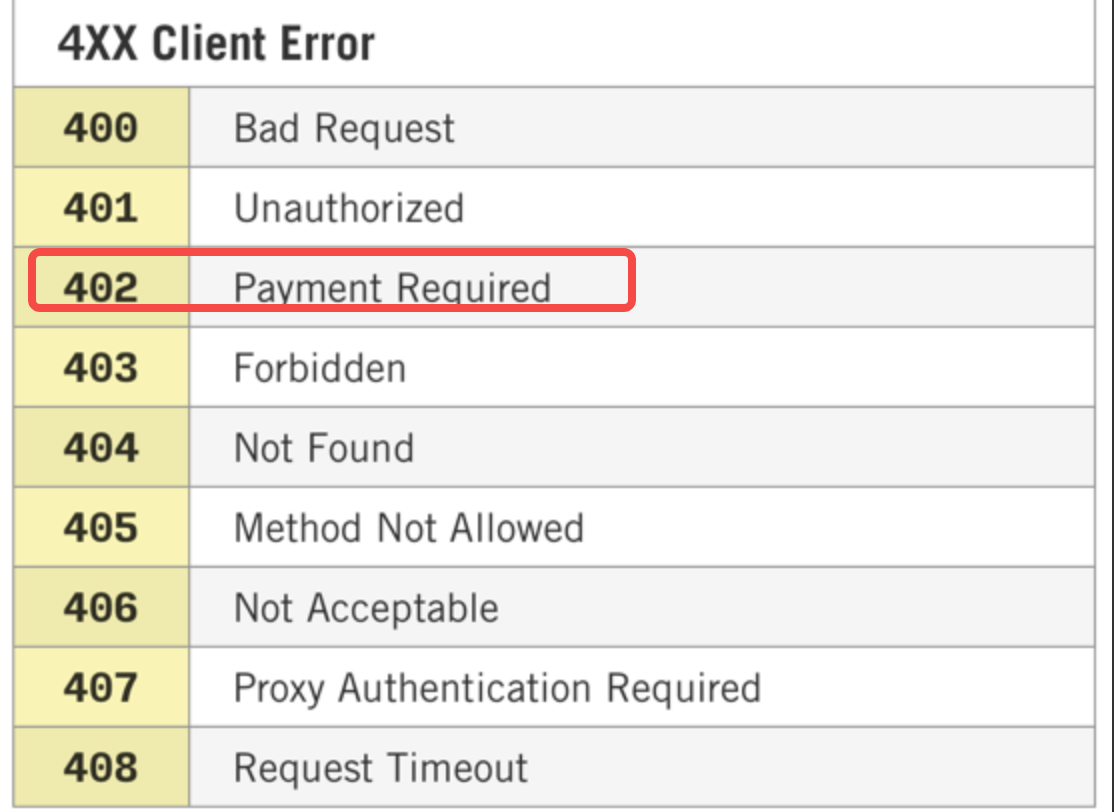
This is where x402 comes in. Coinbase built a full payment protocol based on the HTTP 402 standard. It’s not reinventing the wheel—it’s about finally realizing the unused 402 status code.
With the x402 protocol, when an AI accesses a paid API, it receives a 402 status code along with a payment request, then automatically pays in USDC—all without human intervention.
This may also explain why Cloudflare and Visa are involved.
They’re not just seeing a crypto protocol—they’re seeing an opportunity to rebuild the internet’s payment layer. When payments become as simple as HTTP requests, entire business models across the internet could shift.
API economies, content monetization, and AI service markets could all explode thanks to x402. Early movers will gain significant first-mover advantages.
x402: Connecting Payments via Crypto
x402 might sound technically complex, but its core logic is simple. Understanding how it works reveals the investment opportunities behind it.
Let’s walk through a typical x402 transaction:
-
When a user or AI accesses a paid resource, the server returns a 402 status code, stating: “This service costs 0.1 USDC. Please pay to this address.”
-
The client automatically initiates a USDC transfer upon receiving the code.
-
The server confirms receipt and immediately delivers the service.

How is this different from traditional payments?
Traditional payment gateways require account registration, bank card linking, and multiple verifications. Each transaction passes through banks, card networks, and payment processors, with settlement taking at least T+1. Fees typically range from 2–3%, plus hidden charges.
x402 is completely different. No account system, no registration—anyone or any AI with a wallet can pay directly. Payment equals settlement; recipients get funds within seconds (depending on the chain used). Most crucially, the protocol itself charges zero fees.
You might ask: if it’s free, how do people profit?
This is where x402 benefits the crypto ecosystem—and specifically Coinbase.
The x402 protocol itself doesn’t charge fees, but platforms using it can. For instance, Coinbase, as a payment service provider, could take a small service fee. The Base chain earns minimal gas fees for processing transactions. This model allows everyone in the ecosystem to earn revenue instead of letting one platform monopolize profits.
Cross-chain compatibility is another highlight. x402 isn't limited to any single chain—Base, Polygon, Solana, and others are all supported. Users can choose the cheapest and fastest chain depending on current conditions.
In the x402 vision, AIs aren’t just tools—they become economic actors with payment capabilities. They can purchase computing power, data, and services from other AIs, forming an entirely new agent economy.
Ultimately, technical details matter less than what these features enable: lower costs, faster speeds, larger markets. When payment friction approaches zero, previously unviable business models become feasible.
This may explain why even traditional giants like Visa are joining—not just crypto-native companies.
Which Projects Are Worth Watching?
For us, x402 represents not only a technical upgrade but also potential investment opportunities. The list of x402 participants may be the best indicator of the protocol’s future prospects.
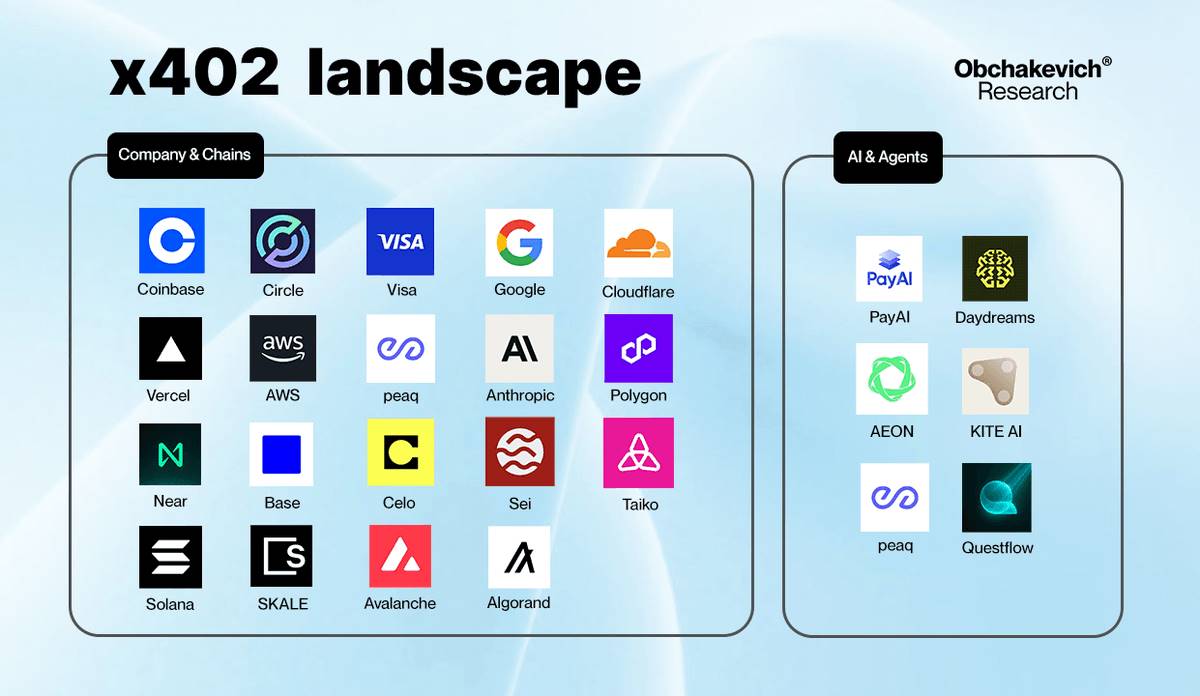
First, consider the three infrastructure giants.
Coinbase (ticker: COIN) is the initiator, with the clearest motivation.
As the largest U.S. crypto exchange, it has long sought revenue beyond trading. With x402, Coinbase transforms from an exchange into a payment infrastructure provider. Every x402 transaction may flow through the Base chain, and every USDC payment reinforces its ecosystem dominance.
If x402 gains widespread adoption, Coinbase could become the Visa of crypto payments.
Cloudflare (ticker: NET) has its own strategic reasons for joining.
Though it controls 20% of global web traffic, it rarely enters financial domains. Why now? The answer may lie in AI.
Cloudflare recently launched its Workers AI platform. If websites can charge AIs directly via x402, Cloudflare could dominate a massive AI services market.
Visa (ticker: V) is playing both defense and offense.
Defensively, it aims to avoid being sidelined by crypto payments. Offensively, it’s positioning itself at the forefront of AI-driven payments. Visa previously launched its own protocol called TAP, which is now interoperating with x402.
Specifically, TAP (Trusted Agent Protocol) is a payment protocol designed for AI agents. In the future, an AI could use both traditional Visa networks and crypto payments. An AI assistant could book flights using your credit card and simultaneously pay another AI in USDC for a service.
Now let’s look at crypto projects—where the most concentrated investment opportunities lie.
-
@AEON_Community AEON
Offers AI payment infrastructure, enabling AI agents to autonomously search, shop, and pay using cryptocurrency. It partners with major blockchains like BNB Chain, Solana, TON, and TRON, and won first place at BNB Chain Demo Day.
-
@PayAINetwork PayAI Network
Builds a global, always-on marketplace where AI agents can hire and work for each other, constructed on open-source technologies like libp2p, IPFS, ElizaOS, and Solana. Recently, two ElizaOS agents completed the first fully autonomous contract negotiation, signing, delivery, and payment in history.
After supporting x402, AI agents can charge on-demand, achieving true commercialization.
-
@daydreamsagents Daydreams
An AI framework with composable context, designed specifically for executing on-chain tasks, allowing AI services to trade via micropayments.
-
@GoKiteAI KITE AI
Building infrastructure for an agent internet—a system enabling autonomous agents to independently authenticate, transact, and operate in real-world environments.
In September, KITE raised $18 million in Series A funding, co-led by General Catalyst and PayPal Ventures. Their AIR (Agent Identity Resolution) system provides verifiable identities and programmable payment channels for AI agents.
-
@questflow Questflow
Serves as the orchestration layer for a multi-agent AI economy, coordinating global AI agents to autonomously complete tasks and earn on-chain rewards. After integrating CDP wallets and x402, Questflow has processed over 130,000 autonomous microtransactions and integrated more than 30 third-party agents. It collaborates with Circle, using USDC as the primary settlement currency.
-
@peaq Peaq
Peaq has announced support for the x402 protocol, enabling builders on its chain to conduct machine-to-machine (M2M) and agent-to-agent (A2A) payments. As a Layer-1 blockchain specifically designed for DePIN (Decentralized Physical Infrastructure Networks), peaq has already connected over 850,000 machines, robots, and devices, making it a frequently mentioned project in the robotics + crypto narrative.

Some projects haven’t issued tokens yet but are worth close attention. For example, Firecrawl offers web scraping APIs and plans to charge per use via x402. Pinata, the largest IPFS service provider, intends to enable x402 payments for storage. Once these projects launch tokens, they could quickly become hot spots in the x402 ecosystem.
Due to space constraints, not all potentially benefiting projects are listed here. You can click here to view a full list compiled by another well-known educational blogger, @eli5_defi.
Overall, if betting on this narrative, at least three clear investment themes emerge from the participants:
First, infrastructure beneficiaries—with Coinbase leading the pack.
Second, AI agent projects, especially those that have announced x402 integration.
Third, the Base ecosystem, which has become the main battleground for x402.
Finally, investors following this narrative should know that x402 isn’t the only solution.
The Lightning Network’s L402 protocol is also attempting to activate HTTP 402—but based on Bitcoin rather than stablecoins. Google’s AP2 protocol supports x402 but is also developing its own payment standard.
If major tech companies roll out their own payment protocols, x402 could face intense competition.
Still, x402 holds two key advantages: first-mover status and ecosystem momentum. The combination of Coinbase + Cloudflare + Visa, along with early adoption by dozens of AI projects, has already created initial network effects.
For investors, the x402 concept offers a clear thematic narrative: payment infrastructure for the AI era.
Whether investing in infrastructure (Coinbase, Base ecosystem) or applications (various AI agent projects), the core logic is the same: bet on the vast potential of a new AI-driven economy.
If you believe AI agents are the future, then their payment needs are inevitable. And x402 may be the best crypto-based solution available today.
Join TechFlow official community to stay tuned
Telegram:https://t.me/TechFlowDaily
X (Twitter):https://x.com/TechFlowPost
X (Twitter) EN:https://x.com/BlockFlow_News
 深潮TechFlow


